

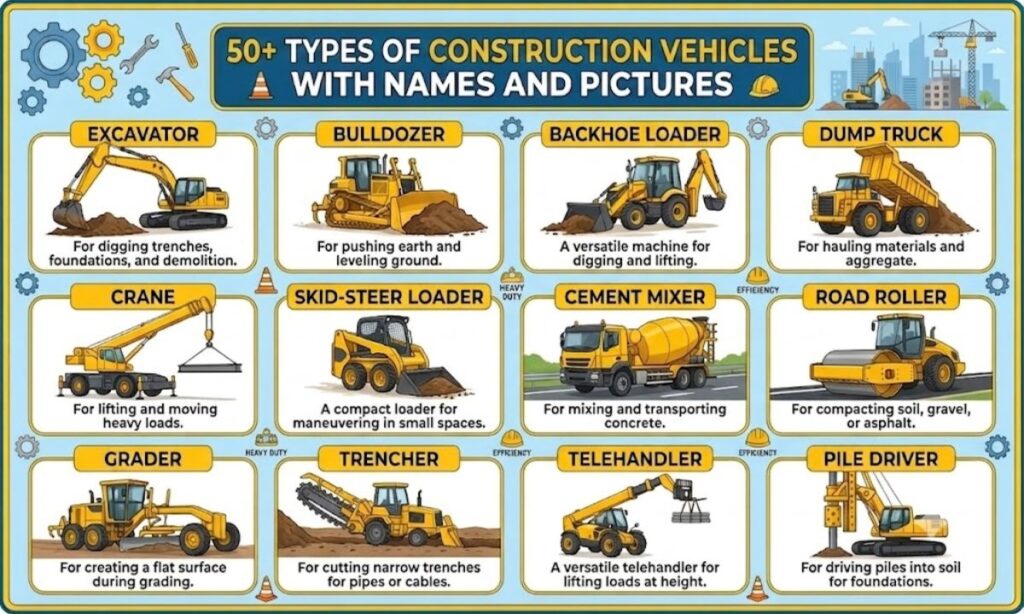
Construction sites run on machines. From digging deep foundations to paving smooth roads, every task depends on a specific piece of heavy equipment designed for the job. If you’ve ever wondered what that yellow machine with the giant blade is called, or how a crane manages to lift steel beams dozens of feet in the air, this guide breaks it all down.
Below, you’ll find a complete list of construction vehicle names, their pictures, and their real-world uses — organized so you can quickly find what you’re looking for, whether you’re a student, an engineer, or just someone curious about the machines shaping our cities.
What Are Construction Vehicles and Their Uses?
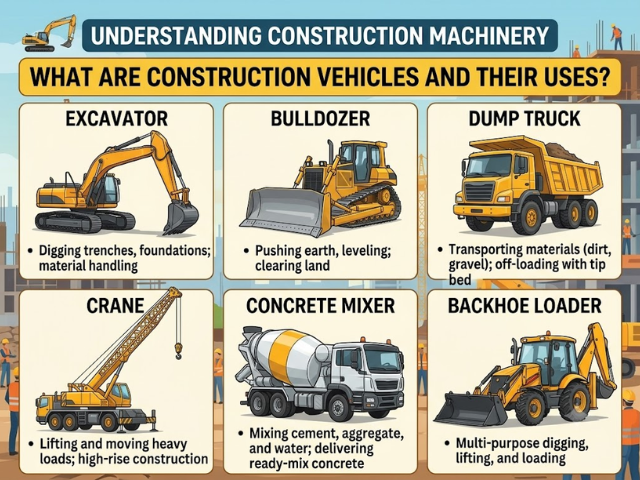
Construction vehicles are heavy-duty machines specifically engineered to perform tasks like digging, lifting, hauling, leveling, and paving on job sites. Unlike regular vehicles, they’re built with reinforced frames, hydraulic systems, and specialized attachments suited to demanding, often rough terrain.
These machines generally fall into a few broad categories:
Earthmoving equipment – bulldozers, excavators, graders
Material handling equipment – cranes, forklifts, loaders
Hauling equipment – dump trucks, articulated trucks
Road construction equipment – pavers, rollers, compactors
Specialty equipment – trenchers, pile drivers, demolition machines
Understanding these categories makes it much easier to identify which machine belongs where — and why.
List of Different Construction Vehicles Names
Here’s a quick-reference list before we go into detail:
| # | Vehicle Name | Primary Use |
| Bulldozer | Pushing soil and debris | |
| Excavator | Digging and lifting | |
| Backhoe Loader | Digging and loading | |
| Wheel Loader | Scooping and transporting materials | |
| Skid Steer Loader | Compact loading in tight spaces | |
| Motor Grader | Leveling surfaces | |
| Dump Truck | Hauling loose materials | |
| Crane | Lifting heavy loads | |
| Forklift | Moving palletized materials | |
| Trencher | Digging narrow trenches | |
| Road Roller | Compacting road surfaces | |
| Asphalt Paver | Laying asphalt | |
| Cement Mixer Truck | Mixing and transporting concrete | |
| Pile Driver | Driving piles into the ground | |
| Mini Excavator | Digging in confined spaces | |
| Telehandler | Lifting materials at height and reach | |
| Scraper | Removing thin layers of soil | |
| Boom Lift | Elevated work access | |
| Scissor Lift | Vertical worker platform | |
| Compactor | Compressing soil or waste |
This is just the starting list — many more specialized vehicles exist depending on the type of project.
Construction Vehicles Names and Pictures with Basic Uses
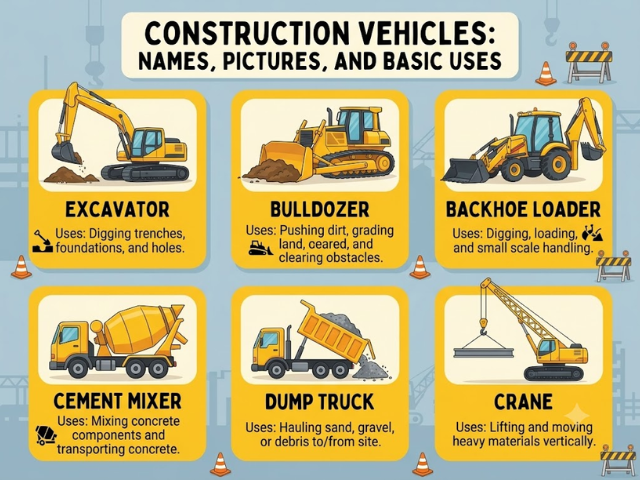
Let’s look closer at some of the most recognizable machines you’ll find on almost any job site.
Bulldozer
A bulldozer is a heavy tractor-like machine with a large metal blade at the front, used to push soil, sand, rubble, and debris across short distances.
![Bulldozer]
Use: Clearing land, pushing debris, rough grading
Key feature: Continuous tracks for stability on uneven ground
Excavator
The excavator is arguably the most versatile construction machine, featuring a boom, stick, and bucket mounted on a rotating platform.
Use: Digging foundations, trenching, demolition, material handling
Key feature: 0-degree rotation for maximum reach and flexibility
Wheel Loader
A wheel loader uses a large front bucket to scoop and transport loose materials like soil, gravel, or sand.
Use: Loading trucks, moving bulk materials
Key feature: Fast mobility on wheels rather than tracks
Backhoe Loader
This dual-purpose machine has a loading bucket in the front and a digging arm at the back.
Use: Small-scale digging, loading, and landscaping
Key feature: Versatility in tight or mixed-use job sites
Crane
Cranes use cables, pulleys, and a boom arm to lift and move extremely heavy loads vertically and horizontally.
Use: Lifting steel beams, building materials, and heavy equipment
Key feature: Massive lifting capacity, often exceeding several tons
Read More….250+ Mass Noun Examples with Sentences and their Pictures
Construction Vehicles for Road Building
Road construction relies on a distinct set of specialized machines built for grading, paving, and compacting.
| Vehicle | Function |
| Motor Grader | Levels and shapes road surfaces |
| Asphalt Paver | Lays asphalt evenly on road beds |
| Road Roller | Compacts asphalt or soil layers |
| Milling Machine | Removes old asphalt layers |
| Chip Spreader | Spreads aggregate for surface treatment |
| Concrete Paver | Lays concrete road slabs |
How These Machines Work Together
Road building follows a set sequence:
Grading – the motor grader levels the base
Compacting – road rollers compress the base layer
Paving – asphalt pavers or concrete pavers lay the surface
Final compaction – rollers finish the surface for smoothness
This step-by-step process ensures roads are durable, even, and safe for traffic.
Construction Vehicles Used for Excavation
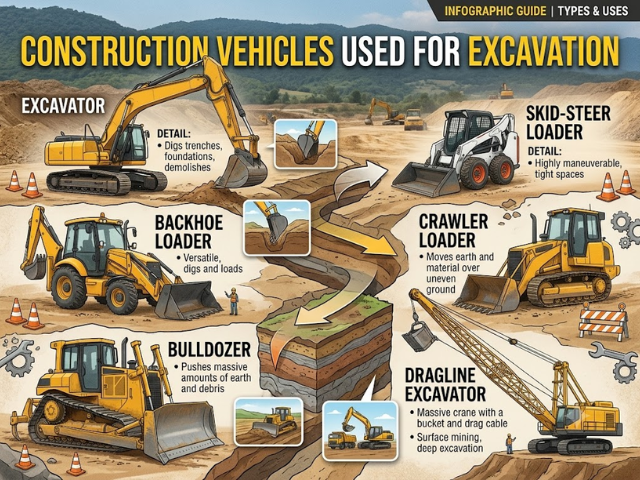
Excavation work — digging foundations, trenches, and basements — requires machines designed for depth, precision, and material removal.
Excavator – primary digging machine for foundations and trenches
Mini Excavator – ideal for tight or residential spaces
Trencher – digs narrow trenches for pipes and cables
Backhoe Loader – handles smaller digging tasks with loading capability
Dragline Excavator – used for large-scale mining and heavy excavation
Scraper – removes and transports thin layers of soil over distances
Choosing Between Excavation Machines
| Task | Best Machine |
| Deep foundation digging | Excavator |
| Narrow utility trenches | Trencher |
| Tight residential spaces | Mini excavator |
| Large open-pit excavation | Dragline excavator |
| Surface soil removal | Scraper |
How to Choose the Right Construction Vehicle
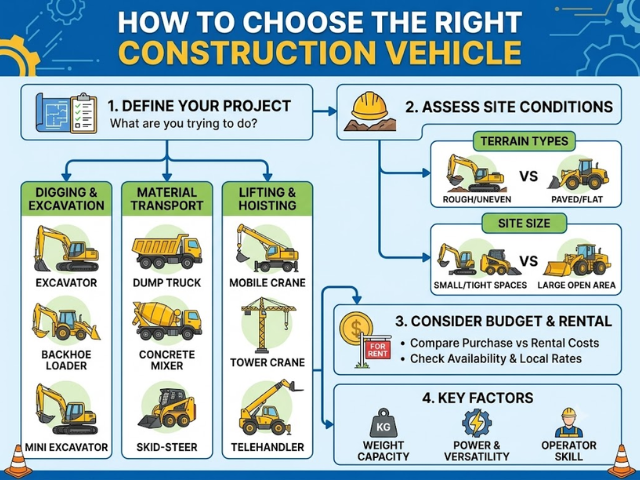
Picking the right machine depends on several practical factors, not just the type of task.
Project size – small residential jobs need compact machines; large commercial projects need heavy-duty equipment
Site conditions – tight urban spaces favor smaller, maneuverable machines
Material type – soil, rock, and asphalt each require different handling equipment
Budget – renting versus buying affects which machines are practical
Timeline – faster projects may need multiple machines working simultaneously
Matching the machine to the job prevents delays, reduces costs, and improves safety on-site.
Heavy Construction Vehicles List with Pictures
Heavy equipment is built for large-scale, high-capacity work where power and durability matter most.
| Machine | Typical Use |
| Bulldozer | Land clearing and grading |
| Excavator | Digging and demolition |
| Dump Truck | Hauling large material volumes |
| Crane | Lifting heavy structural components |
| Wheel Loader | Bulk material handling |
| Pile Driver | Driving support piles for foundations |
| Dragline Excavator | Large-scale earth removal |
| Articulated Truck | Off-road material transport |
These machines are typically found on large infrastructure, mining, and commercial construction projects rather than small residential jobs.
Types of Emergency Vehicles with Names
While not construction machinery themselves, emergency vehicles are often present on or near construction sites for safety and rapid response.
Ambulance – medical emergency response
Fire Truck – fire suppression and rescue
Police Vehicle – site security and traffic control
Rescue Truck – specialized recovery equipment
Mobile Command Unit – on-site emergency coordination
Having quick access to emergency vehicle terminology is useful for safety planning and site documentation.
Types of Vehicles Used in Desert Areas Names
Construction projects in desert or arid regions often require modified or specialized vehicles suited to sand and extreme heat.
Sand Excavators – reinforced for loose, shifting terrain
All-Terrain Cranes – designed for unstable ground conditions
Desert-Modified Dump Trucks – wider tires for sand traction
Water Tanker Trucks – dust control and cooling on-site
Off-Road Loaders – enhanced grip and suspension for sandy terrain
These adaptations help machines maintain performance despite challenging desert conditions like heat, sand, and low traction.
Construction Vehicle Maintenance Tips
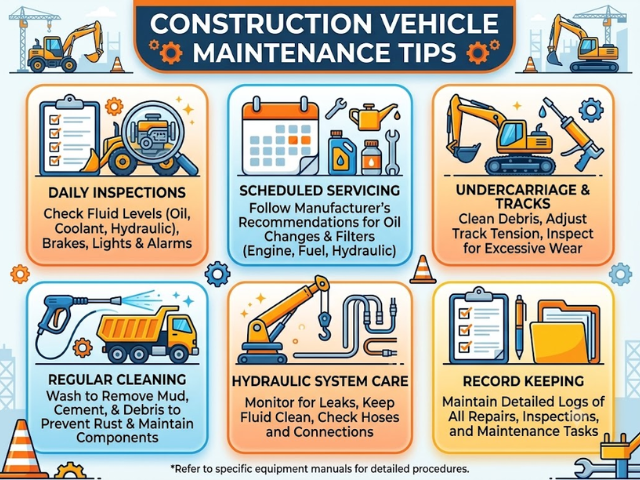
Regular maintenance keeps machines running efficiently and prevents costly breakdowns.
Check fluid levels daily – engine oil, hydraulic fluid, and coolant
Inspect tracks or tires for wear before each shift
Grease moving parts regularly to reduce friction damage
Monitor hydraulic hoses for leaks or cracks
Schedule routine servicing based on manufacturer guidelines
Keep air filters clean to protect engine performance
Log usage hours to track when major servicing is due
Consistent maintenance extends equipment lifespan and reduces unexpected downtime on active job sites.
Safety Tips When Operating Construction Vehicles
Operating heavy machinery comes with serious risk, so safety protocols matter as much as technical skill.
Always complete a pre-operation inspection before starting work
Wear proper personal protective equipment (PPE) at all times
Maintain clear communication with ground crew using signals or radios
Never exceed the machine’s rated load capacity
Keep a safe distance from overhead power lines
Ensure proper training and certification before operating any equipment
Follow site-specific safety rules and speed limits at all times
Following these basics significantly reduces the risk of accidents on construction sites.
FAQs
What is the most common construction vehicle?
The excavator is the most common and versatile construction vehicle, used for digging, lifting, and demolition tasks.
What’s the difference between a bulldozer and an excavator?
A bulldozer pushes materials with a front blade, while an excavator digs and lifts using a rotating boom and bucket.
Which vehicle is best for road construction?
Motor graders, asphalt pavers, and road rollers work together to level, pave, and compact road surfaces.
Are construction vehicles the same as heavy equipment?
Yes, construction vehicles are often referred to interchangeably as heavy equipment or heavy machinery.
What vehicle is used for small residential construction jobs?
Mini excavators, backhoe loaders, and skid steer loaders are ideal for smaller, tighter job sites.
Why is regular maintenance important for construction vehicles?
Routine maintenance prevents breakdowns, extends equipment life, and keeps operations running smoothly and safely.
Conclusion
From bulldozers clearing land to cranes lifting steel beams into place, every construction vehicle plays a specific and essential role in getting a project from blueprint to reality. Knowing these machines by name — and understanding what each one does best — makes it easier to plan projects, communicate on-site, and appreciate the sheer engineering behind modern construction.
Whether you’re studying these machines for school, planning a project, or simply curious about the equipment reshaping our roads and skylines, this guide gives you a solid foundation to identify and understand construction vehicles with confidence.
