

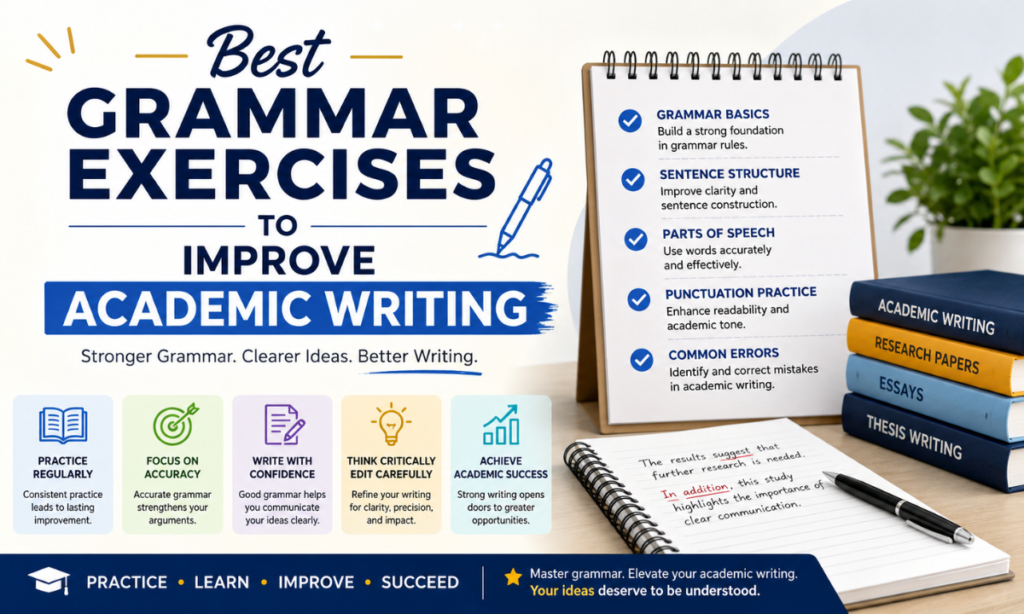
Academic writing demands more than good ideas — it demands precision. A brilliant argument can lose credibility fast if it’s buried under subject-verb mismatches, tense inconsistencies, or clunky sentence structures. The good news? Grammar is a skill, not a talent, and it improves with the right kind of targeted practice.
This guide walks through nine practical grammar exercises specifically designed for academic writers — students, researchers, and professionals who need their writing to read as clearly and confidently as their ideas deserve. No fluff, just exercises you can start using today.
Strengthen Subject–Verb Agreement
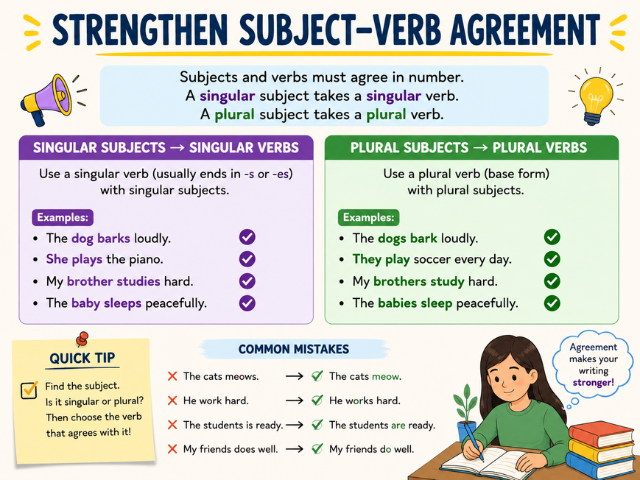
Subject-verb agreement errors are one of the most common grammar mistakes in academic papers, especially in sentences with long subjects or intervening phrases.
Exercise: Take five sentences from your own draft and identify the true subject of each verb, ignoring any prepositional phrases in between.
- Incorrect: The results of the study shows a clear trend.
- Correct: The results of the study show a clear trend.
Common Trouble Spots
| Structure | Example | Rule |
| Collective nouns | The committee decides (as a unit) | Singular verb when acting as one group |
| Compound subjects with “and” | Data and evidence support the theory | Plural verb |
| “Each” or “every” | Each of the samples was tested | Singular verb |
| Long subject phrases | The list of requirements is long | Match verb to the head noun, not the closest noun |
Practicing this daily with your own writing — not generic textbook sentences — builds the habit of pausing before finalizing a verb choice.
Practice Using the Right Verb Tense
Academic writing often mixes tenses depending on context: past tense for describing what was done, present tense for established facts, and present perfect for ongoing relevance.
Exercise: Go through a paragraph of your methodology or literature review and label every verb by tense. Then check for consistency.
- Use past tense for describing completed research actions: The researchers collected data over six months.
- Use present tense for general facts or conclusions: The findings suggest a strong correlation.
- Use present perfect to connect past research to current relevance: Several studies have examined this relationship.
Quick Tense Reference for Academic Sections
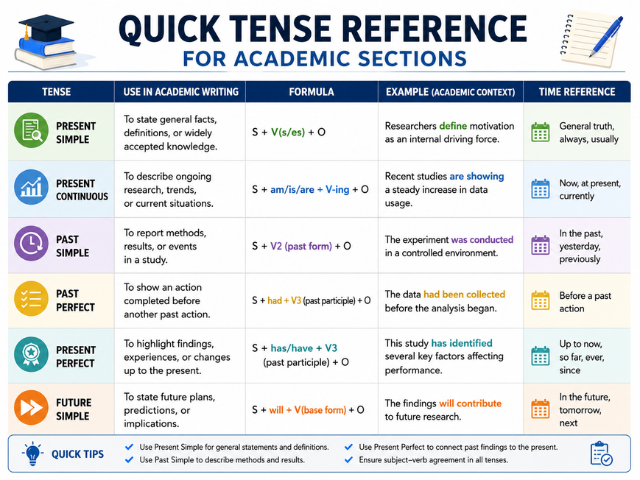
- Introduction — often present tense for background, past tense for prior studies
- Methodology — typically past tense
- Results — past tense for what was found
- Discussion/Conclusion — mix of present tense for interpretation and past for specific findings
Reading your paper section by section and checking tense consistency is one of the fastest ways to catch these slips.
Improve Article Usage
Articles (“a,” “an,” “the”) are notoriously tricky, especially for non-native English writers, because their rules depend heavily on context and specificity.
Exercise: Highlight every noun in a paragraph and ask: Is this general or specific? Countable or uncountable?
- Use “a/an” for a single, non-specific item: A study was conducted.
- Use “the” for something specific or previously mentioned: The study mentioned above found…
- Use no article for general plural or uncountable nouns: Research shows… (not “The research shows” unless referring to specific research)
| Situation | Correct Article Use |
| First mention, general | A theory was proposed |
| Repeated mention | The theory (mentioned earlier) |
| Uncountable noun | Knowledge, information, research (no article) |
| Specific group | The data collected in this study |
Rewrite Long Sentences
Long, tangled sentences are common in academic writing because writers try to pack in too many ideas at once. Clarity often means breaking these down.
Exercise: Take your longest sentence and split it into two or three shorter ones without losing meaning.
- Before: Although the sample size was limited, which may have affected the statistical power of the analysis, the results still indicated a meaningful trend that aligns with previous research in the field.
- After: The sample size was limited, which may have affected statistical power. Even so, the results indicated a meaningful trend consistent with previous research.
Tips for Trimming Sentence Length
- Break compound-complex sentences into two independent ones
- Remove unnecessary qualifying clauses
- Keep one main idea per sentence
- Read the sentence aloud — if you run out of breath, it’s too long
Compare Active and Passive Voice
Both voices have a place in academic writing, but overusing passive voice can make writing feel vague or indirect.
Exercise: Rewrite five passive sentences from your draft into active voice, then decide which version fits better.
| Passive Voice | Active Voice |
| The experiment was conducted by the researchers. | The researchers conducted the experiment. |
| Data were collected over three months. | We collected data over three months. |
| It was concluded that the hypothesis was supported. | The findings supported the hypothesis. |
When passive voice works better: when the actor is unknown, irrelevant, or when you want to emphasize the action/result rather than who performed it — common in scientific methodology sections.
When active voice works better: when clarity, directness, and stronger sentence flow are the priority — common in discussion and argument-driven sections.
Correct Punctuation Errors
Small punctuation mistakes — comma splices, missing commas, misused semicolons — can distort meaning or disrupt flow.
Exercise: Scan a page of your writing specifically for these three punctuation issues:
- Comma splices — two independent clauses joined only by a comma
- Incorrect: The results were significant, the sample size was small.
- Correct: The results were significant; however, the sample size was small.
- Missing commas after introductory phrases
- Incorrect: After analyzing the data the researchers reached a conclusion.
- Correct: After analyzing the data, the researchers reached a conclusion.
- Semicolon misuse — semicolons should join two complete, related sentences
- Correct: The results were promising; further research is needed.
Remove Redundant Words
Academic writing often accumulates redundant phrases that add length without adding meaning.
Exercise: Go through a paragraph and cross out any word that could be deleted without changing the meaning.
| Redundant Phrase | Concise Alternative |
| Due to the fact that | Because |
| In order to | To |
| A large number of | Many |
| At this point in time | Now |
| Completely eliminate | Eliminate |
| Basic fundamentals | Fundamentals |
Trimming redundancy doesn’t just shorten your writing — it makes each remaining word carry more weight, which is exactly what strong academic prose requires.
Read more…1000 Daily Use English Sentences with PDF: Daily Conversations Made Easy
Choose Precise Academic Vocabulary
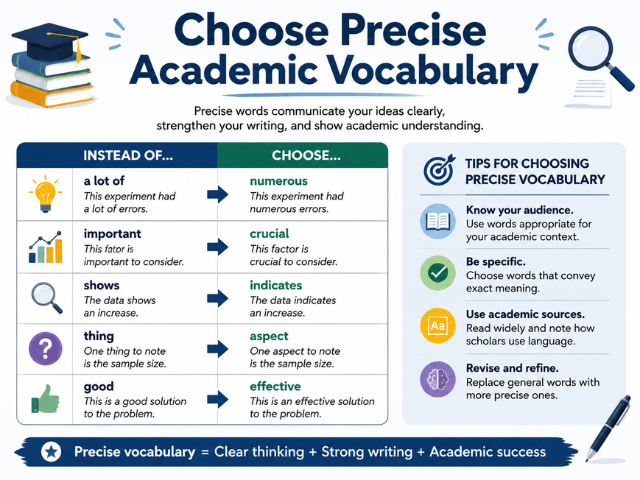
Vague words weaken arguments. Precise vocabulary strengthens them and signals command of the subject.
Exercise: Identify vague words like “good,” “bad,” “big,” or “very,” and replace them with more precise academic alternatives.
- Vague: The results were very good.
- Precise: The results were statistically significant.
- Vague: This is a big problem in the field.
- Precise: This is a persistent or substantial challenge in the field.
Common Academic Word Upgrades
| Casual Word | Academic Alternative |
| Show | Demonstrate, indicate, reveal |
| Look at | Examine, investigate, analyze |
| Get | Obtain, acquire |
| A lot of | Considerable, substantial |
| Think | Argue, propose, suggest |
Proofread Like a Journal Reviewer
The final step is reading your work the way a critical journal reviewer would — actively looking for weaknesses rather than passively reading for meaning.
Exercise: Print your draft (or view it in a different format than you wrote it in) and read it line by line, asking:
- Does every sentence support the paragraph’s main point?
- Is there a grammar or logic issue a reviewer would flag?
- Are transitions between ideas clear?
- Would a stranger understand this without background context?
A Simple Proofreading Checklist
- Read the paper backward, sentence by sentence, to catch grammar errors in isolation
- Check that every paragraph has one clear main idea
- Verify subject-verb agreement in every sentence
- Confirm tense consistency within each section
- Read aloud to catch awkward phrasing
- Set the draft aside for a few hours before final review
FAQs
What is the best grammar exercise for academic writing?
Reviewing your own draft sentence by sentence for subject-verb agreement and tense consistency is one of the most effective exercises.
How often should I practice grammar exercises?
Short, focused practice for 10–15 minutes daily is more effective than occasional long sessions.
Does passive voice weaken academic writing?
Not always — passive voice works well in methodology sections, but overuse elsewhere can make writing feel vague.
How can I improve article usage in English?
Practice identifying whether a noun is specific, general, countable, or uncountable before choosing “a,” “an,” or “the.”
What’s the fastest way to reduce redundant words?
Read each sentence and remove any word or phrase that doesn’t change the meaning when deleted.
Grammar exercises only pay off when you apply them to your own writing, not generic textbook sentences. Real improvement comes from spotting your personal weak points — whether that’s tense drift, article misuse, or passive voice habits — and drilling those specifically. Consistency matters more than trying to master all nine exercises at once.
At the same time, grammar is only part of strong academic writing. Clear structure and logical flow matter just as much as correct sentences, so polishing grammar should come after your argument is solid, not instead of it. Treat these exercises as the final layer of refinement that makes already-good writing read as confidently as it should.
