

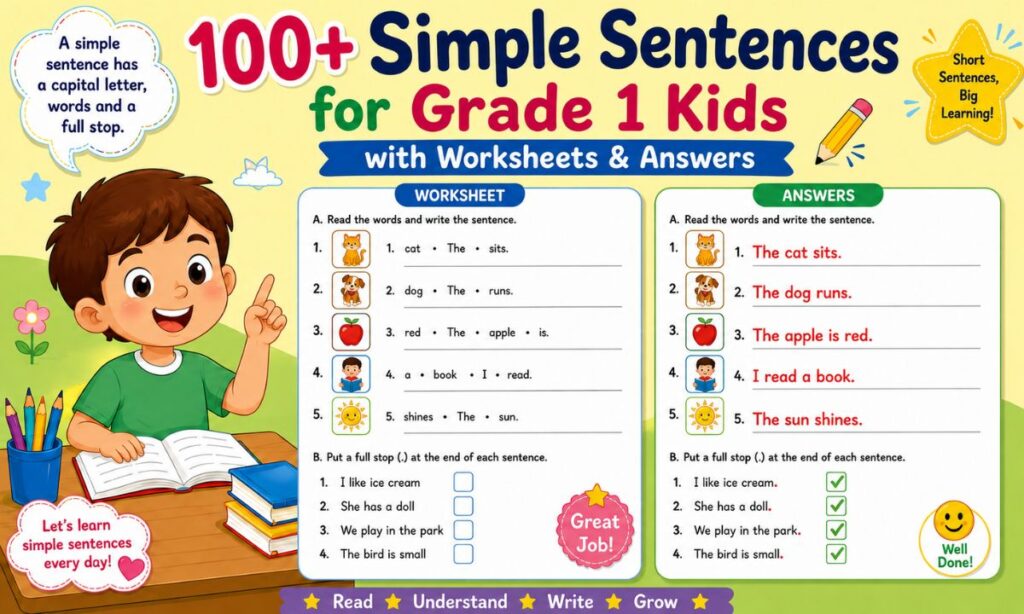
Learning to read and write starts with something small but powerful: the simple sentence. For Grade 1 kids, mastering short, clear sentences builds the foundation for everything that comes next — bigger vocabulary, better reading comprehension, and confident writing.
This guide brings together 100+ easy sentences for Grade 1 students, organized by everyday topics, along with practical worksheets and answers that parents and teachers can use right away. Whether you’re a parent helping at home or a teacher planning a lesson, you’ll find ready-to-use material here.
Easy Sentences for Grade 1 for Kids in English
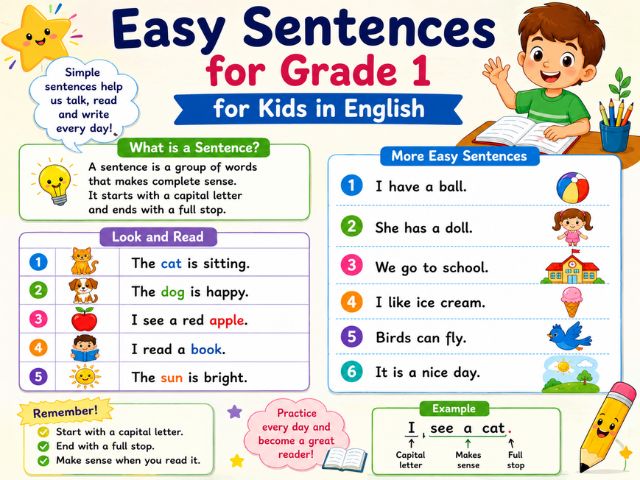
Grade 1 students learn best with sentences that are short, familiar, and connected to their daily lives. Here are some simple, everyday examples to start with:
I like my school.
I love my parents.
We play in the park.
She reads a book.
He kicks the ball.
The dog barks loudly.
I eat my lunch.
We sing a song.
I open the door.
They clap their hands.
These sentences use familiar sight words like “I,” “we,” “is,” “am,” and “the,” which young readers recognize quickly and repeatedly across different texts.
Introduction to Simple Sentences for Grade 1
A simple sentence is the very first building block of writing. It expresses one complete idea using just a subject and a verb — no complicated joining words, no long clauses, just a clear thought a child can read, understand, and repeat.
For a six or seven-year-old, this simplicity is exactly what makes learning possible. Instead of overwhelming young learners with grammar rules, simple sentences let them absorb sentence patterns naturally, the same way they picked up spoken language before ever opening a book.
What is a Simple Sentence for Grade 1?
A simple sentence for Grade 1 is a short sentence containing one subject and one verb that expresses a complete thought. It usually follows a subject-verb-object (SVO) pattern.
Examples:
I run. (subject + verb)
She sings a song. (subject + verb + object)
The dog barks. (subject + verb)
| Part of Sentence | Role | Example |
| Subject | Who or what the sentence is about | I, She, The dog |
| Verb | The action being done | run, sings, barks |
| Object (optional) | What receives the action | a song, the ball |
At this level, sentences don’t need conjunctions like “and,” “but,” or “because” — those come later, once children are comfortable with basic sentence structure.
Why Grade 1 Students Should Learn Simple Sentences
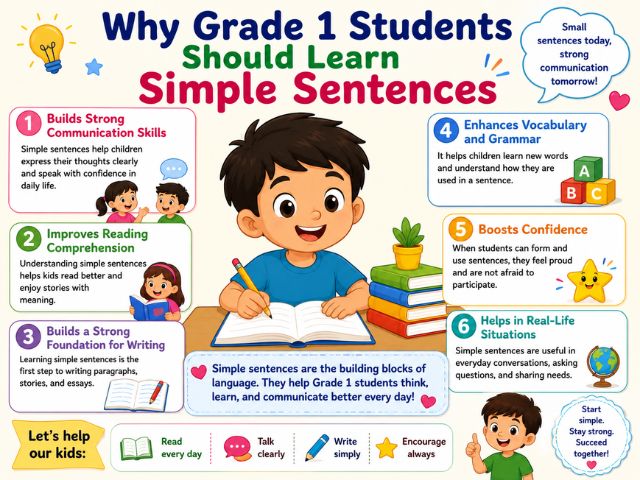
Learning simple sentences isn’t just about grammar — it’s about building the confidence to read, speak, and write independently.
They help children recognize sentence patterns quickly
They reinforce sight words used across all reading materials
They build a base for more complex sentence types later
They improve pronunciation and speaking fluency
They connect classroom learning to real, everyday situations
When children practice sentences that describe their own routines — eating breakfast, going to school, playing outside — the learning feels relevant, not abstract, which keeps them engaged.
Benefits of Practicing Simple Sentences Every Day
Daily practice, even for just ten minutes, has a compounding effect on language development. Here’s what consistent sentence practice builds over time:
Stronger reading fluency — recognizing common words instantly instead of sounding them out each time
Better spelling accuracy — repeated exposure reinforces correct spelling naturally
Improved comprehension — understanding meaning becomes automatic rather than effortful
Writing confidence — kids feel ready to write their own sentences, not just copy them
Cognitive development — connecting words to meaning strengthens memory and focus
Better classroom participation — kids who can form sentences confidently speak up more in class
Quick Comparison: Practicing vs. Not Practicing
| Skill Area | With Daily Practice | Without Regular Practice |
| Reading speed | Improves steadily | Stays slow and effortful |
| Spelling | Becomes more accurate | Remains inconsistent |
| Confidence in class | Increases | Often stays low |
| Writing ability | Progresses to longer sentences | Struggles to move beyond single words |
Good Sentence Examples for Grade 1 in English
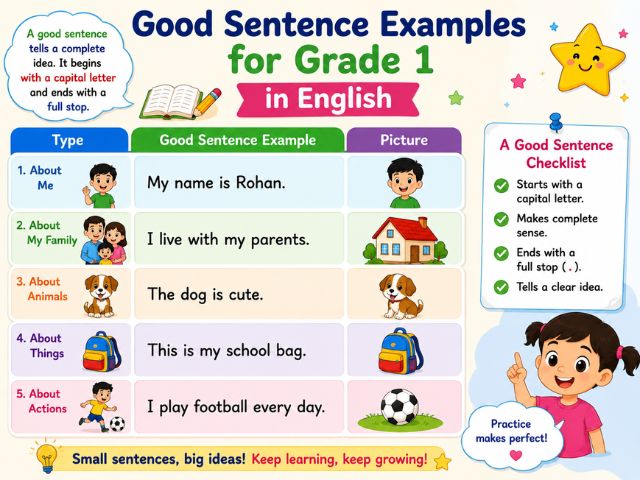
Here’s a well-rounded set of simple, everyday sentences appropriate for Grade 1 reading and writing levels:
I wake up early.
We go to school.
She eats breakfast.
I drink water.
He rides a bike.
I wash my face.
We brush our teeth.
She reads a book.
I write my name.
We play football.
He watches TV.
I take a bath.
She goes to bed.
We eat dinner.
I wear my shoes.
These sentences reflect a child’s actual daily routine, which makes them far easier to remember than random vocabulary-based sentences.
Read More….25+ Orange Fruit Varieties and Pictures: Types of Orange Fruits
Mentor Sentences for Class One in English
Mentor sentences are model sentences that show students exactly how a well-formed sentence looks and sounds. Teachers often use these as a pattern for students to imitate before writing their own.
Examples of mentor sentences for Class 1:
The sun is bright.
My mother cooks food.
The bird flies high.
I like ice cream.
My friend is kind.
How to Use Mentor Sentences in Class
Read the mentor sentence aloud together
Identify the subject and the verb
Ask students to replace one word (e.g., change “bird” to “butterfly”)
Have students create their own version using the same pattern
Share sentences aloud to build speaking confidence
This method works especially well because it removes the pressure of creating a sentence from scratch — students simply follow a proven pattern.
Simple Sentences for 1st Grade Students in English
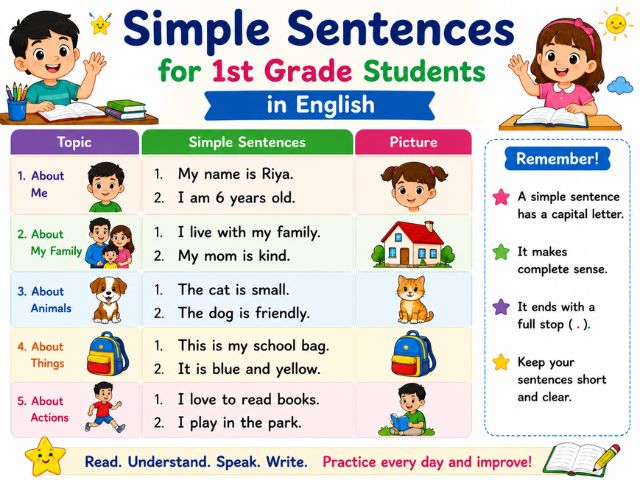
Here’s another practical batch of simple sentences, grouped by common themes young learners encounter often:
About Family:
I love my parents.
My sister is small.
My brother plays outside.
We eat dinner together.
My grandmother tells stories.
About School:
My teacher is nice.
We write in books.
My bag is heavy.
We sit in class.
My desk is clean.
About Animals:
The cat drinks milk.
The dog runs fast.
The bird sings sweetly.
The fish swims in water.
The cow eats grass.
About Nature:
The sun is bright.
The sky is blue.
The flowers smell nice.
The rain falls softly.
The wind blows gently.
1st Grade Sentences for Kids Should Know
Beyond general practice sentences, there are certain foundational sentences every Grade 1 student should be comfortable reading and writing, since they reinforce core sight words and basic grammar patterns.
| Category | Sentence Examples |
| Greetings | Good morning. / Hello, friend. |
| Feelings | I am happy. / I am sad. |
| Actions | I run. / I jump. / I walk. |
| Requests | Please help me. / Can I go? |
| Simple facts | The sky is blue. / Water is wet. |
Mastering these core sentence types gives kids a toolkit they can rely on across subjects — not just English class.
1st Grade Vocabulary Words List
Simple sentences work best when paired with a strong base of common vocabulary. Here’s a helpful word list broken down by category:
Sight Words: I, am, is, are, the, in, to, we, he, she, it, on, at, and
Action Words (Verbs): run, jump, eat, drink, play, read, write, sing, sleep, walk
Describing Words (Adjectives): big, small, happy, sad, fast, slow, bright, soft, loud, kind
Naming Words (Nouns): school, book, dog, cat, ball, sun, moon, tree, house, friend
Why Vocabulary Lists Matter Alongside Sentences
Teaching vocabulary in isolation rarely sticks. But when children see the same words repeated inside simple sentences, they retain both the word and its meaning far more effectively — reinforcing reading and writing skills at the same time.
Sentences for Grade 1 Worksheets with Answers
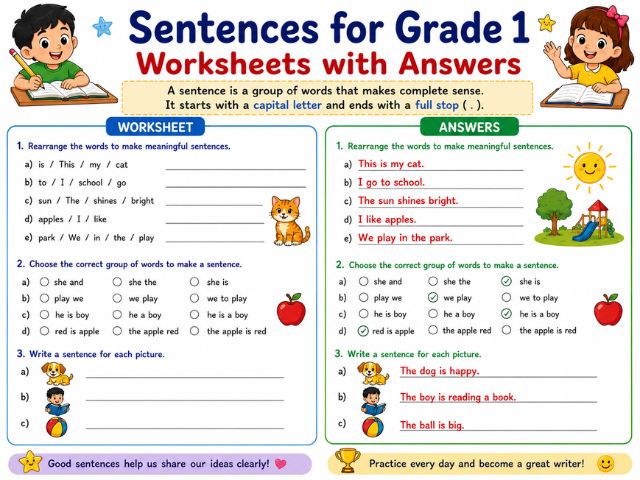
Practical worksheets help turn passive reading into active learning. Below are sample worksheet formats you can use directly.
Worksheet Fill in the Blank
Complete each sentence with the correct word from the box: (run, sings, drinks, reads, plays)
The bird ______ sweetly.
I ______ a book.
The cat ______ milk.
He ______ football.
She can ______ fast.
Answers: 1. sings 2. reads 3. drinks 4. plays 5. run
Worksheet Match the Subject with the Correct Sentence
| Subject | Match to Sentence |
| The dog | A. eats grass |
| The cow | B. barks loudly |
| The bird | C. flies high |
| I | D. drink water |
Answers: The dog – B, The cow – A, The bird – C, I – D
Worksheet Circle the Verb
Instructions: Circle the action word (verb) in each sentence.
I eat my lunch.
She sings a song.
He kicks the ball.
We play in the park.
The dog barks loudly.
Answers: 1. eat 2. sings 3. kicks 4. play 5. barks
Worksheet Write Your Own Sentence
Instructions: Use each word below to write a simple sentence.
Sun — ___________________________
Friend — ________________________
School — ________________________
Sample Answers: 1. The sun is bright. 2. My friend is kind. 3. I go to school.
These worksheet formats can be repeated weekly with new vocabulary, keeping practice fresh while reinforcing the same sentence structure patterns.
FAQs
What is a simple sentence for Grade 1 kids?
A simple sentence is a short sentence with one subject and one verb that expresses a complete thought.
How many sentences should a Grade 1 child practice daily?
Around 5 to 10 short sentences a day is enough for steady, manageable progress.
What are mentor sentences used for?
Mentor sentences give students a model pattern to imitate before writing their own original sentences.
Why are worksheets helpful for learning sentences?
Worksheets turn passive reading into active practice, helping children apply what they’ve learned immediately.
What vocabulary should Grade 1 students know first?
Common sight words, simple verbs, and everyday nouns related to family, school, and daily routines.
Can simple sentences help with reading fluency?
Yes, repeated exposure to simple sentence patterns builds faster word recognition and smoother reading.
Conclusion
Simple sentences are more than a grammar lesson — they’re the first real step toward confident reading, writing, and speaking. By practicing everyday sentences about family, school, animals, and daily routines, Grade 1 students build a natural feel for language instead of memorizing abstract rules.
Pair these sentences with the worksheets above, keep practice short and consistent, and celebrate small wins along the way. With steady daily practice, these simple building blocks will grow into confident, independent writers before you know it
