

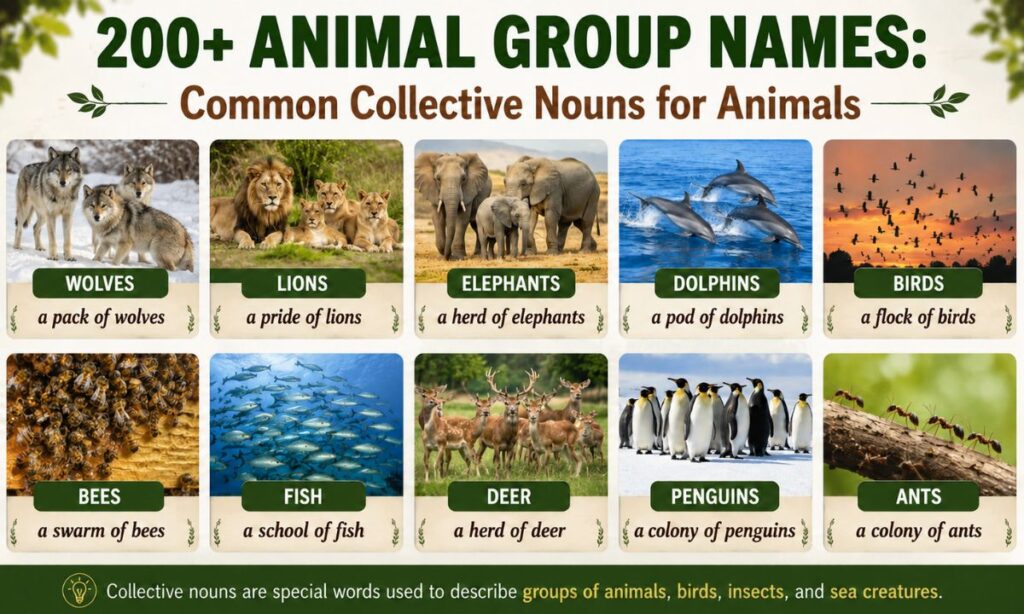
Ever tried to describe a bunch of lions and instinctively said “pride” instead of “group”? That’s the magic of collective nouns — tiny words that turn ordinary animal descriptions into something vivid and specific. English has hundreds of these terms, some practical and widely used, others so unusual they sound made up (they’re not).
This guide brings together over 200 animal group names, organized by category, so you can use them confidently in writing, conversation, quizzes, or just to impress your friends at trivia night. Let’s dive straight in.
Sentences for Collective Nouns: Animals
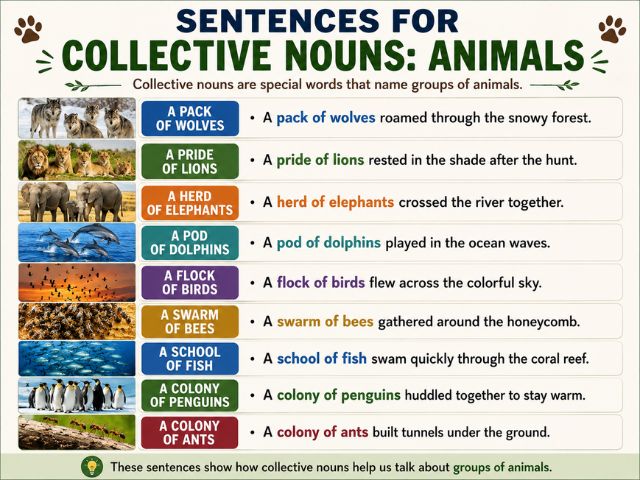
Seeing collective nouns used in real sentences makes them far easier to remember than a list alone. Here are natural examples across different animal types:
A pride of lions rested in the shade during the afternoon heat.
A pack of wolves moved silently through the snow.
The flock of sheep grazed quietly on the hillside.
A school of fish darted away as the shadow passed overhead.
We watched a pod of dolphins leap alongside the boat.
A murder of crows gathered on the old oak tree.
The troop of monkeys swung from branch to branch.
A gaggle of geese waddled across the farmyard.
A swarm of bees buzzed around the blooming garden.
The herd of elephants slowly crossed the dry riverbed.
Notice how each sentence reads naturally — that’s the real test of whether you’re using a collective noun correctly. If it fits smoothly into a sentence the way “group” or “bunch” would, you’re using it right.
Common Animal Group Names with Meanings
Many collective nouns aren’t random — they were chosen because they reflect something about the animal’s behavior, appearance, or reputation. Understanding the meaning behind them makes these words much easier to remember.
| Animal | Group Name | Meaning Behind It |
| Crows | Murder | Linked to old folklore about crows and death |
| Owls | Parliament | Reflects their reputation for wisdom |
| Lions | Pride | Reflects their confident, dominant nature |
| Rhinos | Crash | Describes their heavy, powerful movement |
| Zebras | Dazzle | Refers to their striking striped pattern |
| Jellyfish | Smack | Describes their stinging behavior |
| Hyenas | Cackle | Named after their distinctive laughing call |
| Ferrets | Business | Suggests their busy, energetic movement |
| Giraffes | Tower | Describes their tall, upright appearance |
| Foxes | Skulk | Reflects their sneaky, cautious behavior |
Learning the “why” behind these terms turns memorization into something much more intuitive.
Most Popular Collective Nouns for Animals
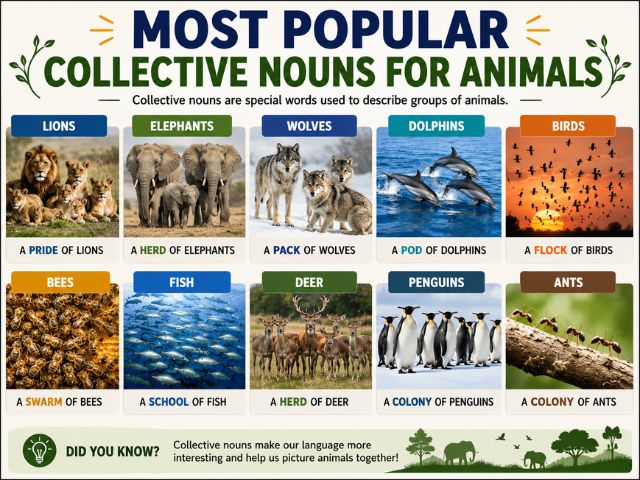
Some collective nouns are used so often that they’ve become part of everyday English vocabulary. These are the ones worth learning first.
Herd – cattle, elephants, deer, buffalo
Flock – birds, sheep, geese (on the ground)
Pack – wolves, dogs
Pride – lions
School – fish
Swarm – bees, insects
Pod – dolphins, whales
Colony – ants, bats, penguins
Troop – monkeys, baboons
Litter – puppies, kittens
These ten terms alone will cover the majority of everyday conversations about animals in groups.
Funny and Unusual Animal Group Names
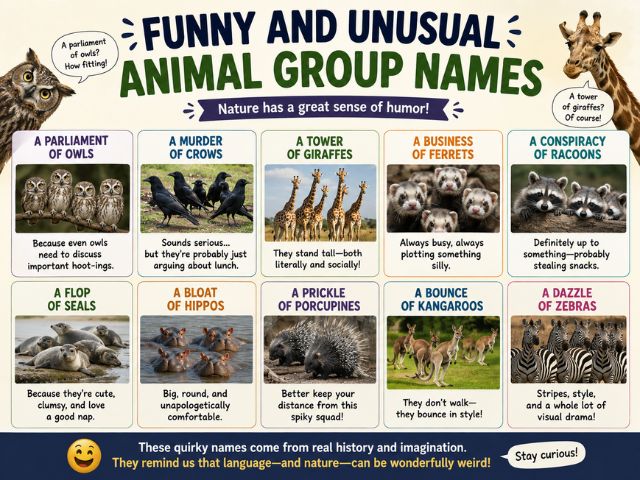
English also has plenty of collective nouns that sound almost invented — but they’re completely real and widely documented.
A conspiracy of lemurs
An implausibility of gnus
A wisdom of wombats
A shrewdness of apes
A bloat of hippos
A prickle of porcupines
An unkindness of ravens
A cackle of hyenas
A flamboyance of flamingos
A shiver of sharks
A murder of crows
A parliament of owls
A business of ferrets
A obstinacy of buffalo
A romp of otters
These quirky names often trace back to medieval hunting terminology, where hunters and scholars gave playful, descriptive labels to animal groups — many of which stuck around for centuries.
Read More…250+ Basic Sentences for Grade 4: Easy English to Learn with Pictures
Alphabetical List of Animal Group Names
Here’s a quick A-Z reference for scanning or study purposes.
| Letter | Animal Group Examples |
| A | Army (of frogs), Ambush (of tigers) |
| B | Bloat (of hippos), Business (of ferrets), Bevy (of quails) |
| C | Crash (of rhinos), Cackle (of hyenas), Colony (of ants), Clowder (of cats) |
| D | Dazzle (of zebras), Drove (of cattle) |
| E | Exaltation (of larks) |
| F | Flock (of birds), Flamboyance (of flamingos) |
| G | Gaggle (of geese), Gam (of whales) |
| H | Herd (of elephants), Hive (of bees) |
| I | Implausibility (of gnus) |
| J | Journey (of giraffes) |
| K | Kindle (of kittens) |
| L | Leap (of leopards), Litter (of puppies) |
| M | Murder (of crows), Mob (of kangaroos) |
| N | Nest (of vipers) |
| O | Obstinacy (of buffalo) |
| P | Pride (of lions), Pack (of wolves), Pod (of dolphins), Parliament (of owls) |
| Q | Quiver (of cobras) |
| R | Romp (of otters), Raft (of ducks) |
| S | School (of fish), Swarm (of bees), Shiver (of sharks), Skulk (of foxes) |
| T | Troop (of monkeys), Tower (of giraffes) |
| U | Unkindness (of ravens) |
| V | Volery (of birds) |
| W | Wisdom (of wombats) |
| Z | (no common example) |
What Are Collective Nouns for Animals
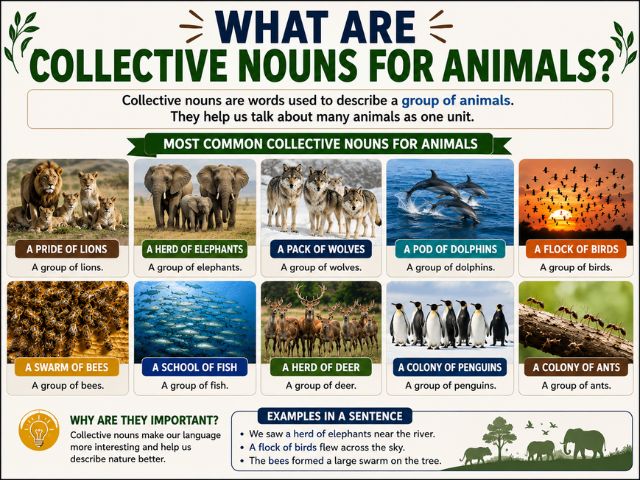
A collective noun for animals is a single word used to describe a group of the same species, treated as one unit rather than counted individually. Instead of saying “many wolves,” you say “a pack of wolves.”
These words appear as singular nouns grammatically, even though they refer to multiple animals:
The herd is grazing peacefully. (singular verb, treating the group as one unit)
Some animals have more than one accepted collective noun depending on context. For example:
Ducks: a raft (on water) or a team (in flight)
Geese: a gaggle (on the ground) or a skein (in flight)
Owls: a parliament or a stare
This flexibility is part of what makes English collective nouns so interesting — the “correct” term can shift depending on what the animals are doing.
Why Are Animal Group Names Important
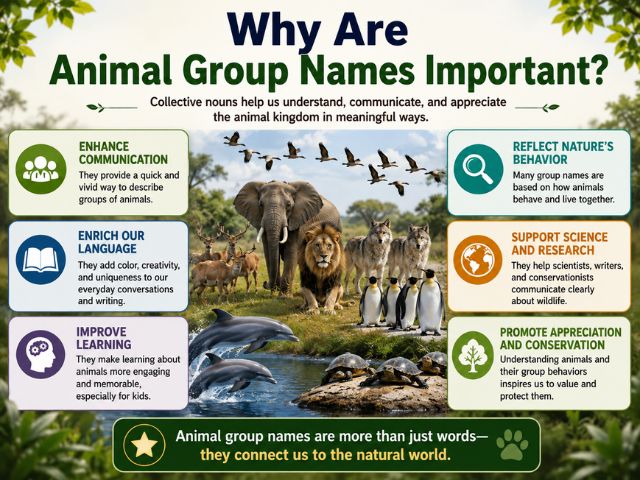
Collective nouns aren’t just trivia — they genuinely improve how we communicate about the animal world.
They add precision. “A pride of lions” instantly tells you more than “a group of lions.”
They paint a mental picture. Words like “murder” or “dazzle” carry built-in imagery and tone.
They’re useful in education. Teachers use these terms to build vocabulary and encourage curiosity about animal behavior.
They appear in exams and writing tests. Collective nouns show up regularly in grammar assessments and English proficiency tests.
They enrich creative writing. Descriptive, unusual collective nouns can make nature writing, storytelling, and journalism far more vivid.
Collective Nouns for Farm Animals
Farm animal group names are some of the easiest to learn since many appear regularly in daily conversation.
| Farm Animal | Collective Noun |
| Cows/Cattle | Herd |
| Sheep | Flock |
| Chickens | Brood or Flock |
| Pigs | Sounder or Drove |
| Goats | Trip |
| Horses | Herd |
| Ducks | Team (on land) |
| Turkeys | Rafter |
| Geese | Gaggle |
| Donkeys | Drove |
Collective Nouns for Wild Animals
Wild animal group names tend to be more varied and descriptive, often reflecting hunting behavior or social structure.
| Wild Animal | Collective Noun |
| Lions | Pride |
| Wolves | Pack |
| Elephants | Herd |
| Tigers | Ambush |
| Zebras | Dazzle |
| Monkeys | Troop |
| Giraffes | Tower |
| Foxes | Skulk |
| Bears | Sloth |
| Kangaroos | Mob |
| Deer | Herd |
| Rhinos | Crash |
Collective Nouns for Birds
Bird group names are among the most poetic in English, often describing flight patterns or behavior.
| Bird | Collective Noun |
| Crows | Murder |
| Owls | Parliament |
| Larks | Exaltation |
| Geese | Gaggle (ground) / Skein (flight) |
| Ducks | Raft (water) / Team (flight) |
| Flamingos | Flamboyance |
| Peacocks | Ostentation |
| Vultures | Wake |
| Starlings | Murmuration |
| Herons | Siege |
| Eagles | Convocation |
Collective Nouns for Sea Animals
Sea creatures have some of the most distinctive collective nouns, many reflecting their movement or grouping behavior underwater.
| Sea Animal | Collective Noun |
| Fish | School or Shoal |
| Dolphins | Pod |
| Whales | Pod or Gam |
| Jellyfish | Smack or Bloom |
| Sharks | Shiver |
| Crabs | Cast |
| Stingrays | Fever |
| Eels | Bed |
| Sea Turtles | Bale |
| Otters | Raft (water) / Romp (land) |
Rare Animal Group Names You Should Know
These are less commonly seen but genuinely used terms — great for quizzes, writing flair, or simply expanding your vocabulary further.
A shrewdness of apes
A skulk of foxes
A cete of badgers
A husk of hares
A descent of woodpeckers
A charm of hummingbirds
A quiver of cobras
A prickle of hedgehogs
A rhumba of rattlesnakes
A coalition of cheetahs
A memory of elephants
A tiding of magpies
Many of these rare terms trace back centuries to old English hunting and nature guides, where writers took creative liberty in naming animal groups based on their observed habits.
FAQs
What is a collective noun for animals?
It’s a single word used to describe a group of animals of the same species treated as one unit, like “pride” for lions.
Do all animals have a unique collective noun?
No, many animals share common terms like “herd” or “flock,” while only some have unique or unusual group names.
Why are some animal group names so unusual?
Many unusual names originated from medieval hunting traditions and creative, descriptive language that stuck over time.
Can an animal have more than one collective noun?
Yes, some animals like ducks and geese have different group names depending on whether they’re on land, water, or in flight.
Are collective nouns important for exams?
Yes, they frequently appear in English grammar tests, vocabulary quizzes, and language proficiency exams.
Conclusion
From the well-known “pack of wolves” to the delightfully odd “implausibility of gnus,” collective nouns for animals add color, precision, and personality to the English language. Whether you’re a student building vocabulary, a writer looking for vivid descriptions, or simply curious about animal behavior, this list gives you a solid foundation to draw from.
Keep this guide handy, revisit it when you need a quick refresher, and don’t be afraid to use the more unusual terms — they’re a simple way to make your writing and conversation stand out.
