

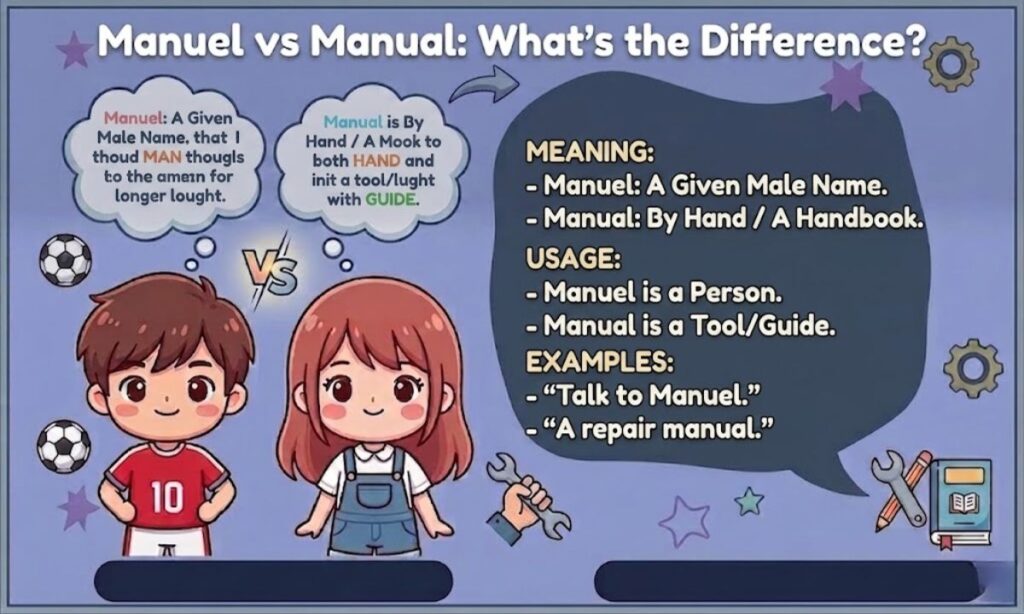
Have you ever typed a text, an email, or a product review and paused halfway through, unsure whether to write “Manuel” or “manual”? You’re not alone. These two words look almost identical, sound nearly the same when spoken quickly, and yet mean completely different things.
One is a person’s name. The other is an everyday English word used to describe instruction books, hand-operated devices, and physical tasks. Mixing them up doesn’t just look like a typo — it can completely change the meaning of your sentence, confuse your reader, or make professional writing look careless.
In this guide, we’ll break down everything you need to know about Manuel vs Manual: their origins, meanings, correct usage, common mistakes, and real-world examples. By the end, you’ll never second-guess yourself again.
Manuel vs Manual: Quick Comparison Table
Here’s a snapshot comparison before we dive deeper.
| Feature | Manuel | Manual |
| Word type | Proper noun (name) | Noun / Adjective |
| Capitalization | Always capitalized | Lowercase unless starting a sentence |
| Origin | Spanish/Portuguese, from “Emmanuel” | Latin manualis, from manus (“hand”) |
| Meaning | A male first name | A guidebook or something done by hand |
| Common usage | Referring to a person | Instructions, hand-operated tasks, gear systems |
| Example | “Manuel fixed the printer.” | “Read the manual before using the printer.” |
| Part of speech | Noun (name only) | Noun or adjective |
| Pronunciation | /man-WEL/ | /MAN-yoo-uhl/ |
This table alone answers most people’s quick question, but let’s unpack each word in more detail.
Definitions of Manuel vs Manual
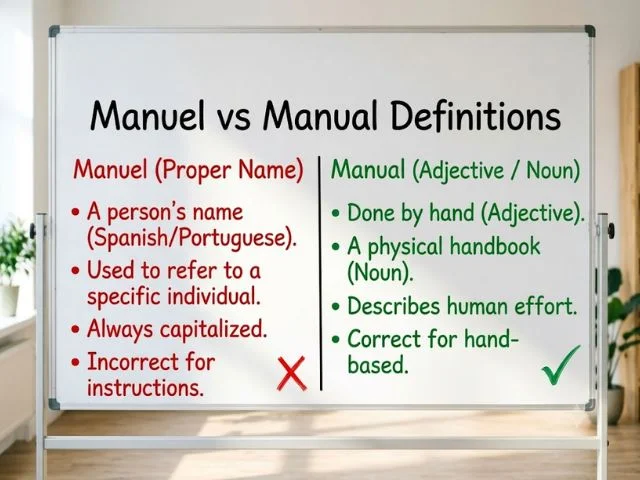
What Does Manuel Mean?
Manuel is a proper noun — specifically, a personal name. It’s a common first name in Spanish, Portuguese, and other Romance-language cultures, historically derived from “Emmanuel,” a Hebrew-origin name meaning “God is with us.” Because it’s a name, Manuel always refers to a specific person and is always capitalized, regardless of where it appears in a sentence.
You’ll find Manuel used as:
- A first name for men across Spain, Portugal, Latin America, and Portuguese-speaking African nations
- A surname in some regions
- A name for public figures, historical rulers, and fictional characters
What Does Manual Mean?
Manual, on the other hand, is a standard English word with two main functions:
- As a noun: A manual is a book or document containing instructions on how to use, assemble, operate, or repair something (e.g., a car manual, a user manual, an employee manual).
- As an adjective: Manual describes something operated by hand rather than by machine or automation (e.g., manual labor, manual transmission, manual override).
The word comes from the Latin term manualis, rooted in manus, meaning “hand.” That’s why so many manual-related meanings connect back to physical, hands-on action.
Manuel vs Manual: What’s the Difference?
At the core, the difference between Manuel and Manual comes down to one simple test:
Are you talking about a person, or are you talking about instructions/hand-operated tasks?
If it’s a person’s name, you need Manuel. If it’s a book, a task, or a system involving hands-on operation, you need manual.
Here’s a deeper breakdown of the distinction:
| Aspect | Manuel | Manual |
| Refers to | A human being | An object, action, or document |
| Grammar role | Subject or object in a sentence (as a name) | Noun or descriptive adjective |
| Flexibility | Fixed meaning — always a name | Multiple meanings depending on context |
| Everyday use | Rare unless addressing/discussing someone named Manuel | Extremely common in tech, automotive, and instructional writing |
Even though the spelling differs by a single letter, confusing the two changes the entire meaning of a sentence. “I called Manuel” and “I called the manual” are two completely different statements — one describes a phone call to a person, and the other doesn’t even make grammatical sense in most contexts.
When to Use Manuel vs Manual
Knowing the rule is one thing — applying it while writing quickly is another. Here’s a simple decision framework:
Use Manuel when:
- You’re referring to a specific person by name
- The word functions as a subject, object, or possessive in a sentence
- It appears in dialogue, biography, or storytelling involving a character or real person
Use manual when:
- You’re referring to an instruction booklet or guide
- You’re describing a task performed by hand, without automation
- You’re discussing gear systems (manual transmission vs automatic)
- You’re using it as an adjective before a noun (manual labor, manual entry, manual settings)
Quick Memory Trick
A simple way to remember the difference: Manuel has a face, manual has pages (or hands). If you can picture a person, it’s Manuel. If you’re picturing a book or physical task, it’s manual.
Manuel vs Manual Book
This is one of the most searched confusions online — people often type “Manuel” when they actually mean an instruction book. There is no such thing as a “Manuel book.” The correct term is always manual when referring to:
- A user manual for electronics or appliances
- A car owner’s manual
- An employee handbook or training manual
- A repair or service manual
- A software or installation manual
If you see the phrase “instruction Manuel,” it’s a spelling mistake. The correct phrase is always “instruction manual.” This particular error is extremely common because of autocorrect settings and muscle memory from typing names.
Read More:At Least or Atleast? Which Is Correct? Meaning, Grammar Rules & Examples (2026)
Manual vs Manuel Meme
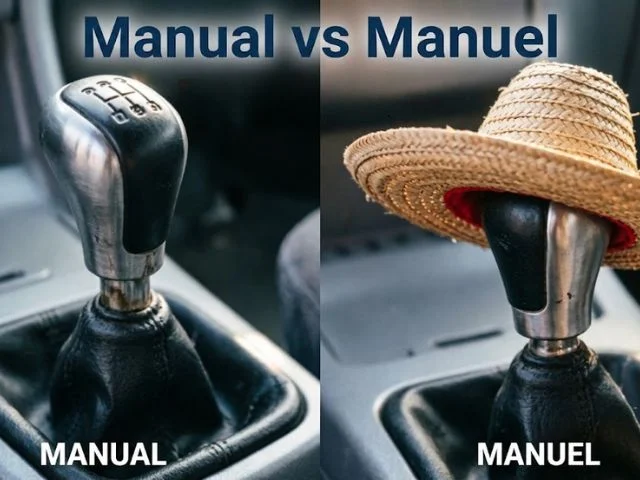
Over the past few years, “Manuel vs Manual” has become a lighthearted meme format online, especially on social media and forums like Reddit and Twitter/X. The humor usually plays on:
- Autocorrect fails where someone’s phone changes “manual” to “Manuel” mid-sentence
- Jokes about a car having a “Manuel transmission” (as if a person named Manuel is driving)
- Screenshots of embarrassing text messages where the wrong word slipped through
These memes have actually helped many people remember the difference, since visual humor tends to stick better than a plain grammar rule. If you’ve ever seen a meme joking about “my car has a Manuel transmission,” now you know exactly why it’s funny — and wrong.
How to Properly Use Manuel vs Manual in a Sentence
Getting the grammar right is simple once you apply the person-vs-object rule consistently. Here’s how each word functions structurally:
Manuel (proper noun):
- Always capitalized
- Can act as a subject: Manuel arrived early.
- Can act as an object: I texted Manuel.
- Can show possession: Manuel’s car broke down.
Manual (noun or adjective):
- Lowercase unless it starts a sentence
- As a noun: The manual explains the setup process.
- As an adjective: This is a manual process.
- Often paired with words like “labor,” “transmission,” “entry,” “override,” or “mode”
Sentence Structure Tip
If the word is followed by a verb describing a human action (arrived, said, worked, called), it’s almost certainly Manuel. If the word is followed by a noun it’s describing (labor, mode, transmission, entry), it’s manual.
Manuel vs Manual Reddit
Online communities, particularly Reddit threads in grammar, language-learning, and even car forums, frequently discuss this exact confusion. Common discussion themes include:
- Non-native English speakers asking why “manual” isn’t spelled like the name “Manuel”
- Car enthusiasts joking about “driving a Manuel” instead of a manual transmission vehicle
- Threads explaining that autocorrect is often the real culprit behind the mix-up
These discussions reinforce a consistent theme: the confusion is almost always accidental, tied to autocorrect, muscle memory, or unfamiliarity with English name conventions — not a lack of intelligence or effort.
Examples of Manuel vs Manual Use in Sentences
Seeing both words in real sentences makes the distinction much easier to internalize.
Examples using Manuel:
- Manuel submitted his report before the deadline.
- Our new team member, Manuel, moved here from Madrid.
- I haven’t spoken to Manuel since last week.
- Manuel’s presentation impressed the entire board.
- The award was given to Manuel for his outstanding service.
Examples using manual:
- Please read the manual before assembling the furniture.
- She prefers manual labor over office work.
- The new car comes with both automatic and manual transmission options.
- He performed a manual backup of the files.
- The technician relied on the service manual to fix the machine.
Notice how every “Manuel” sentence involves a person doing something, while every “manual” sentence involves an object, task, or instruction.
Manual vs Manuel: Common Spelling Mistakes
Because these words are so visually similar, certain mistakes show up again and again in everyday writing. Here are the most frequent ones:
- Autocorrect swaps: If “Manuel” is saved as a contact name on your phone, autocorrect may replace “manual” with “Manuel” without you noticing.
- Typing “Manuel” for instruction guides: Writing “car Manuel” instead of “car manual.”
- Capitalization errors: Writing “manual” with a capital M when it’s not starting a sentence, or writing “manuel” (lowercase) when referring to the name.
- Speed-typing errors: Since both words start with “manu,” fast typists sometimes finish the word incorrectly out of habit.
- Non-native speaker confusion: Learners sometimes assume “manual” is simply the impersonal or generic version of the name “Manuel,” rather than recognizing them as entirely unrelated words.
How to Avoid These Mistakes
- Turn off aggressive autocorrect/predictive text for tricky word pairs
- Proofread before sending emails or publishing content
- Use a grammar-checking tool as a second layer of review
- Remember the rule: name = Manuel, everything else = manual
Manual vs Automatic
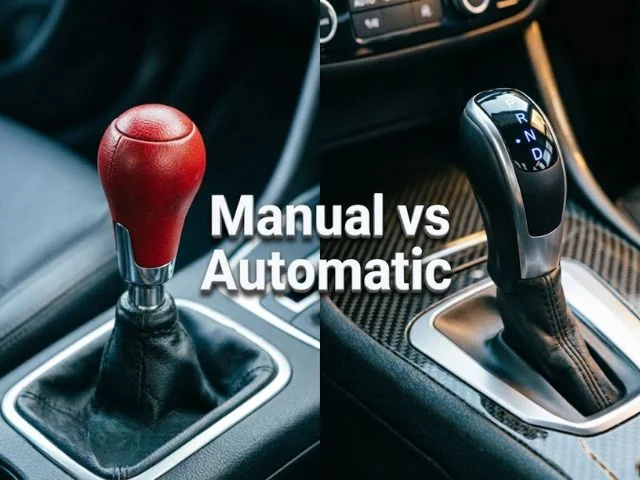
Since “manual” frequently appears in comparisons with “automatic,” it’s worth clarifying this related distinction too, especially in automotive and technology contexts.
| Manual | Automatic |
| Operated by hand or human control | Operated by machine or system without direct human input |
| Requires active input (e.g., shifting gears) | Runs with minimal human intervention |
| Common in manual transmission vehicles | Common in automatic transmission vehicles |
| Often requires more skill or attention | Generally easier and more convenient to use |
| Example: manual gear shifting | Example: automatic gear shifting |
This is a separate comparison from Manuel vs Manual, but the overlap in the word “manual” is often why people search for both topics together.
Why Do People Confuse Manuel vs Manual?
Understanding why this mix-up happens so often can help you avoid it in the future. The main reasons include:
- Visual similarity: The words share the same first five letters, making it easy to misread or mistype one for the other.
- Phonetic closeness: When spoken quickly or with a regional accent, “Manuel” and “manual” can sound almost identical.
- Autocorrect and predictive text: Smartphones often “correct” manual to Manuel if the name exists in your contacts, leading to unintended errors.
- Limited exposure to name origins: Non-native English speakers may not immediately recognize Manuel as a foreign-origin name, especially if they’re unfamiliar with Spanish or Portuguese naming conventions.
- Habitual typing patterns: People who frequently type someone’s name (like a coworker named Manuel) may unconsciously default to that spelling even when writing something unrelated.
Recognizing these root causes makes it easier to slow down and double-check your writing in situations where the mix-up is likely.
Frequently Asked Questions
Is Manuel a real English word?
No. Manuel is not a standard English word — it is a proper noun, specifically a personal name of Spanish and Portuguese origin.
What does manual mean in English?
Manual means either an instruction guidebook or something done by hand rather than by machine or automation.
Can Manuel be used as a common noun?
No. Manuel is always a proper noun referring to a specific person and must be capitalized.
Is “instruction Manuel” correct?
No. The correct term is “instruction manual.” “Instruction Manuel” is a common spelling mistake.
Why does my phone autocorrect manual to Manuel?
If “Manuel” is saved in your contacts or frequently typed, your phone’s predictive text may prioritize it over the word “manual.”
Can a manual be digital?
Yes. A manual can be a printed book, a PDF, or an online guide — the format doesn’t change its meaning.
Is Manuel only a Spanish name?
Primarily, yes, though it’s also used in Portuguese and various Latin American and Filipino naming traditions due to historical Spanish influence.
What is the opposite of manual (adjective)?
The opposite of manual, in the sense of hand-operated, is automatic.
Conclusion
The difference between Manuel and Manual comes down to a simple but important distinction: one is a person’s name, and the other is a word describing instructions or hand-operated actions. While the spelling looks nearly identical, their meanings, grammar roles, and usage contexts are completely different.
The next time you’re unsure which word to use, ask yourself: Am I talking about a person, or am I talking about a book or a hands-on task? If it’s a person, capitalize it as Manuel. If it’s anything else — a guide, a task, or a gear system — go with manual.
With this simple rule in mind, plus the examples, tables, and tips covered in this guide, sfm compile you’ll never confuse Manuel vs Manual again — whether you’re writing a text message, a professional email, or a piece of published content.
