


Noun phrases are everywhere in English, yet most people use them correctly without ever learning the term. If you’ve ever wondered what turns a plain noun like “dog” into something richer like “the big brown dog barking loudly,” you’re really asking about noun phrases.
This guide breaks down noun phrases from the ground up — simple examples, expanded versions, every major type, and how to spot them inside real sentences. Whether you’re a student, teacher, or English learner, you’ll walk away knowing exactly how noun phrases work and how to build stronger ones yourself.
30+ Noun Phrase Examples List in English

Before diving into types and rules, here’s a quick list to get a feel for how noun phrases look in practice:
- The car
- A tall building
- Her favorite song
- The old wooden chair
- A group of students
- His new phone
- The bright morning sun
- A slice of cake
- Their family home
- The quiet street
- A cup of coffee
- The final decision
- Some interesting books
- My best friend
- The angry customer
- A beautiful garden
- The city council
- Her long, curly hair
- A pack of wolves
- The last chapter
- A talented musician
- The heavy rainstorm
- His broken laptop
- The annual meeting
- A small village
- The rising cost of living
- Their upcoming vacation
- A well-known author
- The main entrance
- Some fresh vegetables
- The company’s new policy
Notice something? Every single one of these can act as the subject or object of a sentence, just like a single noun would.
Click Here To Read More:
Noun and Noun Phrase Examples in English
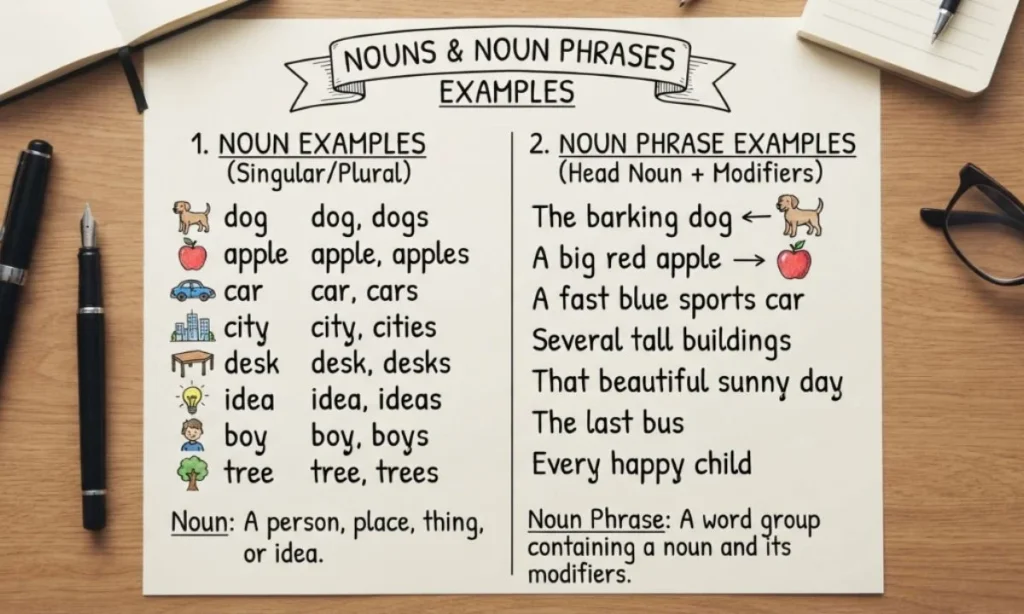
To understand noun phrases properly, it helps to compare them directly with plain nouns.
A noun is a single word naming a person, place, thing, or idea. A noun phrase is that same noun combined with other words (like articles, adjectives, or modifiers) that add detail.
NounNoun PhraseDogThe loyal dog City A busy, crowded city Book Her favorite mystery book Teacher The strict math teacher Car His brand-new car Idea A brilliant business idea House The abandoned house on the hill Friend My childhood best friend
The core word — called the head noun — stays the same. Everything else added around it builds the noun phrase.
List of Noun Phrases with Sentences
Seeing noun phrases inside full sentences makes their function much clearer. In each sentence below, the noun phrase is doing the job a single noun would normally do — acting as subject, object, or complement.
- The old man walked slowly down the street.
- She adopted a friendly golden retriever.
- Their new house is much bigger than the old one.
- He finally finished the difficult assignment.
- A talented young artist painted this mural.
- We visited the historic castle last summer.
- My grandmother’s recipe always tastes amazing.
- They bought a spacious two-bedroom apartment.
- The loud construction noise kept us awake.
- She wrote an inspiring graduation speech.
In every example, the bolded group of words functions as one unit — you could replace it with a single pronoun (“he,” “it,” “they”) and the sentence would still work grammatically.
Noun Phrases Examples with Types of Noun Phrases
Noun phrases aren’t all built the same way. Depending on structure, they fall into different categories, including:
- Simple noun phrases — a noun with minimal modification
- Expanded noun phrases — a noun with multiple descriptive details
- Compound noun phrases — two or more noun phrases joined together
- Prepositional noun phrases — a noun phrase followed by a prepositional phrase
- Appositive noun phrases — a noun phrase that renames another noun
- Gerund noun phrases — a noun phrase built around an “-ing” verb form
- Infinitive noun phrases — a noun phrase built around a “to + verb” form
Each type serves a slightly different purpose, and understanding them individually makes it much easier to spot noun phrases in any sentence you read or write.
Simple Noun Phrases Examples in English

A simple noun phrase usually contains just a determiner (like “a,” “an,” “the,” “my,” “this”) plus a noun, sometimes with one adjective added in.
Think of it as the most basic building block — clear, short, and easy to identify.
- The book
- A car
- My phone
- This chair
- Her bag
- An apple
- The city
- A student
- Our house
- That table
Here’s how a simple noun phrase looks when it’s broken down:
DeterminerHead NounFull Simple Noun PhraseTheBookThe bookACarA carMyPhoneMy phoneThisChairThis chairHerBagHer bag
Simple noun phrases are the foundation — every expanded or compound noun phrase starts from one of these basic patterns.
Common Types of Noun Phrases with Examples
Beyond the structural types mentioned earlier, noun phrases also differ based on how much detail they carry. Here’s a side-by-side comparison:
TypeDescriptionExampleSimpleNoun with minimal detailThe dogExpandedNoun with multiple descriptive wordsThe big, fluffy brown dogCompoundTwo noun phrases joinedThe dog and the catPrepositionalNoun phrase + prepositional phraseThe dog in the yardAppositiveRenames another nounMy dog, a golden retriever, loves walksGerund-basedBuilt from an “-ing” verbRunning every morning keeps me healthyInfinitive-basedBuilt from “to + verb”To win the championship was their goal
This table alone gives you a quick reference for identifying which type of noun phrase you’re looking at in any sentence.
Expanded Noun Phrases
An expanded noun phrase takes a simple noun phrase and adds extra descriptive detail — usually adjectives, but sometimes additional modifiers stacked together.
Formula: Determiner + Adjective(s) + Noun
Examples of Expanded Noun Phrases
- The tall, mysterious stranger
- A bright, sunny afternoon
- Her small, cluttered office
- The loud, chaotic classroom
- A rusty, old bicycle
- The calm, peaceful lake
- His quick, clever response
- The enormous, ancient oak tree
- A soft, warm blanket
- The strict, no-nonsense manager
Why Expanded Noun Phrases Matter
Expanded noun phrases make writing far more vivid without needing extra sentences. Instead of writing “The dog ran. It was big. It was brown,” a single expanded noun phrase — “The big brown dog ran” — says it all in one clean, natural sentence.
This is especially useful in descriptive writing, storytelling, and academic writing where precision and detail matter.
Compound Examples of Noun Phrases
A compound noun phrase joins two or more noun phrases together, usually with “and” or “or.”
Examples of Compound Noun Phrases
- The teacher and the students entered the hall.
- She packed her laptop and her charger.
- A doctor or a nurse will assist you shortly.
- The manager and the new employee discussed the project.
- They ordered pizza and salad for dinner.
- My brother and his best friend are visiting this weekend.
- The book and the notebook are on the desk.
- Coffee or tea will be served after lunch.
Compound noun phrases let you combine related ideas into a single, smooth sentence structure instead of writing two separate clauses.
Prepositional Noun Phrases Example
A prepositional noun phrase occurs when a noun phrase is followed (or modified) by a prepositional phrase that adds location, time, or relationship detail.
Structure: Noun Phrase + Preposition + Object of the Preposition
Examples of Prepositional Noun Phrases
- The keys on the table
- A house by the lake
- The man in the blue jacket
- Her book about ancient history
- The meeting at 3 p.m.
- A path through the forest
- The letter from my grandmother
- The store around the corner
- A cup of hot tea
- The photo on the wall
These phrases are extremely common because they add essential context — where something is, when it happens, or what it relates to — all within a single, compact structure.
Appositive Noun Phrases Examples
An appositive noun phrase renames or explains another noun right beside it, usually set off with commas.
Examples of Appositive Noun Phrases
- My sister, a talented painter, is opening her first gallery show.
- Mr. Ahmed, our history teacher, retired last year.
- The Eiffel Tower, a famous landmark in Paris, attracts millions of tourists.
- Her dog, a playful golden retriever, loves the park.
- Shakespeare, the famous playwright, wrote many timeless works.
- This restaurant, a hidden gem downtown, serves amazing pasta.
- My car, a reliable old sedan, has never let me down.
- Dr. Smith, a well-respected surgeon, operated.
Appositive noun phrases are a great tool for adding extra information without starting a whole new sentence.
Gerund Noun Phrase Examples
A gerund noun phrase is built around a verb’s “-ing” form used as a noun, often paired with additional words that expand its meaning.
Examples of Gerund Noun Phrases
- Running every morning improves your health.
- She enjoys reading mystery novels.
- Learning a new language takes patience.
- His hobby is collecting vintage stamps.
- Cooking dinner for the family relaxes her.
- They love watching old movies together.
- Studying for exams can be stressful.
- Traveling to new countries broadens your perspective.
Because gerund phrases function exactly like nouns, they can act as the subject, object, or complement of a sentence — just like any other noun phrase.
Infinitive Examples of Noun Phrases
An infinitive noun phrase is built using “to + base verb,” functioning as a noun within the sentence.
Examples of Infinitive Noun Phrases
- To win the championship was their ultimate goal.
- She wants to become a doctor.
- To travel the world has always been his dream.
- We plan to finish the project early.
- To learn English fluently takes consistent practice.
- He decided to start his own business.
- Her wish is to visit Japan someday.
- To stay healthy requires good habits.
Like gerund phrases, infinitive noun phrases can serve as subjects, objects, or complements, making them flexible tools in sentence construction.
How to Identify a Noun Phrase in a Sentence
Spotting a noun phrase becomes much easier once you know what to look for. Follow these steps:
- Find the head noun — the main word the phrase is built around.
- Check for a determiner — words like “a,” “an,” “the,” “his,” “this.”
- Look for modifiers — adjectives, prepositional phrases, or appositives attached to the noun.
- Test if it functions as one unit — try replacing the whole phrase with a single pronoun (he, she, it, they). If the sentence still makes sense, you’ve found a noun phrase.
- Watch for gerunds and infinitives — if an “-ing” word or “to + verb” phrase is acting as a subject or object, it’s a noun phrase too.
Quick Identification Checklist
Step: What to Look For 1: Identify the head noun 2: Spot determiners (a, an, the, my, this) 3: Look for descriptive modifiers 4: Check for prepositional or appositive additions 5: Replace with a pronoun to confirm
Noun Phrases Examples in Sentences
Here’s a final combined set showing noun phrases across different types, all working naturally inside sentences:
- The excited crowd cheered loudly at the concert.
- She gave a thoughtful, detailed answer.
- My uncle, a retired pilot, still loves flying.
- Swimming every day keeps him fit.
- Their goal is to expand the business internationally.
- The old bridge over the river was recently repaired.
- A stack of unopened letters sat on the desk.
- The manager and her assistant reviewed the report together.
- His calm, reassuring voice helped ease the tension.
- To finish on time required a lot of discipline.
Each example shows how naturally noun phrases blend into everyday writing and speech — often without readers even noticing the grammatical structure at work.
FAQs
What is a noun phrase?
A noun phrase is a group of words built around a noun that functions together as a single unit in a sentence.
What is a simple example of a noun phrase?
“The red car” is a simple noun phrase that combines a determiner, an adjective, and a noun.
What’s the difference between a noun and a noun phrase?
A noun is a single word, while a noun phrase includes the noun plus other words that add detail or context.
Can a noun phrase be the subject of a sentence?
Yes, noun phrases frequently act as the subject, such as “The tired travelers finally arrived.”
Are gerunds considered noun phrases?
Yes, when an “-ing” verb form functions as a noun (like “Swimming is fun”), it forms a gerund noun phrase.
How do I identify a noun phrase quickly?
Try replacing the group of words with a single pronoun — if the sentence still makes sense, it’s a noun phrase.
Conclusion
Noun phrases might sound like a technical grammar term, but they’re something you already use naturally every time you speak or write. From simple phrases like “the book” to expanded, compound, or appositive versions, noun phrases add clarity, detail, and flow to sentences.
The best way to strengthen your understanding is to start noticing noun phrases in your own writing. Try expanding a simple noun phrase with an extra adjective, or add an appositive to give more context. Small changes like these make your English sound more natural, more descriptive, and far more confident.
