


Have you ever stopped mid-sentence, fingers hovering over the keyboard, unsure whether to type “liter” or “litre”? You’re not alone. This small spelling difference trips up writers, students, and professionals daily. The good news? Both spellings are correct—but which one you should use depends entirely on where you are and who you’re writing for.
Liter vs Litre: Meaning and Definition
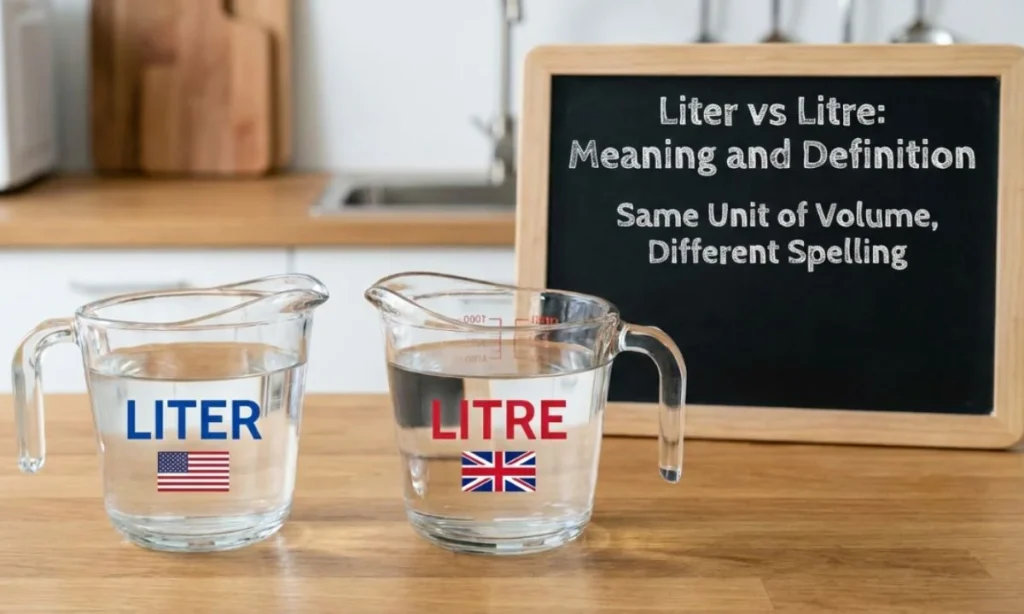
Let’s clear this up right away: liter and litre mean the same thing. Both refer to a metric unit of volume equal to 1,000 cubic centimeters, one cubic decimeter, or approximately 1.75 pints. One liter of water has a mass of almost exactly one kilogram—a relationship established when the kilogram was originally defined in 1795 as the mass of one cubic decimeter of water at melting ice temperature.
The word traces back through French litron to the Greek litra, making it a genuinely ancient term that has evolved across centuries and continents. Today, the liter (or litre) is accepted for use with the International System of Units (SI), though it’s technically not an SI unit itself.
When Should You Use “Liter” in English?
Use “liter” when you’re writing for an American audience or following American English conventions. This spelling with the “-er” ending is the standard in the United States.
Examples:
- “I bought a two-liter bottle of soda for the party.”
- “The car’s fuel efficiency is measured in liters per 100 kilometers.”
Data shows that American English speakers use “liter” 93% of the time compared to just 7% for “litre”. It’s the spelling you’ll see on product labels, in American textbooks, and across U.S. government publications.
When Should You Use “Litre” in English?
Use “litre” when writing for British, Australian, Canadian, or other international English-speaking audiences. This “-re” spelling is the original form and remains the standard in most of the English-speaking world.
Examples:
- “The recipe calls for 250 millilitres of milk.”
- “The fuel tank holds 50 litres of petrol.”
In the UK, “litre” is used 86% of the time. Canada shows a 63% preference for “litre” over “liter,” though both spellings are considered acceptable there. Australia and New Zealand also show strong preferences for “litre” at 86% and 82%, respectively.
Is “Liter” or “Litre” Correct in American English?

“Liter” is the correct spelling in American English. The United States officially uses the imperial system of measurements, but liters appear frequently in scientific contexts, on soda bottles, and in automotive specifications. When Americans do use metric units, they spell it with the “-er” ending.
American usage examples:
- “The engine has a 2.0-liter displacement.”
- “Please bring a one-liter water bottle.”
Is “Liter” or “Litre” Correct in British English?
“Litre” is the correct spelling in British English. This is the spelling used throughout the UK, Ireland, and most Commonwealth countries. The “-re” ending preserves the original French spelling that entered English from the French litron.
British usage examples:
- “The car does 50 miles per gallon, which is about 5.6 litres per 100 kilometres.”
- “Add 1.5 litres of water to the mixture.”
Liter vs Litre: American and British Spelling
The American and British spelling difference follows a familiar pattern. Consider these parallels:
American SpellingBritish SpellingLiterLitreMeterMetreCenterCentreTheaterTheatre
This pattern emerged after American independence when Noah Webster and others deliberately simplified spellings to distinguish American English from British English. The “-er” ending aligns with how Americans typically form agent nouns, while the “-re” ending preserves the French etymology.
Click Here To Read More:
Examples of Liter and Litre in Sentences
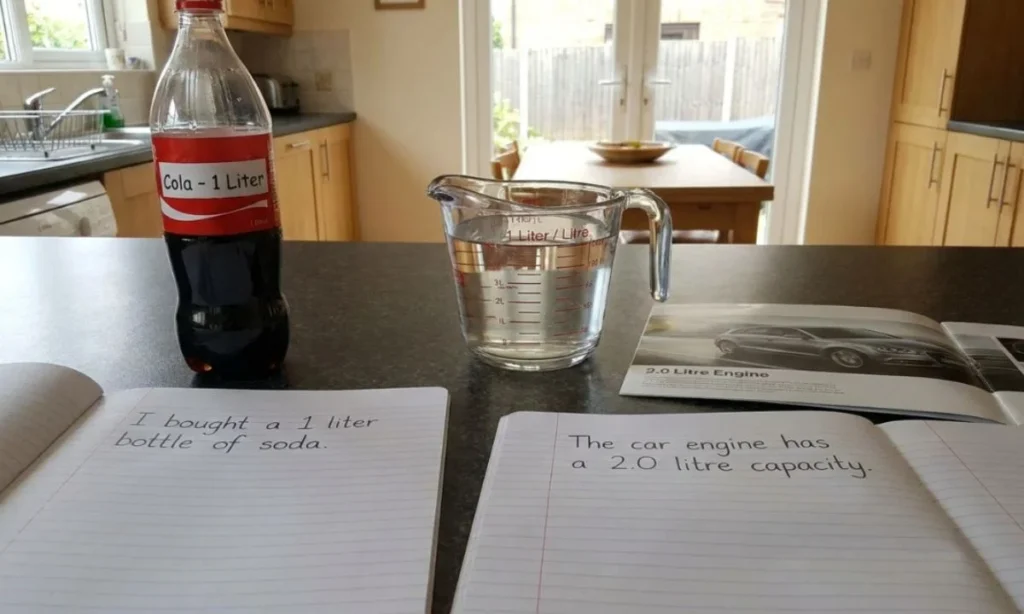
American English (Liter):
- “The container holds exactly 3.7 liters of liquid.”
- “Our new refrigerator has a 500-liter capacity.”
- “She drank two liters of water during the hike.”
British English (Litre):
- “The container holds exactly 3.7 litres of liquid.”
- “Our new refrigerator has a 500-litre capacity.”
- “She drank two litres of water during the hike.”
When context is neutral (both acceptable):
- “The scientist measured the solution in liters/litres.”
- “This bottle contains 1.5 liters/litres of wine.”
How Do You Spell “Liter” or “Litre” Plural?
The plural forms follow standard English rules:
SingularPluralLiterLitersLitreLitres
Examples:
- “I need to buy five liters of paint.” (American)
- “I need to buy five litres of paint.” (British)
Important note about units: When using the measurement as an adjective before a noun, drop the “s” :
- Correct: “This is a 5-liter container.”
- Incorrect: “This is a 5-liters container.”
Similarly, in British English:
- Correct: “This is a 5-litre container.”
- Incorrect: “This is a 5-litres container.”
Common Mistakes When Using Liter and Litre
Mistake 1: Inconsistent usage
Don’t mix spellings in the same document. Choose one based on your audience and stick with it throughout.
Mistake 2: Using the wrong spelling for your audience
Writing for an American publication? Use “liter.” Writing for a British publisher? Use “litre.”
Mistake 3: Misplacing the “r” and “e”
The difference is literally just swapping the last two letters—”er” vs. “re.” This small distinction changes the spelling completely.
Mistake 4: Using the wrong abbreviation
The symbol for both is “L” (uppercase) or “l” (lowercase). The uppercase “L” is preferred in the United States to avoid confusion with the number 1.
- Correct: 5 L, 5 l
- Incorrect: 5 lt., 5 ltr.
Mistake 5: Using “litre” as an adjective incorrectly
- Correct: “The recipe requires a half-litre of milk.”
- Incorrect: “The recipe requires half litres of milk.”
What Are Litres and Liters?
A litre (or liter) is a metric unit of volume. Here’s the precise definition :
1 litre = 1 cubic decimeter = 1,000 cubic centimeters = 0.001 cubic meters
For comparison:
- 1 litre ≈ 1.75 British pints
- 1 litre ≈ 0.264 US gallons
- 1 US gallon ≈ 3.785 litres
The litre is commonly used to measure liquids, but it can apply to solids as well—for example, 1 litre of iron weighs approximately 7.7 kg. The relationship between litre and kilogram was intentionally designed: one litre of water at 4°C (its maximum density) has a mass of very nearly one kilogram.
Should You Write Litres or Liters?
The simple answer: Choose based on your audience.
If you’re writing for…Use…American readersLitersBritish readersLitresCanadian readersLitres (or Liters)Australian readersLitresInternational audiencePick one and be consistent
For global audiences with no specific regional preference, either spelling is acceptable—just maintain consistency throughout your document.
Why Is Liter Spelled Two Ways in the First Place?
The story begins in late 18th-century France. The metric system was introduced in 1791, and the litre (from the old French unit litron) was defined in 1795 as the volume of one cubic decimeter.
When English adopted the term, it preserved the French spelling: litre. This remained the standard in British English.
After the American Revolution, the United States deliberately differentiated its spelling from British conventions. Noah Webster’s dictionaries promoted simplified spellings—changing “-re” to “-er” in words like centre to center and theatre to theater. Litre became liter in American English.
Over 200 years of separation, these spelling differences became entrenched. Today, they’re simply regional variations of the same word, much like color/colour or flavor/flavour.
FAQs
What is the difference between liter and litre?
There is no difference in meaning; only spelling differs based on regional English conventions.
Which spelling is correct, liter or litre?
Both spellings are correct; “liter” is used in American English, while “litre” is used in British and international English.
Is it litre or liter in Canada?
Canada recommends “litre” in official usage, though both spellings are accepted and understood.
How do you abbreviate liter and litre?
Both abbreviate to “L” (uppercase) or “l” (lowercase), with uppercase preferred in the U.S. to avoid confusion with the number 1.
Is it 1 liter or 1 litre?
Both are correct; choose based on whether you’re using American or British English.
Is litre capitalized?
No, except at the beginning of a sentence or in proper nouns. The abbreviation “L” is capitalized.
Conclusion
The liter vs. litre question comes down to one simple factor: regional preference. Both spellings describe the exact same metric unit of volume—a unit defined as 1,000 cubic centimeters, one cubic decimeter, or roughly one-quarter of a gallon.
Choose “liter” for American audiences. Choose “litre” for British, Canadian, Australian, and most other international audiences. Either way, you’re using the correct spelling for your context.
The key is consistency. Pick your spelling based on your audience and use it consistently throughout your writing. Your readers will appreciate the attention to detail, and you’ll avoid the confusion that comes from mixing regional conventions.
So next time you’re writing about that two-liter (or two-litre!) bottle of soda, you’ll know exactly which spelling to use.
