

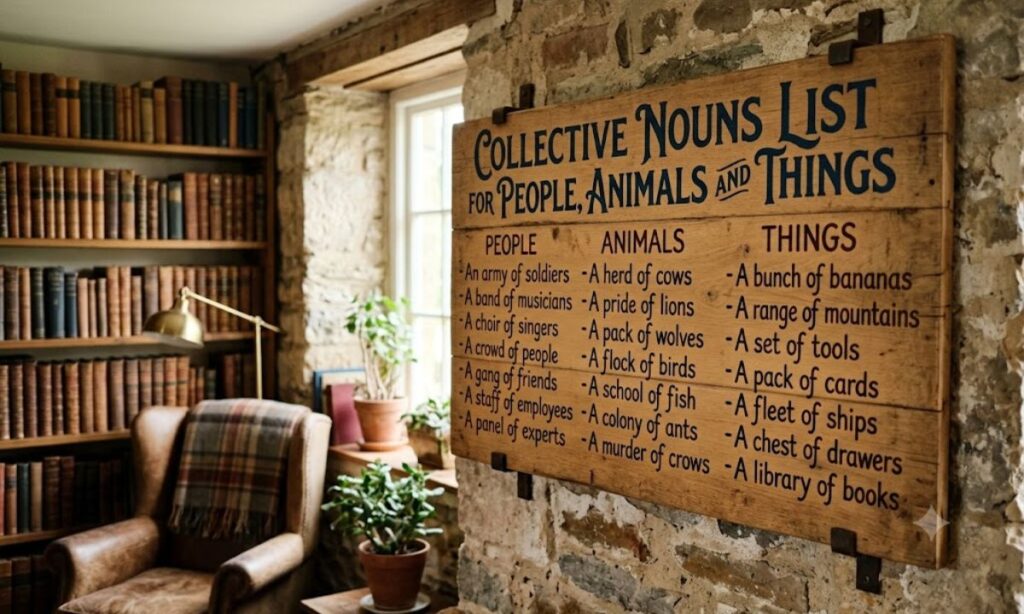
If you’ve ever paused mid-sentence wondering whether it’s a “flock” or a “herd,” a “pack” or a “pride,” you’re not alone. English is full of these quirky little words that let us describe a group as a single unit — and once you start noticing them, you’ll see them everywhere, from nature documentaries to office meetings.
This guide walks you through everything you need to know about collective nouns: what they are, how they work in a sentence, and a massive reference list covering people, animals, birds, and everyday objects. Whether you’re a student prepping for an English exam, a teacher building a vocabulary lesson, or just a word nerd like the rest of us, you’ll find a usable list here.
What Are Collective Nouns?

A collective noun is a single word that names a group of people, animals, or things treated as one unit. Instead of saying “many wolves,” you say “a pack of wolves.” Instead of “several people singing together,” you say “a choir.”
Here’s the interesting grammar twist: collective nouns are singular in form, but depending on context and, notably, on whether you’re using British or American English, they can pair with either a singular or plural verb.
- American English usually treats them as singular: The team is winning.
- British English often treats them as plural when referring to members acting individually: The team are arguing among themselves.
Both are grammatically valid — it just depends on whether you’re emphasizing the group as a whole or the individuals within it.
Why Collective Nouns Matter
Collective nouns aren’t just trivia. They:
- Make your writing more precise and less repetitive
- Add color and personality to descriptions
- Show up regularly in exams, grammar tests, and vocabulary quizzes
- Help you sound more fluent and natural in everyday English
Collective Nouns of Animals
Animal collective nouns are the most famous — and honestly, the most fun — category. Some are practical (“a herd of cattle”), while others sound like they were invented by poets (“a murder of crows,” “a parliament of owls”).
Common Collective Nouns for Animals
| Animal | Collective Noun |
| Lions | A pride of lions |
| Wolves | A pack of wolves |
| Fish | A school of fish |
| Birds | A flock of birds |
| Cattle | A herd of cattle |
| Bees | A swarm of bees |
| Crows | A murder of crows |
| Owls | A parliament of owls |
| Elephants | A herd of elephants |
| Geese | A gaggle of geese |
| Ants | A colony of ants |
| Dolphins | A pod of dolphins |
| Whales | A pod of whales |
| Kangaroos | A mob of kangaroos |
| Jellyfish | A smack of jellyfish |
| Zebras | A dazzle of zebras |
| Rhinos | A crash of rhinos |
| Giraffes | A tower of giraffes |
| Sharks | A shiver of sharks |
| Frogs | An army of frogs |
Unusual and Fun Animal Collective Nouns
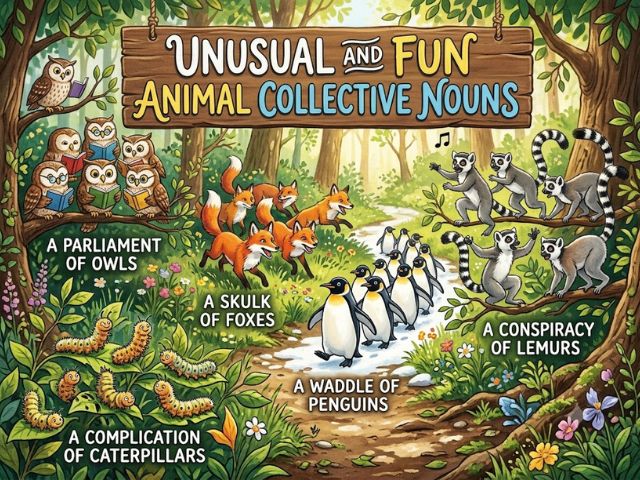
These aren’t ones you’ll use every day, but they’re great conversation starters:
- A cackle of hyenas
- A conspiracy of lemurs
- An implausibility of gnus
- A business of ferrets
- A prickle of porcupines
- A charm of hummingbirds
- An unkindness of ravens
- A skulk of foxes
- A bloat of hippos
- A wisdom of wombats
500+ Collective Nouns in English
Below is a broad reference list grouped by category. Together with the animal list above and the sentence examples further down, this page covers well over 500 individual collective noun uses across people, animals, birds, insects, and objects.
Collective Nouns for People
| Group | Collective Noun |
| Musicians | A band of musicians |
| Singers | A choir of singers |
| Actors | A troupe of actors |
| Soldiers | An army of soldiers |
| Sailors | A crew of sailors |
| Thieves | A gang of thieves |
| Judges | A panel of judges |
| Students | A class of students |
| Workers | A crew of workers |
| Officials | A board of officials |
| Doctors | A team of doctors |
| Dancers | A troupe of dancers |
| Witnesses | A panel of witnesses |
| Fans | A crowd of fans |
| Friends | A circle of friends |
| Experts | A panel of experts |
| Voters | An electorate of voters |
| Employees | A staff of employees |
| Scientists | A community of scientists |
| Directors | A board of directors |
Collective Nouns for Everyday Things
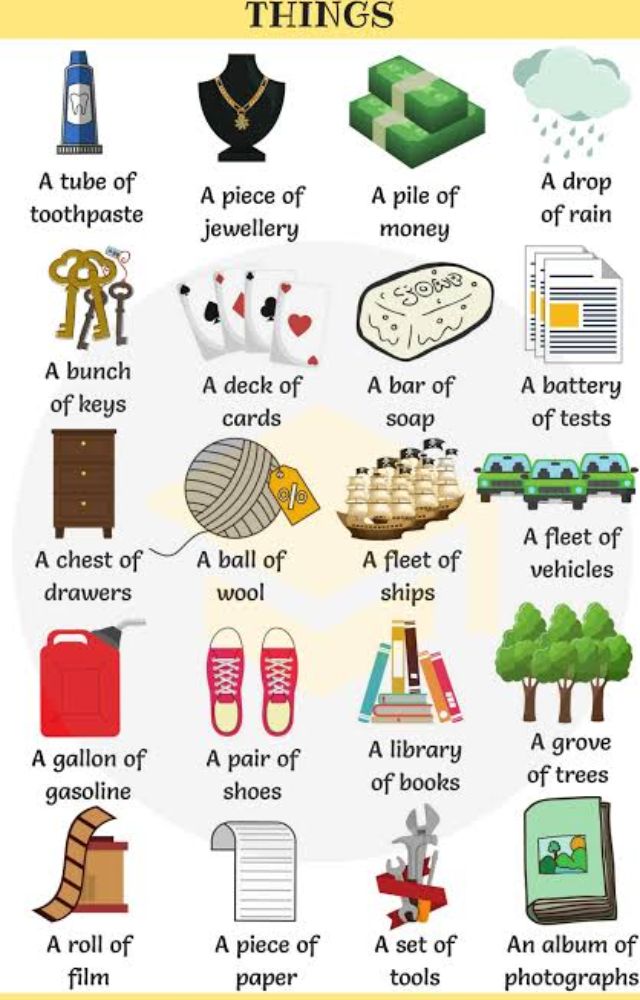
| Object | Collective Noun |
| Flowers | A bouquet of flowers |
| Books | A pile of books |
| Grapes | A bunch of grapes |
| Keys | A bunch of keys |
| Cards | A deck/pack of cards |
| Ships | A fleet of ships |
| Stars | A galaxy of stars |
| Islands | An archipelago of islands |
| Trees | A grove of trees |
| Rocks | A pile of rocks |
| Coins | A stack of coins |
| Clothes | A wardrobe of clothes |
| Tools | A kit of tools |
| Arrows | A quiver of arrows |
| Bananas | A bunch of bananas |
| Grass | A tuft of grass |
| Cars | A fleet of cars |
| Aircraft | A squadron of aircraft |
| Papers | A stack of papers |
| Grapes of information | A wealth of information |
List of Collective Nouns A to Z
Here’s a quick alphabetical reference you can scan through or use for quizzes and worksheets.
| Letter | Collective Noun Examples |
| A | Army (of soldiers), Archipelago (of islands), Audience (of listeners) |
| B | Band (of musicians), Bouquet (of flowers), Bunch (of bananas), Brood (of chickens) |
| C | Choir (of singers), Colony (of ants), Crew (of sailors), Class (of students), Cluster (of grapes) |
| D | Drove (of cattle), Dazzle (of zebras), Deck (of cards) |
| E | Exaltation (of larks), Electorate (of voters) |
| F | Flock (of birds), Fleet (of ships), Family (of relatives) |
| G | Gaggle (of geese), Gang (of thieves), Grove (of trees), Galaxy (of stars) |
| H | Herd (of cattle), Hive (of bees), Host (of angels) |
| I | Implausibility (of gnus) |
| J | Jury (of jurors) |
| K | Kindle (of kittens) |
| L | Litter (of puppies), Legion (of soldiers) |
| M | Murder (of crows), Mob (of kangaroos), Mound (of dirt) |
| N | Nest (of vipers) |
| O | Orchestra (of musicians), Ocean (of water) |
| P | Pride (of lions), Pack (of wolves), Panel (of experts), Pod (of dolphins) |
| Q | Quiver (of arrows) |
| R | Raft (of ducks), Rabble (of butterflies) |
| S | School (of fish), Swarm (of bees), Staff (of employees), Squadron (of aircraft) |
| T | Troupe (of actors), Team (of players), Tower (of giraffes) |
| U | Unkindness (of ravens) |
| V | Volley (of shots) |
| W | Wisdom (of wombats), Wardrobe (of clothes) |
| X | (rare — no common examples) |
| Y | (rare — no common examples) |
| Z | (rare — no common examples) |
Collective Noun Used in Sentences
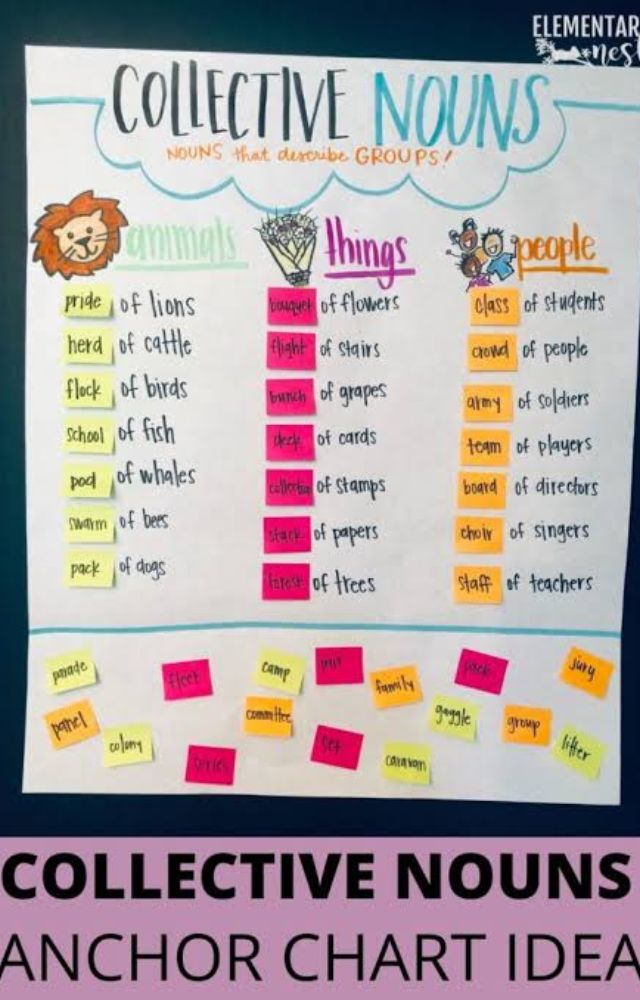
Seeing these words in context makes them much easier to remember. Here are some natural, everyday examples:
- The team is preparing for the championship match.
- A flock of pigeons landed on the rooftop.
- The jury reached its verdict after two hours.
- We watched a pod of dolphins swimming near the boat.
- The choir performed beautifully at the concert.
- A swarm of bees settled near the garden fence.
- The board approved the new budget proposal.
- A bouquet of roses sat on the kitchen table.
- The crew worked through the night to finish the project.
- A herd of elephants crossed the dry riverbed.
Notice how each collective noun replaces a longer phrase (“many bees,” “a group of dolphins”) with one clean, descriptive word.
200+ Examples of Collective Nouns
To round things out, here’s a larger combined batch organized by theme so you can quickly find what you need.
People & Professions: Band, Choir, Troupe, Cast, Congregation, Committee, Cabinet, Council, Faculty, Regiment, Squad, Posse, Tribe, Clan, Delegation, Assembly, Convention, Society, Union, Association, Federation, Corps, Brigade, Platoon, Battalion.
Land Animals: Herd, Pack, Pride, Troop, Drove, Sounder (of pigs), Sloth (of bears), Cete (of badgers), Business (of ferrets), Leap (of leopards), Ambush (of tigers), Mischief (of mice), Nest (of mice), Colony (of rabbits), Warren (of rabbits), Gang (of elk), Herd (of deer).
Birds: Flock, Flight, Murmuration (of starlings), Congregation (of plovers), Convocation (of eagles), Parliament (of owls), Muster (of peacocks), Siege (of herons), Ostentation (of peacocks), Charm (of finches), Wake (of vultures).
Sea & Water Creatures: School, Shoal, Pod, Gam (of whales), Bloom (of jellyfish), Fever (of stingrays), Cast (of crabs).
Insects: Swarm, Colony, Army (of ants), Cloud (of gnats), Plague (of locusts), Business (of flies).
Everyday Objects: Bunch, Bundle, Stack, Pile, Cluster, Set, Batch, Collection, Array, Assortment, Range, Group, Series, Bouquet, Wad (of cash), Fleet, Convoy, Crate, Load.
FAQs
What is a collective noun?
A collective noun is a single word used to describe a group of people, animals, or things as one unit, such as “team” or “flock.”
Is “family” a collective noun?
Yes, “family” is a collective noun because it refers to a group of related people treated as a single unit.
Do collective nouns take singular or plural verbs?
They can take either, depending on whether you’re emphasizing the group as a whole (singular) or its individual members (plural).
What is a group of crows called?
A group of crows is called a “murder.”
What is a group of owls called?
A group of owls is called a “parliament.”
Conclusion
Collective nouns might seem like a small grammar detail, but they add real precision and personality to the English language. From practical, everyday words like “team” and “family” to delightfully odd ones like “an unkindness of ravens,” these words help you describe groups clearly and creatively.
Whether you’re writing an essay, studying for a test, or just want to sound sharper in conversation, keeping a list like this handy is a great way to build your vocabulary one group at a time. Bookmark this page, come back to it whenever you need a refresher, and soon you’ll be using collective nouns as naturally as any native speaker.
