

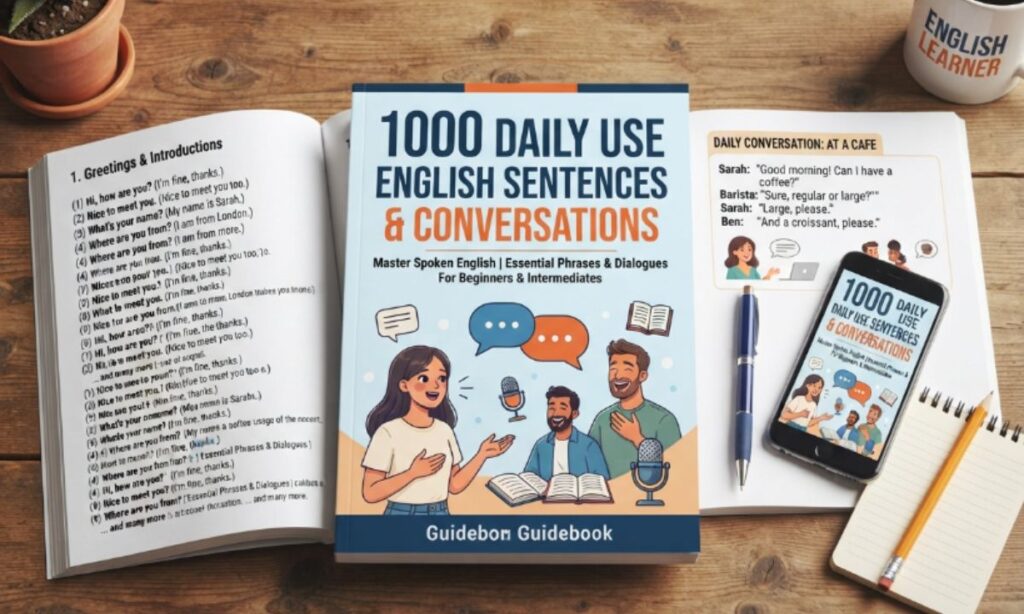
Learning English vocabulary is only half the job. The real challenge shows up the moment you try to speak — words alone don’t help you order coffee, answer a phone call, or explain your morning routine to a colleague. That’s where ready-made sentences come in.
This guide brings together 1000 daily use English sentences for real-life situations: greetings, small talk, phone calls, questions, routines, and more. Everything here is written in simple, natural English so students, working professionals, and beginners can start using it immediately — no grammar lecture required.
Why Daily Use English Sentences Matter
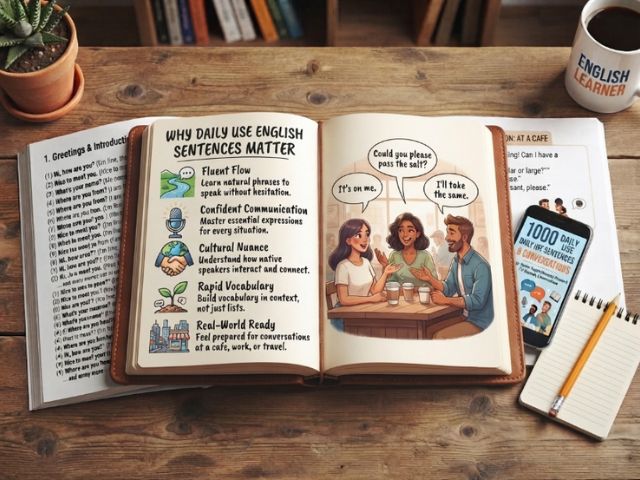
Most learners spend years memorizing grammar rules but still freeze up during an actual conversation. Sentences work differently than isolated words — they show you exactly how native speakers structure their thoughts.
Here’s what practicing ready-made sentences does for you:
- Builds instant recall instead of slow word-by-word translation
- Trains your ear for natural rhythm and sentence patterns
- Removes the fear of “getting the grammar wrong” mid-conversation
- Prepares you for common situations: shopping, office calls, classroom talk, casual chats
Instead of trying to construct sentences from scratch, you borrow patterns that already work — and adjust them slightly for your own situation.
100 Short English Sentences for Daily Conversation
Short sentences are the easiest entry point for beginners. They’re quick to memorize and can be used in almost any casual setting.
| Situation | Example Sentences |
| Greeting someone | Good morning. How are you? Nice to meet you. |
| Making small talk | What’s new? How’s it going? Long time no see. |
| Agreeing | Sounds good. I agree. That works for me. |
| Disagreeing | I’m not sure about that. I see it differently. |
| Asking for help | Can you help me? I need a favor. Could you assist me? |
| Saying goodbye | Take care. See you soon. Have a good day. |
A few more short, everyday lines worth memorizing:
- I’m on my way.
- Give me a second.
- That makes sense.
- I’ll be right back.
- Let’s talk later.
- It’s up to you.
- No worries at all.
- I appreciate it.
- That’s a great idea.
- Let me check on that.
These short sentences for daily conversation work well because they’re flexible — you can drop them into almost any context without sounding forced.
Simple English Sentences for Daily Conversation
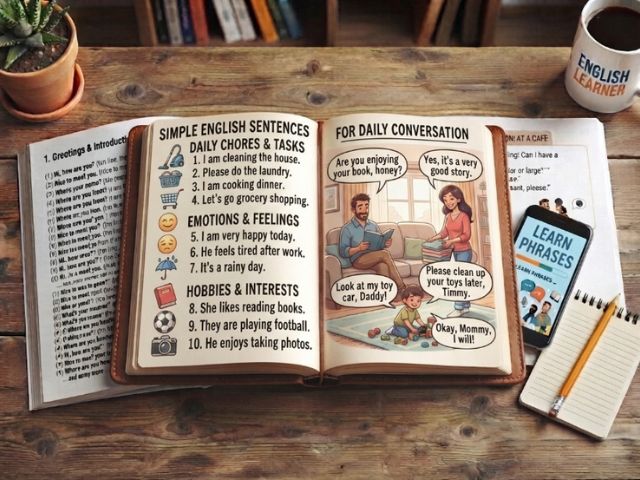
Once you’re comfortable with short lines, the next step is building slightly longer, still-simple sentences. These help you sound more natural rather than robotic.
- I usually wake up early and go for a walk.
- Could you please repeat that? I didn’t catch it.
- I’m looking forward to the weekend.
- She’s been really busy with work lately.
- We should catch up sometime this week.
- I’m not feeling well today, so I’ll rest.
- He said he’d call back in an hour.
- Let’s meet at the café around noon.
- I forgot to bring my umbrella today.
- Everything went smoothly at the meeting.
Simple English sentences like these don’t need complicated grammar — just clear structure and everyday vocabulary. That’s exactly why they stick in memory faster than textbook examples.
English Sentences Used in Daily Life
Beyond conversation starters, there’s a whole layer of English sentences woven into ordinary daily life — at home, in shops, at school, and on the street. Here’s a breakdown by setting.
At Home
- Can you turn off the lights, please?
- Dinner will be ready in ten minutes.
- Have you seen my keys anywhere?
- I’ll do the dishes tonight.
- Please close the door when you leave.
At the Market or Shop
- How much does this cost?
- Do you have this in another size?
- Can I pay by card?
- I’m just looking, thank you.
- Could you wrap this as a gift?
At School or College
- May I ask a question?
- I didn’t understand this part.
- Can you explain that again?
- When is the assignment due?
- I’ll submit it by tomorrow.
On the Street or in Public
- Excuse me, where is the nearest bus stop?
- Is this seat taken?
- Could you tell me the time?
- Sorry, I’m in a hurry.
- Thanks for your help.
These situational sentences used in daily life form the backbone of practical spoken English — they’re the ones you’ll actually reach for, day after day.
Daily Routine English Sentences for Students
Students often need a specific set of sentences to describe their day — for speaking practice, journal writing, or classroom exercises. Here’s a simple routine broken into time blocks.
| Time of Day | Sentence Examples |
| Morning | I wake up at 6 a.m. I brush my teeth and get ready for school. |
| Midday | I have lunch with my classmates. I attend my afternoon classes. |
| Evening | I finish my homework after school. I play outside for a while. |
| Night | I have dinner with my family. I go to bed by 10 p.m. |
Additional daily routine lines for students:
- I pack my school bag the night before.
- My classes start at 8 o’clock sharp.
- I revise my notes during the break.
- I take part in extracurricular activities twice a week.
- I study for at least two hours every evening.
Practicing these daily routine English sentences regularly also helps with tenses — especially the simple present, which routines rely on heavily.
Read More: 500+ Collective Nouns List for People, Animals and Things
Daily Use English Sentences for Asking Questions
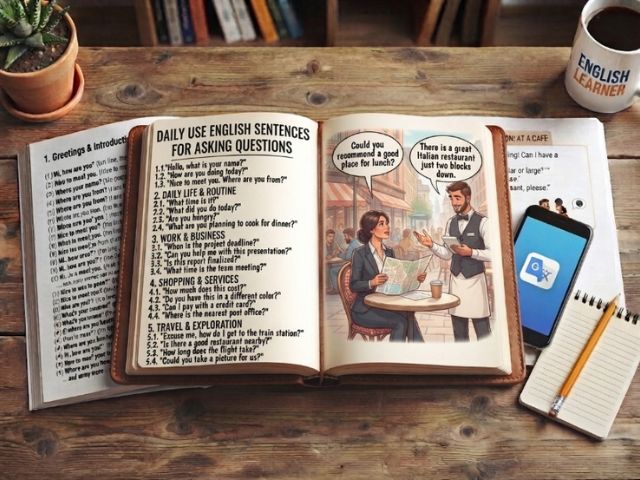
Questions keep conversations alive. If you can ask the right question at the right time, you’ll rarely run out of things to say.
Common Question Starters
- What do you think about…?
- How does this work?
- Why did that happen?
- When will it be ready?
- Where can I find…?
- Who’s in charge of this?
Everyday Question Examples
- What time does the store open?
- How long will this take?
- Could you tell me more about that?
- Is it okay if I join you?
- Do you know how to get there?
- What’s the best way to do this?
- Have you finished your work yet?
- Can I ask you something quickly?
- What happened at the meeting?
- Where did you put my bag?
Asking questions naturally is a skill on its own — these patterns give you a reliable starting point in almost any conversation.
Daily Use English Sentences for Phone Calls
Phone conversations move fast and don’t allow for visual cues, which makes them harder for many learners. Having set phrases ready removes a lot of that pressure.
Starting a Call
- Hello, this is [Name] speaking.
- May I speak to [Name], please?
- Is this a good time to talk?
During the Call
- Could you speak a little louder, please?
- I’m sorry, could you repeat that?
- Let me note that down.
- I’ll get back to you shortly.
- Can you hold on for a moment?
Ending a Call
- Thanks for calling. Talk soon.
- I’ll call you back later today.
- It was nice speaking with you.
- Take care, goodbye.
| Phone Call Stage | Useful Sentence |
| Answering | Hello, who’s calling, please? |
| Connecting | I’ll transfer your call now. |
| Unavailable | He’s not available right now. Can I take a message? |
| Wrapping up | Thanks again, have a great day. |
These daily use English sentences for phone calls work equally well for personal chats and workplace calls.
Daily Used English Sentences: Download PDF
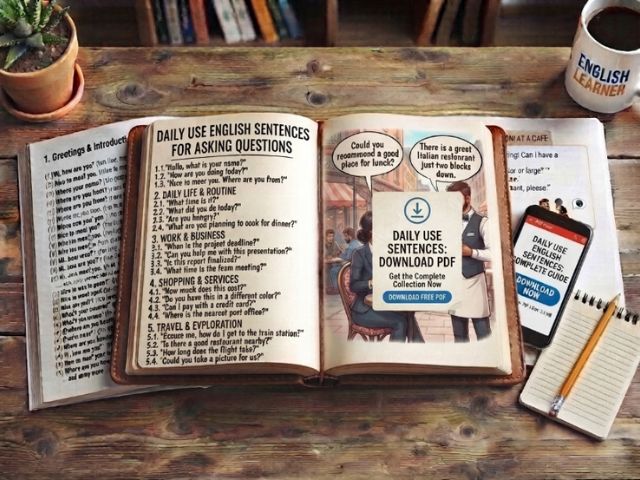
Carrying a printed or saved list makes daily practice much easier — you can review it on your commute, before bed, or during a short break.
To build your own practice PDF:
- Copy the sentence categories most relevant to you (routine, phone calls, questions, etc.).
- Paste them into a document.
- Save or export it as a PDF for offline use.
- Review 10–15 sentences a day rather than trying to memorize everything at once.
If you’d like, I can generate a ready-to-download PDF version of this sentence list for you — just let me know and I’ll put it together as a file.
FAQs
What are daily use English sentences?
They are common, ready-made phrases people use in everyday situations like greetings, shopping, phone calls, and casual conversations.
How many English sentences should a beginner learn first?
Starting with 50–100 short, high-frequency sentences is enough to handle most basic daily conversations.
Can I improve speaking skills just by memorizing sentences?
Memorizing helps, but combining it with speaking practice and listening exercises gives much faster, more natural results.
Are these sentences suitable for students?
Yes, the sentences here are simple enough for school and college students to use in speaking practice, homework, or journaling.
How can I practice these sentences daily?
Try using 5–10 new sentences a day in real conversations, and review older ones through repetition or flashcards.
Conclusion
Fluency doesn’t come from knowing more words — it comes from being able to use the right sentence at the right moment. The categories covered here — greetings, daily routines, questions, and phone calls — represent the situations you’ll face most often, whether you’re a student, a professional, or simply someone building conversational confidence.
Pick a few sentences from each section, practice them out loud, and use them in real conversations as soon as you can. Small, consistent daily practice with these sentences will do more for your spoken English than any amount of passive studying.
