

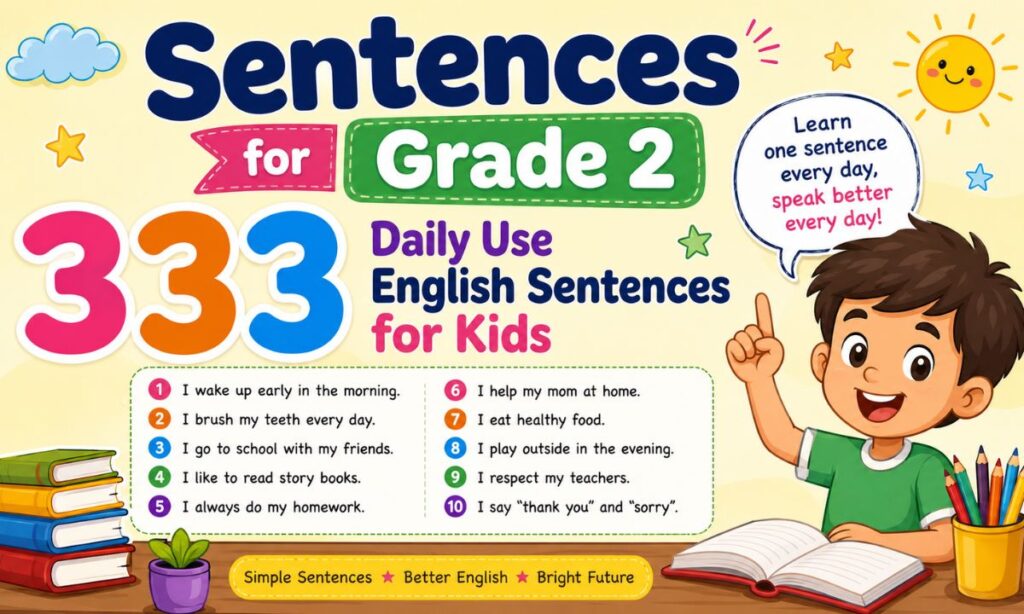
Helping a second grader build strong English sentences doesn’t need to be complicated. At this age, kids learn best through short, simple, everyday sentences they can connect to their own lives — their school day, their family, their favorite animals, and the world around them.
This guide brings together a full collection of daily use English sentences designed specifically for Grade 2 students, along with vocabulary, counting practice, and printable worksheet ideas. Whether you’re a parent helping with homework or a teacher building a lesson plan, you’ll find practical, ready-to-use content here.
Sentences for Grade 2 Students in English
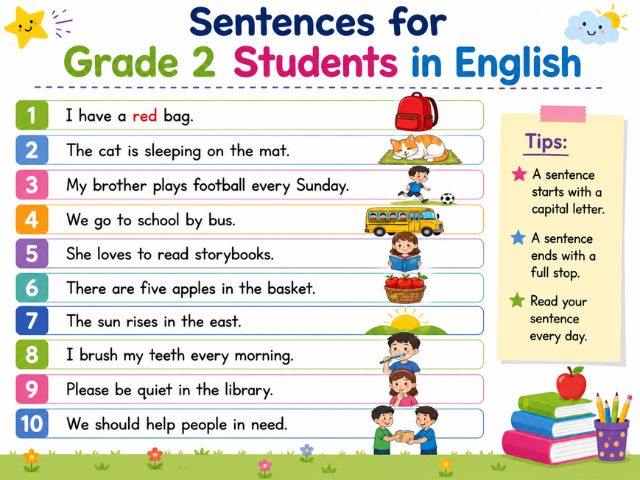
Grade 2 students (usually around 6 to 8 years old) are just beginning to write complete sentences confidently. At this stage, sentences should be short — typically 5 to 7 words — and built around a simple structure: subject, verb, and object.
Here are some foundational sentences that work well for this age group:
I like to play outside.
She reads a story every night.
We go to school together.
He writes neatly in his book.
I help my mother at home.
My father drives me to school.
We eat lunch at noon.
She drinks milk every morning.
I have a red backpack.
My brother likes to draw.
Why Simple Sentence Structure Matters at This Stage
Second graders are still developing reading fluency and sentence awareness. Sticking to one clear idea per sentence helps them:
Understand subject-verb relationships naturally
Build reading confidence without getting overwhelmed
Practice full-thought sentences instead of sentence fragments
Prepare for compound sentences later in the school year
Sentences for Polite Conversations for 2nd Grade
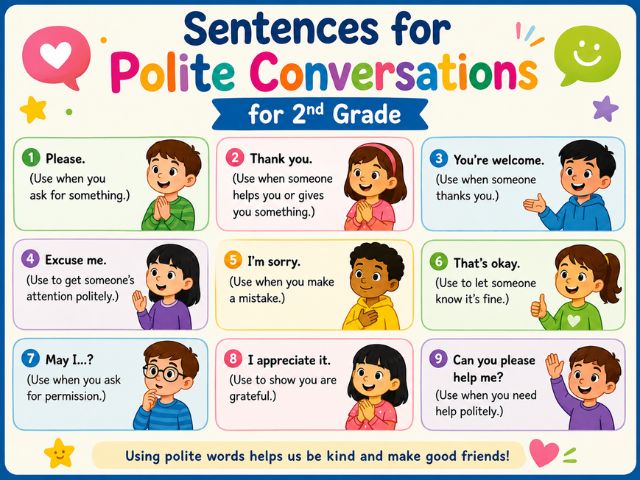
Teaching polite language early helps kids communicate respectfully at school, at home, and with friends. These sentences are perfect for daily classroom or home use:
Good morning!
Thank you very much.
You’re welcome.
Please help me.
Excuse me, may I pass?
I’m sorry.
May I have some water?
Can I play with you?
Let’s share our toys.
See you later!
Polite Phrases Table for Everyday Situations
| Situation | Polite Sentence |
| Asking for help | Can you help me, please? |
| Saying sorry | I’m sorry, I didn’t mean to. |
| Greeting a teacher | Good morning, teacher! |
| Asking permission | May I go to the restroom? |
| Thanking a friend | Thank you for sharing! |
Practicing these regularly helps kids build good manners into everyday conversation without even thinking about it.
Short Sentences for Second Class
Short sentences are ideal for early readers because they’re easy to sound out and remember. Here’s a set focused on brevity and clarity:
I like apples.
She runs fast.
He writes neatly.
We play outside.
I read a book.
She sings well.
He jumps high.
I like ice cream.
She is my friend.
We are happy.
These short sentence patterns are especially useful for reading aloud practice, spelling tests, and simple dictation exercises in class.
100 Easy Sentences for 2nd Grade Kids with Images
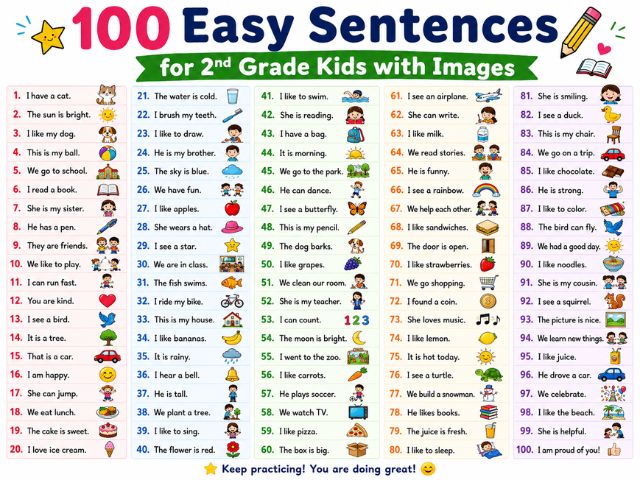
Pairing sentences with pictures helps young learners connect words to meaning much faster. Here’s a themed sample list that works well with simple illustrations:
About Animals:
A dog can bark loudly.
Cats love to drink milk.
Birds fly in the sky.
A cow gives us milk.
Fish live in water.
About Nature:
The sun shines bright in the sky.
The moon comes out at night.
Stars twinkle in the sky.
Trees give us fresh air.
Flowers are pretty and colorful.
About Family and Home:
My mother cooks tasty food.
My father reads the newspaper.
I love my little sister.
We live in a cozy house.
My grandmother tells nice stories.
Tips for Using Picture-Based Sentences
Show the image first, then read the sentence aloud together.
Ask the child to point to the word matching each part of the picture.
Encourage kids to make up their own sentence for the same picture.
Use flashcards for repeated daily practice.
English Sentences for 2nd Grade
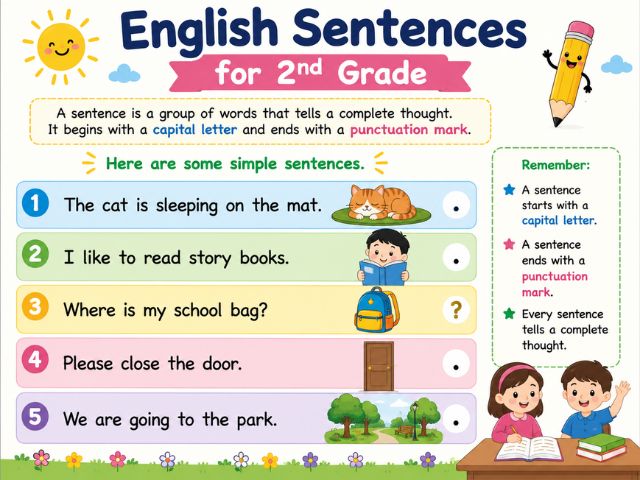
Beyond basic patterns, second graders benefit from sentences that reflect real daily routines and experiences. Here’s a broader daily-life set:
I wake up early every day.
I brush my teeth every morning.
I wash my face with water.
I eat breakfast with my family.
I go to school by bus.
I wear my school uniform.
I listen to my teacher in class.
I play with my friends during recess.
I do my homework in the evening.
I go to bed early at night.
These sentences work especially well as a daily routine writing exercise, helping kids practice sequencing words like “first,” “then,” and “after that.”
Read More….How to Use Is, Am, and Are Correctly in English Grammar
150+ Vocabulary Words for Grade 2
A strong vocabulary foundation makes sentence-building much easier. Here’s a categorized vocabulary list Grade 2 students commonly need:
Everyday Objects
Backpack, pencil, notebook, chair, table, window, door, clock, lamp, blanket, bottle, umbrella, mirror, brush, basket.
Family and People
Mother, father, sister, brother, grandmother, grandfather, friend, teacher, neighbor, baby, family, cousin, uncle, aunt, classmate.
Animals
Dog, cat, cow, horse, elephant, monkey, rabbit, duck, sheep, goat, lion, tiger, bird, fish, frog.
Nature Words
Sun, moon, star, sky, cloud, rain, wind, tree, flower, river, mountain, grass, leaf, snow, rainbow.
Action Words (Verbs)
Run, jump, read, write, eat, drink, sleep, play, sing, dance, walk, talk, laugh, help, share.
Descriptive Words (Adjectives)
Happy, sad, big, small, fast, slow, soft, hard, hot, cold, bright, dark, kind, brave, funny.
Building vocabulary in categories like these makes it far easier for kids to form new sentences on their own, since they can mix and match familiar words.
Counting 1 to 100 for Kids Made Easy with Chart
Counting practice pairs naturally with early English learning, since numbers appear constantly in daily sentences (“I have two pencils,” “There are five birds”).
Simple Counting Chart (1–20)
| 1 | 2 | 3 | 4 | 5 | 6 | 7 | 8 | 9 | 10 |
| One | Two | Three | Four | Five | Six | Seven | Eight | Nine | Ten |
| 11 | 12 | 13 | 14 | 15 | 16 | 17 | 18 | 19 | 20 |
| Eleven | Twelve | Thirteen | Fourteen | Fifteen | Sixteen | Seventeen | Eighteen | Nineteen | Twenty |
Counting by Tens (Up to 100)
Ten, Twenty, Thirty, Forty, Fifty, Sixty, Seventy, Eighty, Ninety, One Hundred.
Easy Ways to Practice Counting
Count objects around the house — spoons, toys, books.
Use a number chart and point while counting aloud daily.
Practice skip-counting by twos, fives, and tens.
Turn counting into a game with clapping or jumping.
Simple Sentences Examples for Grade 2 Students
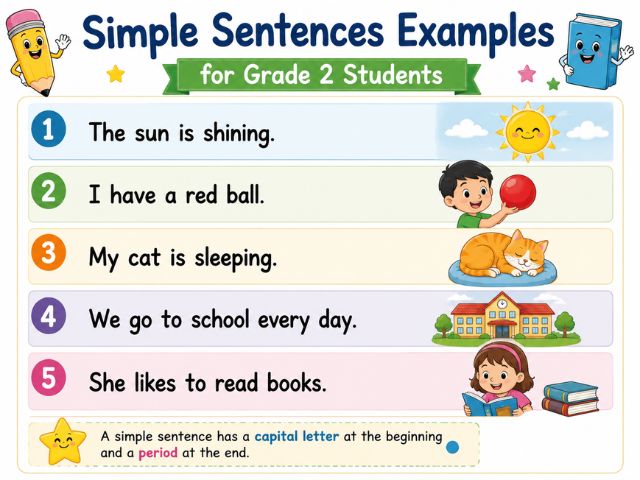
Here’s a final combined batch of simple sentence examples covering multiple everyday themes, ideal for practice sheets or oral repetition:
I can count to one hundred.
We played in the garden today.
I rode my bicycle after school.
She sang a song in class.
He drew a picture of a house.
We visited our grandparents on Sunday.
I cleaned my room this morning.
She fed the birds outside.
We built a sandcastle at the beach.
I finished my homework before dinner.
Sentence Types Kids Should Recognize
| Type | Example | Purpose |
| Statement | I like my school. | Shares information |
| Question | What is your name? | Asks something |
| Command | Please sit down. | Gives an instruction |
| Exclamation | What a beautiful day! | Shows strong feeling |
Recognizing these four sentence types helps kids move beyond memorization and start understanding how sentences actually function.
Sentences for Grade 2 Worksheets
Worksheets reinforce sentence-building through active practice rather than passive reading. Effective Grade 2 worksheets typically include:
Fill-in-the-blank exercises: “The ____ is barking loudly.” (dog, cat, car)
Sentence correction tasks: “the cat run fast” → “The cat runs fast.”
Picture-to-sentence matching: Match an image to the correct sentence.
Scrambled word ordering: Rearrange “school. / to / I / go” into a correct sentence.
Simple dictation practice: Read a sentence aloud for the child to write down.
Benefits of Regular Worksheet Practice
Builds writing confidence through repetition
Reinforces spelling alongside sentence structure
Helps identify common grammar mistakes early
Makes learning interactive rather than purely memorization-based
FAQs
What are good sentences for Grade 2 students?
Short, simple sentences with 5 to 7 words about school, family, and daily routines work best for Grade 2 students.
How many sentences should a 2nd grader practice daily?
Practicing 5 to 10 sentences daily is enough to build steady progress without overwhelming young learners.
What vocabulary should Grade 2 kids know?
They should know everyday words for family, animals, nature, actions, and common objects used in daily conversation.
How can I make sentence practice fun for kids?
Use pictures, games, and worksheets instead of plain repetition to keep young learners engaged.
Is counting important for English learning at this age?
Yes, numbers appear often in daily sentences, so counting practice supports both math and language skills together.
What sentence types should Grade 2 students learn?
They should learn statements, questions, commands, and exclamations to understand how different sentences function.
Conclusion
Building strong English sentences at the Grade 2 level doesn’t require complex grammar lessons — it just requires consistent, simple, everyday practice. From polite conversation starters to picture-based sentences and vocabulary building, every small exercise adds up to real confidence in reading, writing, and speaking.
Start with a few sentences a day, mix in vocabulary and counting practice, and use worksheets to reinforce what’s learned. With steady, playful repetition, second graders will naturally grow into confident, capable young English speakers and writers.
