

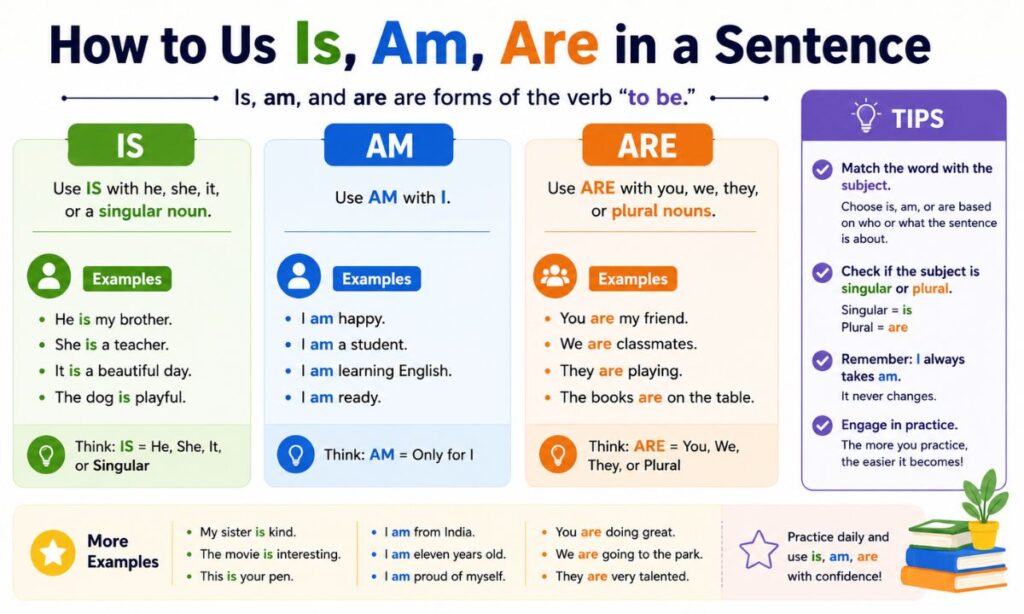
If you’ve ever paused mid-sentence wondering whether to say “I is,” “I am,” or “I are” — don’t worry, you’re in good company. These three tiny words trip up beginners and confuse even confident English speakers when sentences get a little tricky.
The truth is, “is,” “am,” and “are” all come from the same root verb — “to be” — but each one attaches to a different type of subject. Once you understand that one simple connection, the confusion mostly disappears. This guide breaks it all down with clear rules, real examples, and practice sentences so you can use these words correctly, every time.
How to Use Is, Am, and Are in Sentences
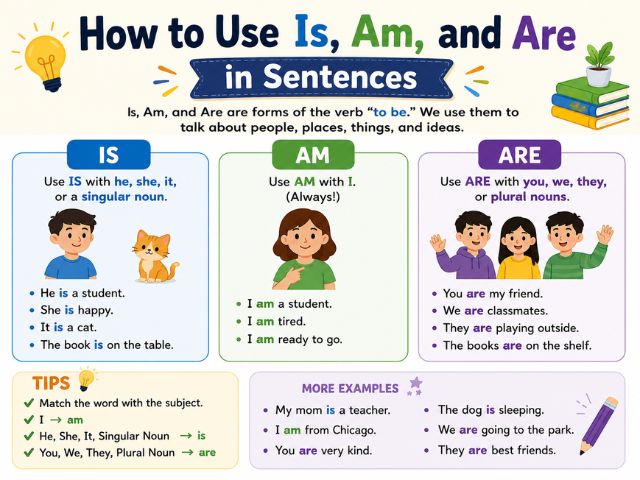
“Is,” “am,” and “are” are all present-tense forms of the verb “to be.” They’re used to describe identity, condition, feelings, age, location, or an action happening right now.
The basic structure looks like this:
Subject + is/am/are + description or action
I am a teacher.
She is tired.
They are at the park.
The word you choose depends entirely on the subject in front of it. Get the subject right, and the verb almost picks itself.
Is, Am, and Are with Singular and Plural Subjects
This is the heart of the entire rule. Singular subjects need singular verb forms, and plural subjects need the plural form.
| Subject Type | Correct Verb | Example |
| I | am | I am ready. |
| He / She / It | is | He is busy. |
| Singular noun | is | The dog is barking. |
| You | are | You are welcome. |
| We | are | We are friends. |
| They | are | They are playing outside. |
| Plural noun | are | The dogs are barking. |
The Simple Pattern to Remember
Am → only with “I”
Is → with one person, one thing, or one idea (he, she, it, singular nouns)
Are → with more than one, and always with “you,” whether it means one person or several
Uses of Is in Different Situations
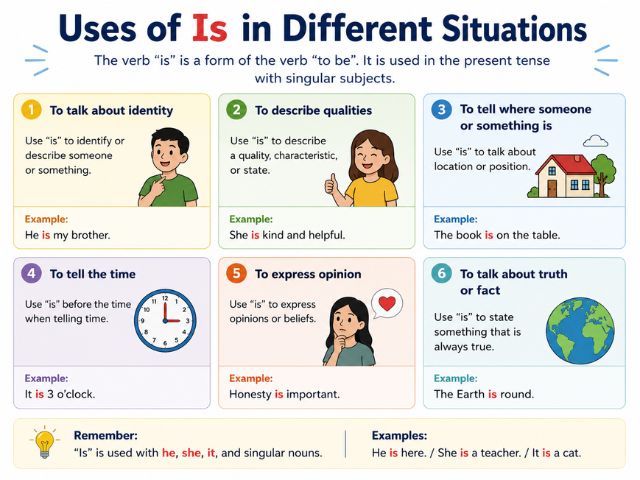
“Is” connects a singular subject to more information about it. It shows up constantly in everyday English, and it’s useful across several different situations:
Identity: She is a doctor.
Condition or feeling: He is happy today.
Location: The book is on the table.
Age: My brother is ten years old.
Ongoing action (present continuous): It is raining right now.
Facts or general truths: Water is essential for life.
Is with Tricky Singular Subjects
Some subjects look plural but are actually treated as singular, especially collective nouns:
The team is winning.
My family is visiting this weekend.
The class is taking a test.
These subjects describe a group acting as one unit, so they typically pair with “is,” especially in American English.
Easy Rules for Using Is, Am, and Are
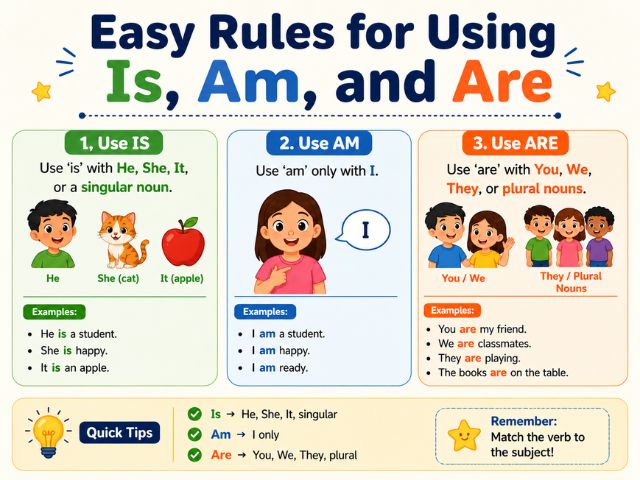
If you only remember three things from this article, make it these:
“Am” is reserved exclusively for “I.” No exceptions.
“Is” pairs with singular subjects — he, she, it, or any single person, place, or thing.
“Are” pairs with plural subjects and “you” — regardless of whether “you” refers to one person or a group.
A quick way to test yourself: replace the subject with “he/she/it,” “I,” or “they/we/you” in your head, and match the verb accordingly.
How to Use Am in English with Examples
“Am” is the easiest of the three because it only ever follows one word: “I.” That single rule makes it nearly impossible to get wrong once it clicks.
I am a student.
I am feeling great today.
I am from Pakistan.
I am not sure about the answer.
I am learning English every day.
Am in Questions and Contractions
Question form: Am I late?
Contraction: I’m (I am) excited about this.
Negative form: I am not ready yet. (Note: there’s no contraction like “amn’t” in standard English — instead, use “I’m not.”)
Uses of Are in Different Situations with Examples
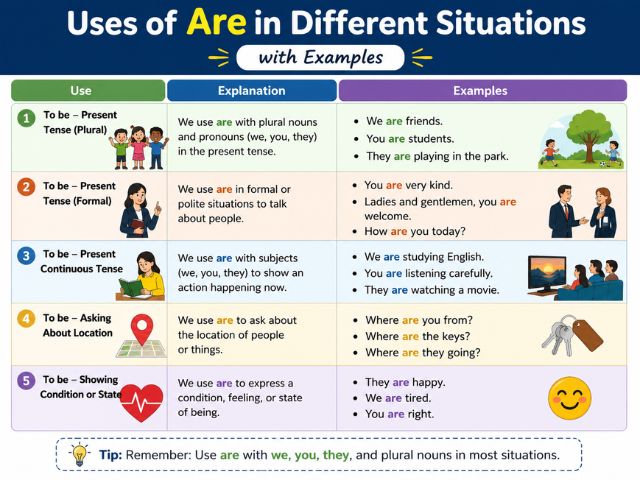
“Are” is the most flexible of the three, since it covers both plural subjects and the pronoun “you” in every context.
With “you” (singular): You are doing great.
With “you” (plural): You are all invited.
With “we”: We are going to the market.
With “they”: They are watching a movie.
With plural nouns: The books are on the shelf.
With compound subjects joined by “and”: My friend and I are going out.
Are with Compound Subjects
When two subjects are joined by “and,” they usually combine into a plural idea, even if each one is singular on its own:
Tom and Jerry are best friends.
Read More….37+ Fruits That Start With Y: Complete List With Names and Facts
Common Mistakes When Using Is, Am, and Are
Even confident speakers slip up here and there. Here are the most frequent errors and how to fix them:
| Incorrect | Correct | Why |
| He are a teacher. | He is a teacher. | “He” is singular — needs “is” |
| We is going to the park. | We are going to the park. | “We” is plural — needs “are” |
| I is excited. | I am excited. | “Am” only follows “I” |
| My friend and I is going. | My friend and I are going. | Combined subject becomes plural |
| The team are winning (in American English). | The team is winning. | Collective nouns often take “is” in American English |
Why These Mistakes Happen
Most of these errors come from focusing on the noun closest to the verb instead of the true subject, or from directly translating sentence patterns from another language where “to be” works differently.
Simple Examples of Is, Am, and Are
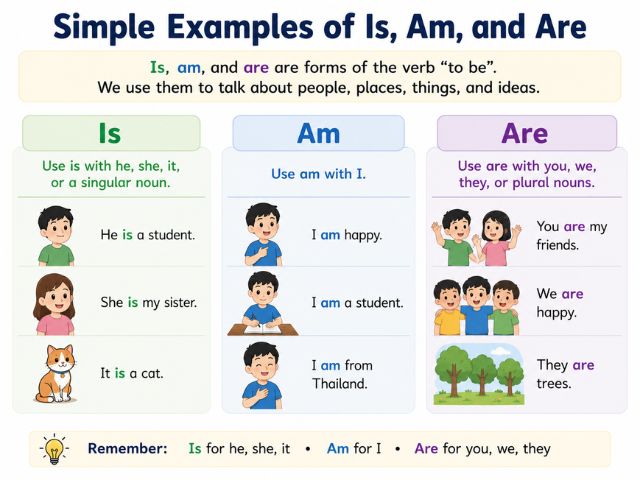
Here’s a quick batch of everyday sentences using all three forms together:
I am happy. She is happy too. They are happy as well.
I am at home. He is at work. We are at school.
I am learning English. My friend is learning Spanish. We are both improving.
I am not tired. She is not hungry. They are not ready.
Is she coming? Am I late? Are they finished?
Practice Sentences with Is, Am, and Are
Try filling in the blanks with “is,” “am,” or “are” before checking the answers below.
I ___ a student.
She ___ my neighbor.
They ___ playing football.
The cat ___ sleeping on the couch.
We ___ going to the market.
He ___ reading a book.
You ___ very kind.
The children ___ laughing loudly.
I ___ not feeling well.
My parents ___ proud of me.
Answers: 1. am, 2. is, 3. are, 4. is, 5. are, 6. is, 7. are, 8. are, 9. am, 10. are
Tips to Remember Is, Am, and Are
Think of “am” as a personal, one-of-a-kind word that only belongs to “I.”
Picture “is” whenever you’re talking about a single person, animal, or object.
Use “are” as your default for anything plural, and always with “you.”
When in doubt, mentally swap the subject for “he/she/it,” “I,” or “they/we” — the correct verb usually becomes obvious.
Read your sentence aloud. Native speakers often “hear” the mismatch before they can explain the rule.
FAQs
What is the basic rule for is, am, and are?
Use “am” with “I,” “is” with singular subjects, and “are” with plural subjects and “you.”
Can “are” be used with a singular subject?
Yes, when the subject is “you,” even if it refers to just one person.
Why do collective nouns like “team” use “is”?
In American English, collective nouns are treated as a single unit, so they typically take “is.”
Is “am” ever used with subjects other than “I”?
No, “am” is used exclusively with the pronoun “I” in standard English.
What’s a simple trick to choose the correct verb?
Mentally replace the subject with “I,” “he/she/it,” or “they/we/you” to quickly identify the correct form.
Do compound subjects always take “are”?
Yes, when two subjects are joined by “and,” the combined subject is usually plural and takes “are.”
Conclusion
“Is,” “am,” and “are” might be small words, but they carry a lot of grammatical weight in everyday English. Once you understand that each one simply matches a different type of subject — “am” for “I,” “is” for singular, and “are” for plural and “you” — the guesswork disappears.
Keep practicing with real sentences, pay attention to tricky subjects like collective nouns and compound subjects, and don’t be afraid to say sentences out loud to train your ear. With consistent practice, choosing between is, am, and are will start to feel completely automatic.
