
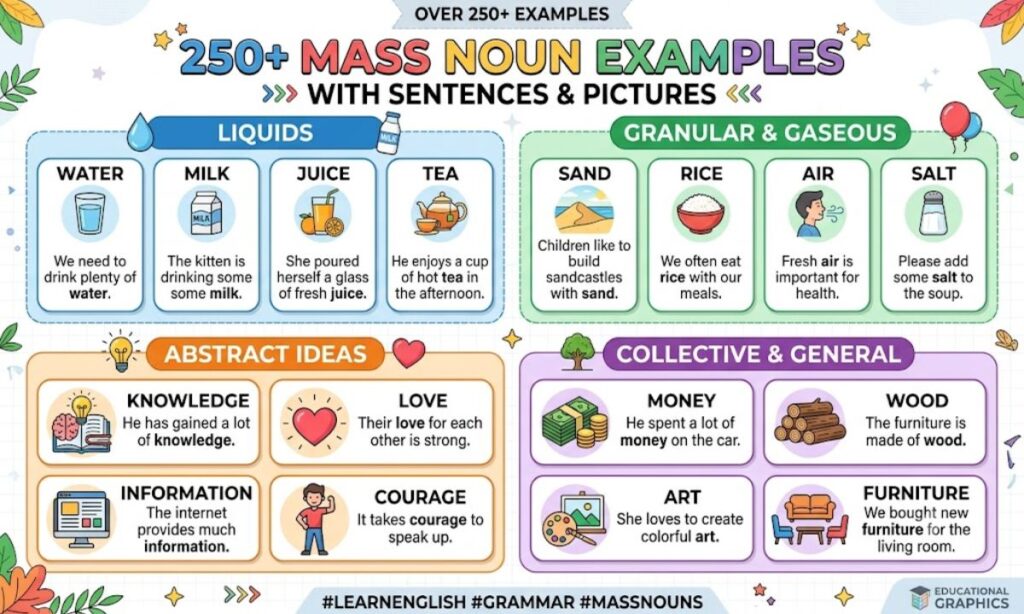
Have you ever tried to say “one water” or “two rices” and had it sound instantly wrong? That’s your brain naturally recognizing a mass noun — a category of words that don’t play by the usual “add an -s for plural” rules of English.
Mass nouns show up constantly in daily conversation, from the food on your plate to the emotions you feel, yet most people never learn the term “mass noun” formally. This guide breaks the concept down clearly, gives you 250+ real examples organized by category, and shows you exactly how to use them correctly in sentences — so you never second-guess whether something needs “a” or “some” again.
What Are Mass Nouns and Examples?
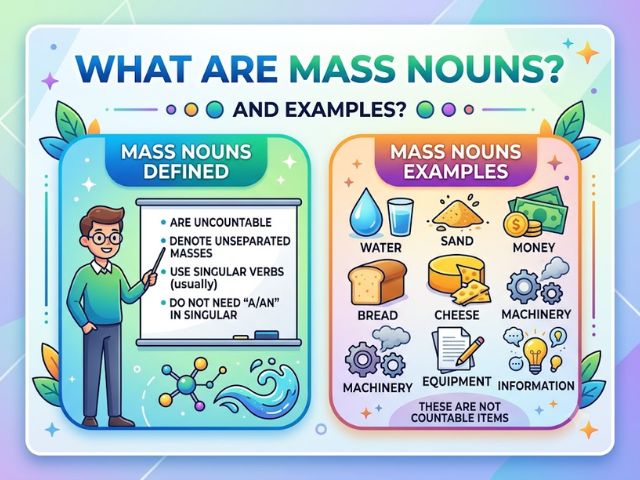
A mass noun — also called an uncountable noun or noncount noun — refers to something that can’t be split into separate, countable units. Instead of counting individual pieces, you measure it using quantity words like “some,” “much,” or a container word like “a cup of” or “a piece of.”
Mass nouns typically fall into these categories:
Substances and materials — water, sand, wood, plastic
Liquids — milk, oil, juice
Abstract concepts — happiness, knowledge, honesty
Food items — rice, bread, sugar
Collective categories — furniture, luggage, equipment
Quick Examples
| Mass Noun | Example Sentence |
| Water | The glass is full of water. |
| Rice | We cooked rice for dinner. |
| Furniture | This furniture looks brand new. |
| Happiness | Happiness comes from within. |
| Advice | She gave me useful advice. |
Notice that none of these words take a plural form. You wouldn’t say “waters,” “rices,” or “furnitures” in standard English — that’s the defining trait of a mass noun.
List of Mass Noun Examples in Sentences
Seeing mass nouns used naturally in sentences makes the rule click much faster than memorizing a list alone.
I need some information about the schedule.
The children were playing in the sand.
We don’t have enough sugar for the recipe.
Her honesty impressed the entire team.
Please bring some bread from the store.
The luggage was too heavy to carry.
He showed great courage during the crisis.
There’s a lot of traffic on the highway today.
The soup needs a bit more salt.
Knowledge is more valuable than money.
Each of these nouns stays in its singular form no matter how much of the substance or concept you’re describing.
Examples of Common Mass Nouns
Some mass nouns appear so often in daily English that they’re worth memorizing as a starting group.
| Category | Common Mass Nouns |
| Food & Drink | Rice, bread, milk, water, coffee, tea, sugar, butter |
| Abstract Ideas | Love, happiness, anger, knowledge, honesty, patience |
| Materials | Wood, glass, plastic, metal, cotton, wool |
| Nature | Air, rain, snow, sunlight, weather |
| Collective Items | Furniture, luggage, equipment, jewelry, clothing |
Why These Nouns Are So Common
These particular words describe things we naturally think of as a “whole” rather than individual pieces — you don’t picture separate units of “happiness” or “air,” which is exactly why English treats them as uncountable.
Mass Nouns Examples for Liquid, Substances and More
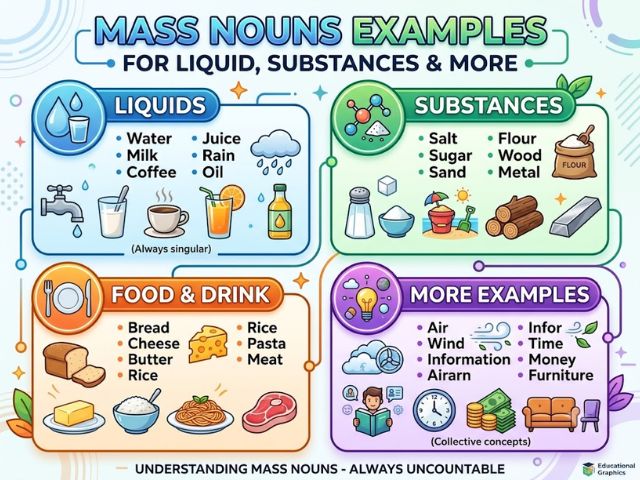
Liquids and raw substances make up one of the largest mass noun categories, since they can’t naturally be divided into countable single units.
Liquids:
Water
Milk
Juice
Oil
Blood
Wine
Coffee
Tea
Honey
Syrup
Substances and Materials:
Sand
Salt
Flour
Cement
Wood
Iron
Gold
Plastic
Cotton
Wool
Using Container Words with Liquids and Substances
Since you can’t count liquids or raw substances directly, English uses measuring or container phrases instead:
A glass of water
A cup of coffee
A bag of sand
A bar of gold
A piece of wood
This pattern — “a [container/unit] of [mass noun]” — is one of the most useful grammar structures to memorize for everyday conversation.
Countable vs Mass Nouns with Examples
Understanding the contrast between countable and mass nouns is the fastest way to avoid grammar mistakes.
| Feature | Countable Nouns | Mass Nouns |
| Can be pluralized | Yes (book → books) | No (rice, not “rices”) |
| Uses “a/an” | Yes (a book) | No (not “a rice”) |
| Uses numbers directly | Yes (three books) | No (needs a unit: three grains of rice) |
| Uses “many” or “few” | Yes | No |
| Uses “much” or “little” | No | Yes |
Examples Side by Side
Countable: I bought three apples. → Mass: I bought some rice.
Countable: She has many friends. → Mass: She has much patience.
Countable: There are five chairs. → Mass: There is furniture in the room.
Some words can actually function as both, depending on meaning:
Countable: She ordered three coffees. (three cups of coffee)
Mass: Coffee is grown in tropical regions. (the substance in general)
Mass Nouns Used in Daily Life
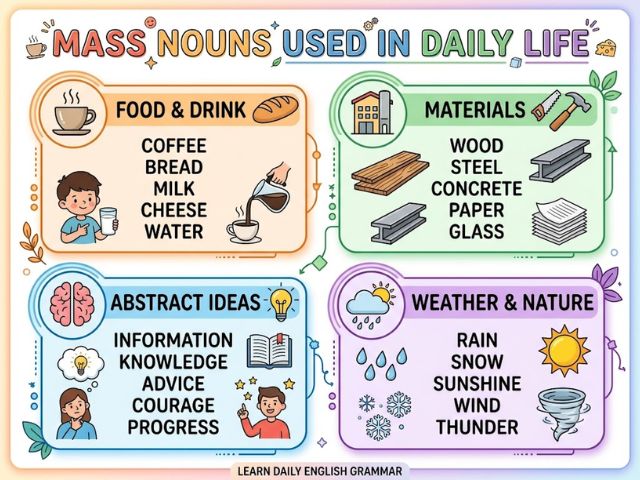
You use mass nouns constantly without even realizing it — in the kitchen, at work, in casual conversation, and while describing feelings.
I need some help with this project.
Can you turn off the electricity?
We spent a lot of money on the trip.
The weather has been unpredictable lately.
I don’t have much time today.
She showed real determination during the exam.
Traffic was terrible this morning.
We ran out of toothpaste.
His research took years to complete.
There’s too much noise in this room.
Recognizing these patterns in daily speech helps you naturally avoid awkward phrasing like “moneys” or “many traffic.”
Read More….Nouns List A to Z: 600+ Common Nouns Examples in English
Food Mass Nouns with Examples
Food-related mass nouns are some of the most frequently used uncountable nouns in English, since raw ingredients are rarely divided into standardized countable units.
| Mass Noun | Example Sentence |
| Rice | We cooked rice with vegetables. |
| Bread | She baked fresh bread this morning. |
| Sugar | Add a spoon of sugar to your tea. |
| Butter | Spread some butter on the toast. |
| Cheese | I love cheese on pizza. |
| Meat | We bought meat for the barbecue. |
| Flour | The recipe requires two cups of flour. |
| Milk | Pour some milk into the cereal. |
A Note on Food Exceptions
Some food-related mass nouns can become countable when referring to varieties or specific types:
“This restaurant serves different cheeses.” (types of cheese)
“France produces excellent wines.” (varieties of wine)
This is a common exception worth remembering, especially in more advanced writing.
Material Mass Nouns with Examples
Material mass nouns describe substances used to build or make things — and like other mass nouns, they stay singular regardless of quantity.
Wood — The table is made of wood.
Glass — The window is made of glass.
Plastic — This bottle is made of plastic.
Cotton — The shirt is made of cotton.
Iron — The gate is made of iron.
Gold — Her ring is made of gold.
Leather — The jacket is made of leather.
Steel — The bridge is built with steel.
Sentence Pattern for Material Nouns
Most material mass nouns follow this pattern: [Object] is made of [material]. This structure is incredibly common in both spoken and written English, especially in product descriptions and academic writing.
Abstract Mass Nouns with Sentences
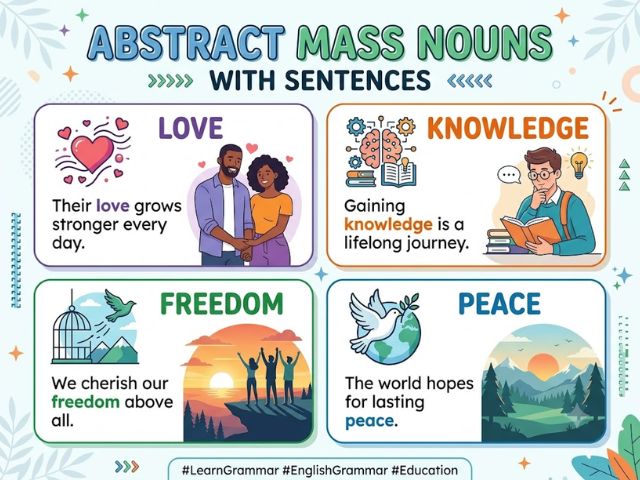
Abstract mass nouns describe feelings, qualities, or ideas — things you can’t physically touch, see, or divide into pieces.
Love — Love makes people do incredible things.
Happiness — Happiness is found in small moments.
Honesty — Honesty builds strong relationships.
Courage — It takes courage to speak up.
Patience — Patience is essential when teaching children.
Wisdom — Wisdom comes with experience.
Freedom — Freedom is a basic human right.
Anger — Anger can cloud good judgment.
Why Abstract Nouns Are Always Uncountable
Since abstract concepts have no physical shape or separable units, they almost always function as mass nouns. You can’t say “two happinesses” or “three angers” — the concept itself resists division.
Kitchen Mass Nouns with Examples
The kitchen is full of everyday mass nouns, since most ingredients are measured rather than counted individually.
| Mass Noun | Example Sentence |
| Salt | Add a pinch of salt to the soup. |
| Oil | Heat some oil in the pan. |
| Flour | Sift the flour before mixing. |
| Rice | Boil the rice for twenty minutes. |
| Sugar | Don’t add too much sugar. |
| Butter | Melt the butter slowly. |
| Water | Fill the pot with water. |
| Milk | Warm the milk before serving. |
Common Kitchen Measuring Phrases
A pinch of salt
A spoon of sugar
A cup of flour
A bottle of oil
A jug of water
These measuring phrases are essential vocabulary for anyone following recipes or writing cooking instructions in English.
List of Common Uncountable Mass Nouns A to Z
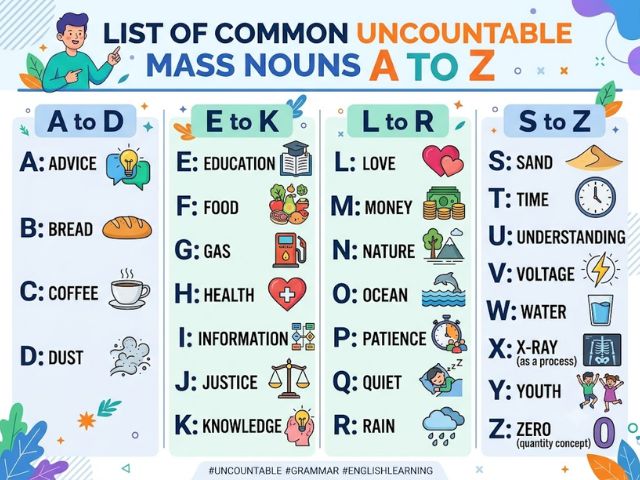
Here’s a quick alphabetical reference for common mass nouns across categories.
| Letter | Examples |
| A | Advice, Air, Anger |
| B | Bread, Butter, Beauty |
| C | Coffee, Cotton, Courage |
| D | Dust, Data |
| E | Electricity, Equipment |
| F | Flour, Furniture, Freedom |
| G | Gold, Grass |
| H | Happiness, Honesty |
| I | Information, Iron |
| J | Juice, Jewelry |
| K | Knowledge |
| L | Luggage, Love |
| M | Milk, Money, Music |
| N | News, Noise |
| O | Oil |
| P | Patience, Plastic |
| Q | Quicksand |
| R | Rice, Research |
| S | Sugar, Sand, Steel |
| T | Tea, Traffic |
| U | Understanding |
| V | Violence |
| W | Water, Wood, Wisdom |
Practice Sentences with Mass Nouns
Try completing these sentences using an appropriate mass noun, or use them as models for your own practice:
I need ___ to finish this report. (information)
The soup tastes better with more ___. (salt)
She showed a lot of ___ during the interview. (confidence)
We ran out of ___ for breakfast. (milk)
His ___ helped him succeed in business. (determination)
There was too much ___ on the road today. (traffic)
The house is filled with antique ___. (furniture)
___ is the best policy in relationships. (honesty)
Practicing fill-in-the-blank sentences like these is one of the fastest ways to internalize which nouns are countable and which are mass nouns.
FAQs
What is a mass noun?
A mass noun is an uncountable noun that refers to a substance, material, or abstract concept that can’t be counted individually.
What are 5 examples of mass nouns?
Common examples include water, rice, furniture, happiness, and information.
Can mass nouns be made plural?
No, most mass nouns don’t have plural forms because they represent things measured, not counted.
Is “furniture” a mass noun?
Yes, “furniture” is a classic mass noun and is always used in singular form, even for multiple items.
How do you use quantity with mass nouns?
Use words like “some,” “much,” or measuring phrases like “a cup of” or “a piece of” instead of numbers.
Can a word be both countable and a mass noun?
Yes, words like “coffee” or “experience” can be countable or uncountable depending on context and meaning.
Conclusion
Mass nouns are one of those grammar concepts that quietly shape how we speak every single day, even if we never learned the term in school. From the food we eat to the emotions we feel, uncountable nouns like water, rice, and happiness follow their own distinct set of rules — no plurals, no direct numbers, just quantity words and measuring phrases.
By reviewing the categories, tables, and practice sentences in this guide, you now have a solid foundation for using mass nouns correctly and confidently. Keep this list handy, revisit it occasionally, and you’ll notice these tricky uncountable nouns becoming second nature in both your writing and everyday conversation.
