

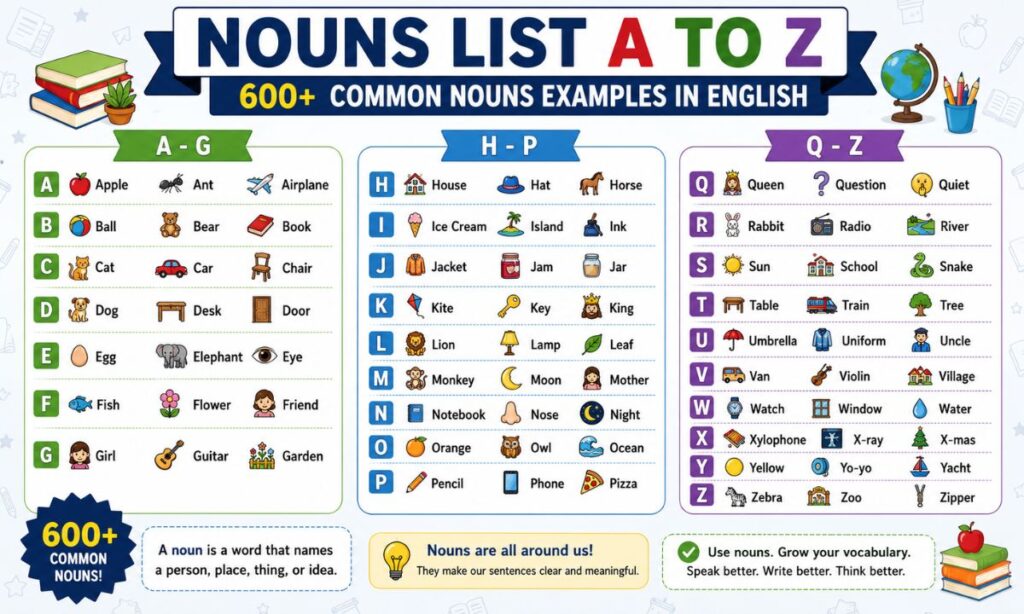
Nouns are the backbone of every sentence you speak or write. They name the people you meet, the places you visit, the objects you use, and even the ideas you can’t touch but still talk about every day. Whether you’re a student building vocabulary, a teacher preparing a lesson, or an English learner strengthening your foundation, having a solid A to Z noun list makes learning faster and more organized.
This guide gives you a complete alphabetical breakdown of common nouns, letter-specific examples with sentences, and a bonus proper noun list — all in one place, so you can learn, practice, and reference it anytime.
What Is a Common Noun?
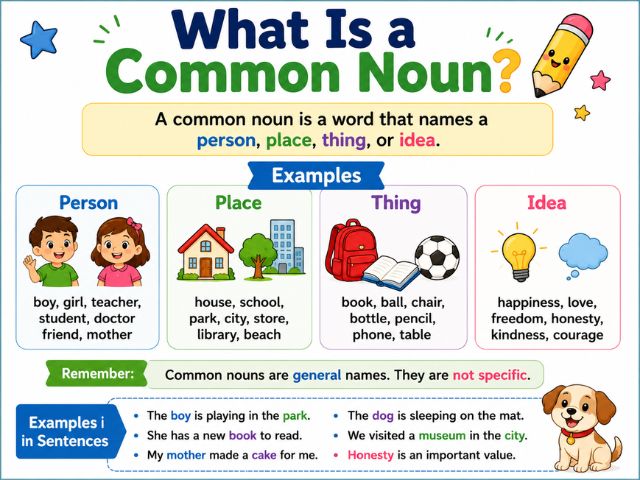
A common noun is a general name for a person, place, animal, thing, or idea — not a specific one. Words like teacher, city, dog, book, and happiness are all common nouns because they refer to general categories rather than one particular person or place.
This is different from a proper noun, which names something specific, like John, London, or Toyota — and always starts with a capital letter.
Common Noun vs Proper Noun
| Feature | Common Noun | Proper Noun |
| Definition | General name | Specific name |
| Capitalization | Lowercase (unless starting a sentence) | Always capitalized |
| Example | city | Paris |
| Example | teacher | Mr. Adams |
| Example | company |
Understanding this distinction early makes grammar, writing, and punctuation far easier to master.
List of Common Nouns in English A to Z
Here is a broad alphabetical reference list to help you build vocabulary letter by letter.
| Letter | Common Noun Examples |
| A | Apple, Ant, Arrow, Airport, Author |
| B | Book, Boy, Bird, Bridge, Bottle |
| C | Cat, City, Chair, Cloud, Candle |
| D | Dog, Door, Desk, Doctor, Diamond |
| E | Egg, Engine, Elephant, Envelope, Earth |
| F | Flower, Family, Forest, Frame, Farmer |
| G | Garden, Guitar, Glass, Goat, Grape |
| H | House, Hill, Hammer, Horse, Honey |
| I | Island, Ink, Igloo, Insect, Idea |
| J | Jacket, Jar, Journey, Judge, Jungle |
| K | Kite, Key, Kitchen, Kangaroo, King |
| L | Lamp, Lake, Leaf, Lion, Library |
| M | Mountain, Moon, Market, Mirror, Museum |
| N | Notebook, Nurse, Nest, Needle, Nation |
| O | Ocean, Orange, Oven, Office, Owl |
| P | Pencil, Park, Phone, Painter, Puzzle |
| Q | Queen, Quilt, Question, Quarry, Quiz |
| R | River, Road, Rabbit, Ring, Roof |
| S | Sun, School, Ship, Spoon, Street |
| T | Tree, Table, Train, Teacher, Tower |
| U | Umbrella, Uniform, University, Utensil, Urn |
| V | Violin, Village, Valley, Vase, Van |
| W | Window, Water, Watch, Wolf, Wall |
| X | Xylophone, X-ray |
| Y | Yacht, Yard, Yarn, Yak |
| Z | Zebra, Zoo, Zipper, Zone |
This alphabetical structure makes it easy to focus on one letter at a time — a technique commonly used in vocabulary-building exercises and classroom worksheets.
Nouns That Start with C: Examples with Sentences
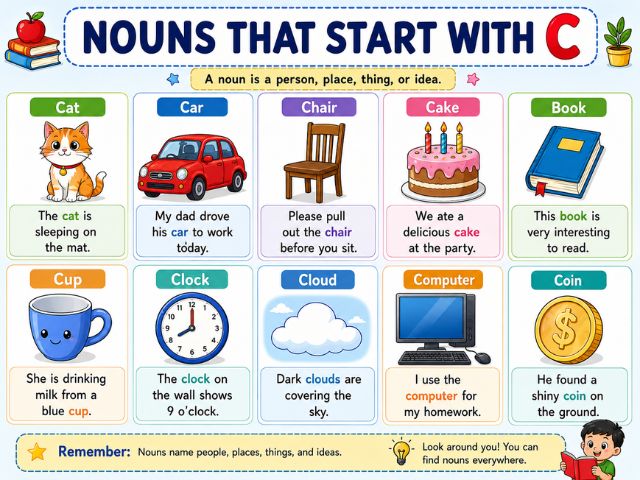
The letter C offers a rich set of nouns across categories — people, places, and everyday objects.
Cat – The cat slept on the windowsill all afternoon.
City – We visited a new city last summer.
Chair – Please pull up a chair and join us.
Candle – She lit a candle during the power outage.
Coach – The coach praised the team’s effort.
Cousin – My cousin is visiting next week.
Camera – He bought a new camera for the trip.
Cottage – They rented a cottage near the lake.
Carpet – The carpet in the hallway needs cleaning.
Cabinet – She stored the dishes in the cabinet.
Common Noun Examples That Start with D
D-nouns cover a wide mix of daily-life vocabulary, from professions to objects.
Door
Desk
Doctor
Diamond
Dinner
Driver
Diary
Drum
Dolphin
Design
People, Places, Things That Start with D
| Category | Examples |
| People | Doctor, Dancer, Driver, Dentist |
| Places | Desert, Dock, Dormitory, District |
| Things | Door, Drum, Diary, Diamond |
Sentence examples:
The doctor examined the patient carefully.
We crossed the desert during our road trip.
He kept his secrets in a locked diary.
The dancer performed gracefully on stage.
Common Nouns That Start with S
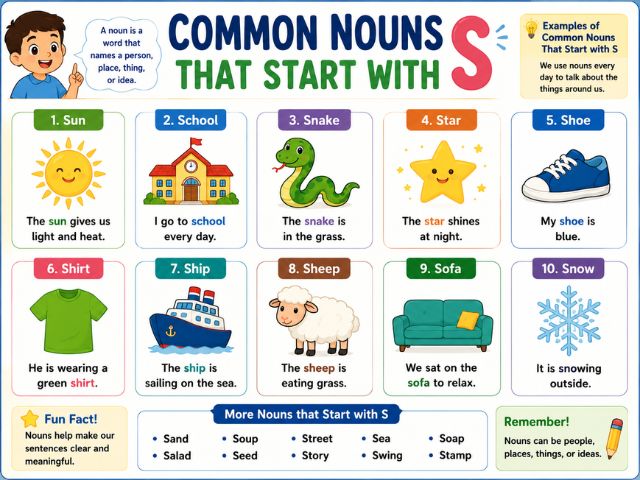
S is one of the richest letters in English vocabulary, covering an enormous range of nouns.
Sun
School
Ship
Street
Spoon
Sister
Snow
Stadium
Suitcase
Statue
Sentence Examples with S Nouns
The sun rose slowly over the hills.
She walked to school early in the morning.
We packed our suitcase for the trip.
The statue stood tall in the town square.
He borrowed a spoon from the kitchen drawer.
Common Nouns That Start with J with Examples
J-nouns are fewer in number but still essential for everyday vocabulary.
Jacket – He wore a warm jacket in winter.
Jar – She filled the jar with homemade jam.
Journey – Their journey lasted three days.
Judge – The judge announced the final decision.
Jungle – Tigers live deep in the jungle.
Juice – I drink orange juice every morning.
Jewel – The jewel sparkled under the light.
Job – She started a new job this month.
Common Nouns That Start with K in English
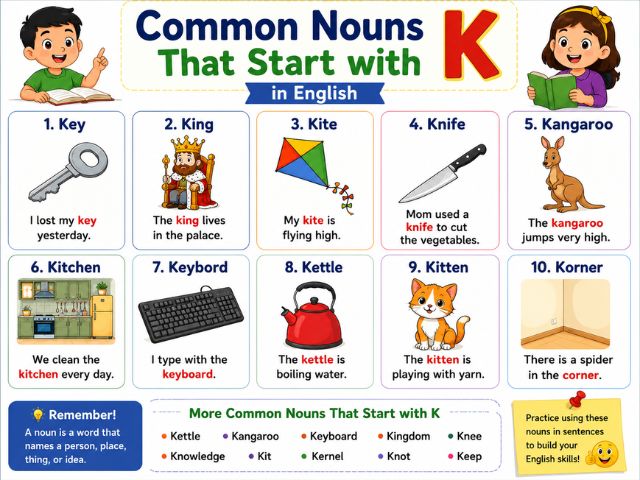
Key
Kitchen
Kangaroo
King
Kite
Kettle
Knife
Kingdom
Sentence examples:
I left my key on the table.
She cooked dinner in the kitchen.
The children flew a kite in the park.
The kettle whistled loudly on the stove.
Common Nouns That Start with L
L offers a strong mix of nature-related and everyday object nouns.
Lamp
Lake
Leaf
Lion
Library
Ladder
Lawyer
Lemon
L-Noun Examples in Sentences
The lamp lit up the entire room.
We swam in the lake during summer.
A lion roared in the distance.
She borrowed a book from the library.
He climbed the ladder to fix the roof.
Useful Nouns That Start with M with Examples
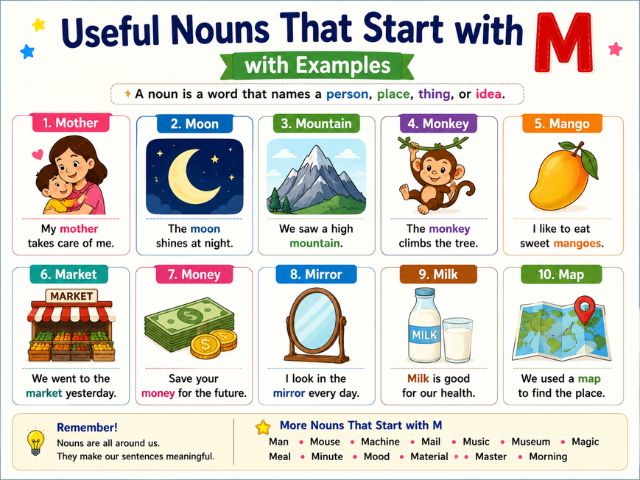
Mountain
Moon
Market
Mirror
Museum
Mother
Machine
Medicine
Sentence examples:
They hiked up the mountain at sunrise.
The moon glowed brightly last night.
We bought vegetables at the market.
She checked her reflection in the mirror.
The museum displayed ancient artifacts.
Read More…Sentences for Grade 2: 333 Daily Use English Sentences for Kids
Nouns That Start with N with Types and Examples
N-nouns can be grouped by type, which makes vocabulary building even more structured.
| Type | Example Nouns |
| People | Nurse, Neighbor, Niece |
| Places | Nation, Neighborhood, Nursery |
| Things | Notebook, Needle, Necklace |
| Ideas | Nature, Nostalgia |
Sentence examples:
The nurse checked the patient’s temperature.
Our neighbor brought us fresh vegetables.
She wrote notes in her notebook during class.
He gave her a beautiful necklace.
The nation celebrated its independence day.
Proper Noun List A to Z
While common nouns name general things, proper nouns name specific people, places, or brands. Here’s a quick alphabetical reference.
| Letter | Proper Noun Examples |
| A | Amazon, Asia, Alex |
| B | Brazil, Barbie, Boston |
| C | Canada, Coca-Cola, Chicago |
| D | Disney, Delhi, David |
| E | Egypt, Emma, Everest |
| F | France, Facebook, Florida |
| G | Google, Germany, Grace |
| H | Harvard, Hawaii, Hannah |
| I | India, Instagram, Italy |
| J | Japan, John, Jupiter |
| K | Kenya, Kevin, Korea |
| L | London, Lisa, LinkedIn |
| M | Mexico, Microsoft, Mark |
| N | Nike, Nepal, Nancy |
| O | Oxford, Oman, Olivia |
| P | Paris, Pepsi, Peter |
| Q | Qatar, Quincy |
| R | Russia, Rome, Rachel |
| S | Spain, Samsung, Sarah |
| T | Tokyo, Tesla, Thomas |
| U | Uganda, Uber, Ukraine |
| V | Vietnam, Victoria, Venus |
| W | Walmart, Washington, William |
| X | Xerox, Xavier |
| Y | Yahoo, Yemen, Yale |
| Z | Zurich, Zoom, Zara |
Learning proper nouns alongside common nouns helps you understand capitalization rules and improves accuracy in both formal and casual writing.
Why Learning Nouns by Letter Helps
Organizing nouns alphabetically isn’t just a formatting choice — it’s a proven vocabulary-building method. Here’s why it works:
Focused learning – Studying one letter at a time prevents overwhelm.
Easy recall – Alphabetical grouping makes it easier to remember and retrieve words later.
Better spelling accuracy – Repeated exposure to words starting with the same letter strengthens spelling patterns.
Useful for games and quizzes – A-Z lists are perfect for classroom activities, spelling bees, and vocabulary games.
Builds sentence-making confidence – Practicing nouns in sentences (not just isolated words) helps you use them naturally in conversation and writing.
Tips to Practice and Remember Nouns Better
Pick 10 nouns a day and use each one in a sentence.
Group nouns by category (people, places, things, ideas) instead of memorizing randomly.
Practice common noun vs. proper noun identification using your own surroundings.
Read children’s books or beginner English texts — they’re full of simple, common nouns in context.
Use flashcards with a noun on one side and a sentence on the other.
FAQs
What is a common noun?
A common noun is a general name for a person, place, thing, or idea, such as “city,” “dog,” or “book.”
What is the difference between a common noun and a proper noun?
Common nouns name general things, while proper nouns name specific people, places, or brands and are always capitalized.
How many common nouns are there in English?
There are thousands of common nouns in English, covering everyday objects, people, places, and abstract ideas.
What are examples of nouns that start with X?
Common examples include “xylophone” and “X-ray,” since very few English nouns begin with this letter.
Why is learning nouns from A to Z helpful?
It organizes vocabulary learning into manageable sections, making it easier to build spelling and sentence skills systematically.
Are abstract nouns considered common nouns?
Yes, abstract nouns like “happiness,” “freedom,” and “courage” are a type of common noun since they name general ideas.
Conclusion
Nouns form the foundation of every sentence, and learning them from A to Z is one of the simplest, most effective ways to strengthen your English vocabulary. From everyday common nouns like “chair” and “school” to specific proper nouns like “London” and “Nike,” this structured approach helps learners of every level build stronger reading, writing, and speaking skills.
Start small — pick a letter, learn five to ten nouns, and practice using them in your own sentences. Over time, this simple daily habit will expand your vocabulary naturally and make your English feel more fluent, accurate, and confident.
