

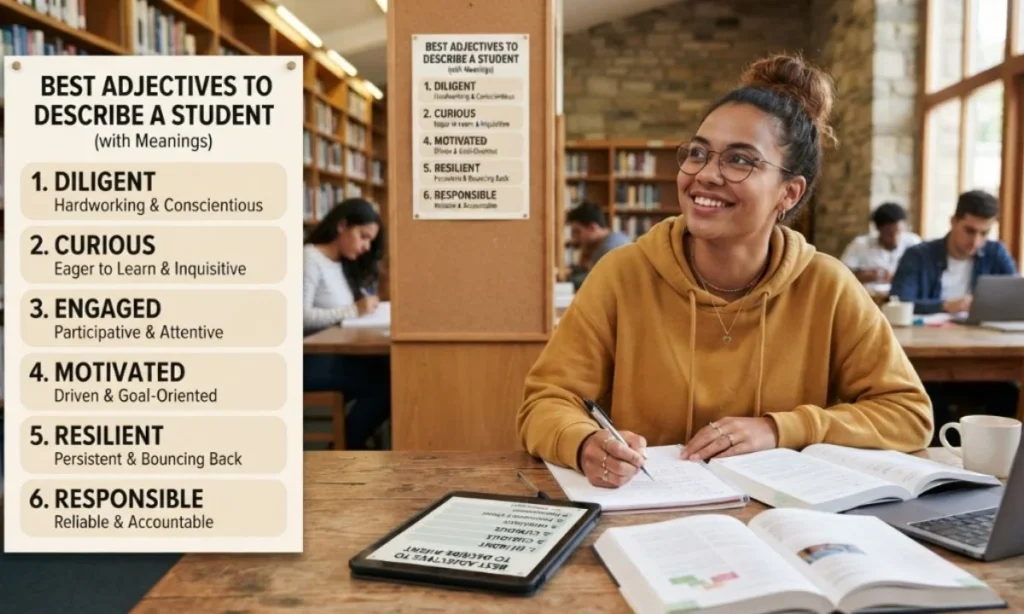
Finding the perfect words to describe a student can be a challenge. Whether you’re writing a report card, a letter of recommendation, or simply trying to capture a child’s unique qualities, having the right vocabulary makes all the difference. This comprehensive guide provides over 120 adjectives to describe a student, organized by category with clear meanings, so you can choose the most accurate and impactful words every time.
What are Adjectives that Describe a Good Student?
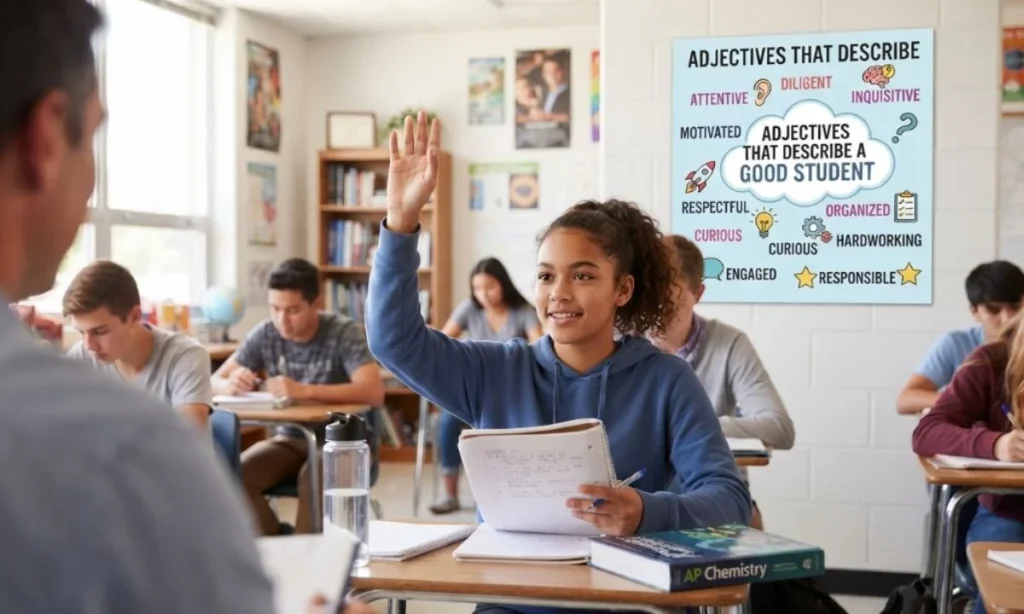
Adjectives that describe a “good student” go far beyond academic performance. They encompass a student’s attitude, behavior, work ethic, and character. A good student is often diligent, attentive, and respectful, but these words only scratch the surface. Understanding the full spectrum of positive descriptors allows for more precise and meaningful descriptions.
CategoryAdjectiveMeaningAcademicDiligentShows careful and persistent effort in studies.Character: Respectful. Treats teachers and peers with consideration and courtesy.Social: Collaborative. Works effectively and harmoniously with others.Work Ethic: Organised. Plans and manages tasks efficiently and in a structured way.
Click Here To Read More:
20+ Best Words to Define a Student with Meanings
The best words to define a student often highlight their potential and distinctive traits. Here are over 20 of the most effective descriptors with clear meanings:
- Ambitious: Having a strong desire and determination to achieve success.
- Analytical: Skilled at breaking down complex information into smaller, understandable parts.
- Articulate: Able to express ideas clearly and effectively in words.
- Attentive: Paying close attention and showing care for details in the classroom.
- Conscientious: Wishing to do what is right and to perform tasks with thoroughness and care.
- Creative: Having the ability to use imagination to produce original ideas or work.
- Curious: Eager to learn or know more about something; inquisitive.
- Dedicated: Devoting time and effort to a task or purpose.
- Determined: Having a firm decision and not letting anything stop you from achieving a goal.
- Empathetic: Showing the ability to understand and share the feelings of another.
- Enthusiastic: Showing intense and eager enjoyment, interest, or approval.
- Focused: Concentrating attention and effort on a specific task or goal.
- Hardworking: Putting in a great deal of effort and energy into work.
- Honest: Telling the truth and being trustworthy; sincere.
- Inquisitive: Curious and asking many questions to gain knowledge.
- Insightful: Having or showing a deep, accurate understanding of a situation or person.
- Motivated: Having a strong reason to act or accomplish something.
- Patient: Able to remain calm and not become annoyed when faced with delays or difficulties.
- Persistent: Continuing to do something despite difficulty or opposition.
- Proactive: Acting in advance to deal with an expected difficulty or to seize an opportunity.
- Reliable: Consistently good in quality or performance; able to be trusted.
- Resilient: Able to withstand or recover quickly from difficult conditions.
- Resourceful: Having the ability to find quick and clever ways to overcome difficulties.
Common Positive Descriptors for a Student with Pictures
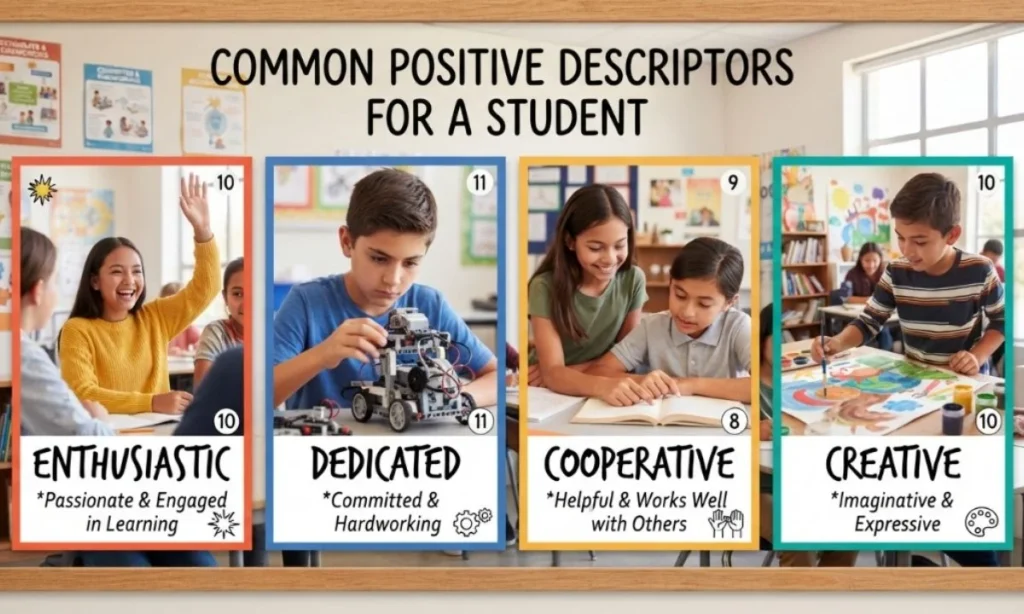
Visualizing these traits can be helpful. While pictures are in the mind’s eye, think of a cooperative student as the one who willingly shares materials, and a supportive student as the one who encourages a struggling classmate. These are common positive descriptors:
- Active: Takes a lively part in class and participates willingly.
- Friendly: Warm and easy to work with, making others feel comfortable.
- Helpful: Always ready to assist teachers and classmates.
- Kind: Warm, considerate, and good to those around them.
- Polite: Courteous to everyone, showing good manners.
- Responsible: Takes care of their work and conduct, managing their own learning.
- Thoughtful: Considers others and their feelings, and thinks carefully before acting.
- Trustworthy: Honest and reliable, often given extra responsibilities because they can be counted on.
Adjectives to Describe a Smart and Intelligent Student
Intelligence in a student takes many forms. Here are adjectives that specifically highlight a sharp mind and quick learning abilities:
- Bright: Quick to learn and understand new concepts.
- Brilliant: Exceptionally clever or talented.
- Clever: Quick to understand, learn, and devise or apply ideas.
- Gifted: Having exceptional talent or natural ability, especially in a particular subject.
- Intelligent: Having the ability to learn, understand, and make judgments based on reason.
- Keen: Sharp, observant, and eager to understand and learn.
- Perceptive: Quick to notice and understand things that are not obvious to others.
- Quick-witted: Having or showing the ability to think and respond quickly.
- Sharp: Quick to perceive or understand things; astute.
- Smart: Having or showing a quick-witted intelligence.
- Talented: Having a natural aptitude or skill for something.
Adjectives to Describe a Student Negatively
Sometimes, it’s necessary to describe a student’s struggles or challenges constructively. When doing so, focus on the behavior or outcome, not the student’s character. The goal is always to be helpful and to frame the description in a way that suggests a path for improvement.
- Disruptive: Causing trouble and interrupting the normal flow of a lesson.
- Distracted: Unable to concentrate or give attention to the task at hand.
- Inattentive: Not paying proper attention to the teacher or the lesson.
- Messy: Disorganized, often resulting in untidy work or a cluttered workspace.
- Struggling: Finding it difficult to keep up with the academic demands of the class.
- Unfocused: Lacking concentration on the task at hand.
- Underachieving: Performing below the expected level of ability.
- Unmotivated: Lacking the drive or enthusiasm to put effort into their studies.
- Unprepared: Not ready for class, often missing homework or necessary materials.
Adjectives for a Friendly Student
A friendly student is a joy to have in the classroom, as they often help create a warm and inclusive environment.
- Affable: Friendly, good-natured, and easy to talk to.
- Approachable: Friendly and easy to talk to; accessible.
- Easy-going: Relaxed and tolerant; not easily upset or angered.
- Gregarious: Fond of company; sociable.
- Likable: Pleasing and easy to like.
- Outgoing: Friendly and socially confident.
- Sociable: Willing to talk and engage in activities with other people; friendly.
- Warm: Showing kindness and enthusiasm, making others feel welcome.
Positive Adjectives to Describe a Student
This is a comprehensive list of positive adjectives that can be used to describe a student’s personality, behavior, and approach to learning. This isn’t just about being “good” but about recognizing diverse strengths.
- Adaptable: Able to adjust to new conditions or changes.
- Ambitious: Having or showing a strong drive for success.
- Brave: Ready to face and endure danger or pain; showing courage.
- Calm: Not showing or feeling nervousness, anger, or other strong emotions.
- Capable: Having the ability, fitness, or quality necessary to do or achieve a specified thing.
- Compassionate: Feeling or showing sympathy and concern for others.
- Confident: Feeling or showing certainty about their own abilities.
- Cooperative: Willing to be of assistance and work with others.
- Courageous: Not deterred by danger or pain; brave.
- Dependable: Trustworthy and reliable.
- Determined: Having made a firm decision and being resolved not to change it.
- Driven: Being highly motivated and determined.
- Earnest: Resulting from or showing sincere and intense conviction.
- Flexible: Able to change or be changed according to circumstances; adaptable.
- Generous: Showing a readiness to give more of something than is strictly necessary or expected.
- Gentle: Mild in temperament or behavior; kind and tender.
- Humble: Having or showing a modest or low estimate of one’s own importance.
- Imaginative: Having or showing creativity or inventiveness.
- Innovative: Featuring new methods; advanced and original.
- Mature: Fully developed in character and mentality.
- Optimistic: Hopeful and confident about the future.
- Organized: Arranged or structured systematically.
- Passionate: Showing or caused by strong feelings or a strong belief.
- Patient: Able to accept or tolerate delays, problems, or suffering without becoming annoyed or anxious.
- Persevering: Continuing to do something despite difficulty.
- Positive: Constructive, optimistic, and confident.
- Sincere: Free from pretense or deceit; proceeding from genuine feelings.
- Steady: Regular, even, and continuous in development, frequency, or intensity.
- Studious: Spending a lot of time studying or reading.
- Tenacious: Tending to keep a firm hold of something; clinging or adhering closely.
Adjectives to Describe a Successful Student
A successful student is often defined by a combination of academic achievement, personal growth, and positive habits. These are the adjectives that paint that picture:
- Accomplished: Highly trained or skilled; having achieved a lot.
- Achieving: Successfully reaching a goal or standard.
- Diligent: Having or showing care and conscientiousness in one’s work or duties.
- Efficient: Achieving maximum productivity with minimum wasted effort or expense.
- Excellent: Extremely good; outstanding.
- Exceptional: Unusually good; outstanding.
- Exemplary: Serving as a desirable model; very good.
- Goal-Oriented: Focused on achieving specific aims.
- High-Achieving: Performing at a level that is much higher than average.
- Notable: Worthy of attention or notice; remarkable.
- Outstanding: Exceptionally good.
- Productive: Achieving or producing a significant amount or result.
- Proficient: Competent or skilled in doing or using something.
- Remarkable: Worthy of attention; striking.
- Self-Motivated: Motivated to do or achieve something because of one’s own enthusiasm or interest, without needing pressure from others.
Words to Describe a Student for Recommendation
Writing a letter of recommendation requires powerful, evidence-based language. The adjectives you choose must be backed up with examples of the student’s work and character. Use words that are not just positive but also demonstrate a specific and superior quality.
Category Superlatives for Recommendations Intellect Imaginative, Insightful, Analytical, Astute, Perceptive, Original, Knowledgeable, LogicalWork EthicTenacious, Resolute, Committed, Efficient, Persevering, Methodical, Thorough Temperament Composed, Bold, Gregarious, Team-oriented, Assured, Earnest, Considerate Vigor Energetic, Self-starting, Enthusiastic, Pace-setting, Diligent, Enterprising
When using these, provide specific context. Instead of saying “John is dedicated,” say “John’s dedicated approach was evident when he spent extra hours perfecting his final project, showing a tenacious commitment to excellence.”
Adjectives to Describe a Student in Class

These adjectives describe observable behavior and participation in the classroom setting.
- Attentive: Listening closely and staying on task.
- Engaged: Participating actively and showing interest in the lesson.
- Focused: Concentrating intently on the material.
- Involved: Joining in class activities and discussions willingly.
- Participatory: Actively taking part in class discussions and group work.
- Questioning: Asking thoughtful questions to deepen understanding.
- Responsive: Answering and reacting thoughtfully to questions and instructions.
- Spirited: Bringing energy and enthusiasm to group activities.
How to Choose the Right Adjective to Describe a Student
Choosing the right adjective is about being specific, accurate, and purpose-driven. Here is a simple process to follow:
- Identify Your Goal: What is the purpose? Is it to praise (report card), evaluate (progress report), recommend (college letter), or describe a student’s classroom behavior?
- Be Specific: General words like “good” or “nice” are weak. Think of an adjective that pinpoints a specific trait or action. For example, instead of “good,” use “diligent” or “creative.”
- Gather Evidence: The best descriptors are supported by examples. In a report or letter, always have a specific anecdote, project, or behavior in mind that backs up your adjective.
- Consider the Context: Are you describing academic performance, social skills, or personal character? An adjective like “analytical” is perfect for a science class, while “empathetic” is better for a collaborative setting.
- Fulfill its Purpose: Use words to build a student up or to help them improve. Even when describing a challenge, choose words that are constructive and offer a path forward.
Adjectives to Describe a Student Academically
These adjectives are specifically focused on a student’s performance and aptitude in their studies.
- Adept: Very skilled or proficient at something.
- Capable: Having the ability to do something.
- Competent: Having the necessary ability, knowledge, or skill to do something successfully.
- Critical: Exercising or involving careful judgment or judicious evaluation.
- Intellectual: Relating to the ability to think and understand ideas at a high level.
- Knowledgeable: Intelligent and well-informed.
- Literate: Knowing a particular subject or field.
- Proficient: Competent or skilled in doing or using something.
- Scholarly: Involving or relating to serious academic study.
- Skilled: Having or showing the knowledge, ability, or training to perform a certain activity or task well.
FAQs
What are the best adjectives for a student who is a good leader?
Answer: The best adjectives include decisive, proactive, inspiring, confident, and collaborative.
How do you describe a student’s behavior positively?
Answer: Use adjectives like respectful, cooperative, responsible, empathetic, and considerate.
What are some good adjectives for a student’s report card?
Answer: Diligent, attentive, consistent, organized, and hardworking are all excellent choices for a report card.
What words describe a student’s poor performance constructively?
Answer: Use terms like developing, improving, struggling, unfocused, or underachieving, focusing on the behavior and potential for growth rather than labeling the student negatively.
Conclusion
The words we use to describe students are powerful. They can shape a student’s self-perception, help them understand their strengths, and guide them toward areas for improvement. This extensive list provides the vocabulary needed to speak with Adjectives precision and care, whether you are a teacher, counselor, parent, or student. By choosing your adjectives thoughtfully and backing them up with evidence, you can provide feedback that is not only accurate but also truly impactful.
