


Few word pairs cause as much confusion in English as affect and effect. They sound almost identical, they’re spelled similarly, and yet using the wrong one can make even a well-written sentence look careless. If you’ve ever paused mid-sentence wondering which one fits, you’re in good company: this is one of the most searched grammar questions in English.
This guide breaks the confusion down for good. You’ll learn the core difference, when to use each word, the rare exceptions that trip people up, and simple tricks to lock the rule into memory permanently.
What Is the Difference Between Affect and Effect?
The simplest way to think about it:
- Affect is usually a verb: it means to influence or change something.
- Effect is usually a noun: it means the result of a change.
Here’s the difference in one clean example:
The loud music affected my concentration. The effect was a terrible headache.
In the first sentence, the music is doing something: that’s the verb, affect. In the second sentence, the headache is the result: that’s the noun, effect.
Affect vs Effect at a Glance
| Word | Most Common Role | Meaning | Example |
| Affect | Verb | To influence or change | The weather affected our travel plans. |
| Effect | Noun | A result or outcome | The effect of the delay was frustrating. |
Once this basic pattern clicks, roughly 90–95% of real-world sentences become easy to get right.
Affect vs Effect: Simple Definitions and Meanings
Let’s break both words down individually so the distinction sticks.
Affect (verb): To influence, change, or have an impact on something.
Example: Stress can affect your sleep.
Effect (noun): A change that results from an action; an outcome.
Example: Lack of sleep noticeably affected her mood.
There are exceptions to both: effect can occasionally act as a verb, and affect can occasionally act as a noun: but those are far less common and covered in detail later in this guide.
Click Here To Read More
When to Use Affect in a Sentence

Use affect when you’re describing an action: something causing a change in something else. It almost always functions as a verb.
- Loud noises affect my ability to focus.
- The new policy will affect thousands of employees.
- Her mood affects how she communicates with the team.
- Poor diet can affect your energy levels.
- The medication may affect your appetite.
A Simple Test for Affect
Ask yourself: Is something causing a change? If yes, and the word is describing an action happening to something, affect is almost always correct.
When to Use Effect in a Sentence
Use effect when you’re describing the result of an action. It almost always functions as a noun.
- The effect of the storm was widespread flooding.
- Her speech had a powerful effect on the audience.
- Side effects of the medication include drowsiness.
- The new law had an immediate effect on the economy.
- One effect of regular exercise is improved mood.
A Simple Test for Effect
Ask yourself: Can I put “the” in front of it? If the sentence still makes sense — “the effect,” “the effects”: you’re almost certainly dealing with a noun, which means effect is the right choice.
Affect vs Effect Examples in Everyday English
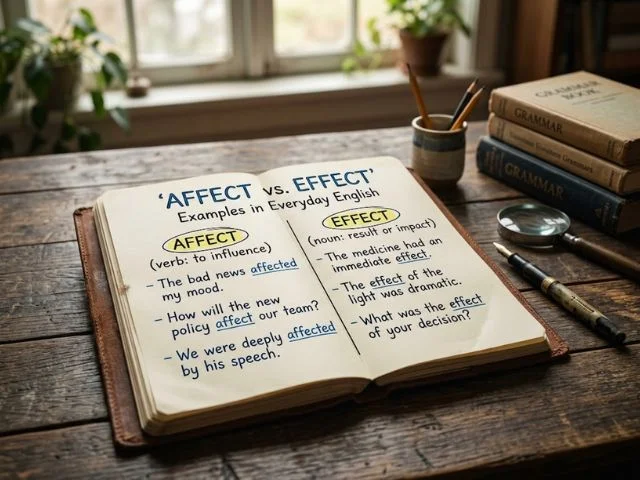
Seeing both words side by side in similar contexts makes the difference much clearer.
| Sentence Using Affect | Sentence Using Effect |
| The rain affected the outdoor event. | The rain negatively affected the outdoor event. |
| Smoking affects lung health. | Smoking has serious effects on lung health. |
| The news affected her deeply. | The news had a lasting effect on her. |
| Sleep affects memory and focus. | Poor sleep has a noticeable effect on memory. |
| The medicine affects blood pressure. | The medicine’s effect on blood pressure was significant. |
Notice the pattern: affect leads to an action happening, while effect names what happened as a result.
How to Remember the Difference Between Affect and Effect
If the grammar rules still feel abstract, these memory tricks make the choice almost automatic.
- A is for Action: Affect starts with A, and so does Action (verb).
- E is for End result: Effect starts with E, and so does End result (noun).
- The “the” test: If you can put “the” in front of the word and it still sounds natural, use effect. If not, use affect.
- RAVEN trick: Remember: Affect, Verb, Effect, Noun.
- Cause and consequence: Affect causes something; effect is the consequence.
Pick whichever trick sticks best for you: even one of these is usually enough to eliminate future mix-ups.
Affect as a Verb: Meaning and Examples
As a verb, affect means to influence, change, or have an impact on someone or something. This is by far its most common usage in everyday English.
- The heat affected everyone’s mood at the office.
- Her decision affects the whole team’s schedule.
- Traffic affected how quickly we arrived.
- The medication affects patients differently.
- Loud environments can affect concentration levels.
There’s also a less common verb meaning of affect: to pretend or put on a false appearance of something.
- He affected confidence, even though he felt nervous.
- She affected surprise, though she already knew the news.
This usage is far rarer and mostly appears in more literary or formal writing.
Effect as a Noun: Meaning and Examples
As a noun, effect refers to a result, outcome, or change caused by something else. This is the word’s dominant role in everyday writing.
- The effect of the announcement was immediate panic.
- Special effects made the movie visually stunning.
- The drug’s side effects include nausea and fatigue.
- One effect of climate change is rising sea levels.
- The new policy had a positive effect on productivity.
Effect commonly appears in set phrases too, such as:
- Take effect: The new rule will take effect next month.
- In effect: The agreement is already in effect.
- Side effect: a secondary, often unintended result
- Special effects: visual or technical results created for film and media
- Cause and effect: the relationship between an action and its result
Can Affect Be Used as a Noun?
Yes: though this usage is rare and mostly limited to psychology and clinical contexts. As a noun, affect refers to an observable emotional expression or mood.
- The patient displayed a flat affect during the interview.
- Her affect seemed unusually calm given the situation.
Outside of psychology or academic writing, affect as a noun is uncommon, so for everyday writing, it’s safe to treat affect as a verb almost every time.
Can Effect Be Used as a Verb?
Yes — though this is also relatively rare and tends to appear in formal or legal writing. As a verb, effect means to bring about or cause something to happen.
- The new CEO hoped to effect meaningful change within the company.
- The committee worked to effect lasting reform.
A helpful way to spot this usage: it almost always appears in the phrase “effect change” or similarly formal constructions. In everyday conversation, this verb form is uncommon enough that you’re unlikely to need it often.
Common Affect vs Effect Grammar Mistakes to Avoid
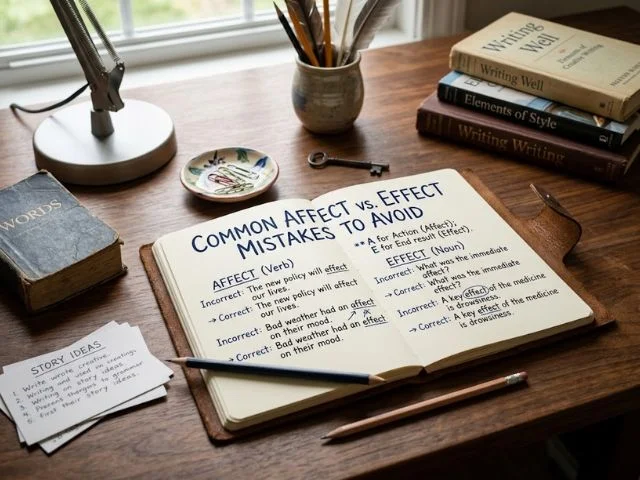
Even confident writers slip up here. Here are the most frequent mistakes:
- Using affect when describing a result
- Incorrect: The affect of the storm was devastating.
- Correct: The effect of the storm was devastating.
- Using effect when describing an action
- Incorrect: The noise effected my focus.
- Correct: The noise affected my focus.
- Confusing “take effect” with “take affect”
- Incorrect: The new law will take affect next week.
- Correct: The new law will take effect next week.
- Overusing effect as a verb in casual writing
- Effect as a verb is rare and formal: in everyday writing, “cause” or “bring about” is usually clearer.
- Assuming the words are interchangeable
- They aren’t. Even though they sound alike, mixing them up changes the grammatical role of the sentence, not just the spelling.
Quick Mistake-Spotting Table
| Common Mistake | Corrected Version |
| The affect was surprising. | The effect was surprising. |
| It effected her badly. | It affected her badly. |
| The rule takes affect Monday. | The rule takes effect Monday. |
| Her affect on the team was positive. | Her effect on the team was positive. |
Affect vs Effect: Quick Comparison and Easy Rules
Here’s a condensed cheat sheet you can reference anytime you’re unsure.
| Rule | Use | Example |
| Describing an action | Affect (verb) | The heat affected the crops. |
| Describing a result | Effect (noun) | The effect was a poor harvest. |
| Rare noun usage | Affect (noun, psychology) | His affect was unusually flat. |
| Rare verb usage | Effect (verb, formal) | She effected real change. |
| Set phrase | Effect | Take effect, in effect, side effect |
Golden rule to remember: Affect = Action. Effect = result. In the vast majority of sentences, that’s all you need.
FAQs
What is the easiest way to remember affect vs effect?
Remember that Affect = Action (verb) and Effect = result (noun): this covers most everyday sentences correctly.
Is it “take effect” or “take affect”?
The correct phrase is always “take effect.”
Can effect ever be a verb?
Yes, though rarely: it means to bring about or cause, as in “effect change.”
Can affect ever be a noun?
Yes, mainly in psychology, where it describes an observable emotional expression.
Do British and American English use these words differently?
No, both affect and effect follow the same rules and spellings in British and American English.
Why do people confuse affect and effect so often?
Because the words sound nearly identical and have closely related meanings, making the grammatical distinction easy to overlook.
In the End
Affect and effect may look like twins, but their roles in a sentence are completely different — one drives the action, the other names the result. Once you internalize that affect is almost always a verb and effect is almost always a noun, the confusion mostly disappears.
Keep the “Action vs result” rule in your back pocket, and when in doubt, try the simple “the” test. With a little practice, choosing between affect and effect will start to feel automatic, and your writing will read cleaner and more confident because of it.
