
I’ve typed this greeting thousands of times — in emails, texts, and casual chats — and I still remember the exact moment I paused and thought, “wait, is this one word or two?” If you’ve landed here with the same doubt, you’re in good company. This is one of the most searched spelling questions in everyday English, and I decided to dig into it properly instead of just trusting autocorrect.
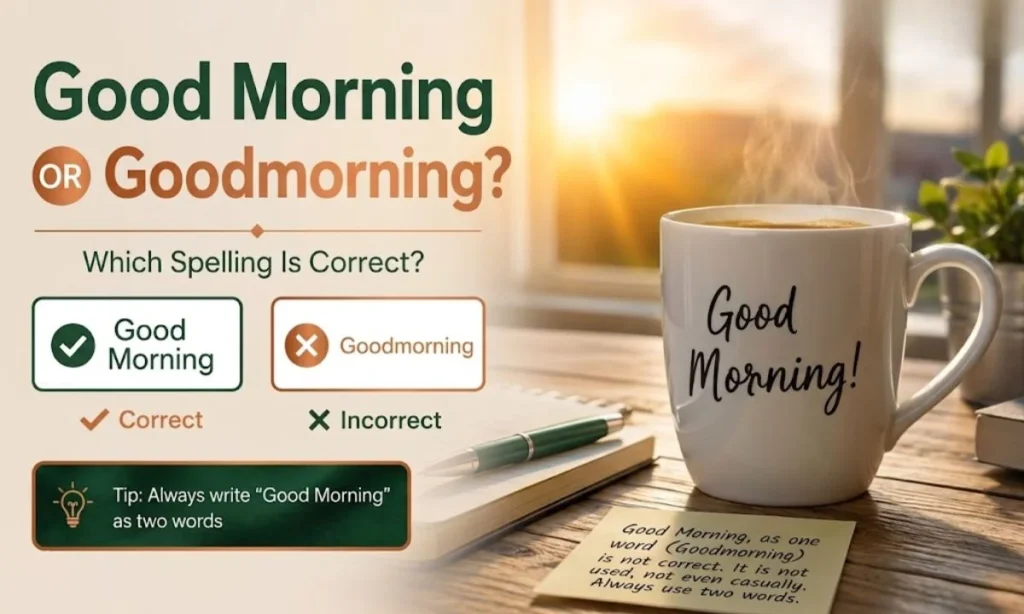
Here’s the short answer before we go deeper: “Good morning” is correct. “Goodmorning” is not. But the reasoning behind it, the common mix-ups, and the exceptions are worth understanding so you never have to second-guess yourself again.
Why I Found It’s Written as Two Words
When I first researched this, I expected some complicated grammar rule. It turned out to be simpler than I thought.
“Good morning” is made up of two separate words doing two separate jobs:
- Good — an adjective describing the quality of the morning
- Morning — a noun referring to the time of day
Because these are two distinct parts of speech working together, English keeps them as separate words. This is called an open compound — a phrase made of two or more words that function together as a single idea, but are never merged into one word.
Compare that to true compound words like “sunflower” or “notebook,” where two words fused into one because the meaning became a single, fixed concept over time. “Good morning” never went through that process. It’s stayed a phrase, not a word, for centuries of English usage.
The Simple Way I Remember It
If I can naturally swap “morning” for “afternoon” or “evening” and the sentence still makes sense, I know it should stay as two words:
- Good morning ✅
- Good afternoon ✅
- Good evening ✅
None of these ever merge into one word, and that consistency is the easiest proof I’ve found.
Click Here To Read More Topics
Since spelling confusion like this comes up constantly in English, here are a few related topics worth exploring if you’re curious:
- Good night vs Goodnight: Why one is different
- Good bye vs Goodbye: The exception explained
- Common one-word vs two-word English mistakes
- Formal vs informal greeting etiquette in emails
Morning vs Good Morning From a Girl

This phrasing shows up a lot in search queries, so I want to address it directly. “Morning” by itself and “Good morning” as a full phrase are not interchangeable in tone, even though people often use them the same way in texting.
- “Morning” — a shortened, casual greeting, often used between friends or in relaxed settings. It skips the adjective entirely.
- “Good morning” — the complete, polite version, appropriate for both casual and formal situations.
If a girl (or anyone) texts just “Morning!” instead of “Good morning,” it’s not incorrect — it’s simply a more casual, friendly shorthand. Think of it the same way “Hey” is a casual version of “Hello.” Neither is wrong; they just carry different tones.
| Version | Tone | Common Setting |
| Good morning | Polite, complete | Emails, formal texts, professional chats |
| Morning | Casual, relaxed | Friends, close coworkers, informal texts |
| Mornin’ | Very casual | Slang, spoken English, playful texting |
The “Goodnight” Confusion: Why It’s Different
This is genuinely where I found most people trip up. If “goodnight” is one word, why isn’t “goodmorning”?
I dug into this because it seemed inconsistent at first — and honestly, English is inconsistent here. But there’s a reason:
- “Goodnight” has been used so frequently as a farewell or closing phrase that it evolved into an accepted, informal, single-word variant in casual writing (though “good night” as two words is still the more formally correct version too).
- “Good morning” never followed the same path. It has always functioned as a greeting phrase, not a sign-off, and it never fused into a single accepted word in dictionaries.
So while you might see “goodnight” used both ways without much pushback, “goodmorning” as one word is still considered a spelling error, not an accepted informal variant.
Quick Comparison Table
| Phrase | One-Word Version Accepted? | Two-Word Version |
| Good morning | No | Good morning ✅ |
| Good night | Sometimes (informal) | Good night ✅ |
| Good afternoon | No | Good afternoon ✅ |
| Good evening | No | Good evening ✅ |
| Goodbye | Yes (standard) | Good bye (rare, older form) |
When and How I Use “Good Morning” Correctly
Over time, I’ve settled into a few consistent rules for using this phrase naturally and correctly across different situations.
- Start emails with it when greeting someone before noon: Good morning, Sarah,
- Capitalize only the first word in a sentence or greeting line, unless it’s a title: Good morning, team.
- Add a comma before a name when addressing someone directly: Good morning, John.
- Use it strictly before noon. Once the clock passes 12 p.m., it shifts to “good afternoon.”
- Keep it in both formal and informal writing — it’s one of the few greetings that works everywhere.
Where I Commonly Use It
- Opening line of a work email
- Greeting a group in a meeting
- Text messages to family or friends
- Public speeches or presentations
- Customer service or professional replies
Good Morning or Goodmorning Meaning
Beyond spelling, I think it’s worth understanding what the phrase actually communicates, because that’s part of why the two-word form matters.
“Good morning” is a polite greeting exchanged during the morning hours, typically used to wish someone well as the day begins. It carries a tone of warmth, respect, and positive intent, which is part of why professional communication leans on it so heavily.
“Goodmorning,” as one word, doesn’t carry a different meaning — readers will still understand it — but it reads as a spelling mistake rather than an intentional stylistic choice. It can make writing look rushed or careless, especially in formal contexts like job applications, business emails, or academic work.
Common Mistakes I’ve Found and How to Avoid Them
After going through examples across emails, texts, and social posts, here are the mistakes I noticed most often:
- ❌ Goodmorning everyone → ✅ Good morning, everyone
- ❌ good Morning team (random capitalization) → ✅ Good morning, team
- ❌ Using “good morning” after 12 p.m. → ✅ Switch to “good afternoon”
- ❌ Skipping the comma before a name → ✅ Good morning, Priya
- ❌ Mixing it with “goodnight” logic and assuming both merge → ✅ Only treat them by their own individual rules
A Short Practice Table
| Incorrect | Correct |
| Goodmorning, have a nice day | Good morning, have a nice day |
| GoodMorning Team | Good morning, team |
| goodmorning sir | Good morning, sir |
| Goodmorning! ☀️ | Good morning! ☀️ |
Memory Tips I Use to Remember the Rule
These are the small mental tricks I personally rely on so I never have to second-guess this again:
- The swap test — if you can replace “morning” with “afternoon” or “evening,” keep it as two words.
- The adjective + noun test — remember “good” is describing “morning,” just like “good weather” or “good news.” You wouldn’t merge those, so don’t merge this.
- The professional test — picture writing it in a formal email. If “goodmorning” would look like a typo to your boss, that’s your answer.
- The dictionary test — no major English dictionary lists “goodmorning” as a standalone word, which settles the debate on its own.
Other Greeting Patterns I Discovered
While researching this, I noticed a broader pattern across common English greetings that’s genuinely useful to know:
| Greeting | Correct Form |
| Good morning | Two words |
| Good afternoon | Two words |
| Good evening | Two words |
| Good night | Two words (formal); “goodnight” accepted informally |
| Goodbye | One word (standard) |
| Hello | One word |
| Good day | Two words |
The takeaway I found: most time-of-day greetings stay as two words, while only a handful of older, farewell-specific phrases like “goodbye” evolved into single words over time.
Real-World Examples I’ve Collected
Here are natural examples showing correct usage across different contexts:
Email:
Good morning, Alex,
I hope this message finds you well. I wanted to follow up on yesterday’s discussion.
Text message:
Good morning! Did you sleep okay? Let’s catch up later today.
Public speaking:
“Good morning, everyone, and thank you for joining us today.”
Customer service reply:
Good morning, and thank you for reaching out. I’d be happy to help with your request.
Casual chat:
Morning! Coffee later?
Notice how the formal and professional examples always keep the full two-word “Good morning,” while casual texting sometimes drops “good” entirely rather than merging the words.
Good Morning vs Goodmorning: My Summary Table
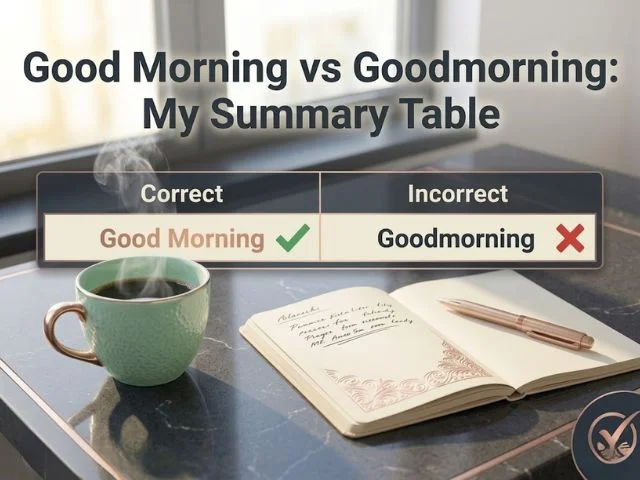
| Feature | Good Morning ✅ | Goodmorning ❌ |
| Grammatically correct | Yes | No |
| Recognized in dictionaries | Yes | No |
| Appropriate for formal writing | Yes | No |
| Appropriate for emails | Yes | No |
| Common in casual texting (mistakenly) | No | Yes |
| Flagged by spell-checkers | No | Yes |
Explore More Grammar Guides
If spelling and usage questions like this interest you, here are a few natural next topics to explore:
- Everyday vs Every day: What’s the difference?
- A lot vs Alot: Why one is always wrong
- Well vs Good: Correct usage explained
- Its vs It’s: A simple breakdown
Frequently Asked Questions
Is “goodmorning” ever correct?
No, “goodmorning” as one word is not accepted in standard English writing or dictionaries.
Why is “good night” sometimes written as one word?
“Goodnight” has become an accepted informal variant as a farewell phrase, unlike “good morning,” which stays two words.
Should I capitalize both words in “Good Morning”?
Only capitalize “Good” as the first word of a sentence or greeting; “morning” stays lowercase unless it’s a title.
Can I use “good morning” in formal emails?
Yes, “Good morning” is appropriate and commonly used to open both formal and informal emails.
What’s the difference between “Morning!” and “Good morning”?
“Morning!” is a casual shorthand greeting, while “Good morning” is the complete, more formal version.
Until what time can I say “good morning”?
Typically until 12 p.m., after which “good afternoon” becomes the correct greeting.
Conclusion
After going through the grammar, the exceptions, and dozens of real examples, my takeaway is simple: “good morning” should always be written as two words, no matter how casual or formal the setting is. The confusion with “goodnight” is understandable, but it doesn’t change the rule for this particular phrase.
Once you understand why it stays two words — an adjective plus a noun, never fused into a compound — it becomes much easier to remember. Next time you start typing a message, email, or greeting, you won’t need to pause and wonder anymore. Just write “Good morning,” and start your message with confidence.
