

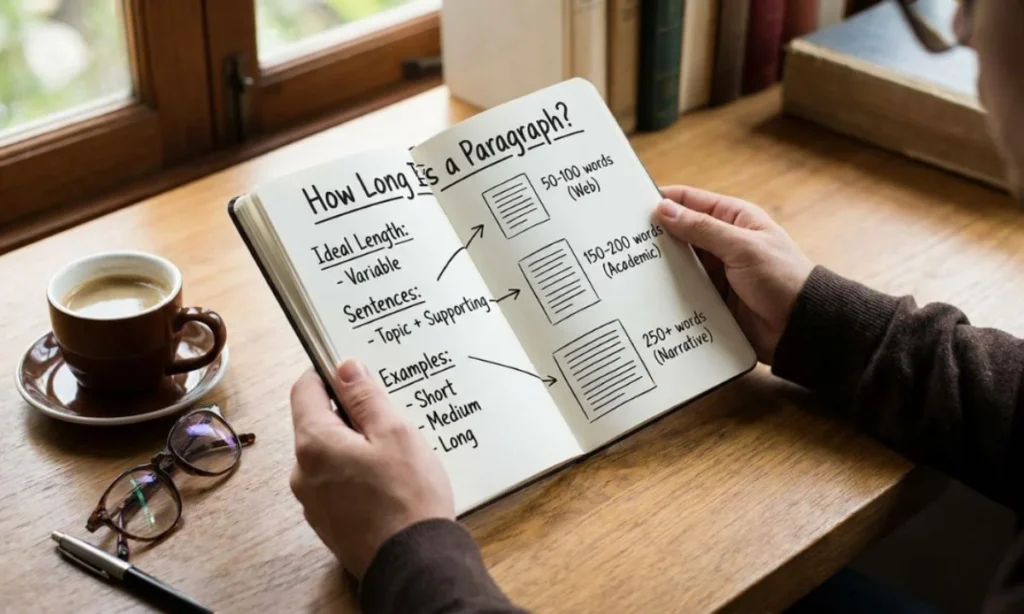
Have you ever stared at a block of text and felt your eyes glaze over before you even read a single word? You’re not alone. The way a page looks before you read it determines whether you’ll actually read it. Paragraph length isn’t just a technical detail—it’s the invisible hand that guides readers through your writing, telling them when to pause, when to breathe, and when to move forward.
The answer to “how long is a paragraph” isn’t a simple number. It depends on what you’re writing, who you’re writing for, and where your writing will appear. A novelist can write a single-word paragraph that leaves readers breathless. A college professor might expect paragraphs that stretch for half a page. An SEO blogger knows that paragraphs longer than three sentences lose half their audience before the first subheading.
This guide breaks down everything you need to know about paragraph length—from word counts and sentence ranges to real examples you can apply immediately. Whether you’re a student, a blogger, or a novelist, you’ll finish this article knowing exactly how long your paragraphs should be.
So How Long Should a Paragraph Be?
The honest answer is: as long as it needs to be to develop one complete idea—and no longer. But “it depends” isn’t very helpful when you’re staring at a blinking cursor. Let’s give you something concrete.
In general writing, most paragraphs run between 3 and 8 sentences. For academic writing, the sweet spot is 100 to 200 words. Web content performs best with 40 to 80 words per paragraph. But these numbers only make sense when you understand the context behind them.
A paragraph isn’t defined by a legal word limit. It’s a readability tool. The moment you understand that paragraphs exist to help readers process information, the rules become much clearer.
How Long Should a Paragraph Be on the Web?

Online readers scan. They don’t read every word—at least not at first. Your job is to make scanning effortless.
For digital content, paragraphs of 40 to 100 words work best, which translates to roughly two to four sentences. Some experts recommend keeping web paragraphs even tighter, around 40 to 80 words. News writing goes even shorter, with paragraphs of just 25 to 50 words—one or two sentences.
Why so short? Screens make dense blocks of text feel overwhelming. A wall of text on mobile is the fastest way to lose a reader. Short paragraphs create visual breathing room, encouraging readers to keep scrolling.
Consider this: when you read an article on your phone, you don’t read linearly. You’re jumping from subheading to subheading, scanning for information that matters to you. Short paragraphs respect that reading behavior.
What Is a Paragraph and Why Does It Matter?
A paragraph is a block of related sentences that develop one idea, separated from other blocks by a line break or indent. That’s the technical definition. But what paragraphs do is far more important than what they are.
Paragraphs serve as signposts for your reader’s brain. They signal: “This is one idea. When this block ends, the next idea begins.” Without paragraphs, even brilliant writing becomes a chaotic stream of consciousness that readers can’t navigate.
The writer’s job isn’t to fill a page with words. It’s to guide the reader’s attention. Paragraph breaks are one of the most powerful tools for doing that. They control pacing, emphasize key points, and give readers natural stopping points to process what they’ve just read.
Click Here To Read More:
How Long Is a Paragraph in Words?
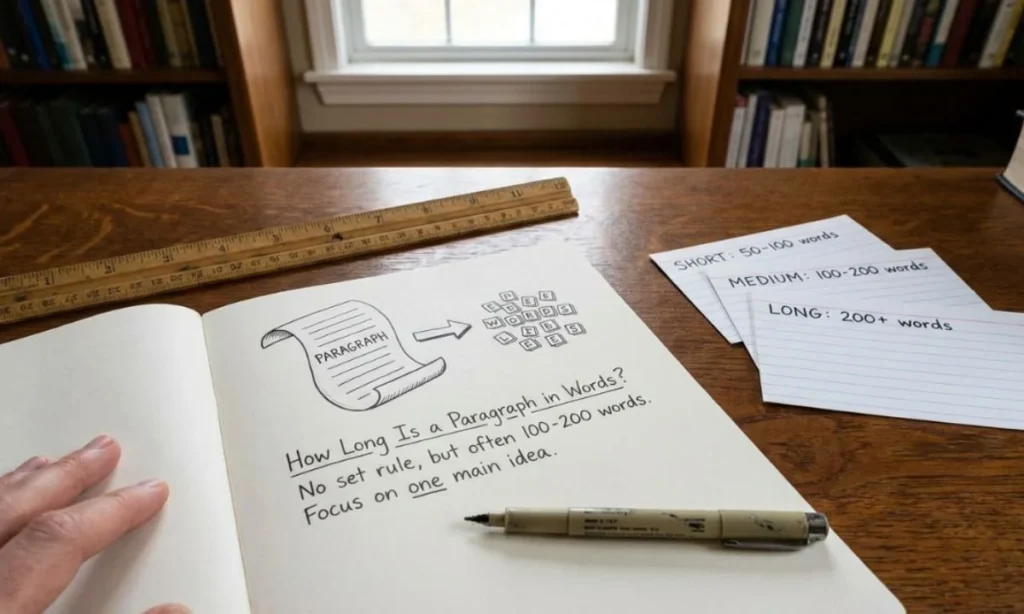
Word counts vary dramatically based on context. Here’s what the research shows:
ContextTypical Words per ParagraphApproximate SentencesWeb / Blog40–100 words2–4 sentencesBusiness Email60–100 words2–4 sentencesNews Article25–50 words1–2 sentencesHigh School Essay100–150 words4–6 sentencesCollege / Academic100–200 words5–8 sentencesFictionNo fixed rulePaced to the scene
These ranges aren’t arbitrary. They reflect how people read in different contexts. Someone reading a novel expects to sink into longer passages. Someone scrolling a news feed wants information delivered in bite-sized chunks.
The key insight: word count matters less than idea completion. A 40-word paragraph that fully develops one point is better than a 150-word paragraph that rambles across three unrelated ideas.
How Many Sentences Should a Paragraph Have?
The most common guideline is 3 to 5 sentences per paragraph. Academic writing often pushes toward 5 to 8 sentences. But here’s what most guides don’t tell you: sentence count is secondary to idea completion.
A paragraph with a single complex sentence that fully explores an idea can work beautifully. A paragraph with eight short sentences that never develop a clear point will fail regardless of its sentence count.
For formal academic writing, aim for at least three sentences. This allows you to introduce an idea, support it with evidence, and connect it to your larger argument. Two sentences often feel abrupt. One sentence paragraphs should be reserved for emphasis or dramatic effect .
In fiction, the rules dissolve entirely. Dialogue exchanges often use one-sentence paragraphs. Action beats get their own paragraphs for pacing. A time jump or perspective shift deserves a new paragraph even if the previous one was only half-complete .
What Is the Ideal Paragraph Length?
The ideal paragraph length is the one that serves both your idea and your reader. There’s no universal sweet spot—context determines everything.
For persuasive essays, a paragraph with a topic sentence, two to three sentences of analysis, and a concluding sentence typically lands around 100 to 120 words or 5 to 6 sentences . This structure gives you enough space to develop a claim fully while maintaining momentum.
For narrative writing, variety matters more than consistency. Good writers mix longer paragraphs (6 to 8 sentences) with shorter ones (2 to 3 sentences) to control pace . A series of long paragraphs feels exhausting. A series of short paragraphs feels choppy and breathless.
The moment you hit the right paragraph length, reading feels effortless. The reader never notices the structure—they just absorb the content without friction. That’s the goal.
How Long Should a Paragraph Be for an Essay?
Academic writing tolerates longer paragraphs than web content. For college-level essays, 100 to 200 words per paragraph is standard, with 150 words being a reliable target .
Research papers often push toward the higher end of that range—150 to 200 words—because each paragraph needs space to integrate sources and develop complex arguments . Argumentative essays work well with moderate-length paragraphs of 100 to 150 words, allowing for clear point-by-point structure .
But academic writing has its own rhythm. Many instructors expect paragraphs that span two-thirds to three-fourths of a page in double-spaced text . A paragraph shorter than three sentences often signals underdeveloped thinking. A paragraph longer than a full page suggests the writer lost control of the idea.
The structure of academic paragraphs follows a predictable pattern: topic sentence, supporting evidence, analysis, and a concluding or transitional sentence. When you follow this structure, paragraph length naturally falls into the 100 to 200-word range.
How Many Words Are in a Short Paragraph?
A short paragraph typically contains 50 words or fewer. In web writing, short paragraphs of 40 to 80 words are the norm, not the exception.
Short paragraphs aren’t inherently better or worse than long ones. They’re a tool for specific purposes. A short paragraph can:
- Emphasize a key point
- Create suspense in fiction
- Provide a transition between ideas
- Make complex information more digestible
Single-sentence paragraphs are the extreme version of this tool. They’re acceptable in journalism, blogs, and fiction, where they create emphasis. In formal academic writing, single-sentence paragraphs are rare and should only be used deliberately.
The danger of short paragraphs comes from overuse. If every paragraph is one or two sentences, the writing feels choppy and underdeveloped. Readers sense that ideas aren’t being fully explored.
How Many Words Are in a Long Paragraph?
A long paragraph generally exceeds 200 words, though what counts as “long” depends on the context. In academic writing, paragraphs of 200 to 250 words can work if they maintain focus on a single idea. In fiction, paragraphs of 200+ words appear regularly, especially in descriptive passages or stream-of-consciousness writing.
The risk with long paragraphs isn’t the word count itself—it’s the tendency to drift across multiple ideas. A 300-word paragraph that develops one complex idea with multiple layers of evidence can be perfectly readable. A 150-word paragraph that touches three unrelated topics will confuse readers regardless of its length.
Long paragraphs also create visual problems on screens. On mobile devices, a 250-word paragraph becomes a wall of text that readers instinctively skip. Even in academic writing, digital submission formats make long paragraphs harder to navigate.
The solution: if a paragraph feels like it’s covering too much ground, find the natural break point. Split it into two paragraphs, adding a transitional sentence if needed.
What Makes a Paragraph Clear and Easy to Read?
Clarity comes from structure, not length. A clear paragraph has three essential elements :
A topic sentence. The first sentence establishes the main idea. Readers should know exactly what the paragraph is about after reading one sentence.
Supporting sentences. These sentences develop the idea with evidence, examples, or analysis. They don’t introduce new topics—they deepen the existing one.
A concluding or transitional sentence. This wraps up the idea and creates a bridge to the next paragraph.
Beyond structure, clarity depends on variety. A page of identically sized paragraphs feels monotonous. Mixing longer and shorter paragraphs creates rhythm, maintains reader interest, and gives emphasis to key points.
The paragraph’s visual appearance also matters. A paragraph that fills an entire screen looks intimidating. A paragraph that’s just one short line looks incomplete. Most readers prefer paragraphs that occupy three to six lines on screen or paper.
Paragraph Length Examples for Different Types of Writing
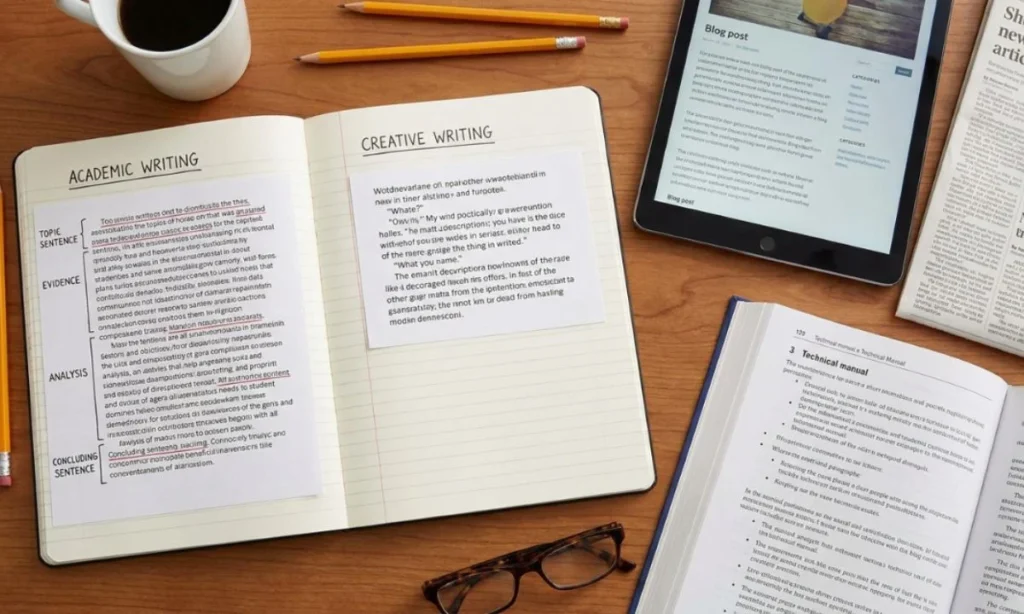
Let’s look at how paragraph length plays out in real writing contexts.
Fiction dialogue. In fiction, paragraph breaks often signal speaker changes. A line of dialogue gets its own paragraph. A character’s action beat gets another. This creates a rapid, cinematic pace during conversations.
Academic argument. A body paragraph in a research paper might run 150 words: one sentence introducing the claim, three to four sentences presenting evidence, and one to two sentences analyzing what the evidence means.
Web blog post. A paragraph in a blog post might be just two sentences long—40 words—before a subheading breaks up the page. This respects the scanning behavior of online readers.
News article. Journalistic paragraphs are famously short, often just one or two sentences. This emerged from print newspaper column formatting, but it persists online because it’s easy to scan.
Persuasive essay. A persuasive paragraph often follows a formula: topic sentence, two to three sentences of supporting analysis, and a concluding sentence that reinforces the thesis. This typically lands around 100 to 120 words.
How to Write a Well-Structured Paragraph
Writing a strong paragraph isn’t about hitting a word count. It’s about fully developing one idea and then stopping.
Start with a clear topic sentence. This sentence should tell the reader what the paragraph will prove, explain, or explore. If you can’t summarize the paragraph’s purpose in one sentence, you don’t have a clear idea yet.
Develop one idea completely. Every sentence in the paragraph should relate to the topic sentence. If a sentence introduces a new idea, it belongs in a new paragraph.
Use evidence and examples. Abstract claims need concrete support. A paragraph that asserts something without evidence feels hollow.
Vary your sentence length. Short sentences punch. Longer sentences flow. Mixing them keeps readers engaged.
End with a transition. The last sentence should either wrap up the idea or set up the next paragraph. This creates a sense of forward momentum.
Read it aloud. If you run out of breath before the paragraph ends, it’s probably too long. If you feel like you’re stopping before the idea is complete, it’s too short.
FAQs
How long should a paragraph be for a college essay?
Aim for 100 to 200 words, or roughly 5 to 8 sentences. This gives you enough space to develop one clear idea with supporting evidence and analysis .
Can a paragraph be one sentence?
Yes. Single-sentence paragraphs are common in fiction, journalism, and web writing for emphasis. In formal academic writing, use them sparingly .
How many sentences should a paragraph have?
Most paragraphs contain 3 to 5 sentences. Academic paragraphs often run 5 to 8 sentences. The key is developing one complete idea .
Is a 50-word paragraph too short?
Not for web content or business writing. Online readers prefer 40 to 80-word paragraphs. In academic writing, 50 words may indicate an underdeveloped idea .
What is the ideal paragraph length for SEO?
For SEO and readability, aim for 40 to 100 words per paragraph. Short paragraphs improve scanability and keep readers on the page longer .
How do I know when to start a new paragraph?
Start a new paragraph when you introduce a new idea, shift perspective, change speakers in dialogue, or need to give readers a visual break .
Conclusion
Paragraph length isn’t a fixed rule—it’s a judgment call that depends on your genre, audience, and purpose. A web blogger needs paragraphs of 40 to 80 words. A college essay demands 100 to 200. A novelist can write a paragraph that’s a single word or a full page, depending on the scene.
What matters most is idea completion. A paragraph exists to develop one thought fully. When that thought is complete, you start a new paragraph—no matter how many words you’ve written.
The best paragraphs are invisible. Readers don’t notice them. They just move through your writing without friction, absorbing your ideas effortlessly. That’s the standard to aim for. Not a word count. Not a sentence range. Just clear, purposeful writing that respects your reader’s time and attention.
