

Some word pairs sound so similar that your brain autocorrects them before you even notice the mistake. “Immerse” and “emerge” are a perfect example — two words that share a root, share a vibe, and yet mean almost the exact opposite of each other. Throw “emerse” into the mix (yes, that’s a real word too), and things get even more confusing.
If you’ve ever typed “she emerged herself in the culture” and paused, wondering if that looked right — this guide is for you. By the end, you’ll know exactly which word to use, when, and why, without having to second-guess yourself again.
What Is the Meaning of the Word “Immerse”?
“Immerse” means to plunge something completely into a liquid, or figuratively, to become deeply involved or absorbed in an activity, subject, or experience.
It has two main uses:
- Literal: Physically submerging something in liquid. Immerse the pasta in boiling water.
- Figurative: Becoming fully engaged or absorbed in something. She immersed herself in her studies.
In modern English, the figurative meaning gets used far more often than the literal one. People talk about immersing themselves in a new language, a book, a culture, or a project — the word has become shorthand for total focus and deep involvement.
Key Traits of “Immerse”
| Feature | Detail |
| Direction | Inward (going into something) |
| Common usage | Figurative (focus, involvement) more than literal |
| Word type | Verb |
| Related noun | Immersion |
| Typical contexts | Language learning, culture, water, activities |
Immerse or Emerge: Which Word Should You Use?
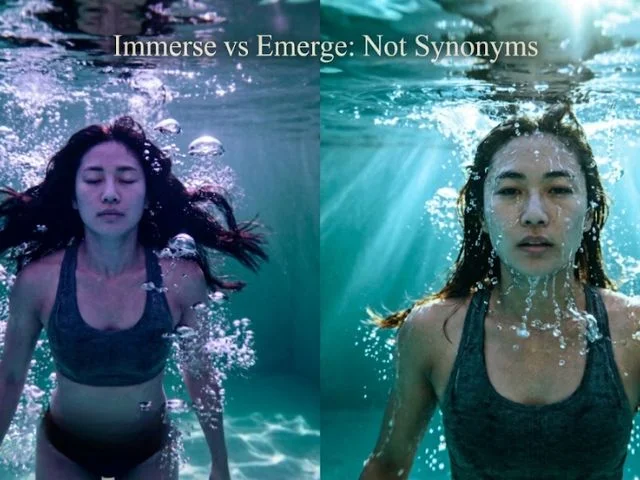
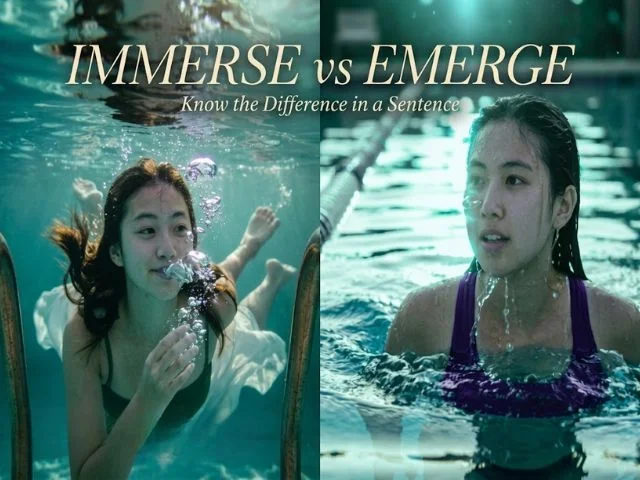
Here’s the simplest way to think about it: immerse means going in; emerge means coming out. They’re near-opposites, even though they look and sound like they should be related synonyms.
- Use immerse when something goes deeply into a liquid, activity, or experience.
- Use emerge when something comes out, appears, or becomes visible.
| Word | Direction | Example |
| Immerse | Into | He immersed the brush in paint. |
| Emerge | Out of | The diver emerged from the water. |
A quick trick to keep them straight: “im-” sounds like “in,” which lines up with immerse’s meaning of going into something. Emerge, by contrast, is about exiting or becoming visible.
Click Here To Read More
Immerse or Emerge: Synonym Options
Knowing synonyms for each word makes it easier to remember which direction they point.
Synonyms for immerse:
- Submerge
- Dip
- Plunge
- Engross
- Absorb
- Involve
Synonyms for emerge:
- Appear
- Surface
- Arise
- Come out
- Materialize
- Show up
If you’re ever unsure which word fits, try swapping in a synonym. If “submerge” or “engross” makes sense, you want immerse. If “appear” or “surface” fits better, you want emerge.
What Is the Origin of the Word “Immerse”?
“Immerse” comes from the Latin word immersus, the past participle of immergere, which combines “in-” (meaning into) and “mergere” (meaning to dip or plunge). Put together, the original sense was simply “to plunge into.”
This Latin root explains why the word has always carried a sense of downward or inward motion — something is being pushed or placed into something else, whether that’s water, an activity, or an experience.
Over centuries, English speakers kept the literal meaning (dipping something into liquid) while gradually expanding it to cover figurative immersion — absorption in ideas, culture, or focus.
What Is the Meaning of the Word “Emerse”?
This is where things get interesting. “Emerse” is a real English word, but it’s rare, technical, and almost exclusively used in scientific writing — particularly botany and aquatic biology.
Emerse describes something that rises above the surface of water or exists in a state of being out of water, typically referring to plants.
- Example: Emerse leaves grow above the waterline, while submerse leaves stay below it.
Unlike “emerge,” which is a common, everyday verb, “emerse” functions more like a specialized adjective used to describe a physical position or growth pattern — mostly in scientific or academic contexts.
Immerse or Emerse in a Sentence
Seeing both words in real sentences makes the distinction much clearer.
Immerse in a sentence:
- She immersed herself in the local culture during her trip.
- The technician immersed the sensor in water to test it.
- Language schools often immerse students in native-speaking environments.
Emerse in a sentence:
- The emerse vegetation attracts pollinators near the pond’s edge.
- Botanists studied the emerse leaves for signs of adaptation.
- Emerse plants tend to grow taller than fully submerged species.
Notice how “emerse” rarely appears in casual writing — it’s a word you’ll mostly encounter in scientific papers, not everyday conversation.
The Relationship of the Word “Emerse” With “Emersion”
Just as “immerse” pairs with the noun “immersion,” “emerse” pairs with emersion — the act or state of rising out of a liquid.
- Immersion = the act of going into something (a liquid, an activity, an experience)
- Emersion = the act of rising out of or emerging from something
A helpful way to visualize this: think of a swimming pool. Immersion is the deep end, where you’re fully submerged. Emersion is the moment you break the surface and climb out.
Immersion vs. Emergence at a Glance
| Term | Meaning | Direction |
| Immersion | Going into or being submerged | Inward |
| Emersion | Rising out or becoming visible | Outward |
What Is the Origin of the Word “Emerse”?
“Emerse” comes from the Latin emergere, formed from “e-” (meaning out of) and “mergere” (meaning to dip or plunge). So while “immergere” meant to plunge into, “emergere” meant to rise or come forth from something.
Both “emerse” and its related noun “emersion” entered English around the same general period as “immerse,” roughly the 1600s. However, “emerse” never achieved the same popularity. Over time, English speakers gravitated toward “emerge” instead, since it felt more natural and covered a broader range of everyday situations. “Emerse” stayed behind as the more precise, technical sibling — mostly surviving in scientific vocabulary.
The Difference Between “Immersion” and “Emersion” (Immerse or Emerse)
Since these two nouns come from opposite Latin roots, their meanings sit at opposite ends of the same idea — one going in, the other coming out.
- Immersion covers a huge range of everyday and professional contexts: education (language immersion), technology (immersive gaming), and personal growth (immersing yourself in a new skill).
- Emersion stays confined mostly to scientific and technical writing, especially in biology, botany, and astronomy (such as the emersion of a moon from an eclipse shadow).
Comparison Table: Immersion vs. Emersion
| Category | Immersion | Emersion |
| Common usage | Very common | Rare, technical |
| Typical fields | Education, tech, culture, water | Botany, astronomy, biology |
| Everyday example | Language immersion program | Emergence of a plant above water |
| Direction | Into | Out of |
How Do People Use the Word “Immersion” (Immerse)
Immersion shows up across an unusually wide range of fields, which is part of why it feels so familiar in everyday language.
- Education: Language immersion programs place students in environments where they must use a new language constantly.
- Technology: Virtual reality and gaming are often described as “immersive experiences.”
- Personal development: People talk about immersing themselves in a hobby, career, or new city.
- Science: Immersing objects in liquid for testing, cleaning, or experiments.
- Travel: Cultural immersion, where travelers fully engage with local customs and daily life.
Because immersion connects to focus, involvement, and experience, it’s one of those words that naturally expanded far beyond its literal, water-related origin.
How Do People Use the Word “Emersion” (Emerse)
Emersion, by contrast, stays largely within specialized fields:
- Botany: Describing plants that grow with leaves or stems above the water’s surface.
- Aquatic ecology: Studying species transitions between submerged and emerse states.
- Astronomy: Referring to the emersion of a celestial body from behind another object, such as during an eclipse.
You’re unlikely to hear “emersion” in casual conversation — it’s a word reserved almost entirely for academic or scientific writing.
Immerse Myself Meaning

The phrase “immerse myself” is one of the most common ways this word appears in everyday English. It means to fully engage with, focus on, or become absorbed in something — mentally, emotionally, or physically.
Examples:
- “I immersed myself in the novel and finished it in one sitting.”
- “She immersed herself in her new job during the first month.”
- “He wants to immerse himself in the local language before the trip.”
In all these cases, “immerse myself” signals total focus — leaving distractions behind to give something your full attention.
Examples of the Use of the Word “Immerse” in Everyday Sentences
To reinforce how naturally “immerse” fits into daily language, here are more real-world examples across different contexts:
- Travel: “We immersed ourselves in the city’s food scene during our trip.”
- Learning: “The best way to learn a language is to immerse yourself in it.”
- Technology: “The game immerses players in a fully interactive world.”
- Cooking: “Immerse the vegetables in cold water to stop them from cooking further.”
- Work: “New employees are immersed in training during their first week.”
- Relationships: “She immersed herself in family life after moving back home.”
These examples show just how flexible “immerse” is — moving easily between literal, physical use and broader emotional or intellectual engagement.
Frequently Asked Questions
What is the difference between immerse and emerge?
Immerse means to go deeply into something, while emerge means to come out or become visible — they’re near-opposites.
Is “emerse” a real word?
Yes, but it’s rare and mostly used in scientific writing to describe plants growing above water.
Can I use “emerse” instead of “emerge”?
No, they aren’t interchangeable — “emerge” is common and general, while “emerse” is technical and specific to certain fields.
What does “immerse myself” mean?
It means to fully focus on or become absorbed in an activity, subject, or experience.
What is the opposite of immerse?
Emerge is generally considered the closest opposite, since it describes coming out rather than going in.
Which word should I default to if I’m unsure?
In everyday writing, “immerse” or “emerge” almost always fits better than “emerse,” which is reserved for technical contexts.
A Final Thought
Immerse, emerge, and emerse may share a common Latin root, but they point in completely different directions — one pulls you in, the other pushes you out, and the third quietly lives in the background of scientific writing. Once that distinction clicks, mixing them up becomes far harder to do.
The easiest rule to remember: if you’re going deep into something, reach for immerse. If something is coming into view or rising, reach for emerge. And unless you’re writing about aquatic plants, you’ll rarely need “emerse” at all.
