

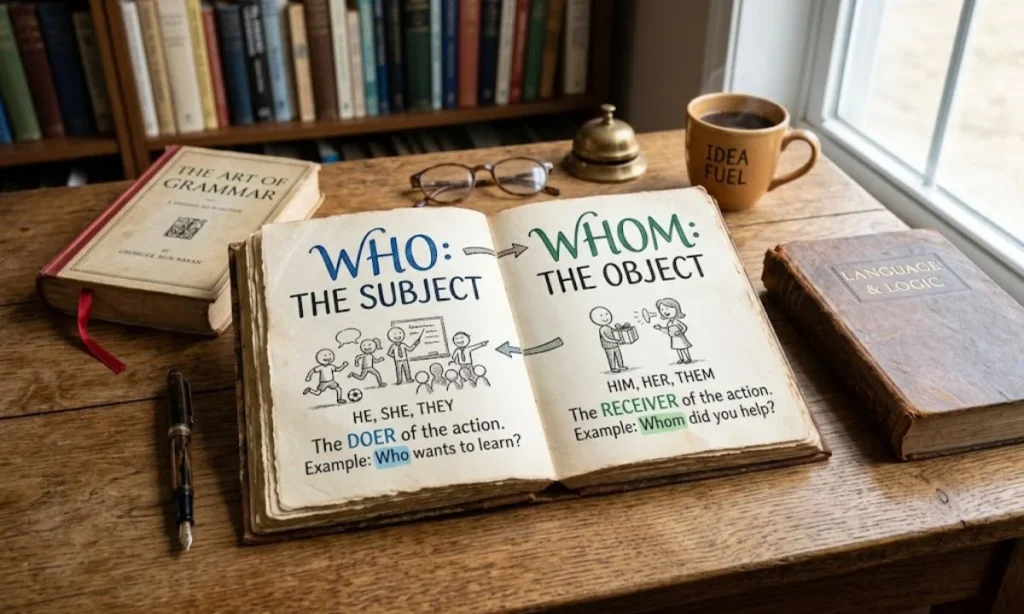
Few grammar questions cause as much hesitation as “who” versus “whom.” Even confident writers pause mid-sentence, unsure which one sounds right or worse, which one is actually correct. If you’ve ever typed “who” and then wondered if it should’ve been “whom,” you’re not alone, and you’re about to fix that for good.
This guide breaks the rule down into simple, practical steps: what each word means, easy memory tricks, real sentence Who vs Whom examples, and practice exercises so you can test what you’ve learned. No dense grammar jargon just clear explanations you can actually use.
What Is the Difference Between Who and Whom
The core difference comes down to one thing: who is a subject pronoun, and whom is an object pronoun.
- Who acts as a subject in a sentence; it’s the one doing something.
- Whom receives the action it’s the one something is being done to.
Think of it the same way you think about “he” versus “him,” or “she” versus “her.” Who behaves like he or she. Whom behaves like him or her.
| Pronoun Type | Who | Whom |
| Function | Subject | Object |
| Matches with | He, she, they | Him, her, them |
| Role in sentence | Performs the action | Receives the action |
| Example | Who called you? | Whom did you call? |
That one distinction is the foundation for every rule that follows.
Who vs Whom: Simple Rules to Remember

Before diving into detailed examples, here are the core rules in their simplest form:
- Use “who” when the pronoun acts as the subject of a verb.
- Use “whom” when the pronoun acts as the object of a verb or preposition.
- Try the substitution trick: swap in “he/she” or “him/her” to test which fits.
- After prepositions (to, with, for, by, from), “whom” is almost always correct.
- In casual speech, “who” is often used for both, but in formal or academic writing, the distinction still matters.
Quick Rule Summary
| Rule | Use Who | Use Whom |
| Subject of a verb | ✅ | ❌ |
| Object of a verb | ❌ | ✅ |
| After a preposition | ❌ | ✅ |
| Casual speech | ✅ (commonly) | Less common |
| Formal writing | ✅ (when subject) | ✅ (when object) |
When Should You Use Who in a Sentence?
Use “who” whenever the pronoun is doing the action, meaning it functions as the subject of the verb.
Examples:
- Who is coming to the party?
- She is the woman who won the award.
- Who left the door open?
- The employee who finished first got a bonus.
- Who wants pizza tonight?
In each case, “who” is directly performing the verb’s action: calling, winning, leaving, finishing, wanting.
Click Here To Read More
When Should You Use Whom in a Sentence?
Use “whom” when the pronoun receives the action, meaning it functions as the object of a verb or a preposition.
Examples:
- Whom did you invite to the party?
- To whom should I address this letter?
- The man whom we met yesterday is a doctor.
- Whom did the manager choose for the role?
- With whom are you traveling?
In each of these, someone else is acting as the person represented by “whom”: inviting, addressing, meeting, choosing, traveling with.
Who vs Whom Examples in Everyday English
Seeing both words in comparable sentences makes the distinction click faster.
| Who (Subject) | Whom (Object) |
| Who wrote this book? | The author whom I admire wrote this book. |
| Who is knocking at the door? | Whom did you hear at the door? |
| Who taught you Spanish? | The teacher whom I studied under was excellent. |
| Who is responsible for this? | To whom does this responsibility belong? |
| Who called the meeting? | Whom did the meeting affect the most? |
Notice how “who” sentences always have the pronoun performing the verb, while “whom” sentences always have someone else acting toward the pronoun.
How to Easily Know When to Use Who or Whom
If the rules still feel abstract, here’s a simple three-step method:
- Identify the verb in the clause containing who/whom.
- Ask who is doing the action if the pronoun is doing it, use “who.”
- Ask who is receiving the action if the pronoun is receiving it, use “whom.”
Example: “___ should I call for help?”
- Ask: Who is doing the calling? I am.
- Ask: Who is receiving the call? The pronoun.
- Since the pronoun receives the action, the answer is “whom”: Whom should I call for help?
This step-by-step thinking works even in longer, more complicated sentences.
The Simple He or Him Trick for Who vs Whom
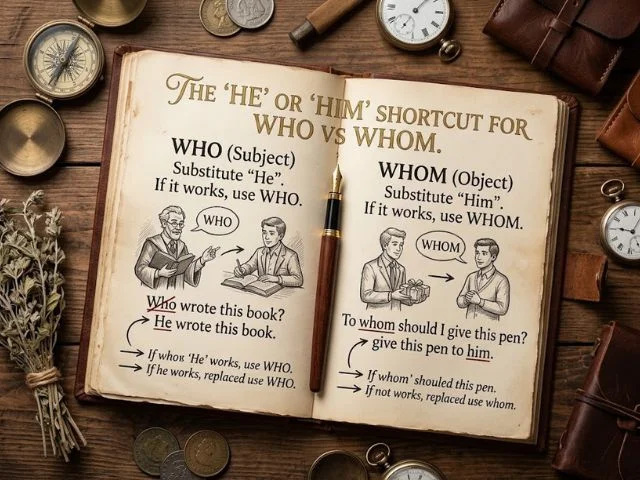
This is the fastest, most reliable trick for choosing correctly, and it works almost every time.
The Trick: Replace “who” or “whom” with “he” or “him” (or “she”/”her”) in the sentence. If “he” fits, use “who.” If “him” fits, use “whom.”
- ___ is going to the concert? → He is going. → Who is going to the concert?
- ___ did you see at the concert? → You saw him. → Whom did you see at the concert?
Why This Works
“Who” and “he” are both subject pronouns. “Whom” and “him” are both object pronouns and conveniently, both end in the letter M, which makes the trick even easier to remember.
Memory tip: Him = Whom. Both end in “m.”
Who vs Whom After Prepositions: What You Need to Know
Prepositions like to, with, for, from, by, and about almost always require “whom” because the pronoun becomes the object of that preposition.
Examples:
- To whom it may concern
- With whom are you going?
- For whom is this gift?
- From whom did you receive this letter?
- About whom are you speaking?
A Common Exception
Sometimes “who” appears right after a preposition, and that’s still correct if “who” is actually the subject of a clause following the preposition, not the object of the preposition itself.
- Example: I’m happy with who I am. Here, “who I am” is a noun clause, and “who” is the subject within that clause not the object of “with.”
| Preposition Pattern | Correct Pronoun | Example |
| Preposition + object | Whom | To whom should I speak? |
| Preposition + clause (pronoun is subject inside) | Who | I’m fine with who I am |
10 Sentence Examples of Whom With Answers
Test yourself with these fill-in-the-blank sentences, then check your answers below.
- ___ did you meet at the conference?
- To ___ should I send this package?
- The client ___ we spoke to yesterday confirmed the deal.
- ___ are you waiting for?
- With ___ did she travel to Paris?
- ___ did the committee select for the award?
- The person ___ I trust most is my mentor.
- For ___ was this letter written?
- ___ should I thank for this gift?
- The candidate ___ they interviewed seemed confident.
Answers
| # | Answer |
| 1 | Whom |
| 2 | Whom |
| 3 | Whom |
| 4 | Whom |
| 5 | Whom |
| 6 | Whom |
| 7 | Whom |
| 8 | Whom |
| 9 | Whom |
| 10 | Whom |
Every one of these sentences uses “whom” because the pronoun is receiving the action, not performing it.
Common Mistakes When Using Who and Whom
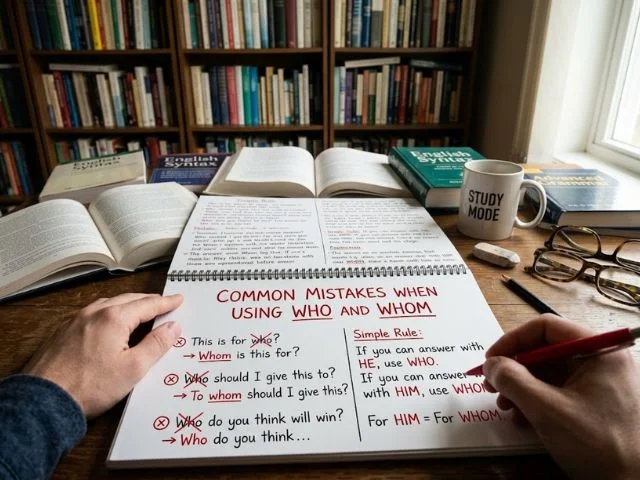
Even experienced writers slip up here. Watch for these common errors:
- Using “whom” to sound formal, even when “who” is correct this often happens right before phrases like “I think” or “I believe.”
- Incorrect: The woman whom I think is the manager approved it.
- The woman, who I think is the manager, approved it. (Test: “I think she is the manager “she” is the subject, so “who” is correct.)
- Defaulting to “who” everywhere, even in formal writing where “whom” is grammatically required after a preposition.
- Skipping the substitution test and guessing based on how the sentence sounds.
- Confusing relative clauses not checking whether the pronoun is the subject or object within its own clause.
- Overcorrecting in casual speech, which can sound stiff or unnatural in everyday conversation.
Quick Mistake-Fix Table
| Mistake | Fix |
| “Whom” before “I think/believe” | Test the clause alone often “who” is correct |
| Guessing without testing | Use the he/him substitution trick |
| Ignoring prepositions | Default to “whom” after prepositions |
| Overusing “whom” casually | Reserve strict usage for formal writing |
Who vs Whom in Questions and Formal Writing
In everyday spoken English, “who” has become widely accepted even in object positions most people say “Who did you call?” instead of “Whom did you call?” and it sounds completely natural.
However, in formal writing academic papers, professional emails, legal documents, or polished business communicatio the traditional rule still applies, and using “whom” correctly signals attention to detail.
When to Follow the Strict Rule
- Academic essays and research papers
- Business and professional correspondence
- Legal or official documents
- Formal public speaking or presentations
When “Who” Is Acceptable Even as an Object
- Casual conversation
- Texting and informal messages
- Social media posts
- Creative or conversational writing where natural tone matters more than strict grammar
Knowing your audience and context matters just as much as knowing the rule itself.
Who vs Whom: Practice Sentences With Answers
Try these final practice sentences to reinforce what you’ve learned.
- ___ is responsible for this project? (Who)
- ___ did the teacher praise? (Whom)
- The friend ___ helped me move is visiting today. (Who)
- To ___ am I speaking? (Whom)
- ___ won the competition last night? (Who)
- The manager ___ they hired starts Monday. (Whom)
- ___ should I contact for support? (Whom)
- ___ is coming to dinner tonight? (Who)
- The author ___ wrote this novel is famous. (Who)
- For ___ did you buy this gift? (Whom)
Go back through each sentence and apply the he/him substitution trick to double-check your answers it’s the fastest way to build confidence without memorizing rules by heart.
Frequently Asked Questions
What is the easiest way to remember who vs whom?
Replace the pronoun with “he” or “him” if “he” fits, use “who”; if “him” fits, use “whom.”
Is it wrong to use “who” instead of “whom” in casual speech?
No, using “who” in casual conversation is widely accepted, even when “whom” is technically correct.
Does “whom” always follow a preposition?
Almost always, since the pronoun becomes the object of that preposition, though exceptions exist with certain noun clauses.
Why does “whom” sound old-fashioned?
Whom is used less often in modern speech, so it can feel more formal or traditional compared to “who.”
Is “whom” still necessary in formal writing?
Yes, using “whom” correctly in formal or academic writing shows grammatical precision and attention to detail.
Can “who” ever be correct after a preposition?
Yes, if “who” is the subject of a clause following the preposition rather than the object of the preposition itself.
Conclusion
Who versus whom isn’t as complicated as it seems once you understand the logic behind it: who acts, whom receives. With the simple he/him substitution trick, you can check almost any sentence in seconds no need to memorize complicated grammar terminology.
Keep practicing with real sentences, pay attention to prepositions, and remember that context matters just as much as the rule itself. Master this distinction, and you’ll write and speak with the kind of confidence that makes grammar feel effortless instead of intimidating.
