

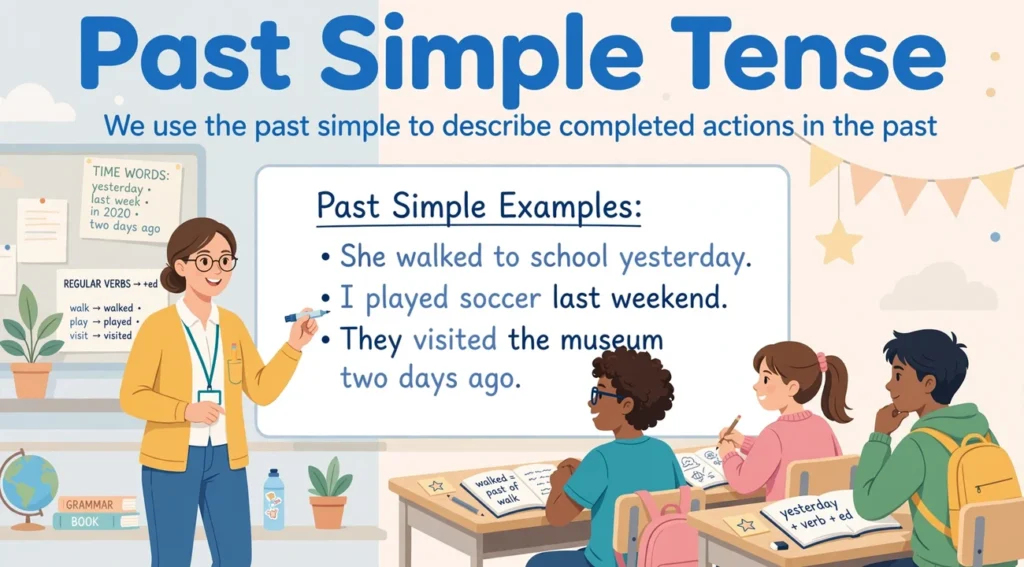
The past simple tense is one of the first verb forms you learn in English, and one of the most useful. We use it every day to talk about things that started and finished in the past. In this past simple tense guide, you will learn the rules, the spelling changes, and the most common mistakes, all in simple English.
Here is the short answer. The past simple tense talks about a finished action in the past. You usually form it by adding -ed to a regular verb — walk becomes walked. Irregular verbs change in their own way — go becomes went, and see becomes saw. Time words like yesterday, last night, and ago often come with it.
In this complete guide, you will learn what the past simple tense is, when to use it, the 5 simple rules, 40 clear examples, the most common mistakes, and a quick quiz. By the end, you will use it with full confidence.
Past Simple Tense: The Quick Answer
See regular and irregular verbs side by side.
| Verb | Past Simple | Example |
|---|---|---|
| walk | walked | I walked to school yesterday. |
| play | played | She played tennis last Sunday. |
| go | went | He went to London last year. |
| see | saw | I saw a rainbow this morning. |
The golden past simple tense rule: if the action started and finished in the past, and the time is finished too, use the past simple. Yesterday is finished, last week is finished, and ten years ago is finished.
What Is the Past Simple Tense?

The past simple tense is the verb form for actions that happened and ended in the past. The action is complete — it is not still going on, and it is not connected to now.
- I watched a film last night.
- She visited her grandmother on Sunday.
- They played football yesterday.
- He bought a new phone last month.
In every sentence, the time is in the past and the action is finished — that is the heart of the past simple tense.
To build stronger sentences, read our guide to the types of sentences.
When Do We Use the Past Simple Tense?
We use the past simple tense in five common situations.
1. Finished Actions in the Past
The action started and ended at a clear time in the past.
- I finished my homework at 8 p.m.
- The train left at 9 o’clock.
2. Past Habits and Routines
For habits that are now finished, we use the past simple.
- We walked to school every day.
- He played cricket every Sunday.
3. Past Facts and Events
We use the past simple for facts and events that belong to history.
- The Wright brothers flew the first plane in 1903.
- Shakespeare wrote many famous plays.
4. Stories and Sequences
In a story, we use the past simple for the main events, one after another.
- She opened the door, saw the gift, and smiled.
- He ran to the station, bought a ticket, and caught the train.
5. With Finished Time Words
Time words like yesterday, last week, ago, and in 2010 tell us the time is finished, so they often come with the past simple tense.
- I met Ali yesterday.
- We travelled to Paris last year.
The past simple also works in the passive voice — see our active vs passive voice guide.
How to Form the Past Simple Tense: A Quick Memory Trick
Here is a two-second trick. Ask yourself: “Is the time finished?” If yes, use the past simple — yesterday, last week, and 1999 are all finished. If the time is not finished, like today, think again.
To form it, take the base verb: regular verbs take -ed, and irregular verbs have a special past form. You learn irregular verbs by reading, listening, and using them often. The most common ones are go–went, see–saw, take–took, come–came, and eat–ate.
The past simple tense stays the same for every person. I walked, you walked, he walked, she walked, we walked, and they walked. There is no -s for he or she, and no change for I or you. That makes this tense easy once you know the verb forms.
5 Simple Past Simple Tense Rules
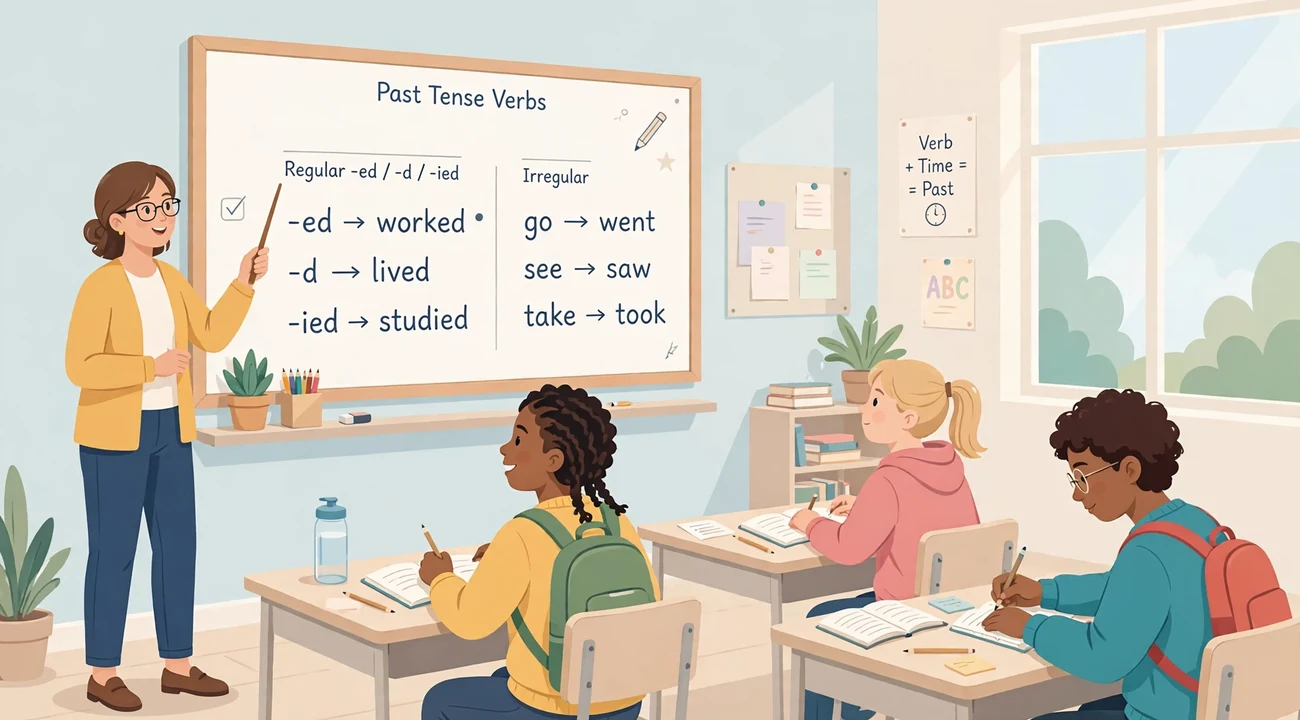
These five rules cover almost every sentence you will write.
Rule 1: Add -ed to Most Regular Verbs
Most regular verbs just take -ed at the end.
- walk → walked
- play → played
- watch → watched
Rule 2: Verbs Ending in -e Take Only -d
If the verb already ends in e, add only d — never write “likeed.”
- like → liked
- live → lived
- smile → smiled
Rule 3: Change -y to -ied
If a verb ends in a consonant + y, change y to i and add -ed. If it ends in a vowel + y, just add -ed.
- study → studied
- cry → cried
- try → tried
Rule 4: Double the Last Letter for Short Verbs
For short verbs with one vowel and one consonant at the end, double the last letter, then add -ed.
- stop → stopped
- plan → planned
- drop → dropped
Rule 5: Learn Common Irregular Verbs by Heart
Irregular verbs do not follow the -ed rule, so learn their past forms one by one.
| Base Verb | Past Simple | Example |
|---|---|---|
| go | went | I went home early. |
| see | saw | She saw a snake in the garden. |
| take | took | He took the last seat. |
| come | came | They came to my party. |
| eat | ate | We ate pizza last night. |
| buy | bought | She bought a new bag. |
The past simple does not change with he, she, or it — see our subject-verb agreement guide.
Past Simple Tense vs Present Perfect
The difference is simple: the past simple is for finished time, and the present perfect is for time that is still open or connected to now.
| Past Simple (finished time) | Present Perfect (open time) |
|---|---|
| I saw that film last night. | I have seen that film. |
| She lived in London in 2010. | She has lived in London since 2010. |
| We finished our work an hour ago. | We have just finished our work. |
Last night, yesterday, and ago point to the past simple. Just, already, ever, and since point to the present perfect.
Time words cause many small mistakes. Our then vs than guide clears up another tricky pair.
40 Past Simple Tense Examples
Here are 40 examples with the past simple tense in action. The first 20 are affirmative, and the last 20 mix negatives and questions.
- I walked to the market yesterday.
- She played piano last night.
- They watched a match.
- He opened the window.
- We visited our cousins.
- The baby cried all night.
- Ali studied for two hours.
- Sara cooked biryani.
- The dog barked.
- My father worked in a bank.
- I went to school.
- She saw a rainbow.
- He took my book.
- We ate at a small cafe.
- They came home late.
- I wrote a letter.
- She bought a red dress.
- The teacher taught a new song.
- He gave a warm smile.
- We drank cold water.
- I did not watch TV last night.
- She did not go to work yesterday.
- They did not play outside.
- He did not eat breakfast.
- We did not travel last summer.
- Did you see the film last night?
- Did she call you yesterday?
- Did they finish on time?
- Did he buy the tickets?
- Did we meet Ali last week?
- I stopped at the shop.
- She tried a new recipe.
- The children carried their bags.
- We planned a trip.
- He dropped his keys.
- Did you enjoy the party?
- She did not like the cold weather.
- I lived in a small town.
- They smiled at the gift.
- We danced at the wedding.
For more everyday sentences, browse our collection of 100 English sentences.
For more on the history and forms of this tense, see the Simple past on Wikipedia page.
Common Past Simple Tense Mistakes
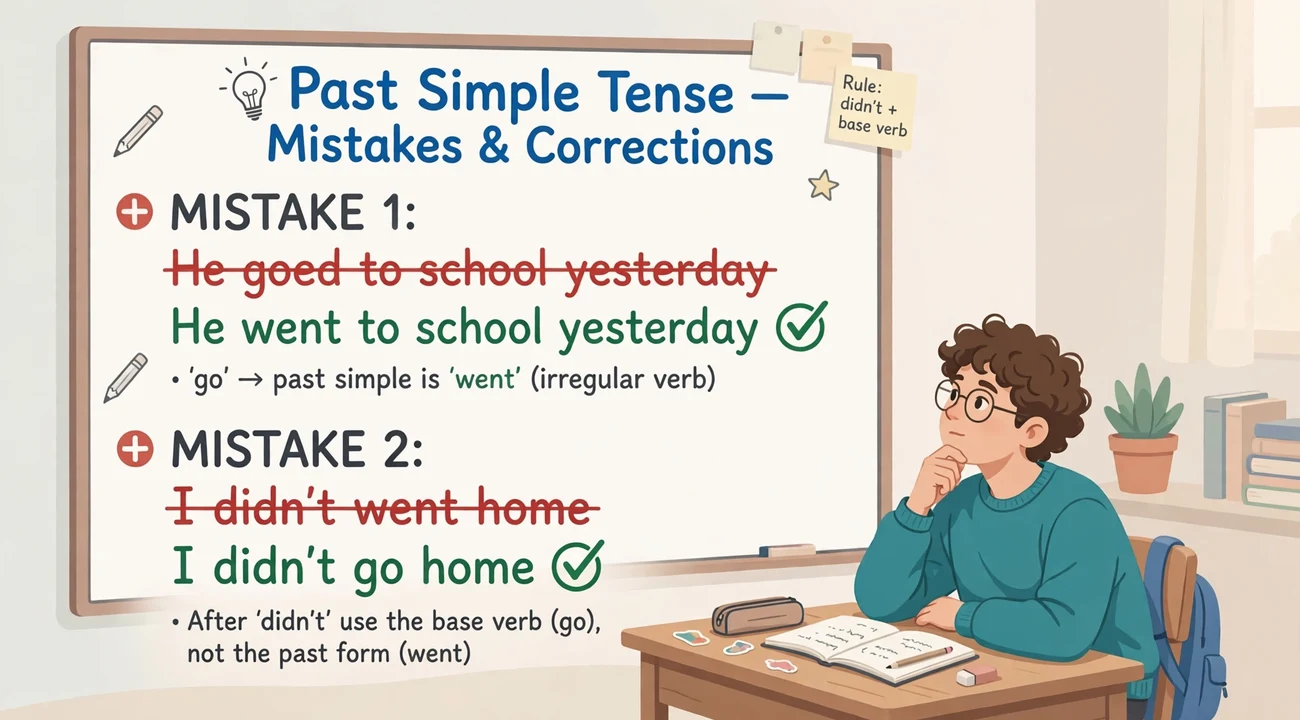
Even good learners make these mistakes. Learn them once and avoid them forever.
Mistake 1: Adding -ed to irregular verbs.
Wrong: “I goed to school.” Right: “I went to school.” Go is irregular, so its past form is went, not goed.
Mistake 2: Using did with the past form.
Wrong: “Did you went there?” Right: “Did you go there?” After did, always use the base verb, never the past form.
Mistake 3: Using the past simple with unfinished time.
Wrong: “I lived here since 2015.” Right: “I have lived here since 2015.” The word since points to time that is still open, so it needs the present perfect.
Mistake 4: Forgetting the -y spelling change.
Wrong: “She studyed hard.” Right: “She studied hard.” Change the y to i before you add -ed.
Mistake 5: Using was with the past form.
Wrong: “I was went home.” Right: “I went home.” You do not need was with a normal past simple verb.
Good punctuation makes past simple sentences easier to read — see our comma rules guide.
Quick Quiz: Test Your Past Simple Tense
Choose the correct past simple form. Answers are at the end — no peeking!
- Yesterday, I ___ (go) to the park.
- She ___ (watch) a film last night.
- They ___ (not / come) to the party.
- ___ you ___ (see) the new teacher?
- He ___ (study) hard for the test.
- We ___ (eat) lunch at home yesterday.
- The baby ___ (cry) all night.
- Ali ___ (buy) a new bag last week.
Answers:
1. went
2. watched
3. did not come
4. Did / see
5. studied
6. ate
7. cried
8. bought
How did you do? 8/8 — excellent! 6–7 — very good. Fewer than 6 — read the 5 rules once more and try again.
Past Simple Tense: Quick Summary
| Point | How It Works |
|---|---|
| Use | Finished actions in the past |
| Regular verbs | Add -ed (walk → walked) |
| Irregular verbs | Special forms (go → went) |
| Negative | did not + base verb |
| Question | Did + subject + base verb |
| Time words | yesterday, last week, ago, in 2010 |
Finished time means the past simple. Keep this summary near your desk until the rules become automatic.
FAQs About the Past Simple Tense
What is the past simple tense in simple words?
It is the verb form for actions that started and finished in the past, like “I walked” and “She went.”
How do I form the past simple tense?
For regular verbs, add -ed: walk becomes walked. For irregular verbs, learn the past form: go becomes went. For negatives, use did not + base verb; for questions, Did + subject + base verb.
What is the difference between the past simple and the present perfect?
The past simple is for finished time, like yesterday. The present perfect is for time that is still open, like just and since 2010.
When do we use did?
We use did in negatives and questions. After did, the verb stays in its base form: “I did not go” and “Did you see it?”
What are the most common irregular verbs?
The most common ones are go–went, see–saw, take–took, come–came, eat–ate, write–wrote, buy–bought, and teach–taught. Learn these eight first.
Is the past simple the same as the simple past?
Yes. They are two names for the same tense. UK books often say “past simple,” while US books often say “simple past.”
Conclusion
The past simple tense is simple once you know the pattern: finished time, finished action. Add -ed to regular verbs, learn the common irregular forms, and use did for questions and negatives.
Practise a little every day, and the past simple tense will soon feel natural. Keep learning with GrammarLuck — grammar made simple.
