


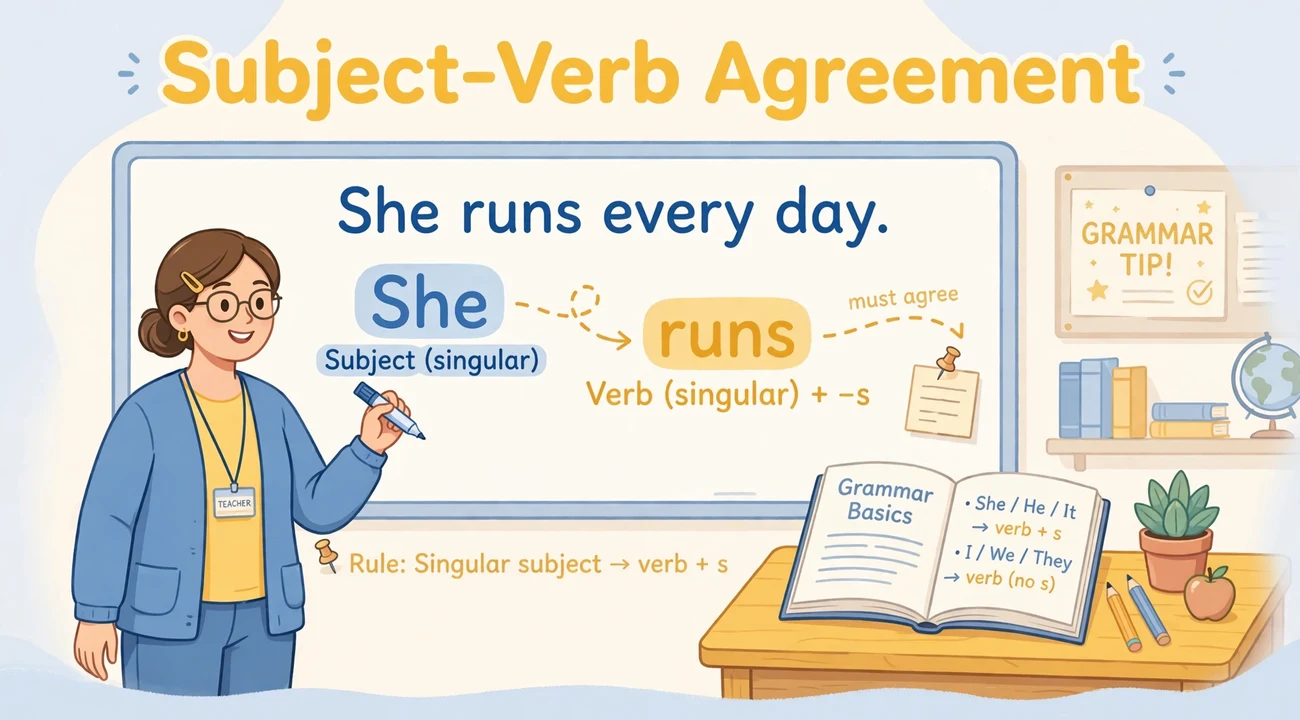
The subject and the verb in a sentence must match. This simple idea is called subject-verb agreement, and it is one of the most useful grammar rules in English. A singular subject takes a singular verb; a plural subject takes a plural verb.
She runs, not she run. They run, not they runs. In this subject-verb agreement guide, you will learn 8 simple rules, a 2-second trick, 40 clear examples, the most common mistakes, and a quick quiz to test yourself.
Just like learning then vs than, this rule looks small, but it changes almost every sentence you write. By the end, subject-verb agreement will feel easy.
The Quick Answer
The fastest way to understand subject-verb agreement is to see it side by side.
| Subject | Verb | Example |
|---|---|---|
| One person or thing (singular) | Verb + s or es | She writes every day. |
| More than one (plural) | Verb without s | They write every day. |
| I or you | Verb without s | I write. You write. |
The golden subject-verb agreement rule: Find the subject first, then match the verb to it. Ignore the extra words in the middle.
What Is Subject-Verb Agreement?
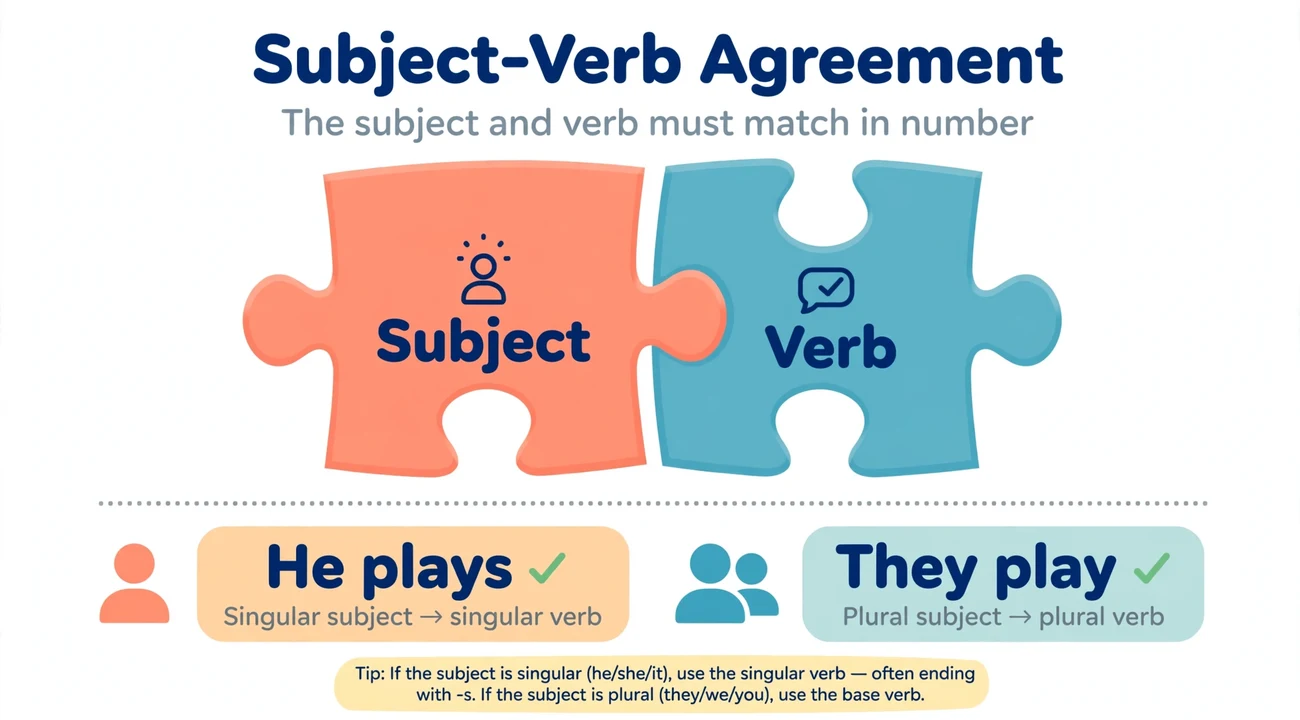
Subject-verb agreement means the subject and the verb in a sentence agree in number. Singular goes with singular, and plural goes with plural.
The subject is the person or thing that does the action. The verb is the action word.
- The dog barks. (dog = subject, barks = verb)
- The dogs bark. (dogs = subject, bark = verb)
- She is happy. (she = subject, is = verb)
- They are happy. (they = subject, are = verb)
Notice the pattern. In the present tense, a singular subject usually takes a verb with s at the end: she writes, he runs. A plural subject takes the verb without s: they write, the boys run. This one pattern is the heart of subject-verb agreement.
The verb be follows subject-verb agreement the same way: she is, he is, it is, they are, we are.
What Is a Subject? What Is a Verb?
The subject answers the question “who or what does the action?” In “Sara reads a book,” the subject is Sara. In “The birds sing,” the subject is the birds.
The verb answers the question “what does the subject do?” In “Sara reads a book,” the verb is reads. Verbs show an action (run, eat, play) or a state (is, are, seem).
| Sentence | Subject | Verb |
|---|---|---|
| Sara reads a book. | Sara | reads |
| The birds sing. | The birds | sing |
| My friends play football. | My friends | play |
When you can find the subject and the verb, subject-verb agreement becomes a simple match.
8 Simple Subject-Verb Agreement Rules
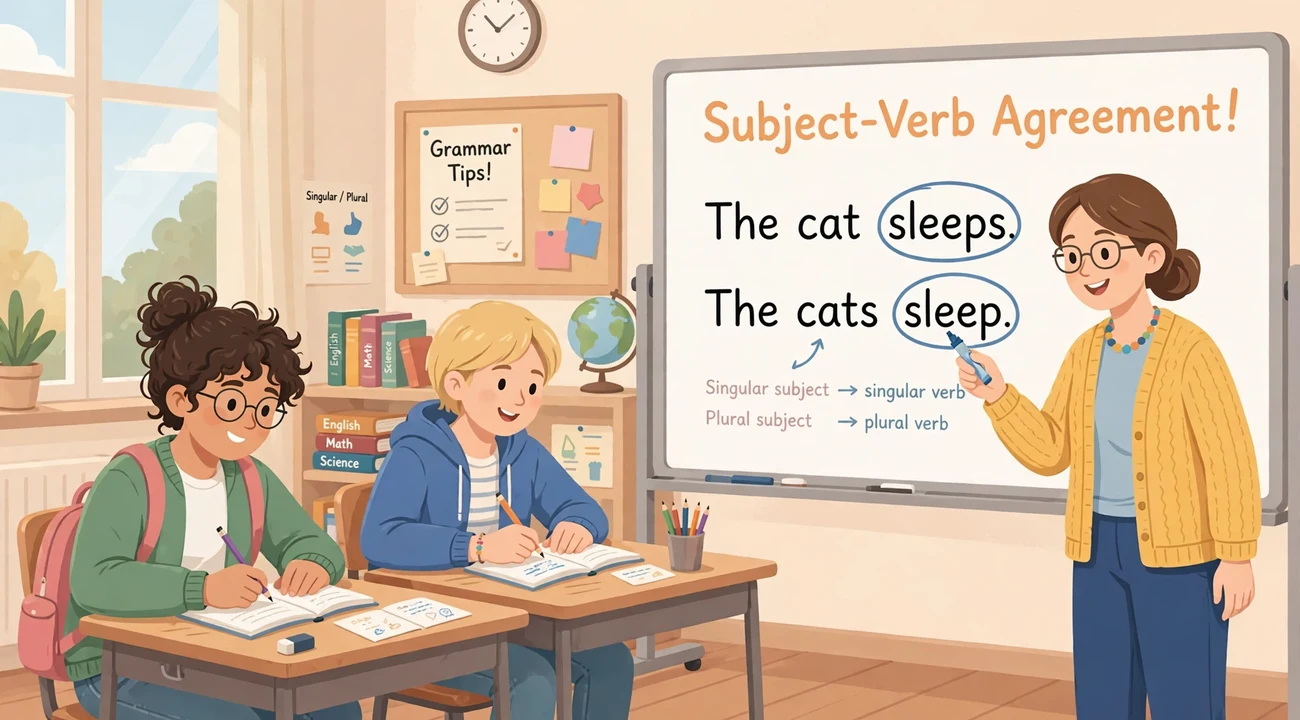
These 8 rules cover almost every sentence you will write.
Rule 1: Singular Subject, Singular Verb
One subject takes a verb with s or es.
- She sings every morning.
- The cat sleeps on the sofa.
Rule 2: Plural Subject, Plural Verb
More than one subject takes a verb without s.
- They sing every morning.
- The cats sleep on the sofa.
Rule 3: I and You Take a Plural-Form Verb
I and you always take a verb without s, even for one person.
- I am ready to go.
- You are my best friend.
Rule 4: Words Between Subject and Verb
Extra words often sit between the subject and the verb. Match the verb to the real subject, not to the nearest noun.
- The box of chocolates is on the table. (box is the subject, not chocolates)
- The students in the class are ready. (students is the subject, not class)
Our comma rules guide shows how commas often mark these extra words.
Rule 5: Two Subjects Joined by And
And joins two subjects into one plural subject, so the verb has no s.
- Tom and Jerry are good friends.
- Sara and Ali play tennis every Sunday.
Rule 6: Or, Either-Or, Neither-Nor
With or, either-or, or neither-nor, the verb matches the nearest subject.
- Neither the teacher nor the students are late. (students is nearer)
- Neither the students nor the teacher is late. (teacher is nearer)
Rule 7: Each, Every, Everybody, Someone, Nobody
These words feel plural, but they are singular: each, every, everybody, everyone, somebody, someone, anybody, anyone, nobody, no one.
- Everybody is welcome here.
- Someone is waiting outside.
This subject-verb agreement rule appears in exams often, so learn the list by heart.
Rule 8: Collective Nouns and Amounts
A collective noun names a group — team, family, class, crowd — and acts as one unit, so it takes a singular verb.
- The team wins every match.
- My family lives in Lahore.
Amounts of money, time, and distance also take a singular verb: “Ten dollars is too much.” “The news is good today.” See our guide to its vs it’s.
The 2-Second Subject-Verb Agreement Trick
Still not sure? This subject-verb agreement trick takes only two seconds.
Ask “who or what?” to find the subject. One → verb with s. More than one → verb without s.
Try the trick on these sentences:
- The girl ___ (sing / sings) well. The girl — one person — so use sings. ✅
- The girls ___ (sing / sings) well. The girls — more than one — so use sing. ✅
- The basket of apples ___ (is / are) full. The basket — one basket — so use is. ✅
Two seconds, two questions, and the trick works every time.
40 Subject-Verb Agreement Examples
Here are 40 examples: 20 singular, 20 plural.
Singular subjects:
- She reads every night.
- He plays football on Sunday.
- The baby cries when hungry.
- My mother cooks well.
- The sun rises early.
- A good teacher explains clearly.
- The dog barks at strangers.
- Sara writes poems.
- The train leaves at nine.
- Each child gets a gift.
- Everybody loves a happy ending.
- The news is good.
- Ten dollars is enough for lunch.
- The team practises every evening.
- My family eats dinner together.
- Neither Ali nor Sara is at home.
- The box of books is heavy.
- Someone is knocking at the door.
- The water is cold.
- This book is interesting.
Plural subjects:
- They read every night.
- The boys play football on Sunday.
- The babies cry when hungry.
- My parents cook well.
- The stars shine at night.
- Good teachers explain clearly.
- The dogs bark at strangers.
- Sara and Ali write poems.
- The trains leave at nine.
- All the children get a gift.
- The students love school.
- The results are good.
- These shoes are comfortable.
- The teams practise every evening.
- Our families eat dinner together.
- Neither the boys nor the girls are at home.
- The boxes of books are heavy.
- Many people are waiting outside.
- The mountains are snowy.
- These books are interesting.
For more examples, see the Purdue OWL guide to subject-verb agreement.
Common Mistakes
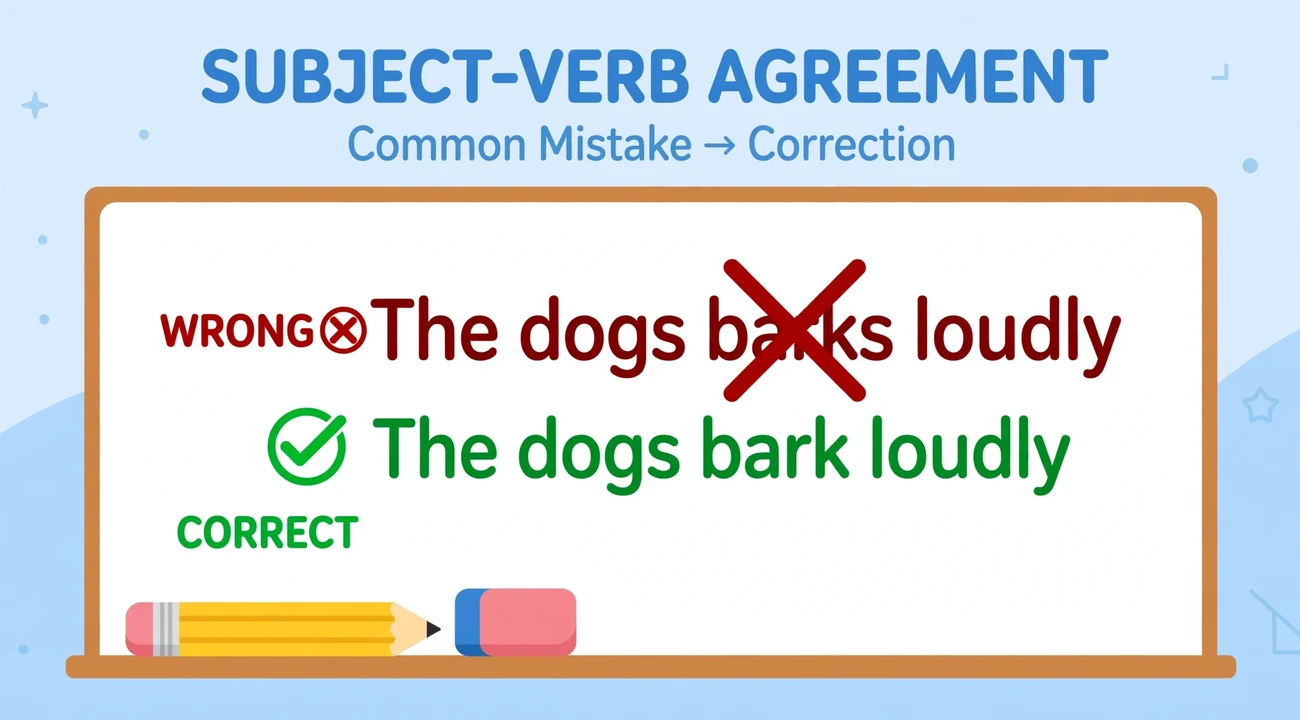
Even good writers make these subject-verb agreement mistakes.
Mistake 1: Adding s to the verb after a plural subject.
Wrong: “They runs fast.” Right: “They run fast.” A plural subject takes a verb without s.
Mistake 2: Matching the verb to the nearest noun instead of the subject.
Wrong: “The basket of apples are full.” Right: “The basket of apples is full.” The subject is basket, not apples.
Mistake 3: Using are with everybody or each.
Wrong: “Everybody are ready.” Right: “Everybody is ready.” Everybody, each, and someone are always singular.
Mistake 4: Using is with two subjects joined by and.
Wrong: “Sara and Ali is here.” Right: “Sara and Ali are here.” And makes the subject plural.
Mistake 5: Using are with news or ten dollars.
Wrong: “The news are bad.” Right: “The news is bad.” News and money amounts take a singular verb.
Apostrophes do not change this rule. If they still confuse you, our apostrophe rules guide clears them up. Practise with short English sentences until subject-verb agreement feels natural.
Quick Quiz: Test Yourself
Choose the correct verb to test your subject-verb agreement. Answers are at the end — no peeking!
- She ___ (write / writes) a letter every day.
- The boys ___ (is / are) playing in the park.
- Everybody ___ (is / are) invited to the party.
- The box of pens ___ (is / are) on the shelf.
- Neither the students nor the teacher ___ (is / are) here.
- Ten dollars ___ (is / are) too much.
- Tom and Jerry ___ (is / are) best friends.
- The team ___ (win / wins) every match.
Answers:
- writes — she
- are — the boys
- is — everybody is singular
- is — the subject is box
- is — teacher is nearer
- is — one total amount
- are — two subjects, and
- wins — a team is one group
8/8 — excellent! 6–7 — very good. Fewer than 6 — read the subject-verb agreement trick once more.
More practice: our grammar exercises have more sentences to test yourself.
Quick Summary
| Subject type | Verb form | Example |
|---|---|---|
| One person or thing | Verb + s | She writes. |
| More than one | Verb without s | They write. |
| I or you | Verb without s | I write. You write. |
| Each, every, everybody, someone | Verb + s | Everybody is ready. |
| Two subjects joined by and | Verb without s | Sara and Ali are here. |
| Or / either-or / neither-nor | Matches the nearer subject | Neither the boys nor Sara is here. |
| Collective nouns and amounts | Verb + s | The team wins. Ten dollars is enough. |
Keep this subject-verb agreement summary near your desk: find the subject first, then match the verb to it.
FAQs About Subject-Verb Agreement
What is subject-verb agreement in simple words?
It means the subject and the verb match in number: “she writes” (singular) and “they write” (plural).
How do I find the subject in a long sentence?
Ask “who or what does the action?” and ignore the extra words. In “The box of chocolates is on the table,” the subject is the box.
Does “everyone” take is or are?
Everyone takes is. Words like everyone, everybody, each, someone, and nobody are always singular, so write “Everyone is ready.”
Is it “the team is” or “the team are”?
Use “the team is.” A collective noun like team, family, or class acts as one unit, so it takes a singular verb.
What about “either the boys or the girl”?
The verb matches the nearer subject. In “Either the boys or the girl is coming,” girl is nearer, so use is.
Why does “ten dollars is” use a singular verb?
Ten dollars names one total amount, not ten separate things. Money, time, and distance work the same way.
Conclusion
It is a small rule with a big effect. Find the subject, ask one or more than one, and match the verb to it.
Practise subject-verb agreement with the 40 examples and the quiz here. Keep learning with GrammarLuck — grammar made simple.
