

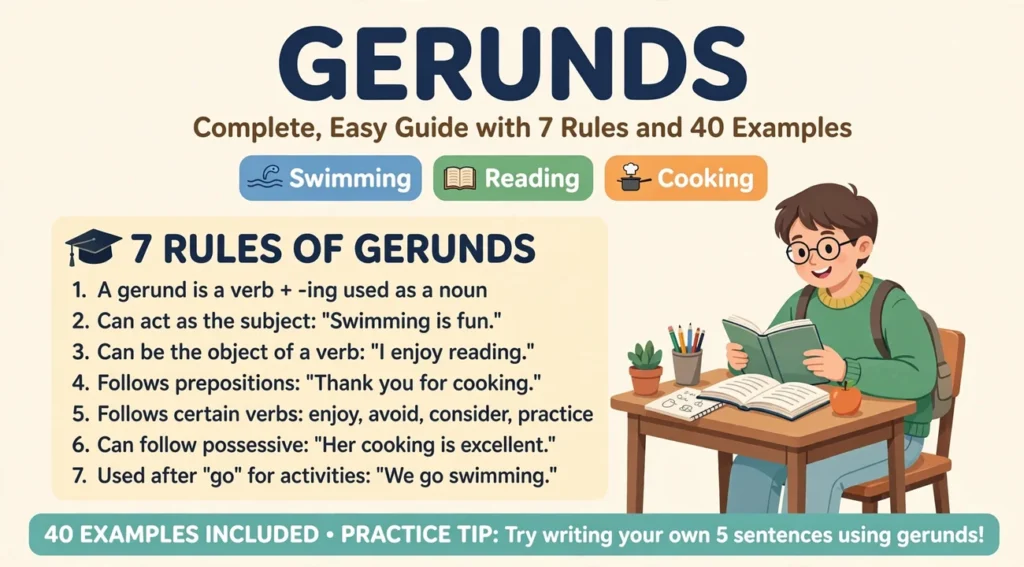
Swimming is fun. Reading is my hobby. Cooking takes time. In each sentence, the -ing word works like a noun — it names an activity. These -ing words are called gerunds. Once you learn how gerunds work, your sentences will sound more natural and correct.
Here is the short answer. A gerund is the -ing form of a verb used as a noun. In “Swimming is fun,” swimming acts as the subject of the sentence, just like a noun. That is the whole idea behind gerunds.
In this complete guide, you will learn what gerunds are, how to use them as subjects, objects, and after prepositions, 7 simple rules, a 2-second trick, 40 clear examples, common mistakes, and a quick quiz. By the end, using gerunds will feel easy and natural.
Gerunds: The Quick Answer
The fastest way to understand a gerund is to compare it with other verb forms.
| Form | What it does | Example |
|---|---|---|
| Gerund | Acts like a noun | Swimming is fun. |
| Infinitive | To + verb, also acts like a noun | To swim is fun. |
| Base verb | Acts like a verb | I swim every day. |
The key point about gerunds is simple: a gerund names an activity. Swimming, reading, and cooking are activities, so they can work as nouns.
What Are Gerunds?
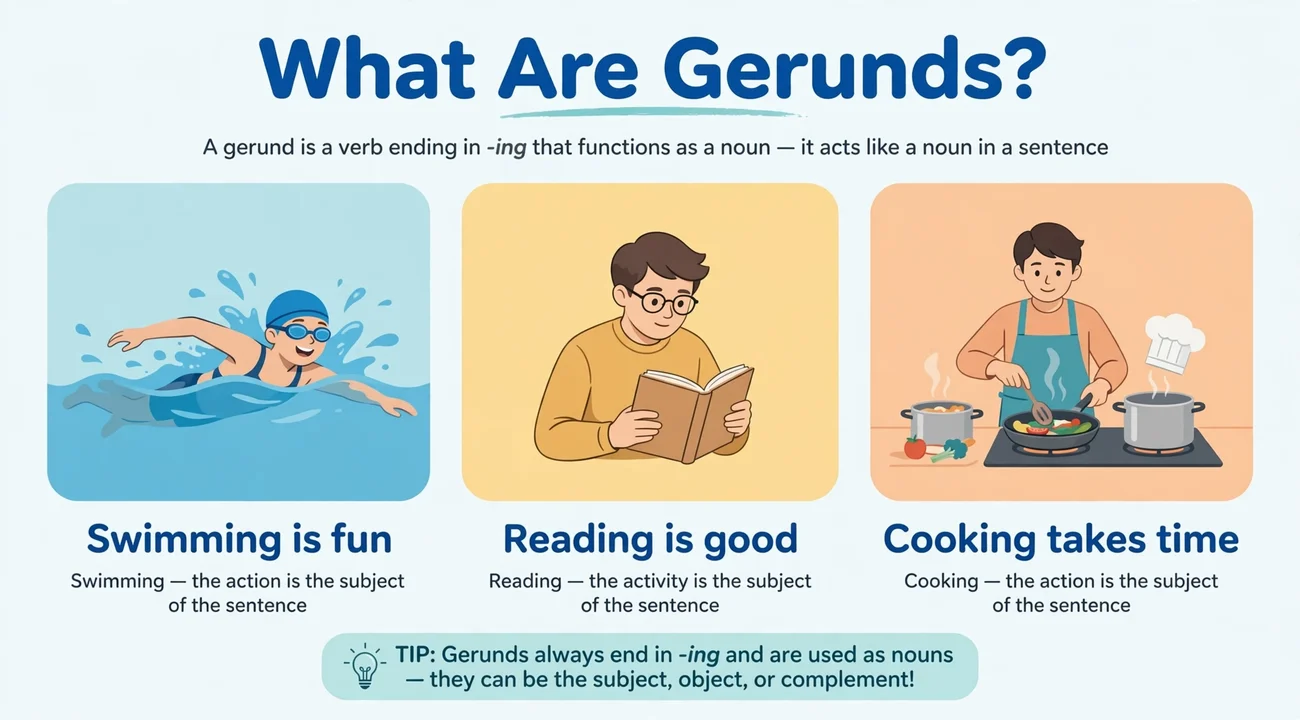
A gerund is the -ing form of a verb that works as a noun. Take the verb swim. Add -ing, and you get swimming. In “Swimming is good exercise,” swimming is the subject — the same job a noun does. In “I love swimming,” it is the object. The form never changes, but the job can change.
- Swimming is my favourite sport. (subject)
- I enjoy reading. (object)
- She is good at cooking. (after a preposition)
- Running keeps me fit. (subject)
- We talked about travelling. (after a preposition)
Gerunds always end in -ing, but not every -ing word is a gerund. In “I am swimming now,” swimming is part of the verb, not a noun. The test is simple: if the -ing word does a noun’s job, it is a gerund.
Gerunds come from verbs, so it helps to know your verbs well.
Gerunds as Subjects
A gerund can be the subject of a sentence — the word that does the action, or the thing we talk about. Put the -ing form at the start, and it works like a noun subject.
- Swimming keeps you healthy.
- Reading opens new worlds.
- Cooking at home saves money.
- Learning English takes time.
- Walking feels fresh.
A gerund subject takes a singular verb: “Swimming is fun,” not “Swimming are fun.” The activity is one thing, so the verb stays singular. This is the same idea you learn in our guide to subject-verb agreement.
Gerunds as Objects
A gerund can also be the object of a verb — the word that receives the action. Many verbs, like enjoy, love, hate, finish, and avoid, are followed by a gerund. This pattern is very common in daily English.
| Verb | Example |
|---|---|
| enjoy | I enjoy swimming. |
| love | She loves reading. |
| finish | They finished cleaning the house. |
| hate | He hates waiting. |
| stop | We stopped talking and listened. |
Some verbs take a gerund, and some take an infinitive. We say “I enjoy reading,” but “I want to read.” You learn the verb list by practice. A gerund object works just like a noun object: in “I love reading,” reading does the same job as “books” in “I love books.” If you know your nouns, this pattern will feel familiar.
Gerunds After Prepositions
After a preposition — words like in, on, at, about, for, and before — we always use a gerund, never the base verb. This rule has no exceptions.
- I am interested in learning French.
- She is good at drawing.
- Thank you for helping me.
- He left without saying goodbye.
- We talked about moving.
- I am tired of waiting.
Remember the pattern: preposition + -ing. “Interested in learn” is wrong; “interested in learning” is right.
7 Simple Gerund Rules
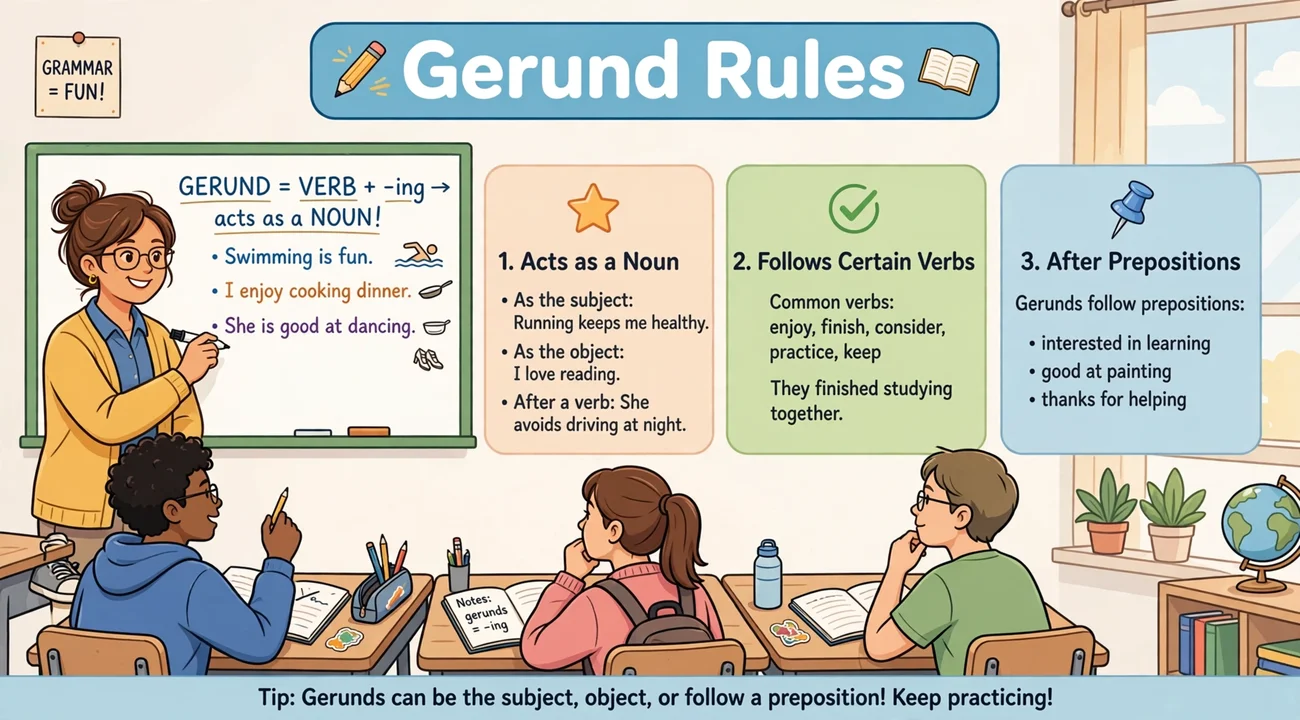
These 7 rules cover everything you need to use gerunds with confidence. Learn them one by one, and practise each with your own sentences.
Rule 1: Add -ing to the Base Verb
Most verbs simply add -ing, and the base verb stays the same.
- read → reading
- play → playing
- talk → talking
Rule 2: Drop the Silent e
If a verb ends in a silent e, drop the e: make → making, write → writing, dance → dancing. But keep the e in be → being and see → seeing.
Rule 3: Double the Last Letter
For short verbs with one vowel and one consonant at the end, double the last letter.
- run → running
- swim → swimming
- stop → stopping
- sit → sitting
Rule 4: A Gerund Subject Takes a Singular Verb
Swimming is fun. Reading helps you learn. The verb stays singular, because one activity counts as one thing.
Rule 5: Use a Gerund After a Preposition
After in, on, at, about, for, before, and without, always use the -ing form: “good at cooking,” “tired of waiting,” “before leaving.”
Rule 6: Some Verbs Are Always Followed by a Gerund
Enjoy, finish, avoid, practise, suggest, and keep are followed by a gerund: “I enjoy reading,” “She finished writing,” “We avoid driving at night.” Learn them as a small group.
Rule 7: Do Not Mix a Gerund with a Present Continuous Verb
In “I am reading now,” reading is part of the verb phrase, not a gerund. The -ing form looks the same, but the job is different. If you are not sure, ask: does this -ing word do a noun’s job? Our guide to the present continuous tense shows the verb side of -ing forms in full.
The 2-Second Gerund Trick
Still not sure if an -ing word is a gerund? Use this quick trick. It takes only two seconds.
Step 1: Try to replace the -ing word with “it” or “this activity.”
Step 2: Read the sentence again.
Step 3: If the sentence still makes sense, the word is a gerund.
Try the trick on these examples:
- “Swimming is fun.” → “It is fun.” ✅ Makes sense — swimming is a gerund.
- “I am swimming now.” → “I am it now.” ❌ Silly — swimming is a verb here, not a gerund.
- “I love reading.” → “I love it.” ✅ Makes sense — reading is a gerund.
This trick works because a gerund does a noun’s job, and “it” can take a noun’s place.
40 Gerunds Examples
Here are 40 simple examples. The first 20 show gerunds as subjects and objects, and the next 20 show them after prepositions. You can find more patterns in our collection of simple English sentences.
As subjects and objects:
- Swimming is my favourite sport.
- Reading every day builds vocabulary.
- Cooking at home is cheaper.
- I enjoy listening to music.
- She loves dancing in the rain.
- Running in the morning keeps me fresh.
- Learning a new language takes time.
- He finished writing his essay.
- We avoid travelling at night.
- Singing makes her happy.
- Gardening is a relaxing hobby.
- They started building the house.
- I hate waiting in long queues.
- Painting helps me relax after work.
- Driving in the rain needs care.
- She practises the piano every day.
- Fishing by the river is calm.
- Studying late at night is a bad habit.
- He suggested going to the park.
- Watching films is a fun way to learn.
After prepositions and in everyday phrases:
- I am good at drawing.
- She is interested in learning Spanish.
- Thank you for coming.
- He left without saying a word.
- We talked about buying a new car.
- I am tired of doing the same work.
- She apologised for being late.
- Are you afraid of speaking in public?
- He is used to getting up early.
- I look forward to meeting you.
- She insisted on paying the bill.
- We succeeded in finishing the project.
- He is busy preparing for exams.
- I dream of travelling the world.
- She is fond of reading.
- They are thinking about moving.
- He gave up smoking last year.
- I am keen on learning to cook.
- She prevented him from leaving.
- We spent the evening playing games.
For trusted reference reading on this topic, the Grammarly guide to gerunds explains the same ideas with extra examples.
Common Gerunds Mistakes
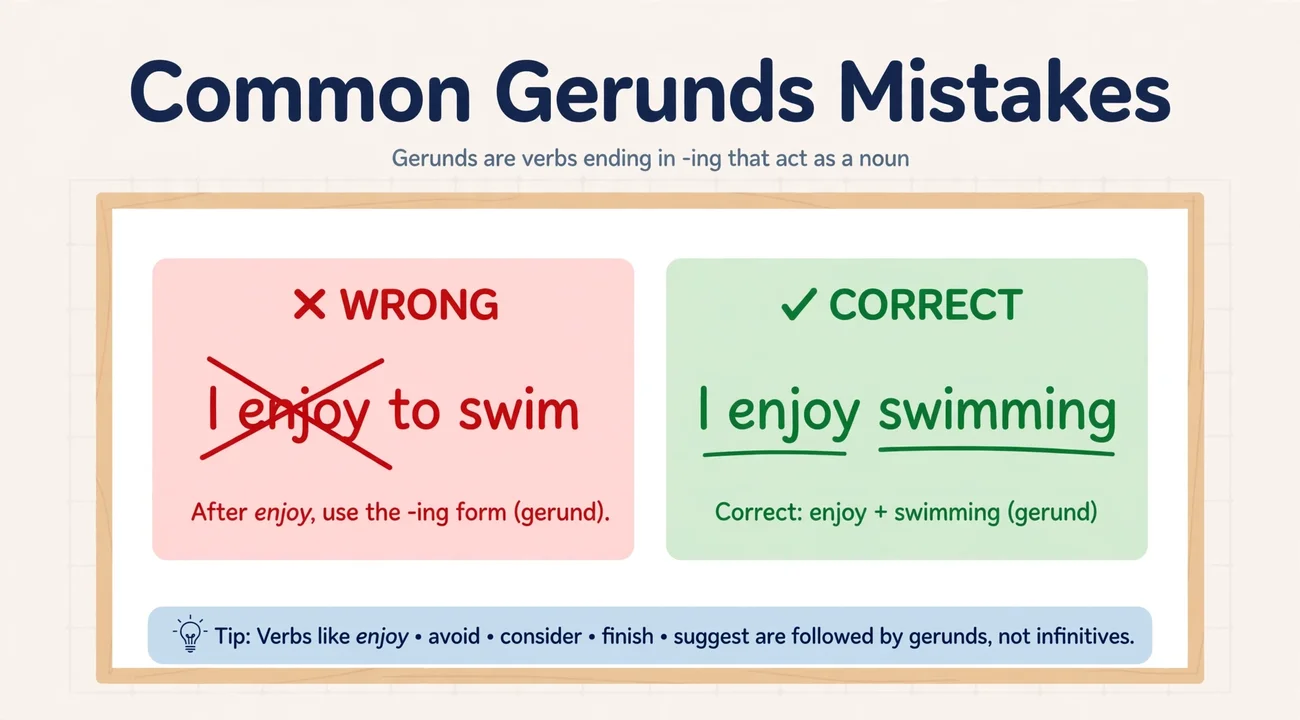
Even good learners make mistakes with gerunds. Learn them once.
Mistake 1: Using the base verb after a preposition.
Wrong: “I am good at draw.” Right: “I am good at drawing.” After a preposition, always use the -ing form.
Mistake 2: Using a plural verb with a gerund subject.
Wrong: “Swimming are fun.” Right: “Swimming is fun.” A gerund subject takes a singular verb.
Mistake 3: Forgetting to double the last letter.
Wrong: “He is runing fast.” Right: “He is running fast.” Short verbs double the last letter before -ing.
Mistake 4: Using an infinitive after enjoy.
Wrong: “I enjoy to read books.” Right: “I enjoy reading books.” Enjoy is followed by a gerund, not an infinitive.
Quick Quiz: Gerunds
Choose the correct -ing form for each sentence. Answers are at the end — no peeking! For more practice, try our grammar exercises.
- ___ (swim) every day keeps you fit.
- I enjoy ___ (read) before bed.
- She is good at ___ (draw).
- They finished ___ (clean) the house.
- He is interested in ___ (learn) French.
- ___ (run) in the morning is my habit.
- Thank you for ___ (help) me.
- We talked about ___ (move) to a new city.
Answers:
1. Swimming (a gerund as the subject)
2. reading (after enjoy)
3. drawing (after the preposition at)
4. cleaning (after finished)
5. learning (after the preposition in)
6. Running (a gerund as the subject)
7. helping (after the preposition for)
8. moving (after the preposition about)
How did you do? 8/8 — excellent, you have mastered gerunds! 6–7 — very good. Fewer than 6 — read the 7 rules once more and try again.
Gerunds Quick Summary
| Point | Rule | Example |
|---|---|---|
| Form | Verb + -ing | swimming, reading |
| Job | Works like a noun | Swimming is fun. |
| As subject | Takes a singular verb | Reading helps you learn. |
| As object | Follows verbs like enjoy | I enjoy reading. |
| After a preposition | Always -ing | Good at cooking. |
The answer is simple: an -ing word that does a noun’s job is a gerund. Keep this table near your desk until gerunds feel automatic.
FAQs About Gerunds
What is a gerund in simple words?
A gerund is the -ing form of a verb used as a noun. In “Swimming is fun,” swimming is a gerund because it works as the subject.
Is every -ing word a gerund?
No. In “I am swimming,” swimming is part of the verb. It is a gerund only when it does a noun’s job.
What is the difference between a gerund and a present participle?
They look the same, but their jobs are different. A gerund works as a noun (“Reading is fun”), and a present participle works as part of a verb or as a describing word (“I am reading”).
Can a gerund be the object of a sentence?
Yes. In “I enjoy reading,” reading is the object of enjoy. Verbs like enjoy, finish, and avoid are followed by a gerund.
Which verbs are followed by a gerund?
Common ones are enjoy, finish, avoid, practise, suggest, keep, mind, and consider — for example, “I enjoy swimming” and “She finished writing.”
Does a gerund take a singular or plural verb?
A gerund subject always takes a singular verb: “Swimming is fun,” “Reading helps you learn.” The activity counts as one thing.
Conclusion
A gerund is a small word with a big job. It starts as a verb, adds -ing, and then works like a noun — as a subject, an object, or after a preposition. Learn the 7 rules for gerunds and use the 2-second trick.
Keep using gerunds in your own sentences. For more simple lessons like this, keep learning with GrammarLuck — grammar made simple.
