

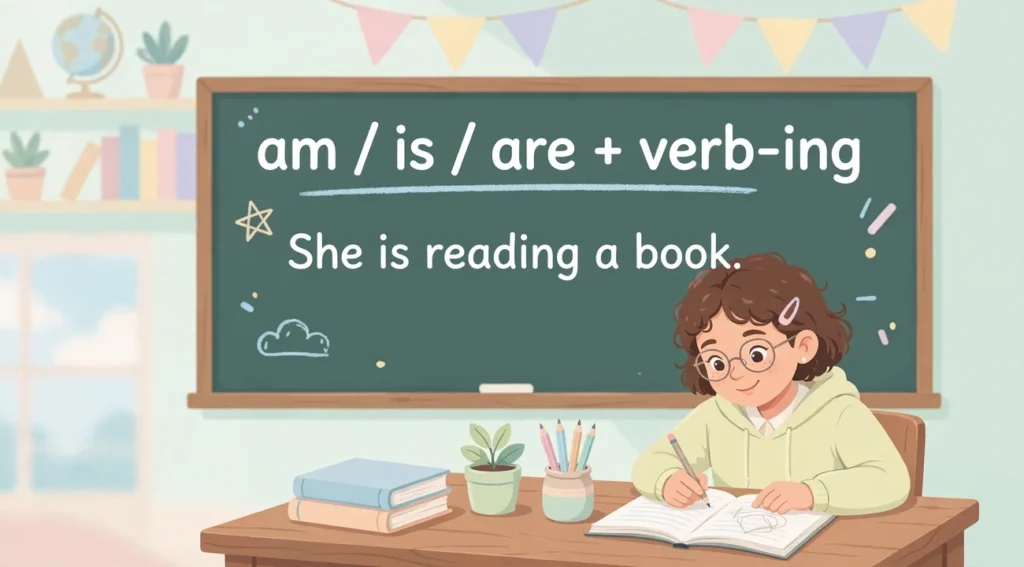
The present continuous tense is one of the most useful tenses in English. It talks about an action that is happening right now, at this moment. When you say “I am reading a book,” the reading is happening now.
Many learners mix up the present continuous tense with the present simple. They say “I read a book now” when they mean the action is happening at this moment. The present simple talks about a habit or a fact, while this tense talks about an action that is in progress now.
In this guide, you will learn the meaning, the form, 5 simple rules, a 2-second trick, 40 examples, common mistakes, and a quick quiz.
Present Continuous Tense: The Quick Answer
The fastest way to understand it is to see it next to the present simple.
| Tense | When to use it | Example | Time words |
|---|---|---|---|
| Present continuous tense | Action happening right now | I am reading a book now. | now, at the moment, today |
| Present simple | Habit, fact, or routine | I read a book every day. | every day, always, usually |
The golden rule: use this tense when the action is happening now. Use the present simple for a habit or a fact. “She is cooking now” — the cooking is happening at this moment. “She cooks every day” — that is a habit. For a refresher on the other side of this pair, read our guide to the present simple tense.
What Is the Present Continuous Tense?
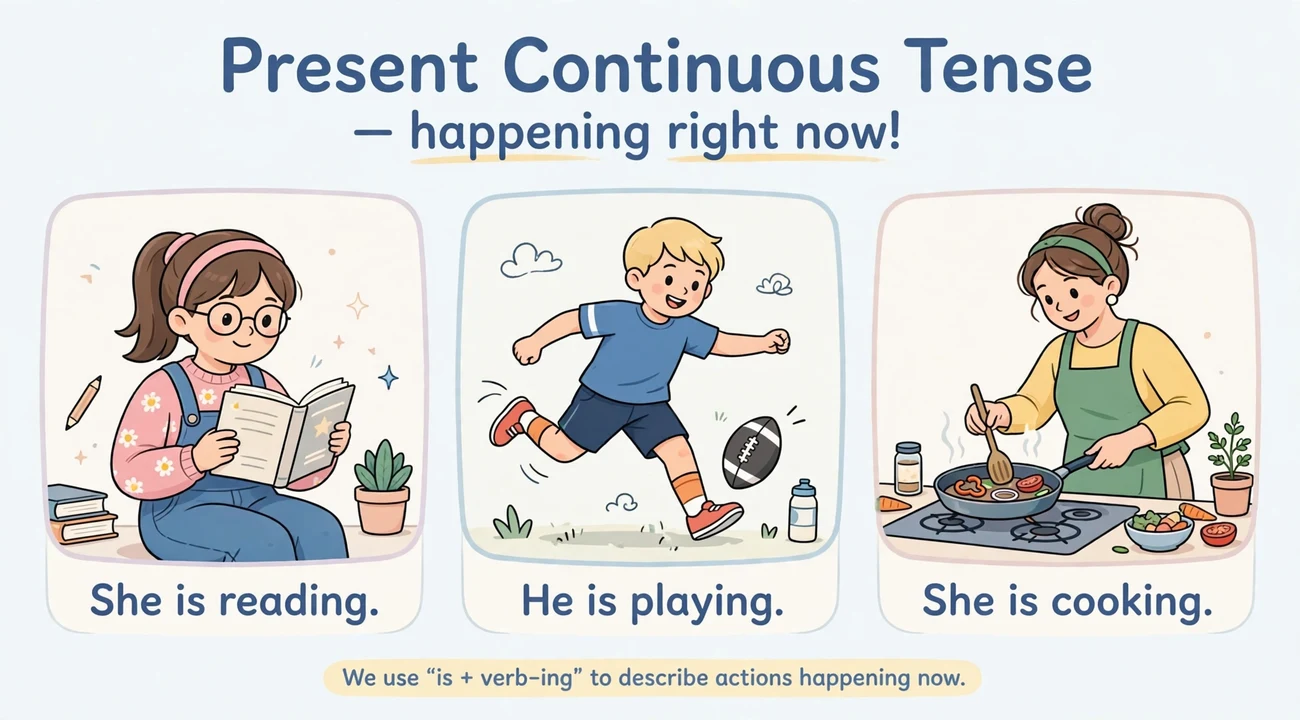
The present continuous tense talks about an action that is happening now, at the moment of speaking. It is the present partner of the past continuous tense.
For example: “I am writing an email now.” — the writing is happening now, not yesterday and not tomorrow.
The form is simple: am / is / are + verb-ing. Use am with I, is with he, she, and it, and are with you, we, and they. The -ing form never changes. You only change am, is, or are to match the subject.
| Subject | Form | Example |
|---|---|---|
| I | am + verb-ing | I am reading now. |
| He / she / it | is + verb-ing | She is reading now. |
| You / we / they | are + verb-ing | They are reading now. |
To make a negative, add not after am, is, or are: “I am not working today” and “She is not sleeping now.” To ask a question, put am, is, or are first: “Are you coming with us?” and “Is he studying now?” To check how subjects and verbs agree in other tenses, read our guide to subject-verb agreement.
The spelling of the -ing form is easy. Most verbs just add -ing: read becomes reading. If a verb ends in e, drop the e first: make becomes making. If a short verb ends in one vowel and one consonant, double the last letter: run becomes running.
5 Simple Present Continuous Tense Rules

Rule 1: Use It for an Action Happening Right Now
Use the present continuous tense for an action that is happening at the moment of speaking.
- I am writing a letter now.
- She is watching TV at the moment.
Rule 2: Use It for a Temporary Action
Use this tense for an action that is true for a short time only, like a short job or a short stay. It is not a habit for life. If an action started in the past and is still true now, you may need the present perfect tense instead.
- I am staying with my uncle this week.
- He is working in a shop these days.
Rule 3: Use It for a Planned Action in the Near Future
Use the present continuous tense for a plan that is already fixed, often with a time word like tonight, tomorrow, or next week.
- We are meeting Ali tomorrow.
- I am flying to London on Monday.
Rule 4: Use It for a Changing Action
Use this tense for something that is changing, growing, or getting better or worse over time.
- The weather is getting colder these days.
- Her English is improving every week.
Rule 5: Use It with Time Words for Now
Time words like now, at the moment, today, this week, these days, look!, and listen! often appear with this tense.
- Look! It is raining now.
- Listen! Someone is calling your name.
The 2-Second Present Continuous Tense Trick
Still not sure? Ask yourself one question: “Is it happening now?”
Step 1: Look at the time in the sentence. Is it now, today, or this week?
Step 2: Ask: is the action in progress at this time?
Step 3: If yes, use the present continuous tense. If it is a habit or a fact, use the present simple.
Try the trick on these sentences:
- “I am reading now.” — reading is happening now, so this tense is right.
- “I read every day.” — that is a habit, so the present simple is right.
Keep this trick in mind, and the choice will soon feel natural.
40 Present Continuous Tense Examples
Here are 40 simple examples of the present continuous tense — the first 20 are affirmative, and the next 20 are negative sentences, questions, and temporary actions.
Affirmative — am / is / are + verb-ing:
- I am reading a book now.
- She is cooking dinner at the moment.
- They are playing football in the park.
- He is driving to work today.
- We are watching a film tonight.
- The baby is sleeping now.
- I am writing an email to my teacher.
- She is teaching English this year.
- They are building a new house.
- He is running in the park.
- We are having lunch at home today.
- The sun is shining brightly today.
- I am learning to swim this summer.
- She is singing a sweet song.
- They are staying with us this week.
- He is fixing his car at the moment.
- We are celebrating Ali’s birthday today.
- The teacher is checking our homework now.
- I am living in a new city these days.
- She is drawing a picture for her mother.
Negative, questions, and temporary actions:
- I am not working today.
- She is not coming to school now.
- They are not using the car this week.
- He is not sleeping at the moment.
- We are not meeting them today.
- Are you coming to the party tonight?
- Is she waiting at the station now?
- Are they playing cricket today?
- Is he using his laptop at the moment?
- Are you staying here for a week?
- Are you going to the market this evening?
- Is it raining outside now?
- I am studying for my exam this week.
- She is looking for a new job these days.
- We are visiting our grandparents tomorrow.
- He is travelling to Dubai next week.
- They are moving to a new house this month.
- My brother is learning French these days.
- The price of rice is rising these days.
- I am reading a new novel this week.
You can also use this tense in the passive voice — learn how in our guide to active vs passive voice. For more reading, see the Present continuous on Wikipedia page.
Common Present Continuous Tense Mistakes
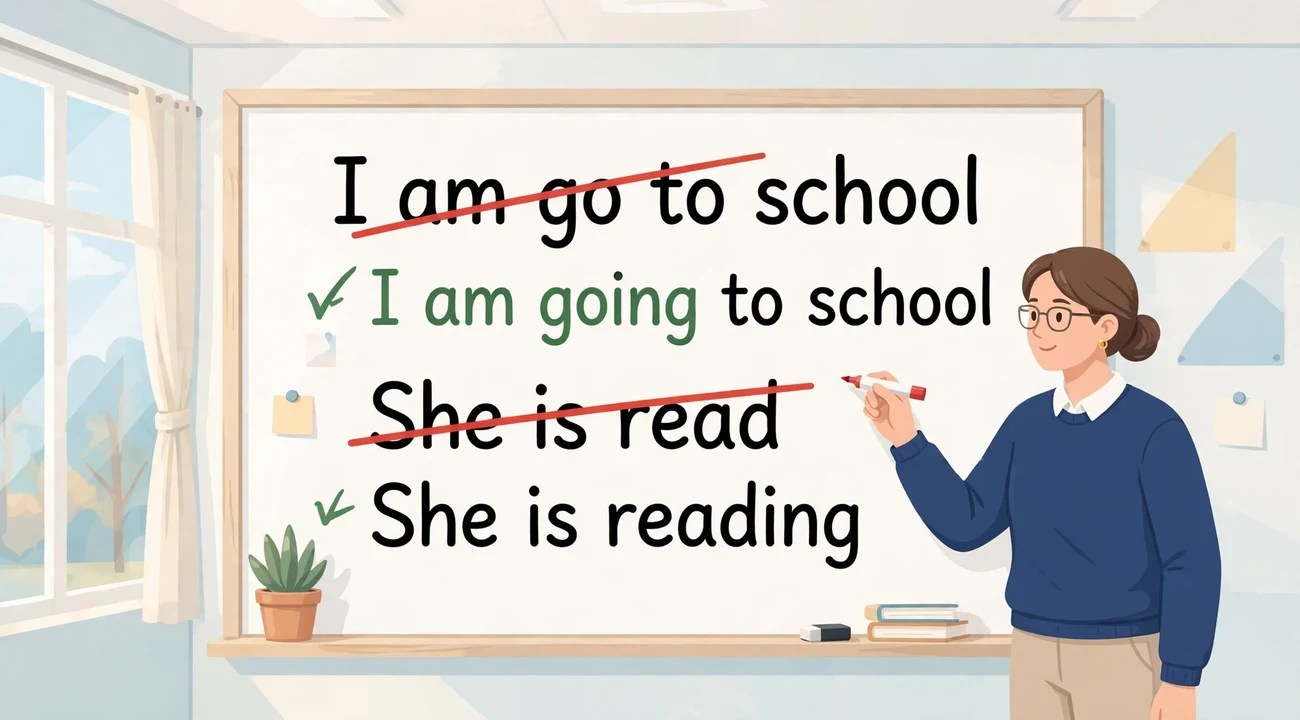
Even good learners make these present continuous tense mistakes — learn them once and avoid them.
Mistake 1: Using the present simple for an action happening now.
Wrong: “I read a book now.” Right: “I am reading a book now.” When the action is happening now, use this tense, not the present simple.
Mistake 2: Forgetting am, is, or are.
Wrong: “She cooking dinner now.” Right: “She is cooking dinner now.” The words am, is, and are are part of the form — never leave them out.
Mistake 3: Using the base verb instead of verb-ing.
Wrong: “I am read a book now.” Right: “I am reading a book now.” After am, is, or are, always use the -ing form of the verb.
Mistake 4: Using this tense with a state verb.
Wrong: “I am knowing the answer.” Right: “I know the answer.” Verbs like know, like, love, hate, want, need, and belong show a state, not an action, so they do not take the -ing form in this tense.
Mistake 5: Spelling the -ing form in the wrong way.
Wrong: “She is makeing a cake.” Right: “She is making a cake.” Drop the e before -ing: make becomes making, and write becomes writing. Also double the last letter in run: run becomes running.
Quick Quiz: Present Continuous Tense
Fill in the correct form — answers are below!
- I ___ (read) a book now.
- She ___ (cook) dinner at the moment.
- They ___ (not come) to school today.
- ___ you ___ (wait) for the bus now?
- He ___ (drive) to work today.
- We ___ (have) lunch at home today.
- Look! It ___ (rain) outside now.
- She ___ (not sleep) at the moment.
Answers:
1. am reading
2. is cooking
3. are not coming
4. Are, waiting
5. is driving
6. are having
7. is raining
8. is not sleeping
How did you do? 8/8 — excellent! 6–7 — very good. Fewer than 6 — read the trick once more.
Present Continuous Tense: Quick Summary
| Use | Example | Time words |
|---|---|---|
| Action happening right now | I am reading a book now. | now, at the moment |
| Temporary action | I am staying with my uncle this week. | this week, these days |
| Planned action in the near future | We are meeting Ali tomorrow. | tomorrow, next week |
| Changing action | The weather is getting colder. | these days, now |
| With a time word for now | Look! It is raining now. | look!, listen!, today |
The present continuous tense feels hard for a week — then easy for life.
FAQs About the Present Continuous Tense
What is the present continuous tense in simple words?
It talks about an action that is happening now, at the moment of speaking. It is formed with am, is, or are + verb-ing, as in “I am reading now.”
How do I form the present continuous tense?
Use am / is / are + verb-ing for every subject: “I am reading,” “She is reading,” “They are reading.” For a negative, add not: “I am not reading.” For a question, put am, is, or are first: “Are you reading?”
What is the difference between the present continuous tense and the present simple?
This tense shows an action happening now: “I am reading now.” The present simple shows a habit or a fact: “I read every day.” Use the time in the sentence to choose the right one.
What time words do we use with the present continuous tense?
The most common ones are now, at the moment, today, this week, these days, tonight, tomorrow, look!, and listen!
Can I use the present continuous tense for future plans?
Yes. “We are meeting Ali tomorrow” is correct. Use it when the plan is already fixed and a future time word is in the sentence.
Is “I am knowing the answer” correct?
No. Know is a state verb, not an action verb. State verbs like know, like, love, want, and need do not take the -ing form. The correct sentence is “I know the answer.” Always check the verb before you add -ing.
Conclusion
The present continuous tense is smaller than it looks. One form — am, is, or are + verb-ing — covers an action happening now, a short plan, a change, and a future plan. Remember: if the action is happening now, use the present continuous tense.
Practise with the examples and quiz in this guide, and soon you will choose the right tense without thinking. You can also practise building these sentences in new forms with our guide to the types of sentences.
