

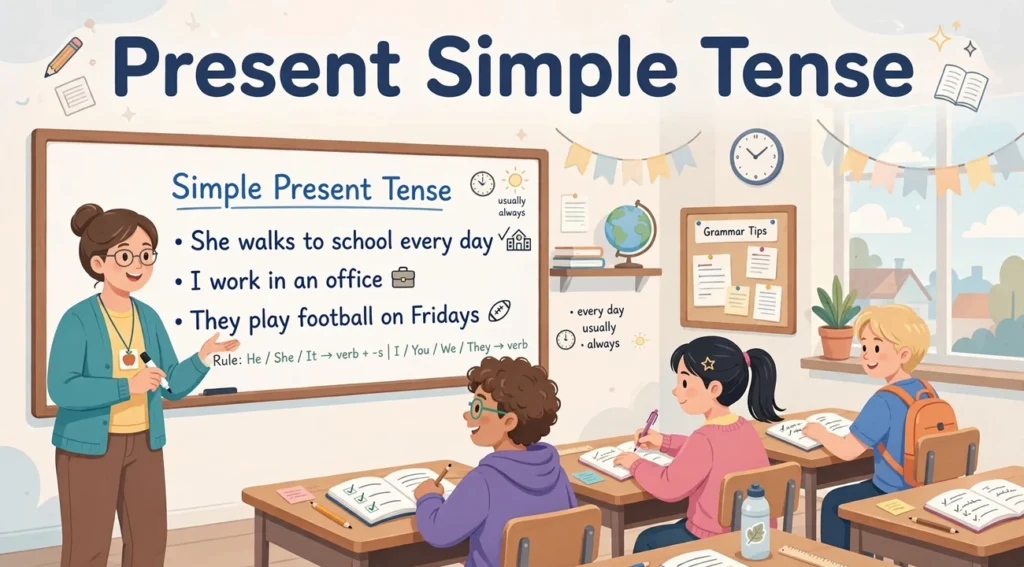
The present simple tense is the first verb tense every English learner meets, and it is also the one you will use the most. We use it for facts, daily habits, routines, and things that are always true. The sun rises in the east. I drink tea every morning. She works in a bank. These are all present simple tense sentences.
Most of the time, you only need the base form of the verb — play, eat, go, work. You only change it for he, she, or it. In this present simple tense guide, you will learn when to use it, the 5 rules, a 2-second trick, 40 examples, common mistakes, and a quick quiz.
By the end, you will build these sentences without stopping to think.
Present Simple Tense: The Quick Answer
The fastest way to understand this tense is to see it in a small table.
| Subject | Verb | Example |
|---|---|---|
| I / you / we / they | base form | I play football on Sundays. |
| he / she / it | base form + s / es | She plays football on Sundays. |
The golden present simple tense rule: use the base form for I, you, we, and they. Add -s or -es only for he, she, and it. That one change is the heart of this tense.
What Is the Present Simple Tense?
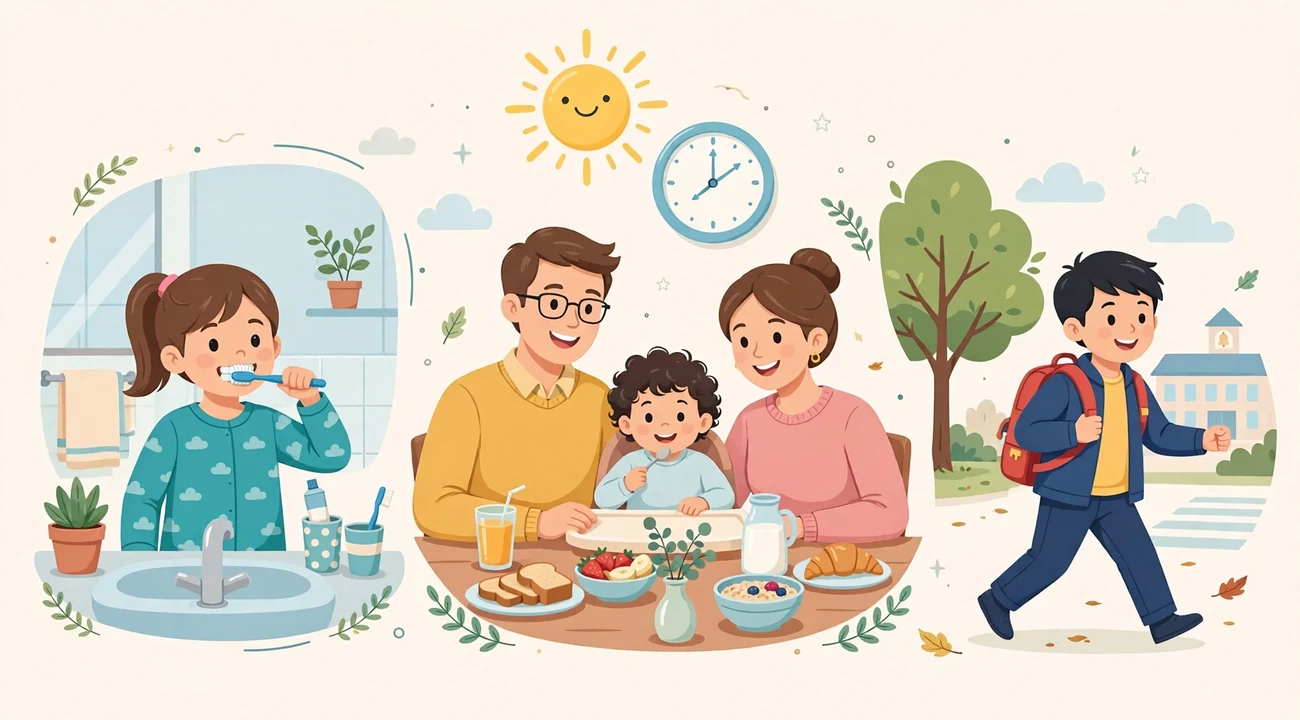
The present simple tense is the verb form we use for things that happen again and again, things that are true all the time, and things that follow a set plan. It does not talk about one moment happening right now — it talks about the normal pattern of life.
- Water boils at 100 degrees.
- Ali walks to school every day.
- They live in Lahore.
In short, this tense answers the question “What usually happens?” See our guide to Subject-Verb Agreement for the same -s rule.
When Do We Use the Present Simple Tense?
We use this tense in five main situations.
1. Facts and General Truths
Use it for things that are always true.
- The Earth moves around the Sun.
- Dogs are loyal animals.
2. Habits and Routines
Use it for things you do again and again.
- I brush my teeth twice a day.
- We visit our grandparents every Friday.
3. Schedules and Time Tables
Use it for buses, trains, classes, and other fixed plans.
- The train leaves at 7:30.
- Our class starts at 8 o’clock.
4. Feelings, Likes, and Thoughts
Verbs that show a state of mind — like, love, know, want — take this tense.
- I love chocolate ice cream.
- She knows the answer.
5. Instructions and Directions
Use it to give steps and directions.
- First, you mix the flour and sugar.
- He adds salt to the soup.
These five uses cover almost every sentence you will meet.
How to Form the Present Simple Tense: A 2-Second Trick
Look at the subject first, then pick the verb form.
Step 1: Find the subject — who or what does the action?
Step 2: For I, you, we, or they, use the base verb: I work, they work.
Step 3: For he, she, or it, add -s or -es: He works, she works.
Try the trick:
- “She (play) tennis.” → She plays tennis. ✅
- “They (play) tennis.” → They play tennis. ✅
When you feel stuck, ask: is the subject he, she, or it? If yes, add -s.
For questions and negatives, use do or does. Do goes with I, you, we, and they; does goes with he, she, and it. After do or does, the main verb goes back to its base form.
- Do you like mangoes? Yes, I do.
- Does he like mangoes? Yes, he does.
- I do not (don’t) eat meat.
5 Simple Present Simple Tense Rules
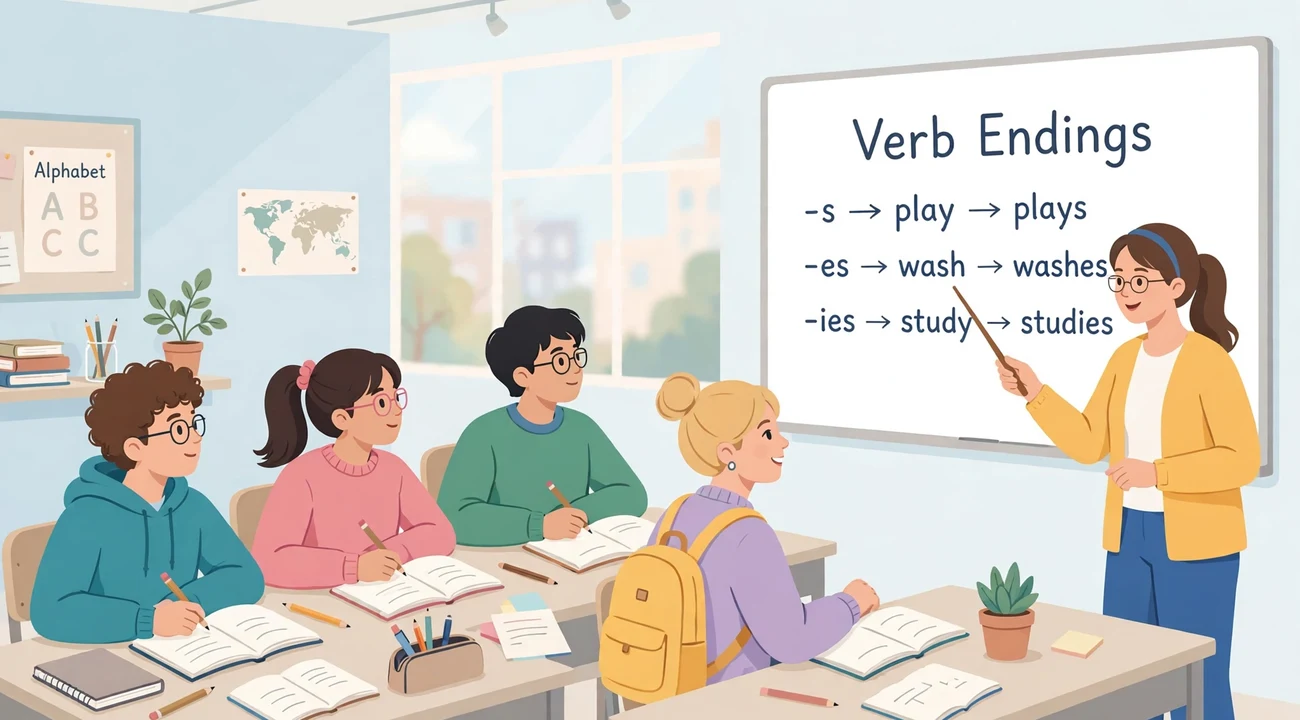
Rule 1: Add -s to Most Verbs for He, She, and It
For most verbs, just add -s when the subject is he, she, or it: He plays cricket. She reads books.
Rule 2: Add -es After -s, -x, -z, -ch, and -sh
When a verb ends in -s, -x, -z, -ch, or -sh, add -es: He watches TV. He washes his hands.
Rule 3: Change -y to -ies After a Consonant
When a verb ends in a consonant plus -y, change the y to i and add -es: She studies English. When a vowel comes before the y, just add -s: He plays.
Rule 4: After Do and Does, Use the Base Form
In questions and negatives, the -s moves to does: Does she play tennis? (not “Does she plays?”) He doesn’t like cold coffee. (not “He doesn’t likes?”)
Rule 5: Keep the Same Tense for Repeated Actions
In a routine with two or more actions, keep every verb in the same tense: Every morning, Ali wakes up, brushes his teeth, and eats breakfast.
These five rules are the whole grammar of the present simple tense. Learn the spelling changes, remember rule 4, and your sentences will be correct almost every time. See our 100 English sentences with examples for more daily practice.
Present Simple Tense vs Present Continuous
One talks about what usually happens; the other talks about what is happening right now.
| Point | Present Simple Tense | Present Continuous Tense |
|---|---|---|
| Use | Habits, facts, routines | Actions happening right now |
| Form | base verb / verb + s | am / is / are + verb-ing |
| Example | I read every night. | I am reading now. |
| Time words | always, every day, usually | now, at the moment, today |
“She works in a bank” means it is her job. “She is working in a bank” means she is there at this moment. Read our guide to Active vs Passive Voice, and see Simple present on Wikipedia.
40 Present Simple Tense Examples
The first 20 are affirmative, the next 10 are negative, and the last 10 are questions.
Affirmative (1–20):
- I wake up at 6 o’clock every day.
- She teaches maths at a school.
- They play football on Fridays.
- He drives to work every morning.
- We eat dinner together at night.
- The sun rises in the east.
- It rains a lot in July.
- Ali speaks three languages.
- My mother cooks delicious food.
- The train arrives at 8 sharp.
- She loves to read storybooks.
- We watch the news every evening.
- He studies hard for his exams.
- The baby sleeps for ten hours.
- Birds sing in the morning.
- She works in a hospital.
- They visit the park on Sundays.
- I drink a glass of milk daily.
- He fixes computers for a living.
- Our teacher gives us homework every day.
Negative (21–30):
- I do not smoke.
- She does not like spicy food.
- They do not play on Mondays.
- He does not watch TV at night.
- We do not eat meat.
- It does not rain in winter here.
- Ali does not drive fast.
- My father does not work on Sundays.
- She does not speak French.
- They do not live in this city.
Questions (31–40):
- Do you like coffee?
- Does she play the piano?
- Do they live near the school?
- Does he work in a bank?
- Do we need more chairs?
- Does it snow here in winter?
- Do you speak English?
- Does Ali study every day?
- Do your parents live in Lahore?
- Does the shop open at nine?
Read these present simple tense examples aloud. Hearing the -s ending trains your ear.
Common Present Simple Tense Mistakes
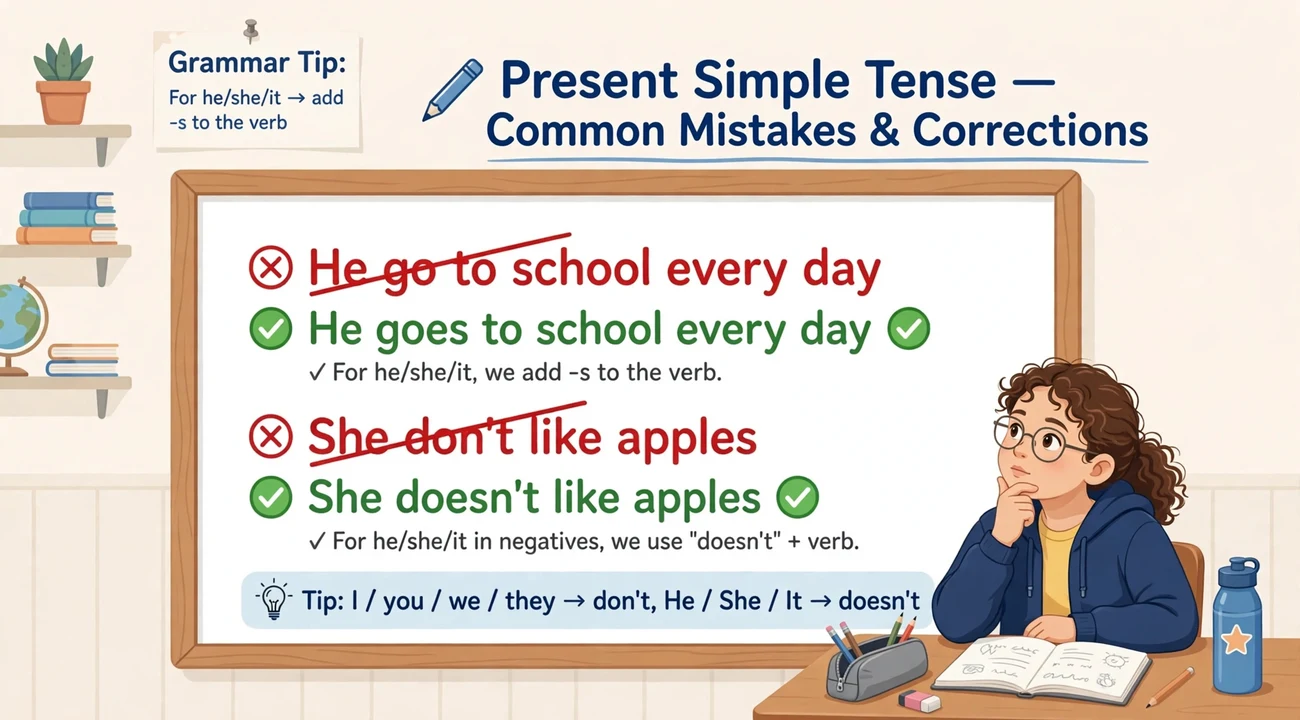
Even good learners make these mistakes. Learn them once and avoid them forever.
Mistake 1: Forgetting the -s for he, she, and it.
Wrong: “He play football.” Right: “He plays football.”
Mistake 2: Adding -s after does.
Wrong: “Does she plays tennis?” Right: “Does she play tennis?”
Mistake 3: Using the present simple for an action happening right now.
Wrong: “I read a book now.” Right: “I am reading a book now.” Use the continuous tense for actions happening now.
Mistake 4: Using the wrong spelling after -y.
Wrong: “She studys English.” Right: “She studies English.” Change y to ies after a consonant.
Mistake 5: Using does with I, you, we, and they.
Wrong: “Does they like tea?” Right: “Do they like tea?” Does is only for he, she, and it.
Our guide to Types of Sentences shows you how to build clear, correct sentences of every kind.
Quick Quiz: Present Simple Tense
Choose the correct verb form. Answers are at the end!
- She ___ (watch) TV every evening.
- They ___ (not like) cold weather.
- ___ he ___ (play) cricket on Sundays?
- The shop ___ (open) at 9 o’clock.
- Ali ___ (study) English every night.
- We ___ (not eat) meat on Fridays.
- ___ your mother ___ (work) in a school?
- It ___ (rain) a lot in July.
Answers:
1. watches (she needs -es)
2. do not like (they takes do)
3. Does / play (does + base form)
4. opens (it needs -s)
5. studies (study → studies)
6. do not eat (we takes do)
7. Does / work (mother is she)
8. rains (it needs -s)
8/8 — excellent! 6–7 — very good. Fewer than 6 — read the 5 rules once more.
Present Simple Tense: Quick Summary
| Point | Present Simple Tense |
|---|---|
| Use | Facts, habits, routines, schedules, general truths |
| Form (I / you / we / they) | base verb — I play, they play |
| Form (he / she / it) | verb + s / es / ies — he plays, she watches, it studies |
| Negative | do not / does not + base verb |
| Question | Do / Does + subject + base verb |
| Time words | always, usually, often, every day, never |
| Example | She plays tennis every Sunday. |
If it happens again and again, or if it is always true, use this tense. Keep this summary near your desk until the -s rule becomes automatic. You will also enjoy our guide to Its vs It’s.
FAQs About the Present Simple Tense
What is the present simple tense in simple words?
It is the verb form for facts, habits, and routines: “I drink tea every morning.” It talks about what usually happens, not what is happening right now.
When do we use the present simple tense?
For facts, habits, routines, schedules, feelings, and instructions. Words like always and every day are strong signs.
How do you form the present simple tense?
Use the base form for I, you, we, and they; add -s or -es for he, she, and it. Questions and negatives use do or does with the base form.
What is the difference between the present simple and the present continuous tense?
The simple form is for habits (“I read every night”); the continuous form is for actions happening now (“I am reading now”).
Why do we add -s to verbs with he, she, and it?
It marks the third person singular: “he plays,” “she works,” “it rains.” With I, you, we, and they, the verb stays in its base form. See our guide to Who vs Whom for more.
Can we use the present simple tense for the future?
Yes, only for fixed schedules: “The train leaves at 7:30.” For other plans, use will or going to.
Conclusion
The present simple tense is small, but it carries most of your daily English. Remember the golden rule: base form for I, you, we, and they, and add -s or -es for he, she, and it.
Practise with the 40 examples and the quiz, and soon you will build these sentences without thinking. Keep learning with GrammarLuck — grammar made simple.
