

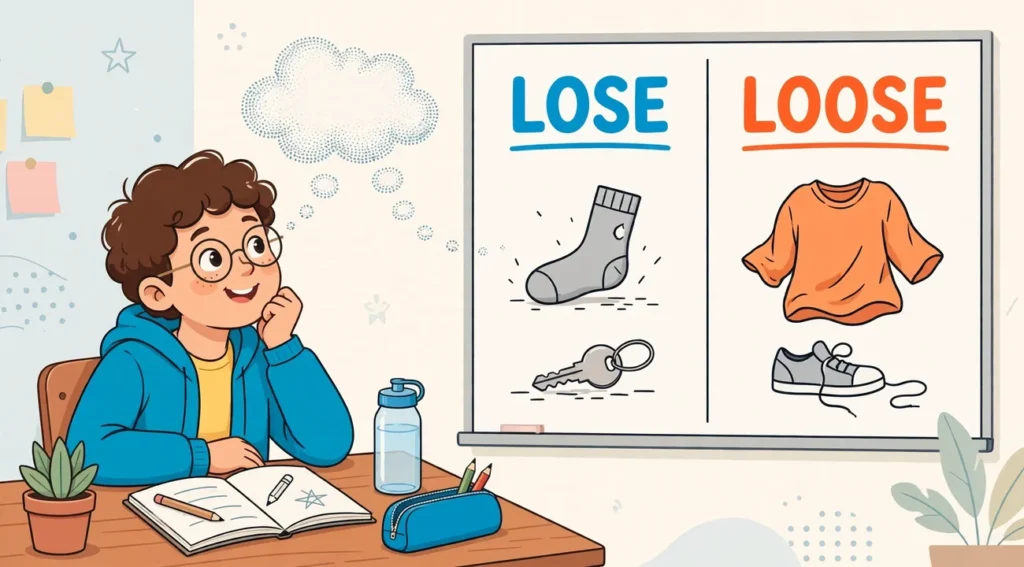
The lose vs loose mix-up is one of the most common mistakes in English writing. These two words sound almost the same, and only one letter sets them apart. Yet that one letter changes the meaning completely. In this lose vs loose guide, you will learn one simple rule that fixes this mistake forever.
Here is the short answer. Lose is a verb — it means to not win, to not find, or to stop having something. Loose is mostly an adjective — it means not tight, or not fixed in place. That is the whole lose vs loose difference in one line. You can lose your keys, but your shoes can be too loose.
Many learners confuse these two words because of the extra o. But once you see the patterns below, you will never mix them up again. Read this lose vs loose guide slowly and use the 40 examples to build your confidence step by step.
What Does Lose Mean?
Lose is a verb. It means to not win, to not find, to stop having something, or to waste time or an opportunity. It is the present form of lost. Here are the main uses of lose.
- To not win: “Our team will lose if we play like this.”
- To not find: “I always lose my phone at home.”
- To stop having: “He lost his job last month.”
- To waste: “Do not lose time on small details.”
- To become less: “She is trying to lose weight.”
- To get rid of: “Try to lose the habit of late sleeping.”
Verb forms of lose: lose (present), loses (he/she/it), losing (present participle), lost (past and past participle).
Remember: lose is always about an action. It is a thing you do or something that happens to you. It is never used to describe how tight or free something feels.
What Does Loose Mean?
Loose is mainly an adjective. It means not tight, not fixed in place, or free to move. It can also mean not exact or careless. As a verb, loose is rare and means to release or set free. Here are the main uses of loose.
- Not tight: “These shoes are too loose for me.”
- Not fixed in place: “The door handle is loose.”
- Free to move: “The dog broke loose and ran away.”
- Not exact: “That is only a loose translation.”
- Careless: “Do not make loose statements about people.”
- To release (verb): “Loose the ropes and let the boat go.”
Remember: loose is mostly about a state or a quality. It tells you how something feels, fits, or moves. If you can replace the word with “not tight” or “free,” loose is the right word.
5 Rules to Never Confuse Lose and Loose
Use these five rules in order. They will help you pick the right word in every sentence. You can also use them as a quick test before a test, an email, or an exam.
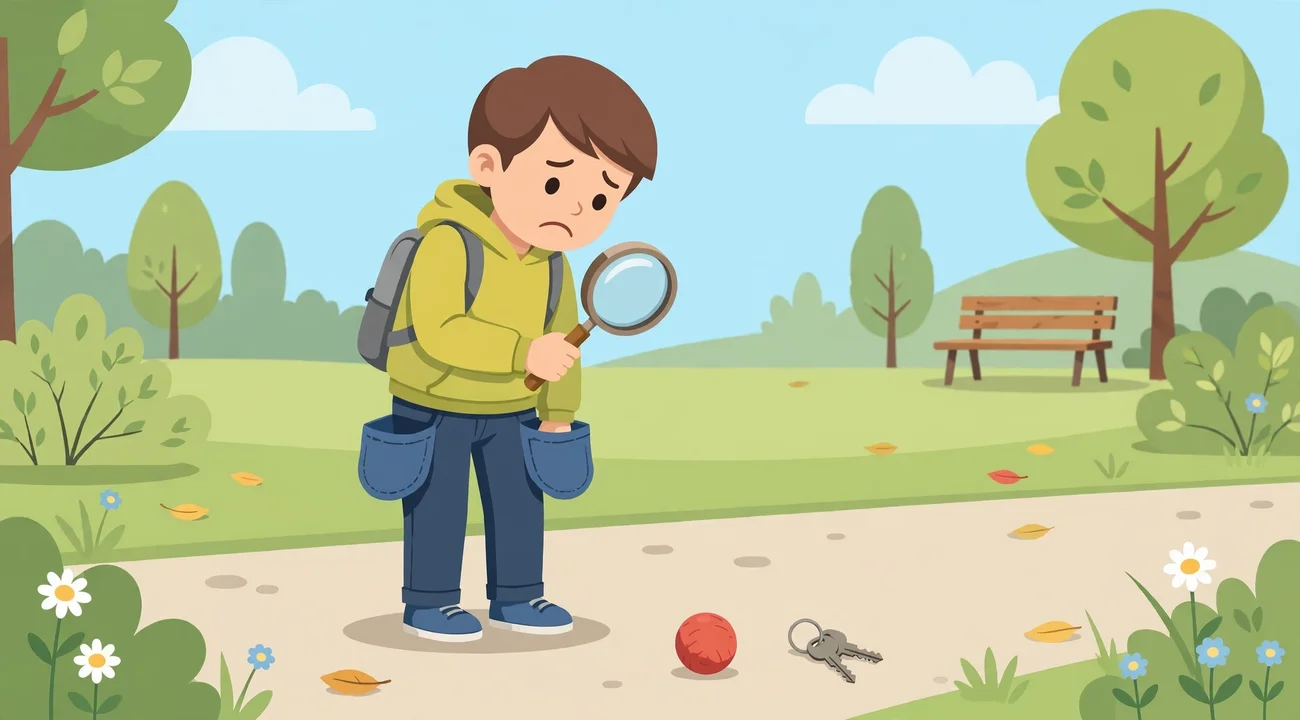
Rule 1: If it is a verb, use lose
If the word is doing the work of an action, it is lose. You can test it by changing the tense: lose, loses, losing, lost.
Examples:
- Lose the weight — you are dropping pounds, not describing a belt.
- Do not lose your temper in a meeting.
- She did not want to lose the match.
Rule 2: If it describes how tight or free something is, use loose
If the word is describing a noun, and you can replace it with “not tight” or “free,” it is loose.
Examples:
- A loose tooth — the tooth is not fixed in place.
- A loose shirt — the shirt is not tight.
- A loose dog — the dog is free to move.
Rule 3: If you can say “lost,” use lose
The golden lose vs loose rule: If the word means “to not win,” “to not find,” or “to stop having,” it is lose. Try the past form: lost. If lost fits the sense, choose lose. Example: “I lost my keys.” The base form is lose, not loose.
Word pairs like this one appear in almost every test. You will also like our then vs than guide, our to vs too vs two guide, our accept vs except guide, our advice vs advise guide, our there vs their vs they’re guide and our its vs it’s guide.
Rule 4: “Loose” has two o’s because it is longer and freer
The word loose has two o’s, and it feels longer and freer — just like the meaning. Loose things have room to move. Lose has only one o because something is missing. You lost an o.
Notice the pattern: lose is an action word, with forms like loses, losing and lost. Loose is mostly a describing word, with forms like looser and loosest. To learn more from an expert source, read the Grammarly guide to lose vs loose.
Rule 5: Use the three-second check
Before you write, ask these questions in this order:
Step 1: Is it an action? Use lose. Step 2: Is it describing tightness or freedom? Use loose. Step 3: Still unsure? Replace it with “lost” or “not tight” and see which one works. You will find the answer in the trick below.
Lose vs Loose Rules for Students
Here is the fast student version of the five lose vs loose rules. Keep it in your notebook or on your desk. Read it once a day for a week.
- Lose = a verb. It means to not win, to not find, or to stop having.
- Loose = mostly an adjective. It means not tight, or not fixed in place.
- Lose has one o, because you lost one.
- Loose has two o’s, because it is longer and freer.
- Test with “lost” or “not tight” before you write.
The “lose lost an o” trick: lose has only one “o” because it lost one, and loose kept both of its “o’s.” When you lose something, you have one less of it — just like the word lose.
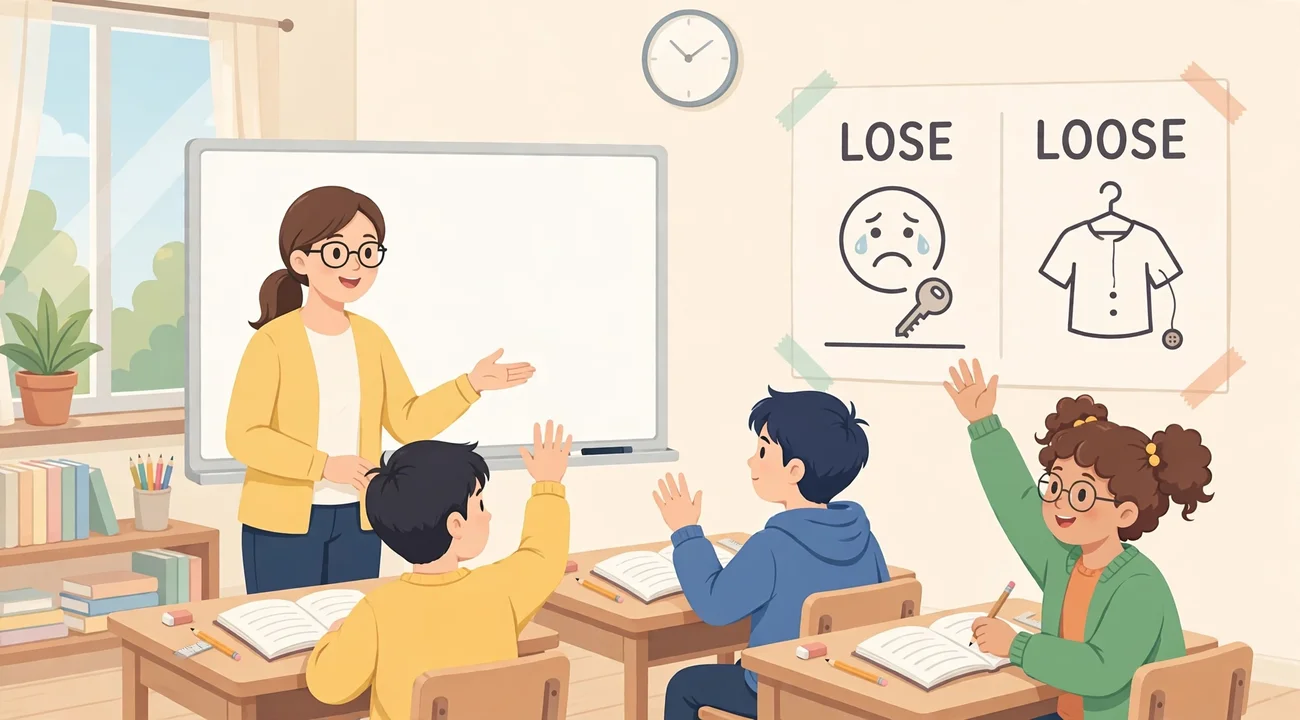
Memory Trick: Loose Goose, Lose the Extra O
Loose Goose: “The loose goose is easy to remember because both words have two o’s.” The loose goose is free and not tied up.
Lose the Extra O: “Lose the extra o, and the word lose is left with one o.” When you lose something, you have one less of it — and the word lose has one less o.
Now, whenever you write a lose vs loose sentence, ask: “Am I talking about a goose that is free, or am I talking about something I lost?” The picture will tell you the right word in one second.
40 Examples of Lose vs Loose
Here are 40 lose vs loose examples: 20 for lose and 20 for loose. Read them aloud. Say the key word in each sentence slowly and notice the meaning.
20 Examples with Lose
- I do not want to lose this game.
- She will lose her keys if she is not careful.
- Do not lose hope, even in hard times.
- He lost his wallet on the bus.
- We might lose the match if we play badly.
- I always lose my pen at school.
- Try not to lose your temper in a meeting.
- She is trying to lose weight before summer.
- Do not lose time on small things.
- He does not want to lose his job.
- If you lose focus, you will make mistakes.
- She lost her way in the big city.
- Do not lose your chance to apply for the job.
- They lost the final by one point.
- I lose my glasses almost every week.
- He lost his voice after shouting all day.
- Do not lose heart; you can still win.
- She will lose her train if she leaves late.
- We lost power for two hours last night.
- I never lose my notes before an exam.
20 Examples with Loose
- These shoes are too loose for my feet.
- The screw is loose, so the chair shakes.
- She wore a loose dress in the summer.
- The dog got loose and ran into the street.
- His shirt was loose and comfortable.
- The pages of the old book are loose.
- Do not leave the wires loose on the floor.
- The tooth is loose and may fall out soon.
- She tied her hair in a loose bun.
- The rope was loose around the box.
- His belt was too loose after he lost weight.
- The loose soil is easy to dig.
- The gate was loose, so it moved in the wind.
- She gave a loose answer to the question.
- The loose change in my pocket is small.
- Do not wear loose clothes near the machine.
- The horse broke loose from the fence.
- Her grip on the bag was loose.
- The button on my coat is loose.
- It’s clear now — the lose vs loose rule is simple!
Lose vs Loose Common Mistakes
Here are the most common lose vs loose mistakes. Most learners make these lose vs loose mistakes because the words sound the same and the spelling is close. Check each one and learn the fix.

❌ Wrong vs ✅ Correct
- ❌ “My shoes are too lose.” ✅ “My shoes are too loose.”
- ❌ “Do not loose your keys.” ✅ “Do not lose your keys.”
- ❌ “I will loose the game.” ✅ “I will lose the game.”
- ❌ “The dog got lose.” ✅ “The dog got loose.”
- ❌ “He has a lose tooth.” ✅ “He has a loose tooth.”
- ❌ “I do not want to loose my job.” ✅ “I do not want to lose my job.”
- ❌ “The rope is too lose.” ✅ “The rope is too loose.”
- ❌ “She will loose weight soon.” ✅ “She will lose weight soon.”
Why do learners mix them up? Because “lose” and “loose” sound almost the same, and the spelling differs by only one o. The key is to stop and ask: is it an action or a description? Actions use lose. Descriptions of tightness use loose.
Quick Quiz: Lose vs Loose
Now test yourself on lose vs loose. Pick lose or loose for each sentence. The answers are below.
- I do not want to ______ my phone. (lose / loose)
- These jeans are too ______ for me. (lose / loose)
- Our team might ______ the final. (lose / loose)
- The handle is ______ and needs fixing. (lose / loose)
- He ______ his wallet on the bus yesterday. (lose / loose)
Click to see the answers
Answers: 1. lose (to not find) 2. loose (not tight) 3. lose (to not win) 4. loose (not fixed in place) 5. lost (to stop having)
Lose vs Loose FAQ
What is the difference between lose and loose?
Lose is a verb that means to not win, to not find, or to stop having something. Loose is mostly an adjective that means not tight, not fixed in place, or free to move.
Is loose a verb or an adjective?
Loose is mainly an adjective, and it means not tight or free. As a verb, it is rare and means to release or set free, as in “loose the ropes.”
What is the past tense of lose?
The past tense of lose is lost. For example: “I lost my keys yesterday.” Loose has no past form lost; it uses looser and loosest for comparison.
How can I remember lose vs loose easily?
Remember the loose goose: loose has two o’s, just like goose, and it means free. Lose lost an o, so it has only one o. If it is an action, use lose. If it is about tightness, use loose.
Is “loose” ever a verb?
Yes, but rarely. As a verb, loose means to release or set free, as in “loose the dog from its chain.” In almost all daily use, loose is an adjective.
Key Takeaways
The lose vs loose rule is simple: lose is a verb, and loose is mostly an adjective. Lose means to not win, to not find, or to stop having. Loose means not tight, not fixed in place, or free. Remember the loose goose and the lost o, and you will get it right every time.
Practice the 40 examples in this lose vs loose guide and use the quick quiz to test yourself. With only five rules and a little daily practice, you will never confuse lose vs loose again.
Key Rule
Lose is a verb (one o — it lost one): to not win, to not find, or to stop having. Loose is mostly an adjective (two o’s — longer and freer): not tight, not fixed in place, or free. Test with “lost” or “not tight” before you write.
| Word | Part of Speech | Meaning | Example |
|---|---|---|---|
| lose | Verb | To not win, to not find, or to stop having | I do not want to lose my keys. |
| loose | Adjective | Not tight, not fixed in place, or free | These shoes are too loose. |
