

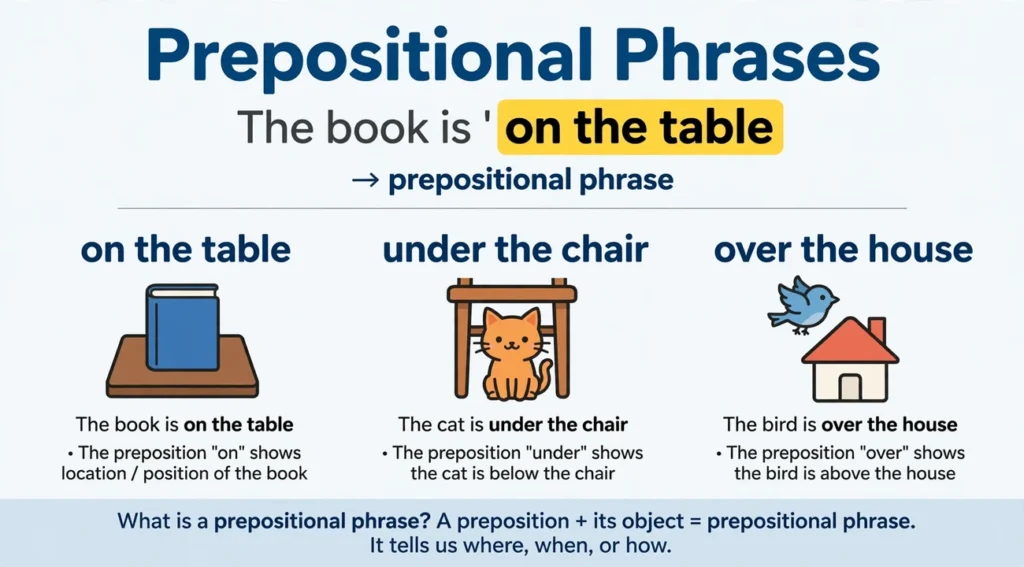
The dog in the garden is barking. The book on the shelf is new. In each sentence, a small group of words adds extra detail. It starts with a small word like in, on, or with, and it ends with a noun. These small word groups are called Prepositional Phrases.
Here is the short answer. A prepositional phrase is a group of words that starts with a preposition and ends with a noun or a pronoun. In “The book on the shelf is new,” the words on the shelf tell us where the book is. That is the whole idea behind Prepositional Phrases.
In this guide, you will learn what Prepositional Phrases are, 7 simple rules, a 2-second trick, 40 examples, common mistakes, and a quick quiz.
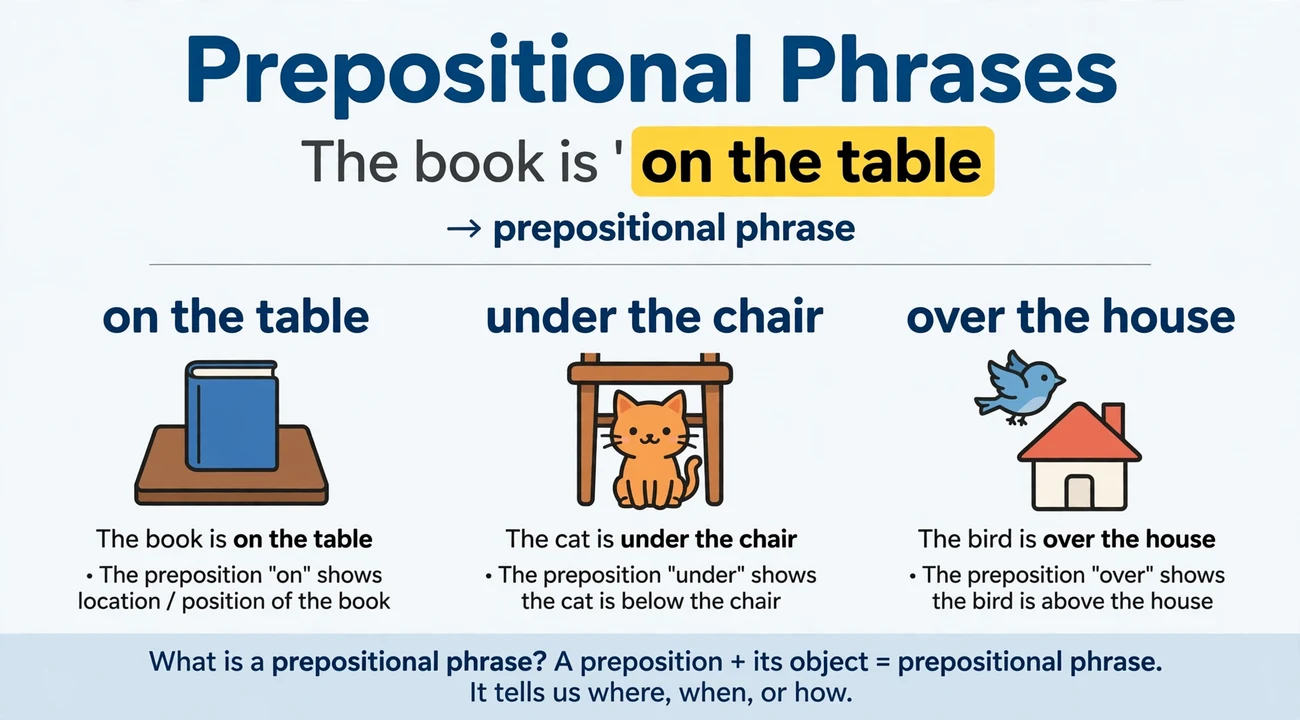
Prepositional Phrases: The Quick Answer
The fastest way to understand Prepositional Phrases is to compare a prepositional phrase with a single word.
| Form | What it does | Example |
|---|---|---|
| A prepositional phrase | Adds detail about place or time | The cat under the table is asleep. |
| A single adjective | Describes a noun in one word | The red cat is asleep. |
| A single adverb | Describes a verb in one word | She walked slowly. |
The key point about Prepositional Phrases is simple: a small group of words can add a clear detail to a sentence.
What Are Prepositional Phrases?
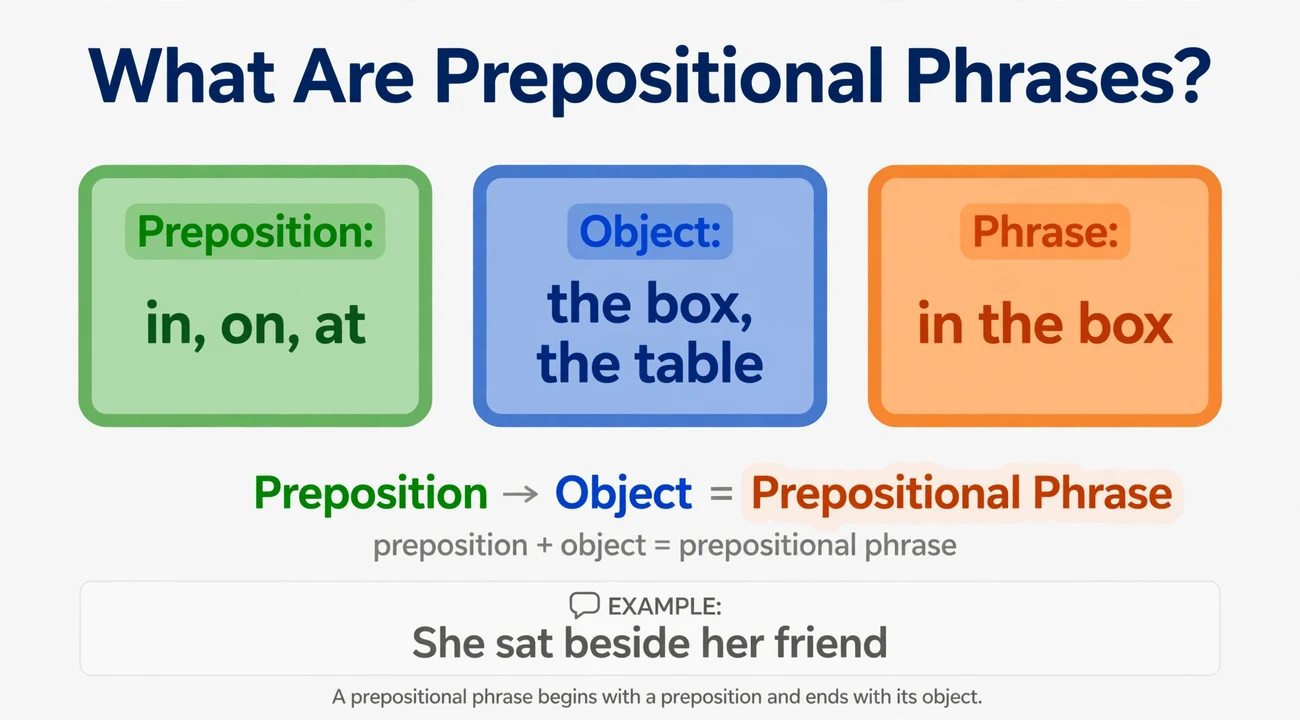
A prepositional phrase is a group of words that starts with a preposition and ends with a noun, a pronoun, or a noun group. Most Prepositional Phrases start with a small word like in, on, at, to, with, for, or from.
Prepositional Phrases always begin with a preposition and always end with a noun or a pronoun. The words in the middle are small helpers like the, a, my, or two.
- The keys in my bag are missing.
- She sat beside her brother.
- We went to the park after lunch.
- He wrote the note with a pencil.
- The shop near the school sells fresh bread.
A prepositional phrase is never a full sentence on its own. For a quick refresher, read our guide to prepositions. It also helps to know your nouns, because the phrase always ends with a noun or a pronoun.
| Preposition | Example phrase | What it shows |
|---|---|---|
| in | in the box | place |
| on | on the shelf | place |
| after | after lunch | time |
Prepositional Phrases as Adjectives and Adverbs
Prepositional Phrases do two main jobs. They can describe a noun, like an adjective, or a verb, like an adverb.
As Adjectives
When a prepositional phrase comes after a noun, it works like an adjective. It answers the question “which one?”
- The girl with the red bag is my sister.
- The house on the hill looks old.
- The cake in the box is for you.
- The man at the door is waiting.
“With the red bag” tells us which girl.
As Adverbs
When a prepositional phrase tells us more about a verb, it works like an adverb. It answers “where?”, “when?”, or “how?” Our guide to adverbs shows how single-word adverbs do the same job.
- She ran to the shop. (where?)
- We will meet after lunch. (when?)
- He spoke in a soft voice. (how?)
- They played in the rain. (where?)
The same phrase can do a different job in a different sentence.
7 Simple Prepositional Phrases Rules
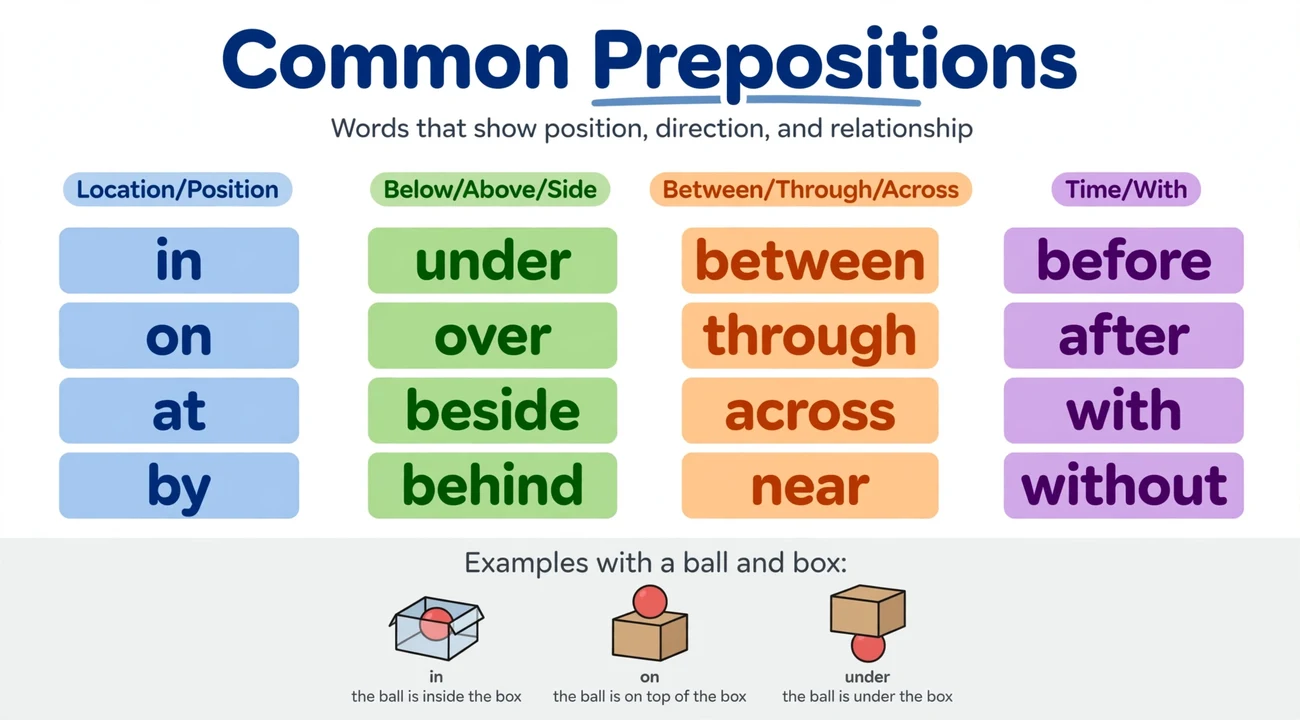
These 7 rules cover everything you need to use Prepositional Phrases with confidence.
Rule 1: Start with a Preposition
Every prepositional phrase starts with a preposition: in, on, at, to, with, for, from, of, about, or under.
Rule 2: End with a Noun or a Pronoun
The last word is a noun or a pronoun. In “under the old bridge,” the phrase ends with bridge. In “with him,” it ends with him.
Rule 3: Keep the Phrase Close to the Word It Describes
Put the phrase right after the word it adds detail to. “The boy with the blue cap won the race” is clear.
Rule 4: A Phrase After the Subject Does Not Change the Verb
The verb must agree with the subject, not with the noun inside the phrase. In “The box of pens is on the desk,” the verb is is because the subject is box. Our guide to subject-verb agreement explains this in full.
Rule 5: Keep Your Phrases Short and Clear
Keep your Prepositional Phrases short and clear. “The letter from my friend in London arrived today” is fine.
Rule 6: Do Not Use Two Prepositions for One Job
Use one preposition for each link. Do not write “to at the shop” or “in on the table.”
Rule 7: Learn Common Phrases as Fixed Groups
Learn common phrases as whole groups: in the morning, on time, at home, by train, with care, for a long time. Our guide to types of sentences shows where they fit.
The 2-Second Prepositional Phrases Trick
Still not sure if a group of words is a prepositional phrase? Use this quick trick to spot Prepositional Phrases in any sentence. It takes only two seconds.
Step 1: Is the first word a preposition like in, on, at, with, or under?
Step 2: Is the last word a noun or a pronoun?
Step 3: If both answers are yes, the group is a prepositional phrase.
Try the trick on these examples:
- “under the table” — under is a preposition, table is a noun. Yes.
- “very happy” — very is not a preposition. No.
- “after the match” — after is a preposition, match is a noun. Yes.
A prepositional phrase always has the same shape: a preposition at the start and a noun at the end.
40 Prepositional Phrases Examples
Here are 40 simple examples of Prepositional Phrases. The first 20 are short and easy.
Short and easy:
- The cat under the bed is sleeping.
- She kept her phone in her pocket.
- The photo on my desk is old.
- We walked to the market.
- He sat beside his friend.
- The flowers in the garden are red.
- I bought a gift for my mother.
- The boys played in the park.
- She reached the office before nine.
- The dog ran across the field.
- He wrote a letter with a blue pen.
- The book about animals is fun.
- We stayed at home.
- The train to the city leaves at six.
- She looked under the chair.
- The lamp beside the bed is new.
- They talked about the film.
- He stood behind the door.
- The shop near my house opens at eight.
- She went to bed without supper.
In longer, everyday sentences:
The next 20 show Prepositional Phrases in longer, everyday sentences.
- The man with the white hat is our teacher.
- We had lunch at a small cafe.
- The children ran into the garden.
- She opened the box with great care.
- The road to the village is long.
- He waited at the bus stop.
- The letter from my cousin arrived today.
- They travelled by train.
- The house at the end of the street is empty.
- She sang a song about the sea.
- The boy in the blue shirt scored a goal.
- We sat under a big tree.
- He gave the book to the girl.
- The cake with chocolate was for the party.
- She walked through the park with her dog.
- The meeting on Friday will start at ten.
- He hid behind the curtain.
- The birds in the trees sang.
- We bought tickets for the show.
- She smiled at the baby in her arms.
For the full grammar background, read the Prepositional phrase page on Wikipedia.
Common Prepositional Phrases Mistakes

Even good learners make mistakes with Prepositional Phrases. Learn them once and avoid them for life.
Mistake 1: Putting the phrase in the wrong place.
Wrong: “She gave the book to Ali in the park with a red cover.” Right: “She gave the book with a red cover to Ali in the park.”
Mistake 2: Using the wrong preposition.
Wrong: “He is good in maths.” Right: “He is good at maths.” Learn fixed pairs like good at and interested in.
Mistake 3: Ending the phrase with a verb.
Wrong: “She is interested in learn English.” Right: “She is interested in learning English.” A prepositional phrase ends with a noun, so use the -ing form. Our guide to verbs shows more.
Mistake 4: Adding too many phrases.
Wrong: “The man in the shop with the hat on the chair went home.” Right: “The man in the shop wore a hat.” Short and clear wins.
Quick Quiz: Prepositional Phrases
Test what you know about Prepositional Phrases. Answers are at the end — no peeking!
- Which group is a prepositional phrase? a) very fast b) under the bed c) she runs
- In “The cat on the roof is black,” which words are the prepositional phrase? a) the cat b) on the roof c) is black
- Which sentence has a prepositional phrase that tells us when? a) We met after lunch. b) The car is fast. c) She sings well.
- What does a prepositional phrase end with? a) A verb b) A noun or a pronoun c) An adjective
- Which sentence is correct? a) The box of pens are on the desk. b) The box of pens is on the desk. c) The box of pens be on the desk.
Answers:
1. b) under the bed.
2. b) on the roof.
3. a) We met after lunch.
4. b) A noun or a pronoun.
5. b) The box of pens is on the desk.
How did you do? 5/5 — excellent! 4 — very good. Fewer than 4 — read the 7 rules once more.
Prepositional Phrases Quick Summary
| Point | Rule | Example |
|---|---|---|
| Form | Starts with a preposition, ends with a noun | on the shelf |
| As an adjective | Describes a noun | The girl with the red bag |
| As an adverb | Describes a verb | We met after lunch. |
| After the subject | Does not change the verb | The box of pens is on the desk. |
| Keep it short | Keep phrases short | The letter from my friend arrived today. |
A small group that starts with a preposition and ends with a noun adds a clear detail to a sentence. Keep this table near your desk until Prepositional Phrases feel easy.
FAQs About Prepositional Phrases
What is a prepositional phrase in simple words?
A prepositional phrase is a group of words that starts with a preposition and ends with a noun or a pronoun. In “on the shelf,” shelf is the noun.
How do I find a prepositional phrase in a sentence?
Look for a preposition like in, on, at, or with, then read to the next noun. The words from the preposition to that noun form the phrase.
Can a prepositional phrase be at the start of a sentence?
Yes. “In the morning, we went for a walk” starts with one that tells us when. Put a comma after it.
What is the difference between a prepositional phrase and a preposition?
A preposition is one word, like on. A prepositional phrase is the whole group, like on the shelf.
Can a sentence have two prepositional phrases?
Yes. “She sat in the garden with her friend” has two: in the garden and with her friend.
Do prepositional phrases change the verb in a sentence?
No. The verb agrees with the subject, not with the noun inside the phrase. “The box of pens is on the desk” takes is because box is the subject.
Conclusion
A prepositional phrase is a small group with a big job. It starts with a preposition, ends with a noun, and adds a clear detail about place, time, or manner. Learn the 7 rules, use the 2-second trick, and practise with the 40 examples above.
Keep using prepositional phrases in your own sentences. For more simple lessons, keep learning with GrammarLuck — grammar made simple.
