

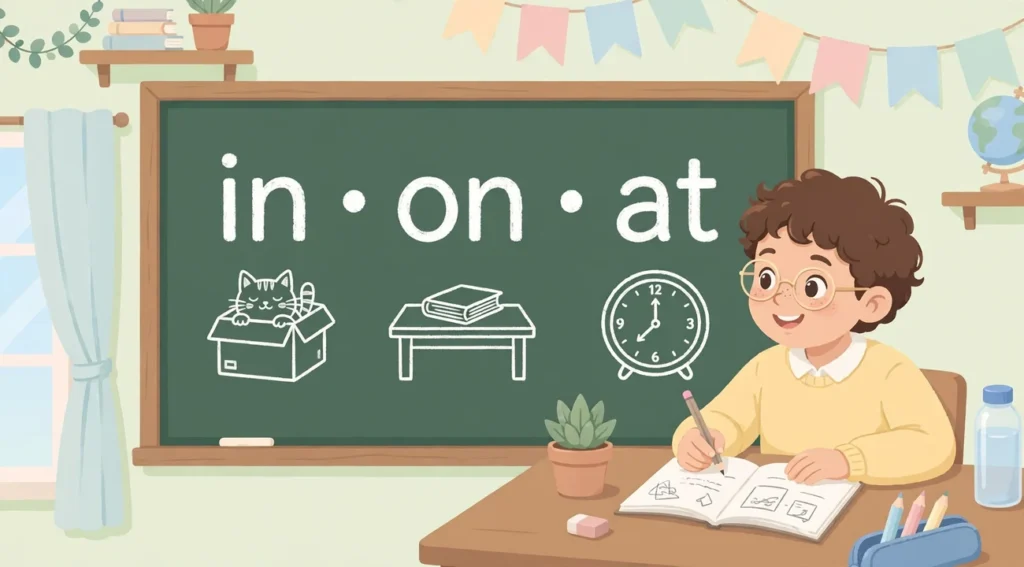
Prepositions are small words that show the link between a noun or a pronoun and another word in a sentence. Words like in, on, at, to, and from are prepositions. They tell us about time, place, and direction. In this guide, you will learn the meaning, 5 simple rules, a 2-second trick, 40 examples, common mistakes, and a quick quiz.
Many learners find prepositions hard because one small word can change the whole meaning. “I am at school” and “I am in school” do not mean the same thing. The good news is that prepositions follow a few clear patterns. Once you learn the patterns for time, place, and direction, you will choose the right word most of the time.
In this complete guide, you will learn what prepositions are, the 5 simple rules, a 2-second trick, 40 examples, the most common mistakes, and a quick quiz to test yourself. By the end, you will use these prepositions — in, on, at, to, and from — with confidence.
Prepositions: The Quick Answer
The fastest way to learn them is to see the three main groups side by side: time, place, and direction. The words in, on, and at appear in the time and place groups, and the group tells you which word to pick.
| Group | Word | Use it for | Examples |
|---|---|---|---|
| Time | in | Months, years, long time | in June, in 2025, in the morning |
| Time | on | Days and dates | on Monday, on 5 May, on Christmas Day |
| Time | at | Clock times and night | at 7 o’clock, at night, at noon |
| Place | in | Inside a closed space | in the room, in London, in the box |
| Place | on | On a surface | on the table, on the wall, on the bus |
| Place | at | A point or a small place | at school, at home, at the door |
| Direction | to, into, onto, from | Movement | go to school, jump into the pool, climb onto the roof, come from work |
The golden rule: ask “time, place, or direction?” first. Then pick in, on, or at from the right row of the table. Learn the group first, and the word follows.
What Are Prepositions?
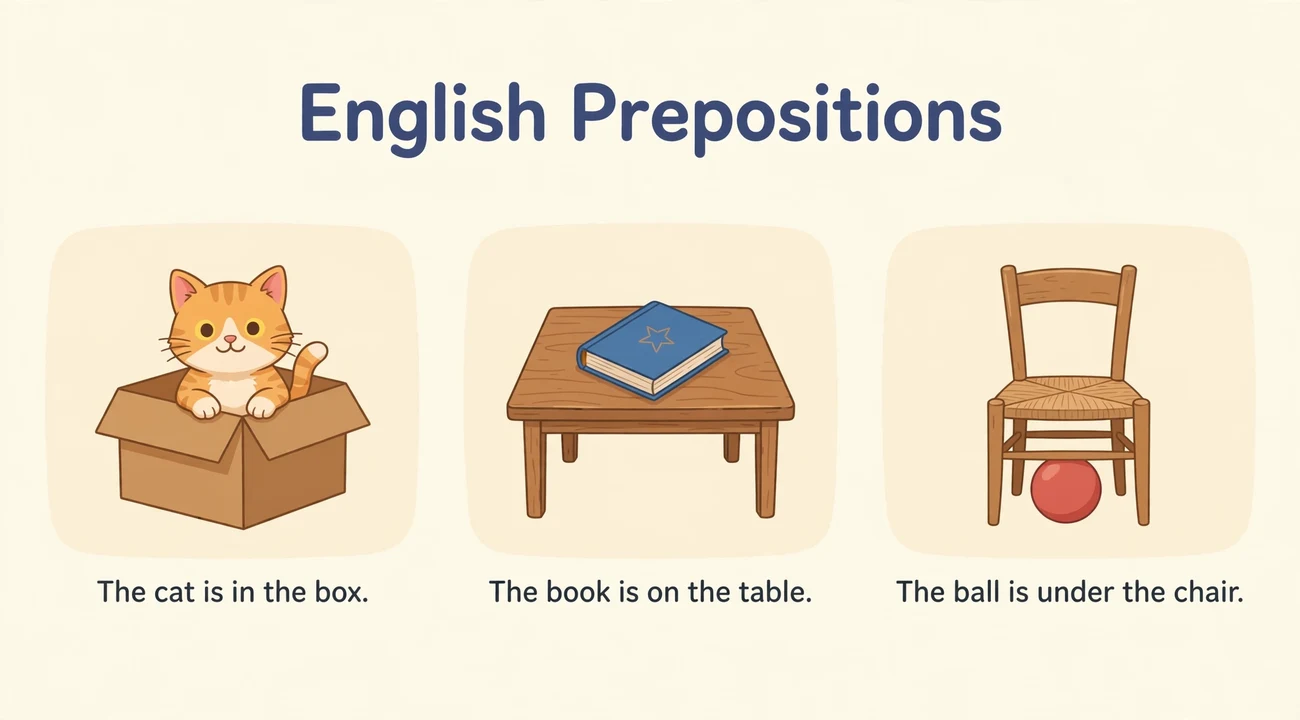
A preposition is a small word that comes before a noun or a pronoun and shows how that noun links to the rest of the sentence. In “The book is on the table,” the word on links the book to the table. Without these small words, a sentence feels broken and unclear.
Prepositions do three main jobs. They show time (in June, on Monday, at night), place (in the room, on the wall, at school), and direction (to the park, into the house, from work). A few also show other links, such as the tool used for a job: “She cut the cake with a knife.”
Read our guide to articles a, an, the to see how these small words work with nouns. For a refresher on the basic tenses, start with our guide to the present simple tense.
| Preposition | Group | Example |
|---|---|---|
| in | Time and place | in the morning, in London |
| on | Time and place | on Friday, on the bus |
| at | Time and place | at 8 p.m., at work |
| to | Direction | go to school |
| into | Direction | walk into the room |
| onto | Direction | climb onto the chair |
| from | Direction | come from home |
| with | Link | play with friends |
| by | Link | go by bus |
| about | Link | talk about the film |
You do not need to learn every preposition at once. Start with in, on, at, to, into, onto, and from. These seven words cover most of the sentences you will write and speak each day. When you meet a new one, ask which group it belongs to.
5 Simple Prepositions Rules
These five rules cover most of the mistakes learners make. Learn them one by one, and say each example aloud. Each rule below works in all types of sentences.
Rule 1: Use In, On, and At for Time
For time, use in for long parts of time, on for days and dates, and at for exact times.
- She was born in June.
- The test is on Monday at 9 o’clock.
Rule 2: Use In, On, and At for Place
For place, use in for closed spaces and towns, on for surfaces, and at for a point or a small place. Inside, on top, and at a point — that is the whole rule.
- The keys are in the bag.
- The picture hangs on the wall, and Ali is waiting at the door.
Rule 3: Use To, Into, Onto, and From for Direction
Direction words show movement. To shows the end point, into shows movement inside, onto shows movement on top, and from shows the start point.
- She walked into the room and sat on the chair.
- The cat jumped onto the table, and they came from work at 6 o’clock.
Rule 4: Learn Prepositions After Verbs and Adjectives
Some verbs and adjectives always take the same preposition, and there is no short rule for them. You learn them as fixed pairs. Good at, interested in, afraid of, and proud of are four of the most common pairs.
- She is good at maths and interested in science.
- He is afraid of dogs, but he is proud of his son.
Rule 5: Use No Preposition Before Today, Tomorrow, and Next Week
Before words like today, tomorrow, yesterday, this morning, and next week, use no preposition at all. English drops the word here. Say “I will see you tomorrow,” not “on tomorrow.”
- We met this morning.
- She will start her new job next week.
The 2-Second Prepositions Trick
Still not sure which word to use? Ask yourself one question: “Time, place, or direction?”
Step 1: Is the word after the gap a time, a place, or a direction?
Step 2: Time takes in, on, or at by size. Place takes in, on, or at by inside, surface, or point.
Step 3: Direction takes to, into, onto, or from.
Try the trick on these sentences:
- “She will arrive ___ Monday.” — Monday is a day, so time plus on gives “on Monday.”
- “The pen is ___ the table.” — the table is a surface, so place plus on gives “on the table.”
Keep this trick in mind, and the choice will soon feel natural. Most prepositions become easy once you ask the right question first.
40 Prepositions Examples
Here are 40 simple examples with prepositions — the first 20 are about time and place, and the next 20 are about direction and fixed pairs after verbs and adjectives.
Time and place:
- I was born in June.
- She will come on Monday.
- The class starts at 9 o’clock.
- We met in the morning.
- He works in London.
- The book is on the table.
- She is at school now.
- They arrived on 5 May.
- I sleep at night.
- The keys are in the bag.
- The picture hangs on the wall.
- Ali is waiting at the door.
- We will travel in 2026.
- The test is on Friday.
- He eats lunch at noon.
- The cat is in the box.
- She sat on the bus.
- They live at 12 Green Street.
- It rains a lot in winter.
- The match is on Sunday at 4 p.m.
Direction and fixed pairs:
- She walked into the room.
- The cat jumped onto the table.
- We go to school by bus.
- He came from work at 6 o’clock.
- They flew to Dubai last week.
- Put the books into the bag.
- She climbed onto the roof.
- I am good at English.
- He is interested in music.
- She is afraid of spiders.
- We are proud of our team.
- He is tired of the noise.
- She is married to Ali.
- This book belongs to Sara.
- He looked at the picture.
- She listened to the teacher.
- We talked about the film.
- He is waiting for the bus.
- She arrived at the station.
- They walked from the park to the shop.
Use these sentences in your own writing. For more short sentences, see our English sentences collection. For the full grammar background, read Prepositions on Wikipedia.
Common Prepositions Mistakes
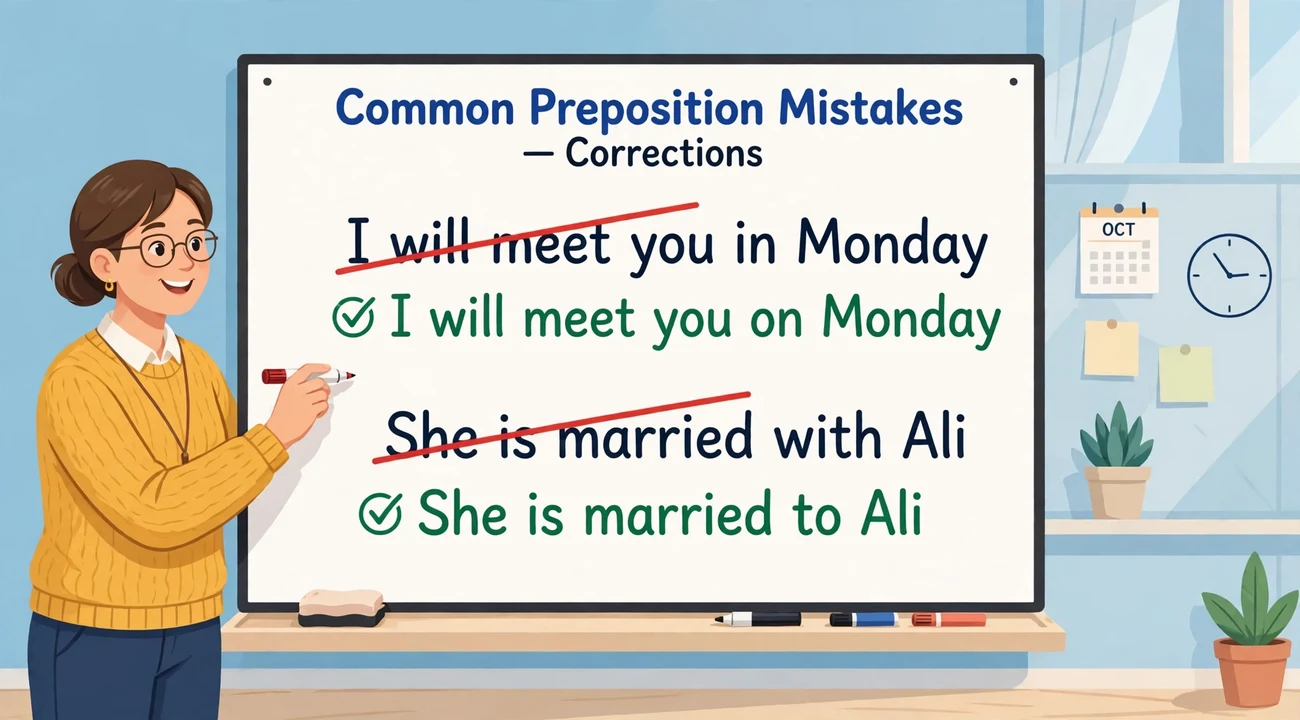
Even good learners make these mistakes with prepositions. Learn them once and avoid them for life.
Mistake 1: Using “in” before a day.
Wrong: “I will see you in Monday.” Right: “I will see you on Monday.” Days take on, not in.
Mistake 2: Adding “about” after “discuss.”
Wrong: “We discussed about the plan.” Right: “We discussed the plan.” The verb discuss takes no preposition.
Mistake 3: Using “married with” instead of “married to.”
Wrong: “She is married with Ali.” Right: “She is married to Ali.” Married takes to, not with.
Mistake 4: Using “arrived to” instead of “arrived at.”
Wrong: “She arrived to the station.” Right: “She arrived at the station.”
Mistake 5: Using “depends of” instead of “depends on.”
Wrong: “It depends of the weather.” Right: “It depends on the weather.”
Practise these fixes with short drills in our grammar exercises until the right form feels natural.
Quick Quiz: Prepositions
Fill in the blank — answers are below!
- I was born ___ June.
- The test is ___ Monday.
- She arrived ___ 7 o’clock.
- The book is ___ the table.
- We walked ___ the room.
- He is good ___ maths.
- She is afraid ___ dogs.
- I will see you ___ tomorrow.
Answers:
1. in
2. on
3. at
4. on
5. into
6. at
7. of
8. no preposition
How did you do? 8/8 — excellent! 6–7 — very good. Fewer than 6 — read the trick once more.
Prepositions: Quick Summary
| Group | Words | Example |
|---|---|---|
| Time | in, on, at | in June, on Monday, at 9 o’clock |
| Place | in, on, at | in the room, on the wall, at school |
| Direction | to, into, onto, from | go to school, jump into the pool |
| After verbs and adjectives | at, in, of, to | good at, interested in, afraid of, married to |
| No preposition | — | today, tomorrow, this morning, next week |
Prepositions feel hard for a week — then easy for life.
FAQs About Prepositions
What are prepositions in simple words?
Prepositions are small words like in, on, at, to, and from. They come before a noun or a pronoun and show time, place, or direction.
What is the difference between in, on, and at?
In is for long times and closed spaces, on is for days, dates, and flat tops, and at is for exact times and points.
When do we use no preposition?
Use no preposition before today, tomorrow, yesterday, this morning, this week, and next week. These time words stand on their own.
What are the most common prepositions?
The most common ones are in, on, at, to, from, with, by, about, for, and of. Learn in, on, and at first.
Why are prepositions hard for learners?
They are hard because every language has its own habits, and one small word can change the meaning. “At school” and “in school” are not the same. The fix is to learn the three groups and practise each day.
Can a sentence end with a preposition?
Yes. In simple English, it is fine to end with a word like to, about, or with. “Who are you talking to?” sounds natural. In exams and everyday English, ending with one is fine.
Conclusion
Prepositions are smaller than they look. Three questions and five simple rules cover most sentences you will ever write. Remember in, on, and at, learn the fixed pairs like good at and interested in, and drop the word before today and tomorrow.
Practise with the examples and quiz in this guide, and soon you will choose the right word without thinking. Keep building your grammar with our guide to subject-verb agreement, and keep learning with GrammarLuck — grammar made simple.
