

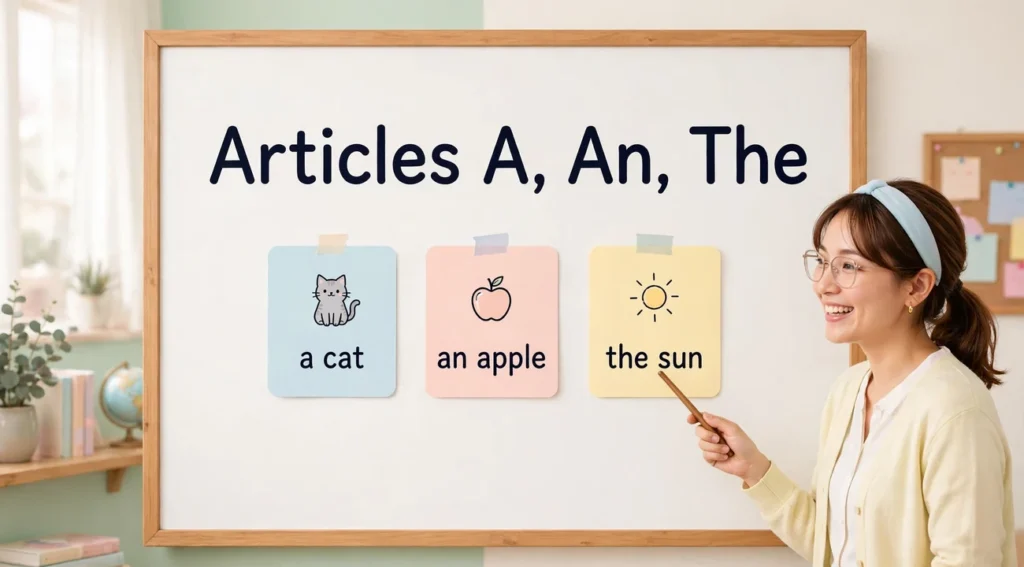
The words a, an, and the are three of the smallest words in English, and three of the most useful. We use them every day. In this articles a an the guide, you will learn when to use each one, the simple rules, and the most common mistakes, all in simple English.
Here is the short answer. A and an point to one thing that is not special or known yet — a book means any book. The points to a thing we both know — the book means that one book we talked about. An is a before a vowel sound, like an apple.
In this complete articles a an the guide, you will learn what articles are, the 7 simple rules, 50 clear examples, the most common mistakes, and a quick quiz. By the end, you will use them with full confidence.
Articles A An The: The Quick Answer
See a, an, and the side by side.
| Article | Use | Example |
|---|---|---|
| a | One thing, not known yet | I saw a dog in the park. |
| an | One thing before a vowel sound | She ate an orange after lunch. |
| the | A known thing, or the only one | I saw the dog again today. |
| no article | General ideas, names, days | Dogs are loyal animals. |
The golden articles a an the rule: use a or an the first time you talk about a thing, and use the the next time you talk about the same thing.
What Are Articles?
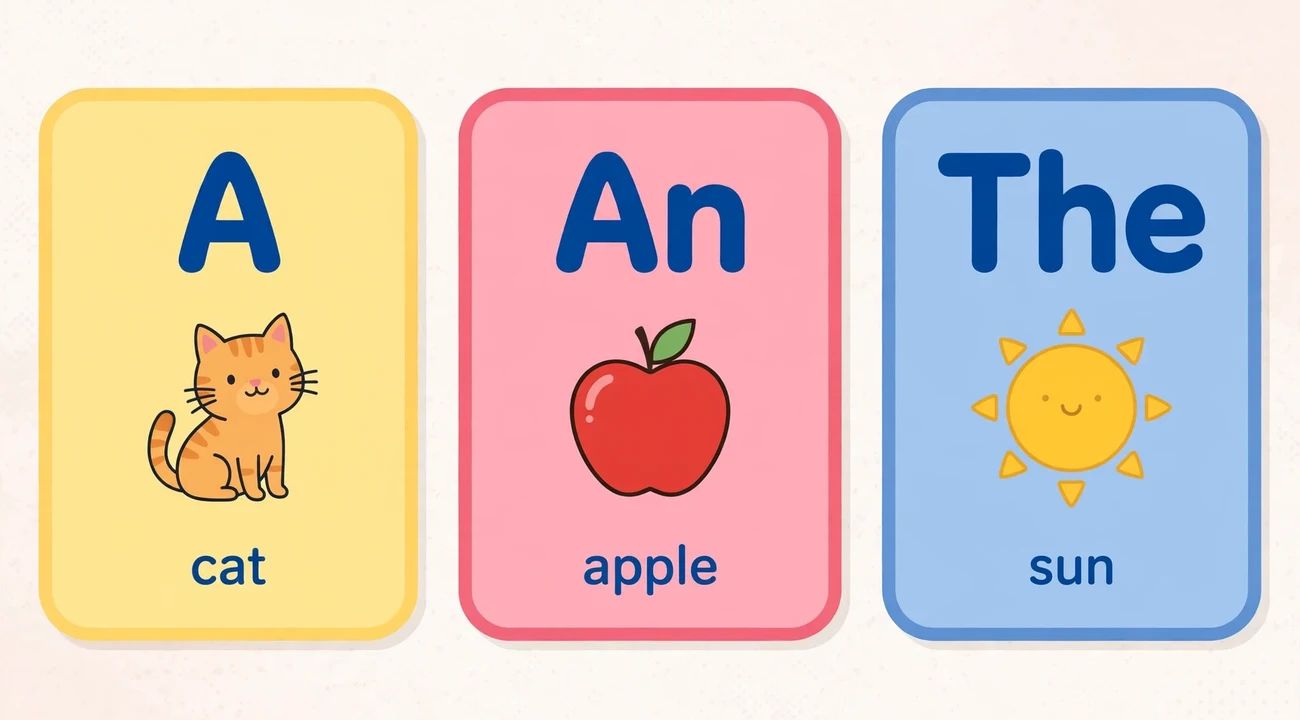
The articles a an the words are small words that come before a noun. They tell us if the noun is one of many, or one special thing we both know. Without them, a sentence can sound strange.
- I bought a pen.
- She found an umbrella.
- He opened the door.
- They visited the park.
In every sentence, the small word before the noun changes the meaning — that is the heart of articles a an the.
You will see articles a an the in almost every sentence you read. They are short, but they carry a big job.
To build stronger sentences, read our guide to the types of sentences.
When Do We Use A, An and The?
We use articles a an the in five common situations.
1. A or An for One Thing, Not Known Yet
Use a or an when you talk about one thing for the first time.
- I need a pencil.
- She is an engineer.
2. An Before a Vowel Sound
Use an before a word that starts with a vowel sound. Listen to the sound, not the letter.
- He ate an apple.
- It was an honest answer.
3. The for a Thing We Both Know
Use the when both people know which thing you mean.
- Please close the door.
- The teacher smiled at us.
4. The for the Only One
Use the for things that are the only one of their kind.
- The sun rose at six.
- We watched the moon.
5. No Article for General Ideas and Names
We use no article with names, days and months, and most general ideas.
- Life is short.
- She lives in Paris.
Articles go with singular nouns, so keep the verb in agreement — see our subject-verb agreement guide.
How to Use Articles A An The: A Quick Memory Trick
Here is a two-second trick. Ask yourself: “Do we both know which one?” If the answer is no, use a or an. If the answer is yes, use the. First time: a dog. Next time: the dog.
The articles a an the trick is simple: first mention gets a or an, and second mention gets the.
Remember the sound rule too. An goes before a vowel sound, and a goes before a consonant sound. The spelling can trick you, but the sound never does.
7 Simple Articles A An The Rules

These seven articles a an the rules cover almost every sentence you will write.
Rule 1: Use A Before a Consonant Sound
Use a before a word that starts with a consonant sound. A university takes a because u sounds like y.
- a cat, a house, a year
Rule 2: Use An Before a Vowel Sound
Use an before a word that starts with a vowel sound. An hour takes an because the h is silent.
- an egg, an umbrella, an idea
Rule 3: Use The for a Thing Named Before
When you name a thing a second time, use the. The first mention is new, and the second is known.
- I saw a film. The film was funny.
- She bought a bike. The bike is red.
Rule 4: Use The with Superlatives and First, Best, Only
Use the before the best, the first, and the only, because they point to one clear thing.
- the best day, the first time, the only one
Rule 5: Use The with Seas, Rivers, and Groups of Places
Use the with rivers, seas, and groups of mountains or islands, like the Nile and the Alps.
- the Thames, the Red Sea, the USA
Rule 6: No Article with Names, Days, and Most General Ideas
We use no article with names of people and places, and with days, months, and meals.
- Ali, London, Monday, breakfast
Rule 7: Use The with Musical Instruments and Inventions
Use the with musical instruments, like the piano, and with famous inventions, like the telephone.
This is one of the most useful articles a an the rules for daily talk.
- play the piano, the radio, the computer
Capitals also matter with names and places — see our capitalization rules guide.
Articles A An The: A vs An vs The
The sound decides a or an, and shared knowledge decides the.
| Word | Meaning | Example |
|---|---|---|
| a | Any one thing | I need a pen. |
| an | Any one thing, vowel sound | I need an eraser. |
| the | The one we know | I need the pen on the desk. |
When in doubt, ask the two-second question from the trick above: do we both know which one?
Still mixing up two small words? Our then vs than guide clears up another tricky pair.
50 Articles A An The Examples
Here are 50 articles a an the examples in action. The first 25 use a and an, and the last 25 use the.
- I bought a pen.
- She ate an apple.
- He is a teacher.
- We saw an owl.
- Ali needs a bag.
- Sara found an old key.
- This is a nice day.
- He drank a glass of juice.
- She wore a red dress.
- They built a small house.
- I met an honest man.
- We watched a film.
- He bought a guitar.
- She wrote a letter.
- The child drew a cat.
- I need an umbrella.
- He is an engineer.
- We had a picnic.
- She gave me an idea.
- They live in a flat.
- I saw a bird.
- He told an interesting story.
- She bought a cake.
- We need a plan.
- It was an hour of work.
- Please close the door.
- The sun is hot today.
- I put the keys away.
- The teacher gave us homework.
- We visited the museum.
- The dog barked all night.
- She opened the window.
- The children played outside.
- He is the best player.
- The Nile is a long river.
- I love fresh bread.
- The moon was bright last night.
- We crossed the bridge.
- The book on the shelf is mine.
- She plays the piano every day.
- The train left at nine o’clock.
- I met the doctor.
- The lake water is cold.
- He is the only boy in the class.
- The Earth moves around the sun.
- We sat under the tree.
- The first day was fun.
- I read the news.
- The cat slept on the chair.
- She thanked the driver.
For more everyday sentences, browse our collection of 100 English sentences.
For more on the history of articles, see the Article (grammar) on Wikipedia page.
Common Articles A An The Mistakes
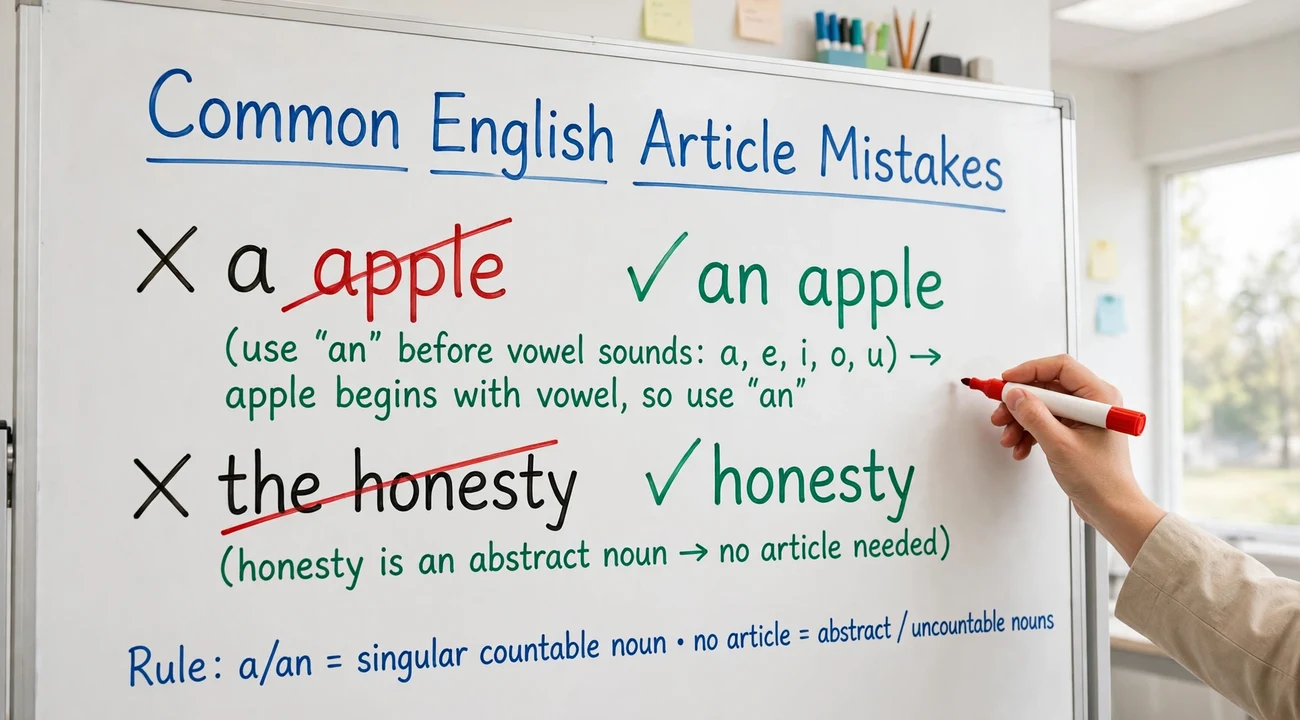
Even good learners make articles a an the mistakes. Learn them once and avoid them forever.
Mistake 1: Using a before a vowel sound.
Wrong: “I saw a elephant.” Right: “I saw an elephant.” Elephant starts with a vowel sound.
Mistake 2: Using the before a general idea.
Wrong: “The life is short.” Right: “Life is short.” We use no article for a general idea.
Mistake 3: Using a with a plural noun.
Wrong: “I bought a books.” Right: “I bought some books.” A goes with one thing only.
Mistake 4: Forgetting the for a thing named before.
Wrong: “I saw a dog. Dog was big.” Right: “I saw a dog. The dog was big.” The second mention needs the.
Mistake 5: Using an before a consonant sound.
Wrong: “He is an university student.” Right: “He is a university student.” University starts with a y sound.
Good punctuation makes articles easier to read — see our comma rules guide.
Quick Quiz: Test Your Articles A An The
Choose the correct article. Answers are at the end — no peeking!
- I saw ___ elephant at the zoo.
- She is ___ honest woman.
- ___ sun rises in the east.
- He bought ___ umbrella yesterday.
- We visited ___ Eiffel Tower.
- Life is ___ gift.
- I need ___ hour to finish.
- Ali is ___ best student.
Answers:
1. an
2. an
3. The
4. an
5. the
6. a
7. an
8. the
How did you do on this articles a an the quiz? 8/8 — excellent! 6–7 — very good. Fewer than 6 — read the 7 rules once more and try again.
Articles A An The: Quick Summary
| Point | How It Works |
|---|---|
| a | One thing, consonant sound (a book) |
| an | One thing, vowel sound (an apple) |
| the | Known, second mention, or only one |
| no article | Names, days, general ideas |
First mention takes a or an, and second mention takes the. Keep this summary near your desk.
FAQs About Articles A An The
What are articles in simple words?
Articles are the small words a, an, and the. They come before a noun and show if we mean any one thing, or one special thing.
When do I use a and when do I use an?
Use a before a consonant sound, like a book, and an before a vowel sound, like an apple. Listen to the first sound, not the first letter.
When do I use the?
Use the when both people know which thing you mean, or when it is the only one, like the sun.
Why do we say an hour but a university?
The articles a an the rules say a goes before a consonant sound and an before a vowel sound. Hour starts with a vowel sound, and university starts with a y sound.
Do we use the with names of people and places?
No. We use no article with most names, like Ali, London, and Monday. But we use the with some place names, like the USA and the Nile.
What is the difference between a and the?
A means any one thing, like a dog, and the means the one we both know, like the dog we saw yesterday. Use a first, then use the for the same thing.
Conclusion
The articles a an the pattern is simple: a or an for a first, unknown thing, and the for a known thing.
Practise a little every day, and articles a an the will soon feel natural. Keep learning with GrammarLuck — grammar made simple.
