

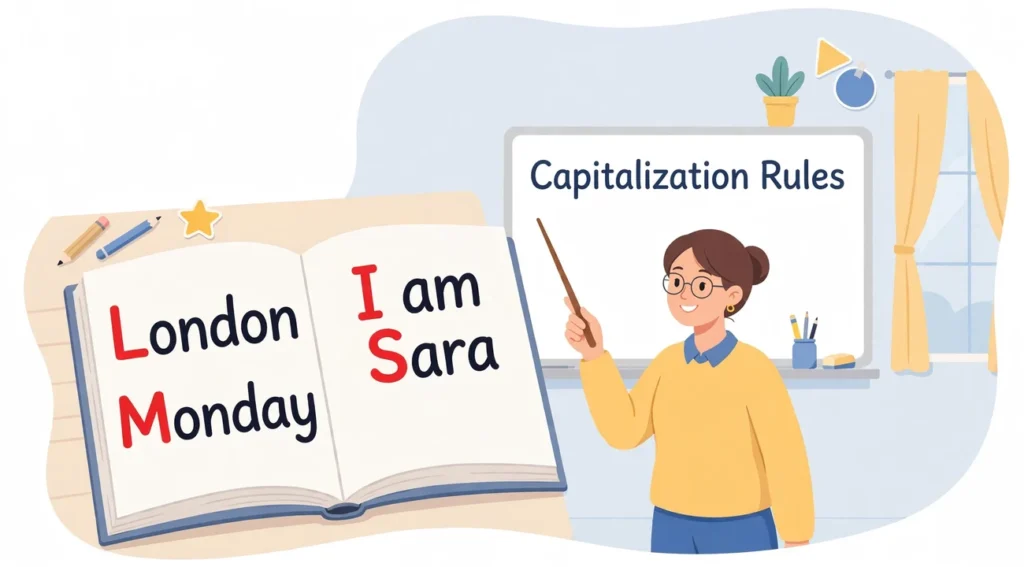
Capital letters are small, but they change everything. A capital letter at the start of a sentence, in a name, or in a title tells the reader where a new idea begins. In this capitalization rules guide, you will learn 8 simple rules that fix common mistakes for good.
Here is the short answer. Capitalization rules tell you when a word needs a capital letter (A, B, C) and when it stays small (a, b, c). Use a capital at the start of a sentence, for names of people and places, for days and months, and for the word I. That is the whole idea in one line.
In this complete capitalization rules guide, you will learn the 8 simple rules, a 2-second memory trick, 40 examples, the most common mistakes, and a quick quiz.
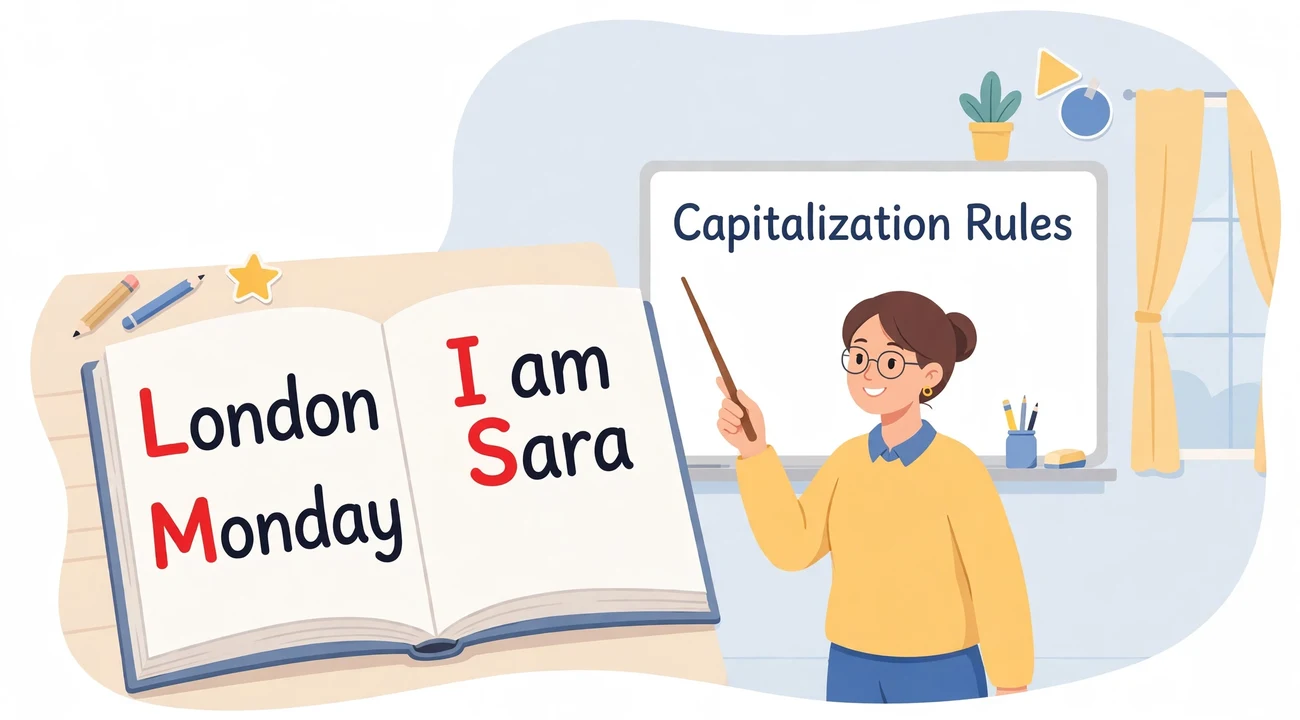
Capitalization Rules: The Quick Answer
| Use a capital letter for… | Example |
|---|---|
| Start of a sentence | The sun is out. |
| Names of people | Sara, Ali, Mr. Jones |
| Names of places | London, Pakistan, the Nile River |
| Days, months, holidays | Monday, June, Eid |
| The word I | Ali and I went home. |
| Titles of books and films | The Jungle Book |
| Languages and nationalities | English, Urdu, Pakistani |
The golden capitalization rules test: if it is the name of one special person, place, or thing, give it a capital letter. If it is a general word, keep it small.
What Are Capitalization Rules?

Capitalization means using a capital letter — a big letter — at the start of a word. The capitalization rules tell you which words get one and which stay small.
The main idea is the difference between a common noun and a proper noun. A common noun is a general word; a proper noun is the name of one special person, place, or thing. Common nouns stay small. Proper nouns get a capital letter.
| Common noun | Proper noun |
|---|---|
| boy | Ali |
| city | London |
| dog | Rover |
| river | the Nile |
| month | June |
| language | English |
Capital letters also mark the start of a sentence: every new sentence begins with one.
Learn the other key mark in our guide to Apostrophe Rules.
8 Simple Capitalization Rules
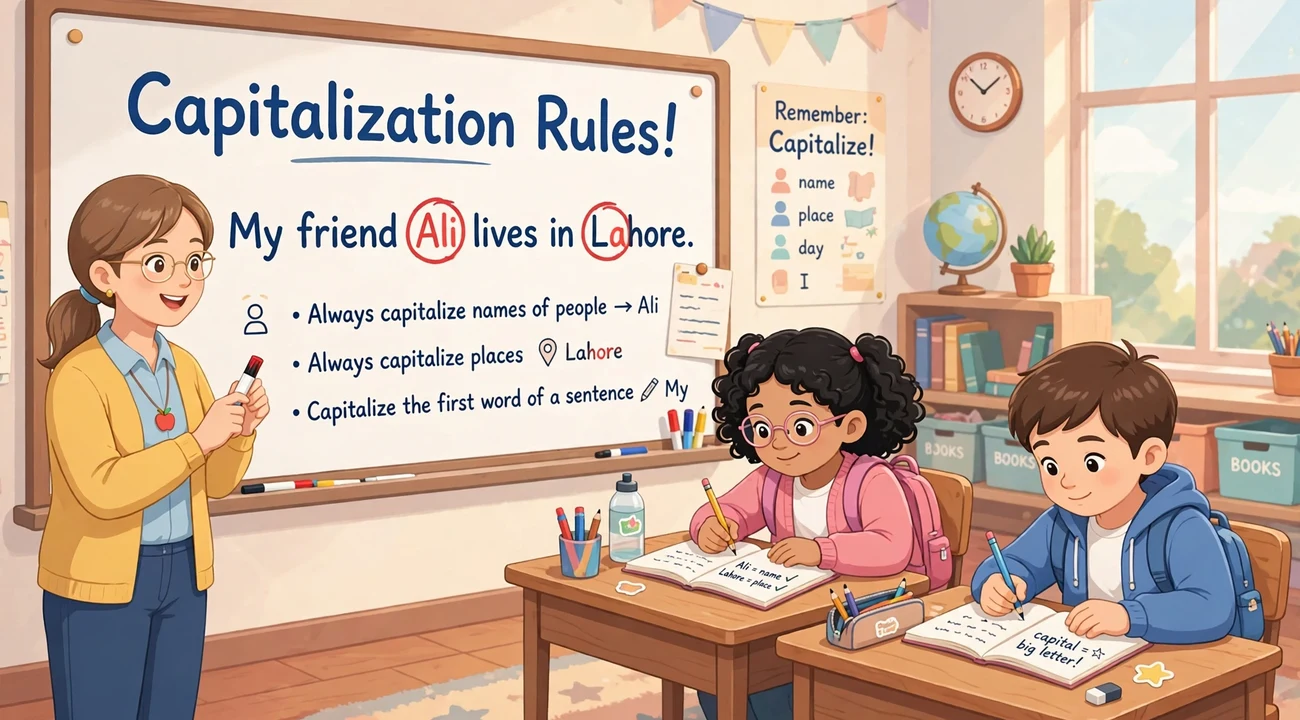
These 8 capitalization rules cover almost every sentence you will write.
Rule 1: Capitalize the First Word of Every Sentence
Every sentence starts with a capital letter.
- The sun is out today.
- My friend came home early.
See more clean sentences in our English sentences for learners.
Rule 2: Always Capitalize the Word I
The word I is always a capital letter, even in the middle of a sentence.
- Ali and I went to school.
- I am happy today.
Never write a small i for yourself.
Rule 3: Capitalize Names of People and Titles Before Names
A person’s name always starts with a capital letter, and so do titles like Mr., Mrs., Miss, and Dr. before a name.
- Sara is my best friend.
- Mr. Jones teaches English.
But job words on their own stay small: “The teacher said hello.” Names also take commas in lists — see our Comma Rules guide.
Rule 4: Capitalize Names of Places
Cities, countries, streets, rivers, and mountains are all names, so they take capital letters.
- London is a big city.
- We live in Pakistan.
- The Nile is a long river.
But city, street, river, and mountain stay small on their own: “We live in a big city.”
Rule 5: Capitalize Days, Months, and Holidays
Days, months, and holidays always take capital letters.
- Today is Monday.
- My birthday is in June.
But the seasons stay small: summer, winter, spring, and autumn never take a capital letter.
Rule 6: Capitalize Languages, Nationalities, and Religions
Languages, peoples, and religions always take a capital letter.
- I speak English and Urdu.
- She is Pakistani.
The word for the people who speak a language takes a capital too: “My friend is French.”
Rule 7: Capitalize Titles of Books, Films, and Songs
Book, film, song, and story titles take capitals for the first word and the important words.
- We read The Jungle Book in class.
- My favourite film is The Lion King.
Small words like a, an, the, and, of, and in stay small inside a title, unless they come first.
Rule 8: Capitalize Names of Groups, Schools, and Companies
A school, company, team, or group name is a proper noun, so it takes a capital letter.
- She studies at Oxford University.
- He works for the Red Cross.
But school, company, team, and group stay small on their own.
The 2-Second Capitalization Rules Memory Trick
Still not sure? Ask: “Is this the name of one special person, place, or thing?” If yes, use a capital letter. If no, keep it small.
Try this trick on three sentences:
- “ali went to london.” The names of a person and a place: “Ali went to London.” ✅
- “today is monday.” The name of a day: “Today is Monday.” ✅
- “i love summer.” The word I takes a capital, but the season stays small: “I love summer.” ✅
Two seconds, one question, and the trick works every time.
40 Capitalization Rules Examples
Here are 40 capitalization rules examples.
Sentences and names:
- The cat is sleeping.
- My mother cooks well.
- Ali and I went to the park.
- Sara is reading a book.
- I am learning English.
- Can you help me, please?
- Mr. Smith is our teacher.
- Dr. Khan works at the hospital.
- We visited our grandmother.
- She is my best friend.
- It is raining today.
- They play football every day.
- Miss Ayesha gave us a test.
- I like to read stories.
- Open your book, please.
- The baby is sleeping now.
- Ahmed and I are good friends.
- Do you speak Urdu?
- My father works in a bank.
- This is a beautiful place.
Places, days, and titles:
- We live in Pakistan.
- London is the capital of England.
- Today is Monday.
- My birthday is in June.
- We celebrate Eid with joy.
- I speak English and Urdu.
- She is Pakistani.
- The Nile is a long river.
- Mount Everest is very high.
- We walked down Oxford Street.
- We read The Jungle Book.
- My favourite film is The Lion King.
- She studies at Oxford University.
- He works for the Red Cross.
- Christmas is in December.
- I love summer holidays.
- Twinkle Twinkle Little Star is a sweet song.
- The Red Lions won the match.
- Ali and I will visit London in June.
- It’s clear now — the capitalization rules are simple!
For the full history of capital letters, see the Capitalization page on Wikipedia.
Common Capitalization Mistakes
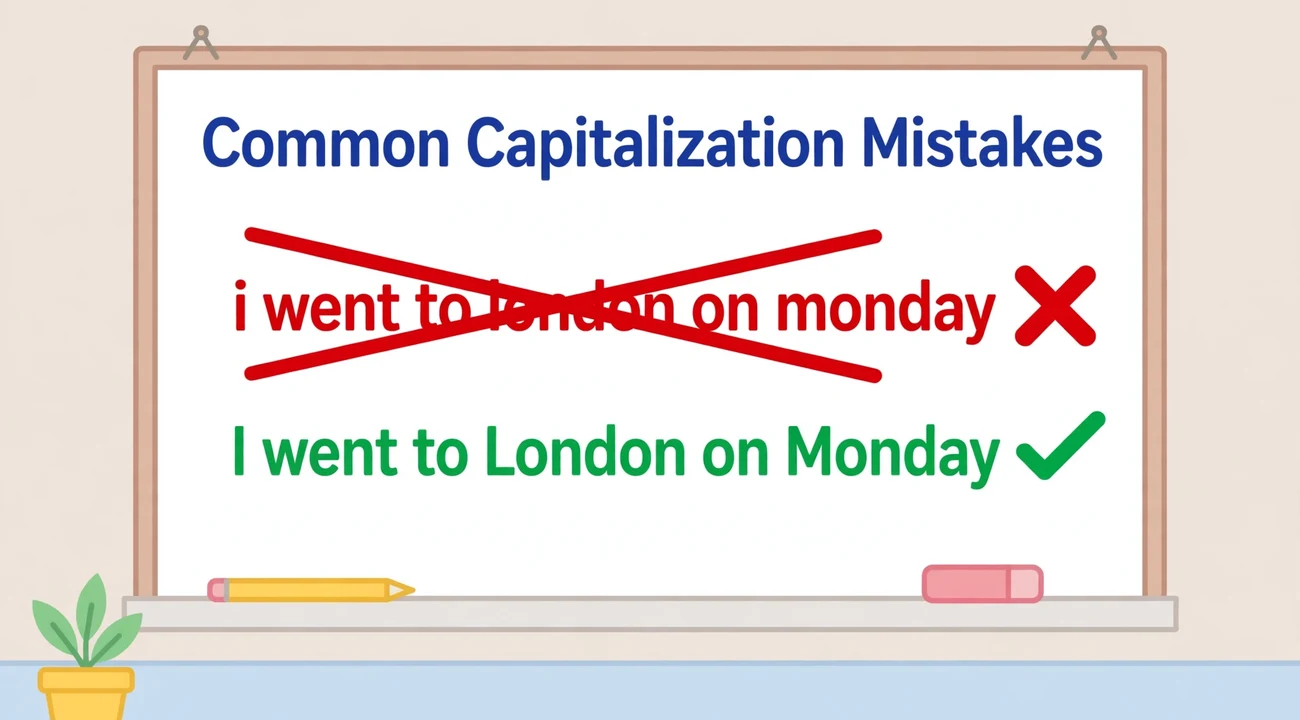
Even good writers get these capitalization rules wrong.
Mistake 1: Capitalizing common nouns.
Wrong: “I love my Dog.” Right: “I love my dog.”
Mistake 2: Forgetting to capitalize I.
Wrong: “Ali and i went home.” Right: “Ali and I went home.”
Mistake 3: Capitalizing seasons.
Wrong: “I love Summer.” Right: “I love summer.” Seasons stay small.
Mistake 4: Writing months and days small.
Wrong: “My birthday is in june.” Right: “My birthday is in June.”
Mistake 5: Capitalizing job words.
Wrong: “The Teacher is kind.” Right: “The teacher is kind.” But “Miss Sara is kind” is correct.
Mistake 6: Writing titles all small.
Wrong: “we read the jungle book.” Right: “We read The Jungle Book.”
If you mix up words that sound the same, read our guide to To vs Too vs Two. To check mistakes like these, try our grammar exercises. For another small mark that changes meaning, see our Oxford Comma guide.
Quick Quiz: Test Your Capitalization Rules
Choose the correct form. Answers are at the end — no peeking!
- ___ (ali / Ali) is my best friend.
- Today is ___ (monday / Monday).
- ___ (i / I) am ready to go.
- We speak ___ (english / English) at school.
- She lives in ___ (london / London).
- My birthday is in ___ (june / June).
- We read ___ (the jungle book / The Jungle Book).
- I love ___ (winter / Winter) mornings.
Answers:
- Ali (a person’s name)
- Monday (days take a capital)
- I (I is always capital)
- English (languages take a capital)
- London (places take a capital)
- June (months take a capital)
- The Jungle Book (titles take capitals)
- winter (seasons stay small)
How did you do? 8/8 — excellent! 6–7 — very good.
Capitalization Rules: Quick Summary
| Rule | Capitalize | Example |
|---|---|---|
| First word of a sentence | Yes | The sun is out. |
| The word I | Always | Ali and I went home. |
| Names of people | Yes | Sara, Mr. Jones |
| Names of places | Yes | London, Pakistan |
| Days, months, holidays | Yes | Monday, June, Eid |
| Seasons | No | summer, winter |
| Languages and nationalities | Yes | English, Pakistani |
| Titles of books and films | Yes | The Jungle Book |
| Names of groups and companies | Yes | Oxford University |
Keep this capitalization rules summary near your desk: names of special things take a capital letter, and general words stay small.
FAQs About Capitalization Rules
What are capitalization rules in simple words?
Capitalization rules tell you when to use a capital letter: at the start of a sentence, for names of people and places, for days and months, for the word I, and for titles. Everything else stays small.
Do I capitalize the seasons?
No. Summer, winter, spring, and autumn always stay small. But holidays take a capital letter: Christmas, Eid, and New Year.
Is the word “I” always a capital letter?
Yes, always — even in the middle of a sentence: “Ali and I went home.” Never write a small i for yourself.
Do I capitalize every word in a title?
No. Capitalize the first word and the important words. Small words like a, an, the, and, of, and in stay small unless they come first.
Do I capitalize job titles like teacher or doctor?
Only when the title comes before a name: Dr. Ayesha, Mr. Jones, Miss Sara. On its own, the job word stays small: “The teacher is kind.” “The doctor is busy.”
What is the difference between a proper noun and a common noun?
A common noun is a general word: city, boy, dog. A proper noun is the name of one special person, place, or thing: London, Ali, Rover. Proper nouns take a capital letter; common nouns do not.
Conclusion
These 8 capitalization rules cover almost everything: capitals at the start of every sentence, for the word I, for names of people and places, for days, months, and holidays, for languages, for titles, and for names of groups.
Practise with the examples and quiz here, and soon you will use capital letters without thinking. Keep learning capitalization rules with GrammarLuck — grammar made simple.
