

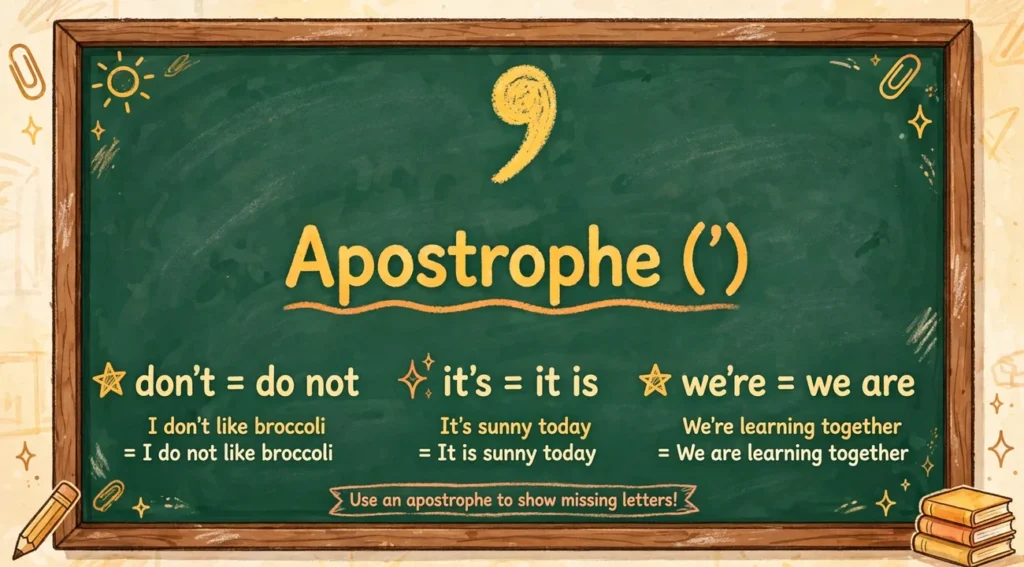
The apostrophe is one of the smallest marks in English, but it causes some of the biggest mistakes. In this apostrophe rules guide, you will learn 7 simple rules that fix the problem for good.
Here is the short answer. An apostrophe has two main jobs: it shows that something belongs to someone, and it shows that letters are missing in a short form. The cat’s toy means the toy belongs to the cat, and don’t means do not. That is the whole idea in one line.
In this complete apostrophe rules guide, you will learn what an apostrophe is, the 7 simple rules, a 2-second memory trick, 40 examples, the most common mistakes, and a quick quiz.
Apostrophe Rules: The Quick Answer
See the four uses side by side.
| Use | Mark | Example |
|---|---|---|
| Possession, one owner | ‘s | The girl‘s bike is red. |
| Possession, many owners ending in s | s’ | The boys‘ shoes are by the door. |
| Contraction (missing letters) | ‘ | Don‘t means do not. |
| Plural (more than one) | No apostrophe | Three apples, not apple’s. |
The golden apostrophe rules test: Does something belong to someone? Use ‘s or s’. Is a letter missing? Put the apostrophe where the letter was. If neither is true, leave it out.
What Is an Apostrophe?

An apostrophe (‘) is a small curved mark above the line. It is not a comma or a quote mark. It has only two jobs, and learning them is the key to the apostrophe rules.
- It shows possession: the dog’s bone, Sara’s book, the teachers’ room. In each case, the apostrophe shows the owner.
- It shows missing letters: don’t means do not, it’s means it is, we’re means we are.
The apostrophe never makes a word plural.
If you also mix up word pairs, our guide to Who vs Whom will help.
7 Simple Apostrophe Rules
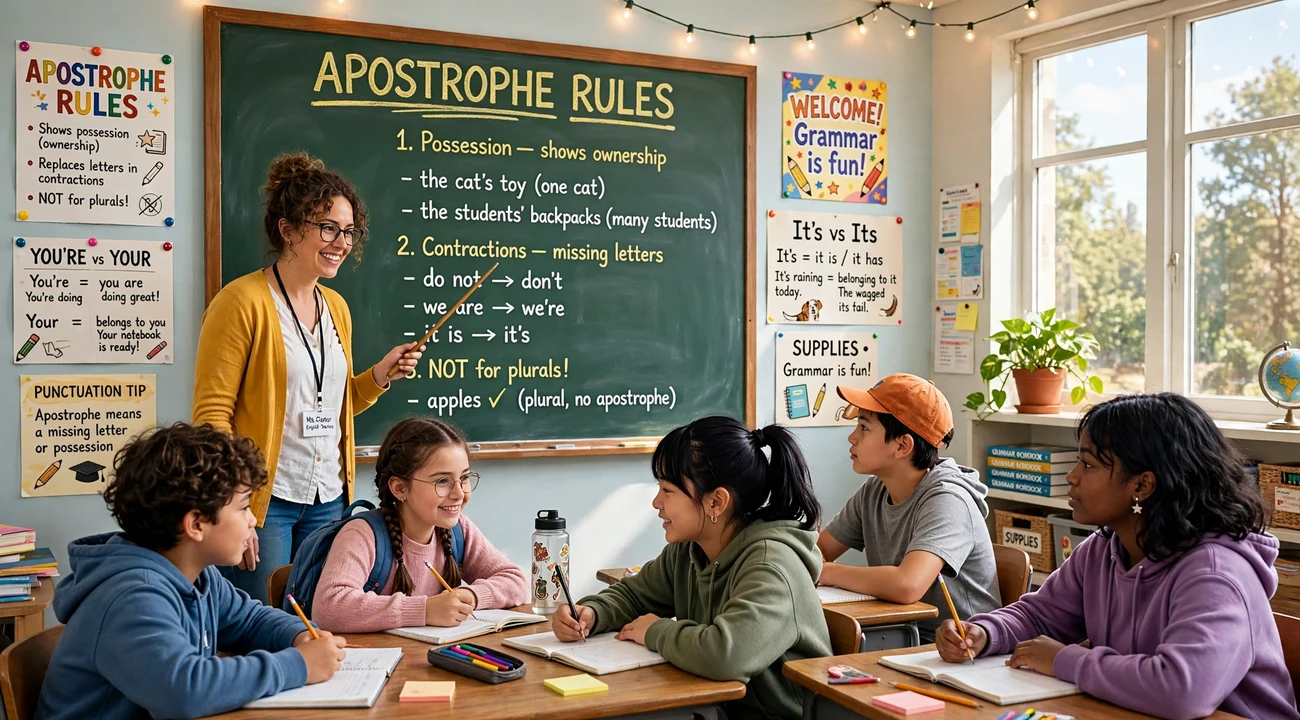
These 7 apostrophe rules cover almost every sentence you will write.
Rule 1: Add ‘s to a Singular Noun to Show Possession
When one person, animal, or thing owns something, add ‘s.
- The girl‘s bike is red.
- My father‘s car is old.
- The baby‘s toy is on the floor.
Rule 2: Add Only an Apostrophe to a Plural Noun Ending in s
When many owners share a word ending in s, add only an apostrophe after the s.
- The boys‘ shoes are by the door.
- The teachers‘ room is on the second floor.
- My parents‘ house is near the park.
Rule 3: Add ‘s to a Plural Noun That Does Not End in s
Some plurals do not end in s — children, women, men, people. These words take ‘s, just like singular nouns.
- The children‘s toys are everywhere.
- The women‘s team won the match.
- The men‘s coats are on the rack.
If the plural word does not end in s, treat it like a singular word and add ‘s.
One more look at the three possession forms:
| Owner | Form | Example |
|---|---|---|
| One girl | girl’s | The girl’s bike |
| Many girls | girls’ | The girls’ bikes |
| Children | children’s | The children’s toys |
See also our Affect vs Effect guide.
Rule 4: Use an Apostrophe in Contractions
A contraction joins two words into one short form. The apostrophe sits where the missing letters were.
- Don‘t = do not (the o is missing)
- Can‘t = cannot (the n and o are missing)
- It‘s = it is (the i is missing)
- We‘re = we are (the a is missing)
Contractions make your writing sound natural. See our Oxford Comma guide for another small mark that changes meaning.
Rule 5: Its vs It’s — No Apostrophe for Possession
This is the hardest of all the apostrophe rules: its shows possession, but it never takes an apostrophe.
- The dog wagged its tail. (possession — no apostrophe)
- It’s raining today. (it is — apostrophe)
- The company changed its logo. (possession — no apostrophe)
- It’s been a long day. (it has — apostrophe)
Possessive pronouns — his, hers, its, ours, theirs — never use an apostrophe. See our full Its vs It’s guide for 40 more examples.
Rule 6: Names Ending in s — Add ‘s (or Just an Apostrophe)
Names ending in s follow a free choice: add ‘s, or add only an apostrophe. Both are correct, so pick one style and use it every time.
- James‘s book is on the table. (also correct: James’ book)
- Charles‘s dog is friendly.
- Mr. Jones‘s car is blue.
Just do not mix the two styles.
Rule 7: Never Use an Apostrophe to Make a Plural
Apostrophes do not make plurals. If you only mean “more than one,” add s or es and leave the apostrophe out.
- I have three apples, not apple’s.
- The 1990s were a fun time, not the 1990’s.
- She bought two CDs, not CD’s.
Shop signs and social media posts are full of this mistake.
The 2-Second Apostrophe Rules Memory Trick
Still not sure? Ask one question: “Does something belong to someone, or is a letter missing?” If yes to the first, use ‘s. If yes to the second, put the apostrophe where the letter was. If no to both, leave it out.
Try this apostrophe rules trick on three sentences:
- “The cats tail is long.” The tail belongs to the cat: The cat‘s tail is long. ✅
- “Its raining outside.” It is raining: It’s raining outside. ✅
- “I bought three apple’s.” More than one: I bought three apples. ✅
Two seconds, one question, and the trick works every time.
40 Apostrophe Rules Examples
Here are 40 apostrophe rules examples: 20 for possession, 20 for contractions.
Possession:
- The cat‘s whiskers are long.
- Sara‘s bag is pink.
- My brother‘s room is messy.
- The school‘s gate is closed.
- The baby‘s blanket is soft.
- The birds‘ nest is in the tree.
- The students‘ books are on the desk.
- The children‘s park is full of life.
- The women‘s club meets on Friday.
- The dog‘s tail wags when it is happy.
- James‘s bike is new.
- The city‘s streets are clean.
- Our teacher‘s voice is kind.
- The team‘s captain is strong.
- The shop‘s door is open.
- The workers‘ lunch break is at noon.
- The family‘s car is big.
- My mother‘s cooking is the best.
- The book‘s last page is sad.
- The girls‘ dresses are blue.
Contractions:
- I don‘t like cold coffee.
- She can‘t swim yet.
- It‘s a lovely morning.
- We‘re going to the park.
- They‘ve finished their work.
- He‘ll come tomorrow.
- You aren‘t late.
- It hasn‘t rained today.
- We‘d love to join you.
- She‘s my best friend.
- I‘m ready to go.
- That isn‘t fair.
- Who‘s at the door?
- Let‘s start now.
- It won‘t take long.
- I‘ve seen that film.
- They don‘t know the answer.
- You‘re doing great.
- She‘d like a cup of tea.
- It‘s clear now — the apostrophe rules are simple!
For the history of this small mark, see the Apostrophe on Wikipedia.
Common Apostrophe Mistakes
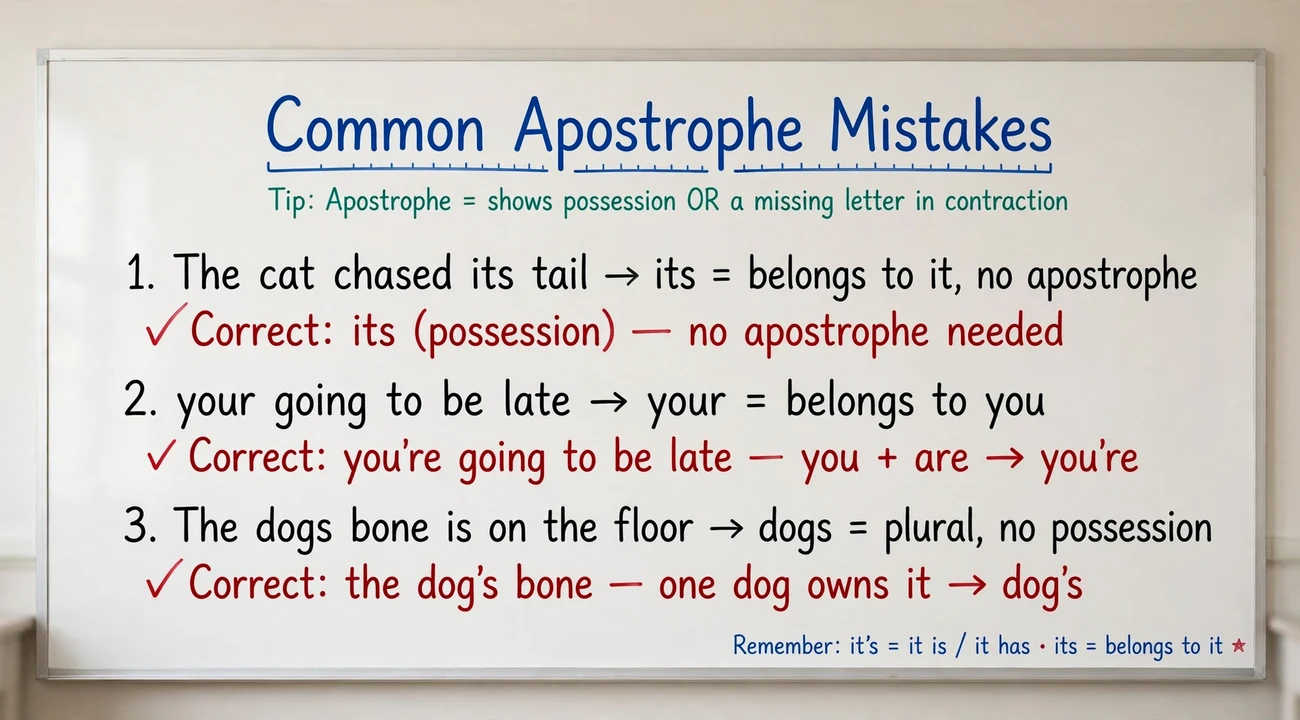
Even good writers get these apostrophe rules wrong.
Mistake 1: Adding an apostrophe to a plural.
Wrong: “I bought three apple’s.” Right: “I bought three apples.”
Mistake 2: Using it’s for possession.
Wrong: “The dog wagged it’s tail.” Right: “The dog wagged its tail.”
Mistake 3: Using its for “it is.”
Wrong: “Its raining today.” Right: “It’s raining today.”
Mistake 4: Forgetting the apostrophe in contractions.
Wrong: “Dont go now.” Right: “Don’t go now.”
Mistake 5: Adding ‘s to a plural noun that ends in s.
Wrong: “The boys’s shoes are wet.” Right: “The boys‘ shoes are wet.”
To check mistakes like these in your own writing, read our guide on how to check and fix your English grammar. The Blue Book of Grammar and Punctuation is a trusted next read.
Quick Quiz: Test Your Apostrophe Rules
Choose the right form. Answers are at the end — no peeking! These apostrophe rules questions use everything you learned above.
- The ___ (dog / dog’s) bone is on the floor.
- I ___ (dont / don’t) know the answer.
- The ___ (teachers / teachers’) room is upstairs.
- ___ (Its / It’s) a beautiful day today.
- The ___ (childrens / children’s) toys are in the box.
- I have three ___ (apples / apple’s).
- ___ (James / James’s) car is red.
- The ___ (girls / girls’) dresses are new.
Answers:
1. dog’s (one owner)
2. don’t (do not — a letter is missing)
3. teachers’ (many owners, ends in s)
4. It’s (it is)
5. children’s (children does not end in s)
6. apples (more than one — no apostrophe)
7. James’s (names ending in s take ‘s)
8. girls’ (many owners, ends in s)
How did you do? 8/8 — excellent! 6–7 — very good. Fewer than 6 — read the rules once more.
Apostrophe Rules: Quick Summary
| Use | Mark | Example |
|---|---|---|
| One owner | ‘s | The girl’s bike |
| Many owners, word ends in s | s’ | The boys’ shoes |
| Plural, word does not end in s | ‘s | The children’s toys |
| Contraction | ‘ where letters are missing | Don’t = do not |
| Plural (more than one) | No apostrophe | Three apples |
Keep this apostrophe rules summary near your desk. The answer is always the same: possession takes an apostrophe, missing letters take an apostrophe, and plurals take none.
FAQs About Apostrophe Rules
What are apostrophe rules in simple words?
Apostrophe rules tell you where to put the small (‘) mark. Use it to show that something belongs to someone, like “Sara’s book,” or to show missing letters, like “don’t” for “do not.” Never use it just to make a word plural.
Where does the apostrophe go in a plural noun ending in s?
Put the apostrophe after the s: the boys’ shoes, the teachers’ room. The word is already plural, so you only add the apostrophe.
Is it James’s or James’?
Both are correct. Most guides say James’s, and some say James’. Pick one style and use it the same way.
Why does “its” have no apostrophe for possession?
Because possessive pronouns never use apostrophes. Just like his, hers, and theirs, its shows possession without an apostrophe. Apostrophes in pronouns appear only in contractions like it’s. This is why apostrophe rules feel tricky at first.
Can I use an apostrophe for years, like 1990’s?
No. Write 1990s, 2000s, and 1980s with no apostrophe. Years are plurals, not owners. The same goes for CDs, DVDs, and TVs.
Do contractions need an apostrophe every time?
Yes. Every contraction needs an apostrophe where the letters were dropped. Don’t, can’t, won’t, it’s, we’re — the mark is never optional.
Conclusion
These 7 apostrophe rules cover almost everything: ‘s for one owner, s’ for many owners ending in s, ‘s for plurals that do not end in s, an apostrophe for missing letters, no apostrophe for its, and never an apostrophe for plurals.
Practise with the examples and quiz here, and soon you will place the apostrophe without thinking. Keep learning apostrophe rules with GrammarLuck — grammar made simple.
