

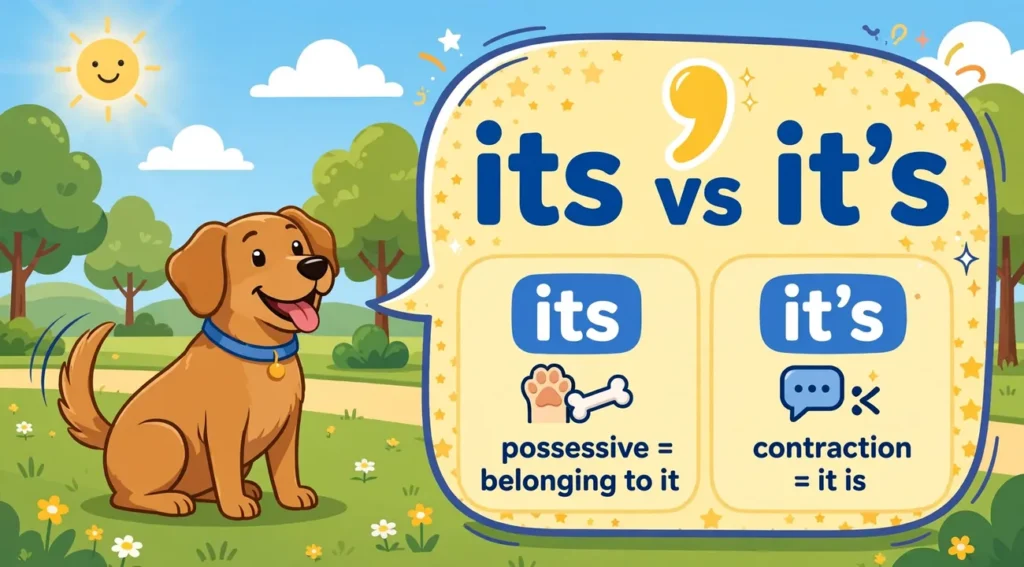
Its vs it’s is the one grammar question that a single apostrophe can answer. Its owns something — the dog wagged its tail — and it never takes an apostrophe, just like his, hers, and theirs. It’s is short for “it is” or “it has” — it’s raining, it’s been a while. One rule settles every its vs it’s choice: if you can expand the word to “it is” or “it has”, write it’s; if you cannot, write its.
Here is the short answer. Its shows possession — it means “belonging to it.” It’s is a short form of “it is” or “it has.” That is the whole its vs it’s difference in one line. The dog wagged its tail, and it’s a happy dog. One word owns something, the other word joins two words together.
In this complete guide, you will learn what each word means, the 5 simple its vs it’s rules, a 2-second test that always works, 40 clear examples, the most common mistakes, and a quick quiz to test yourself. By the end, the its vs it’s question will never confuse you again.
Its vs It’s: The Quick Answer
The fastest way to understand the difference is to see them side by side.
| Word | Meaning | Example |
|---|---|---|
| Its | Belonging to it (possessive) | The dog wagged its tail. |
| It’s | It is / It has (contraction) | It’s raining today. |
The golden its vs it’s rule: If you can replace the word with “it is” or “it has” and the sentence still makes sense, use it’s. If the replacement sounds wrong, use its. This one test works in almost every sentence, and you will practise it many times in this guide.
What Does Its Mean?
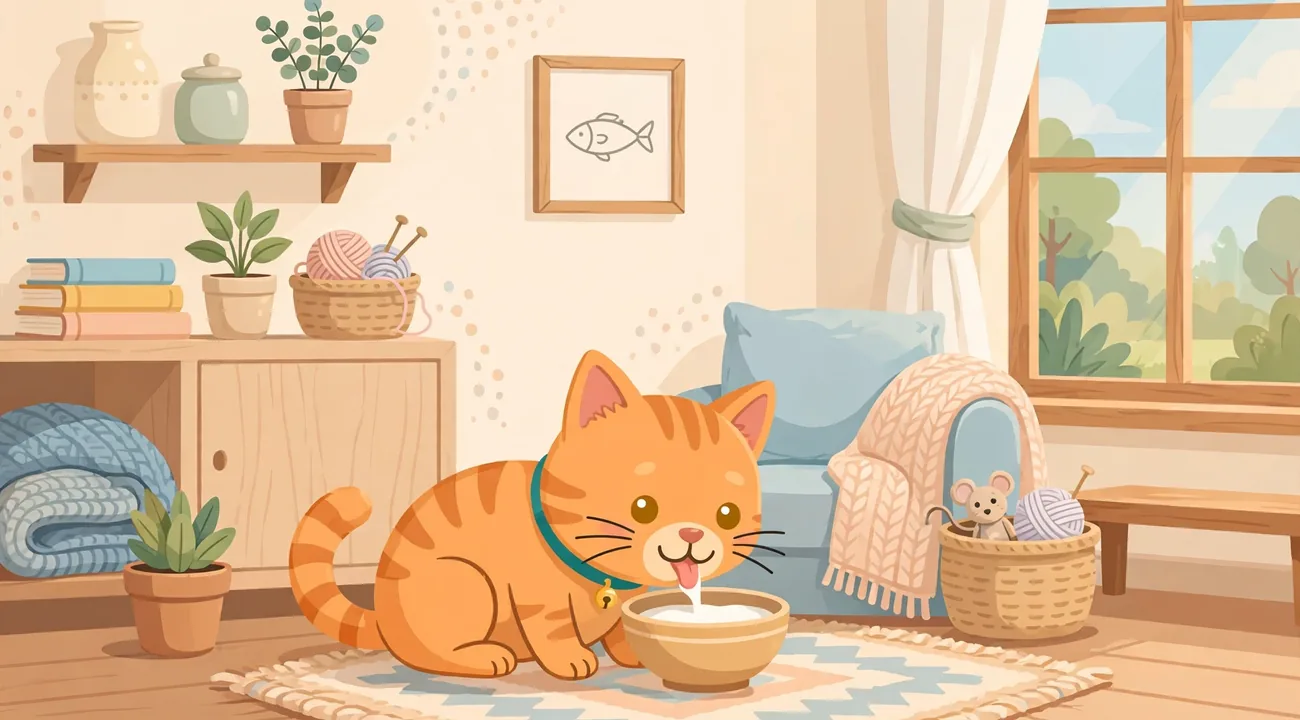
Its is a possessive word. It shows that something belongs to a thing, an animal, a place, or an idea that you already mentioned. In the its vs it’s pair, its is the owner word — just like his, her, and their.
- The cat drank its milk.
- The tree lost its leaves in winter.
- The company changed its logo.
- The book is famous for its final chapter.
- The baby bird opened its beak.
Notice something important in this its vs it’s lesson: possessive pronouns never use an apostrophe. We write his, not hi’s. We write hers, not her’s. In the same way, we write its, not it’s, for possession. Remembering this one fact solves half of the problem.
If you enjoy word pairs like this one, you will also like our guide to Who vs Whom, another pair that confuses almost every English learner.
What Does It’s Mean?
It’s is a contraction — a short form made by joining two words and removing some letters. The apostrophe shows where the missing letters were. In the its vs it’s pair, it’s can mean two things:
- It’s = it is. Example: It’s a beautiful day. (= It is a beautiful day.)
- It’s = it has. Example: It’s been a long day. (= It has been a long day.)
More examples:
- It’s time to go home.
- It’s not fair!
- It’s been raining since morning.
- I think it’s your turn now.
- It’s a kind of magic.
Every time you see the apostrophe in this guide, read the word as “it is” or “it has” in your head. If the sentence still works, the apostrophe is correct.
Contractions like this one appear in almost every English text. You can see hundreds of them inside our collection of simple English sentences for learners.
The 2-Second Its vs It’s Test
Still not sure which word to use? Use this its vs it’s test. It takes only two seconds.
Step 1: Replace the word with “it is” (or “it has”). Step 2: Read the sentence again. Step 3: If it makes sense, write it’s. If it sounds silly, write its.
Try the test on these examples:
- “The dog wagged it is tail.” — Silly, so use its: “The dog wagged its tail.”
- “It is raining outside.” — Makes sense, so use it’s: “It’s raining outside.”
- “The flower opened it is petals.” — Silly, so use its: “The flower opened its petals.”
- “It has been a busy week.” — Makes sense, so use it’s: “It’s been a busy week.”
This trick never fails. When you feel stuck while writing an essay, an email, or an exam answer, stop for two seconds and run this test.
5 Simple Its vs It’s Rules
Rule 1: Use Its for Possession
When something belongs to a thing or an animal, use its with no apostrophe.
- The elephant sprayed water with its trunk.
- Our school celebrated its 50th anniversary.
- The phone is known for its strong battery.
Rule 2: Use It’s for “It Is” or “It Has”
When you can expand the word into “it is” or “it has,” use it’s with an apostrophe.
- It’s my birthday today. (= It is)
- It’s been three years since we met. (= It has)
Rule 3: Possessive Pronouns Never Take an Apostrophe
This is the rule behind the whole its vs it’s confusion. Possessive pronouns — my, your, his, her, its, our, their — never use an apostrophe. Apostrophes in pronouns only appear in contractions. So for possession, the answer always means no apostrophe.
Small rules like this become automatic when you practise them in daily grammar exercises.
Rule 4: Never Write Its’
There is no such word as its’ in English. It does not exist. There are only two options: its and it’s. If you ever type its’, delete it and run the 2-second test.
Rule 5: When in Doubt, Expand the Sentence
If a sentence still feels hard, write it in full. Instead of guessing, write “it is” in the sentence and read it aloud. Your ear will tell you the answer almost every time.
Why the Its vs It’s Mix-Up Happens
Why is its vs it’s so confusing? Because normal nouns work the opposite way. With nouns, an apostrophe shows possession: the dog’s tail, Sara’s book, the teacher’s desk. So learners naturally want to write it’s tail for possession too.
But pronouns follow a different rule. Look at this table:
| Possessive pronoun | Example | Contraction | Example |
|---|---|---|---|
| his | The coat is his. | he’s = he is | He’s happy. |
| her / hers | The coat is hers. | she’s = she is | She’s happy. |
| its | The dog wagged its tail. | it’s = it is | It’s happy. |
| their / theirs | The house is theirs. | they’re = they are | They’re happy. |
| your / yours | The book is yours. | you’re = you are | You’re happy. |
In every row, the possessive word has no apostrophe, and the contraction has one. The its vs it’s pair follows exactly the same pattern. Once you see this pattern, the its vs it’s rule becomes easy to remember.
This is the same kind of pattern you learn in our Affect vs Effect guide — two similar words, one clear rule, and the confusion disappears.
Its vs It’s Examples Side by Side
Reading pairs together is the fastest way to train your eye.
- Its colour is red. / It’s a red car.
- The bird built its nest. / It’s a strong nest.
- The city is famous for its food. / It’s famous all over the world.
- The robot moved its arm. / It’s moving again!
- The team won its first match. / It’s a historic win.
In each pair, the first sentence shows ownership, and the second sentence means “it is.” That contrast is the heart of the its vs it’s lesson.
40 Its vs It’s Examples
Here are 40 simple examples. The first 20 use its, and the next 20 use it’s.
Its (possession):
- The dog buried its bone in the garden.
- The cat licked its paw.
- The tree dropped its fruit.
- The company raised its prices.
- The baby held its mother’s finger.
- The car lost its front wheel.
- The bird sang from its cage.
- The school painted its walls blue.
- The river changed its course.
- The spider built its web in the corner.
- The book has its own charm.
- The machine stopped making its usual noise.
- The lion protected its cubs.
- The flower turned its face to the sun.
- The city is proud of its history.
- The team changed its captain.
- The phone saves its battery well.
- The snake shed its skin.
- The hotel is known for its friendly staff.
- Every country has its own culture.
It’s (it is / it has):
- It’s a sunny day today.
- It’s time for lunch.
- It’s been a pleasure meeting you.
- It’s not easy to learn a new language.
- It’s raining, so take an umbrella.
- It’s my favourite song!
- It’s been three hours since the train left.
- It’s important to sleep well.
- It’s a small world.
- It’s your turn to play.
- It’s never too late to learn.
- It’s been ages since we talked.
- It’s cold outside tonight.
- It’s a beautiful place to visit.
- It’s time to say goodbye.
- It’s not what it looks like.
- It’s been a wonderful journey.
- It’s the best day of my life.
- It’s okay to make mistakes.
- It’s clear now — the its vs it’s rule is simple!
Common Its vs It’s Mistakes
Even native speakers make these its vs it’s mistakes. Learn them once and avoid them forever.
Mistake 1: Using it’s for possession. Wrong: “The dog wagged it’s tail.” Right: “The dog wagged its tail.” Run the test: “it is tail” makes no sense, so no apostrophe.
Mistake 2: Using its for “it is.” Wrong: “Its raining today.” Right: “It’s raining today.” The test: “it is raining” works, so the apostrophe belongs there.
Mistake 3: Writing its’. Wrong: “The company changed its’ policy.” Right: “The company changed its policy.” The word its’ never exists in correct English.
Mistake 4: Adding apostrophes to other possessive pronouns. Wrong: “The book is her’s.” Right: “The book is hers.” The same its vs it’s logic applies to his, hers, ours, yours, and theirs — no apostrophes, ever.
If you want a full check of mistakes like these in your own writing, read our guide on how to check and fix your English grammar.
Quick Quiz: Its or It’s?
Choose the correct word for each sentence. Answers are at the end — no peeking!
- The parrot repeated ___ favourite word.
- ___ going to rain this evening.
- The village is known for ___ old houses.
- ___ been a long time since our last trip.
- The turtle hid inside ___ shell.
- ___ a perfect day for a picnic.
- The company announced ___ new plan today.
- ___ not easy, but ___ worth trying.
Answers: 1. its (the word belongs to the parrot) 2. It’s (It is going to rain) 3. its (the houses belong to the village) 4. It’s (It has been a long time) 5. its (the shell belongs to the turtle) 6. It’s (It is a perfect day) 7. its (the plan belongs to the company) 8. It’s / it’s (It is not easy, but it is worth trying)
How did you do? 8/8 — excellent, you have mastered this rule! 6-7 — very good. Fewer than 6 — read the 2-second test once more and try again.
Its vs It’s: Quick Summary
| Point | Its | It’s |
|---|---|---|
| Meaning | Belonging to it | It is / It has |
| Type | Possessive pronoun | Contraction |
| Apostrophe | Never | Always |
| Test | “It is” sounds wrong | “It is” sounds right |
| Example | The cat drank its milk. | It’s a cute cat. |
For students, writers, and bloggers, the answer is simple: possession takes its, and “it is” takes it’s. Keep this summary near your desk until the rule becomes automatic.
If you are building your punctuation and grammar basics step by step, the Blue Book of Grammar and Punctuation is a trusted next read after this guide.
FAQs About Its vs It’s
What is the difference between its and it’s in simple words?
Its shows that something belongs to it, like “its tail.” It’s means “it is” or “it has,” like “it’s raining.” This simple its vs it’s difference is the only rule you need.
How can I remember the its vs it’s rule?
Use the 2-second test: replace the word with “it is.” If the sentence makes sense, write it’s. If it sounds silly, write its.
Is its’ ever correct?
No. Its’ is never correct in English. The only two correct forms are its and it’s.
Why does its have no apostrophe for possession?
Because possessive pronouns never use apostrophes. Just like his, hers, and theirs, the word its shows possession without an apostrophe. Apostrophes in pronouns are only for contractions like it’s.
Can it’s mean “it has” as well as “it is”?
Yes. It’s can mean “it has” in sentences like “It’s been a long day” (= It has been a long day). The 2-second test works for both meanings.
Is it’s formal or informal?
It’s is a contraction, so it is slightly informal. In very formal writing, such as legal documents, you can write “it is” in full. In essays, emails, blogs, and exams, it’s is perfectly fine.
Conclusion
This rule is smaller than it looks. One apostrophe, two meanings: its owns something, and it’s joins “it is” or “it has” together. Remember the 2-second test, never write its’, and keep possessive pronouns apostrophe-free.
Practise with the examples and quiz in this guide, and soon you will choose the right word without even thinking. For more simple lessons like this, keep learning with GrammarLuck — grammar made simple.
