

Determiners are small words that come before a noun and tell us which one, how many, or whose it is. Words like the, a, this, my, some and every are all determiners. They may look small, but they change the meaning of a sentence. In this guide from GrammarLuck, you will learn what they are, the main types, 7 easy rules, 40 examples, common mistakes and a quick quiz.
Here is the short answer. A determiner always sits before a noun and gives extra information about it. It answers which one? how many? or whose? For example, “this book” points to one book near you, “three books” tells you the number, and “my book” tells you the owner. Without these small words, English sentences would sound unclear and unfinished.
In this guide, you will learn the types, the 7 rules, a 2-second trick, 40 examples, the most common mistakes, and a quick quiz to test yourself. By the end, you will use determiners with full confidence in essays, emails and exams.
Determiners: The Quick Answer
The fastest way to understand them is to see them in action. Each row below shows one type with a simple example.
| Type | Determiner | Example |
|---|---|---|
| Articles | a, an, the | I read a book. |
| Demonstrative | this, that, these, those | This pen is mine. |
| Possessive | my, your, his, her, our, their | Her bag is red. |
| Quantifiers | some, many, few, all, most | Some students came early. |
| Numbers | one, two, first, second | I have two brothers. |
| Question words | which, what, whose | Which colour do you like? |
The golden rule of determiners: a determiner always comes before the noun it describes, and most nouns need one. You cannot say “book is on table” — you need “the book is on the table”.
What Are Determiners?
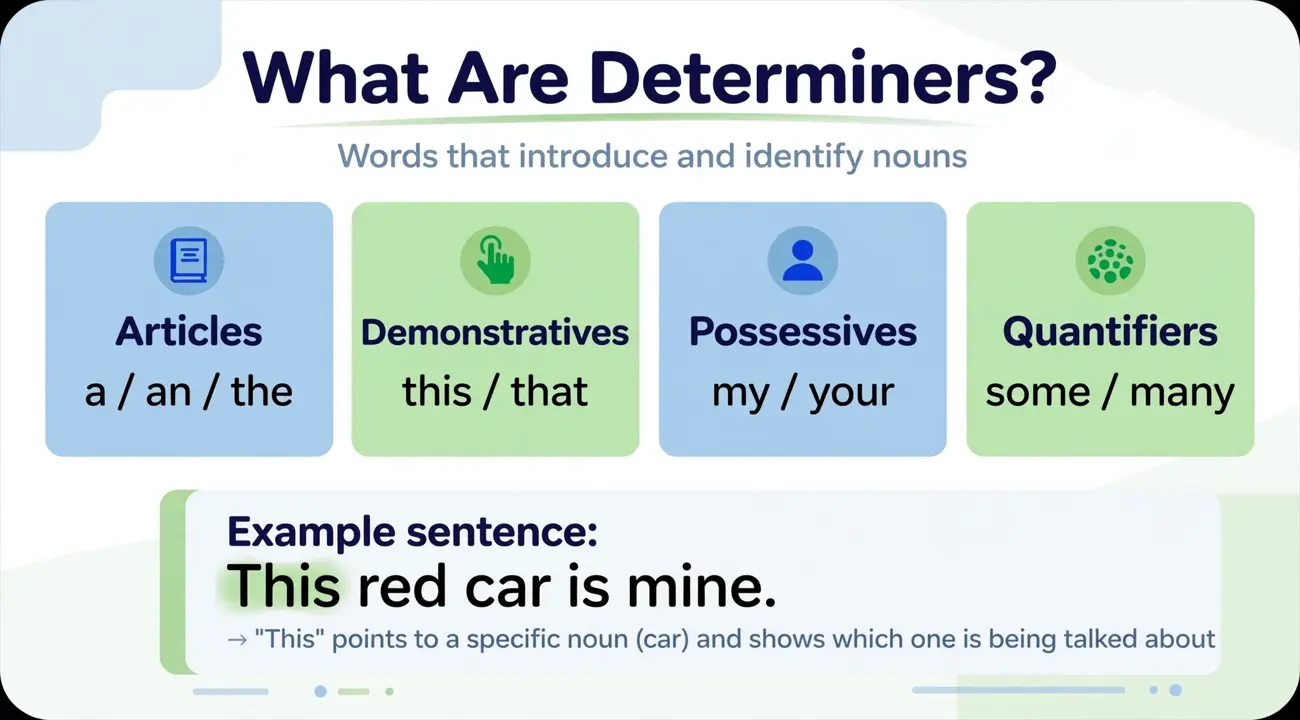
Determiners are words that come before a noun and limit or describe it. They tell the reader which noun you mean, how many there are, or who owns it. They are not adjectives, but they sit in the same place. Adjectives describe a noun (a red car), while these words point to it or count it (this car, my car).
There are six main types. Once you know them, you will spot them in every sentence.
1. Articles: A, An and The
Articles are the most common type. A and an point to any one thing, the to a special one. Read the full rules in our guide to articles a, an and the.
- I saw a bird in the garden.
2. Demonstrative Determiners: This, That, These, Those
These words point to a noun. This and these point to things near you; that and those point to things far away. This and that go with one noun, these and those with more than one.
- This book is very interesting.
3. Possessive Determiners: My, Your, His, Her, Its, Our, Their
These words show who owns the noun. They always come before the noun, never after it. They are close cousins of possessive pronouns.
- My mother cooks tasty food.
4. Quantifiers: Some, Any, Many, Few, All, Most
Quantifiers tell us how much or how many. Many and few go with countable nouns, much and little with uncountable nouns.
- Some water is in the glass.
5. Numbers: One, Two, First, Second
Numbers work the same way before a noun. One, two and three count things; first, second and third show order.
- I have two sisters and one brother.
6. Question Determiners: Which, What, Whose
Which, what and whose can also do this job before a noun in a question. “Which book is yours?” is a common example.
- Which colour do you like?
7 Simple Determiners Rules
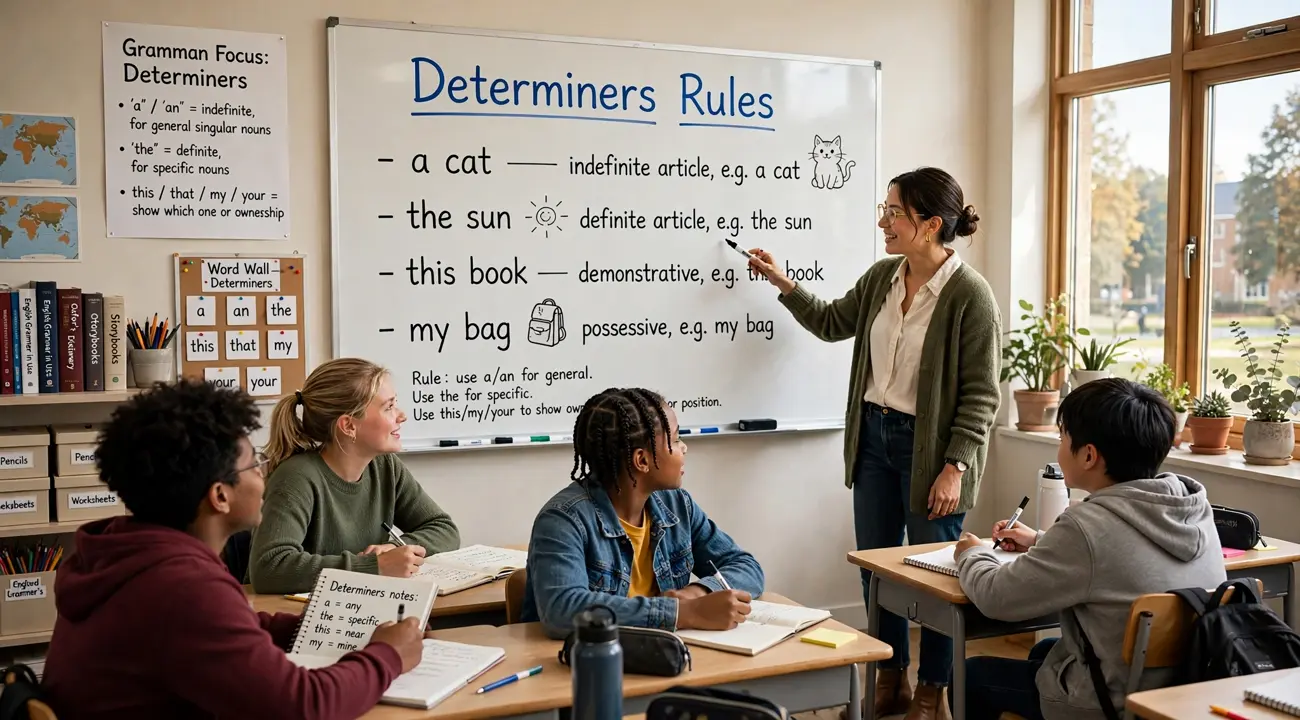
Rule 1: Put the Determiner Before the Noun
The determiner always comes first, then the noun. You say “the big house”, not “big the house”. Even with an adjective between them, it still comes first: “a red car”.
- The old man crossed the road.
Rule 2: Use A or An for One General Thing
Use a or an for one thing in general, not a special one. Use an before a vowel sound (an apple, an hour) and a before other sounds (a book, a university).
- He is a teacher.
Rule 3: Use The for a Special or Known Thing
Use the when both the speaker and the listener know which thing you mean — a thing you talked about before, the only one of its kind, or a thing clear from the situation.
- I bought a pen. The pen is blue.
Rule 4: Match This and That with One Noun, These and Those with Many
This and that go with singular nouns: this book, that boy. These and those go with plural nouns: these books, those boys. Check the noun before you choose the word.
- This chair is broken.
- These chairs are broken.
Rule 5: Use Only One Determiner at a Time
You cannot put two of these words before the same noun. “The my book” is wrong, and “a this pen” is wrong too. Choose one and use it alone. If you need more meaning, add an adjective: “my new book”.
- Wrong: the my book. Right: my book.
Rule 6: Use Some in Positive Sentences and Any in Questions
Use some in positive sentences and offers, and any in questions and negative sentences. “I have some money” is positive, “Do you have any money?” is a question.
- I need some help.
Rule 7: Do Not Use A or An with Plural or Uncountable Nouns
A and an mean “one”, so they only work with singular countable nouns. You cannot say “a books” or “a water”. Use some or the instead: “some books”, “the water”.
- Wrong: a informations. Right: some information.
The 2-Second Trick
Not sure which one to use? Ask three quick questions about the noun. It takes only two seconds.
Step 1: Ask “which one?” — For a special one, use the, this or that.
Step 2: Ask “how many?” — For a number or amount, use two, some, many or few.
Step 3: Ask “whose?” — For an owner, use my, your, his, her, our or their.
Try the trick on these examples:
- “___ book is on the table.” The book is the one we know — so use the. ✅
This trick works because determiners always answer one of these three questions. When you feel stuck, stop for two seconds and run it.
40 Determiners Examples
Here are 40 examples of determiners in two groups of 20.
Articles and Demonstrative (1–20):
- A cat is sleeping on the sofa.
- An elephant is a big animal.
- The teacher is very kind.
- This mango is very sweet.
- That dog is barking loudly.
- These flowers smell lovely.
- Those mountains look beautiful.
- I need a pen to write.
- She bought an umbrella yesterday.
- The baby is crying for milk.
- This road leads to the market.
- That movie was funny.
- These shoes are too small.
- Those children are playing in the park.
- He is a good friend.
- It was an exciting match.
- The train arrived on time.
- This cake tastes delicious.
- That shop sells bread.
- These books belong to the library.
Possessive and Quantifiers (21–40):
- My father works in a bank.
- Your room is very clean.
- His bike is new and fast.
- Her dress is pink.
- Our school starts at eight.
- Their house is near the river.
- Some boys are playing football.
- Many birds fly south in winter.
- Few people know the real story.
- All students must bring books.
- Most children love ice cream.
- Each student got a new notebook.
- Every morning I walk.
- No money was left.
- Any student can join the club.
- Three friends went to the zoo.
- First prize went to a young girl.
- Which book do you want to read?
- Whose jacket is this?
- What colour is your new car?
For more detail, see the Wikipedia page on determiners.
Common Determiners Mistakes

Even good writers make these mistakes.
Mistake 1: Leaving out the determiner.
Wrong: “Book is on table.” Right: “The book is on the table.”
Mistake 2: Using a or an with a plural noun.
Wrong: “I need a books.” Right: “I need some books.”
Mistake 3: Mixing this with a plural noun.
Wrong: “This books are new.” Right: “These books are new.”
Mistake 4: Stacking two together.
Wrong: “The my car is red.” Right: “My car is red.”
Mistake 5: Using some in a negative sentence.
Wrong: “I do not have some money.” Right: “I do not have any money.”
These mistakes become rare when you practise them in daily grammar exercises.
Quick Quiz: Test Yourself
Choose the correct determiner for each sentence. Answers are at the end — no peeking!
- ___ sun rises in the east. (a / an / the)
- I saw ___ elephant at the zoo. (a / an / the)
- ___ books are mine. (This / These / That)
- She did not buy ___ apples. (some / any / much)
- ___ pen is this? (Who / Whose / Which)
Answers:
1. the (only one sun)
2. an (an before a vowel sound)
3. These (these goes with plural nouns)
4. any (any in negative sentences)
5. Whose (asks about the owner)
How did you do? 5/5 — excellent! 4 — very good. Fewer than 4 — read the 7 rules once more and try again.
Determiners: Quick Summary
| Type | Words | Example |
|---|---|---|
| Articles | a, an, the | The book is on the table. |
| Demonstrative | this, that, these, those | This pen is mine. |
| Possessive | my, your, his, her, our, their | My bag is red. |
| Quantifiers | some, any, many, few, all, most | Some students came early. |
| Numbers | one, two, first, second | I have two brothers. |
| Question words | which, what, whose | Which colour do you like? |
The answer is simple: a determiner always comes before its noun, and it tells you which one, how many, or whose it is. Keep this summary near your desk.
To build your grammar step by step, our guide to prepositions is a good next read.
FAQs About Determiners
What are determiners in simple words?
Determiners are small words that come before a noun and tell you which one, how many, or whose it is. Words like the, a, this, my, some and two are all in this group.
What is the difference between determiners and adjectives?
They point to or count a noun (this car), while adjectives describe it (a red car). A determiner comes before any adjective in the same noun group.
Can a sentence have more than one determiner?
Yes, but only one determiner can come before each noun. Each noun can have its own, like “My brother bought a book and some pens.”
Are articles a type of determiner?
Yes. Articles (a, an, the) are the most common type in this group.
Do all nouns need a determiner?
Most do, but not all. Plural and uncountable nouns can stand alone, like “Dogs are loyal” or “Water is life”. Singular countable nouns almost always need one.
What are the most common determiners in English?
The most common ones are the, a, an, this, that, my, your, some, any, all and no. Learn these well.
Conclusion
Determiners are small words with a big job. They tell your reader which noun you mean, how many there are, and who owns it. Learn the six types, follow the 7 rules, and use the 2-second trick when you feel stuck. With daily practice, choosing the right one will become a habit.
Practise with the 40 examples and the quiz, and soon you will use determiners without thinking. Keep learning with GrammarLuck — grammar made simple.
