

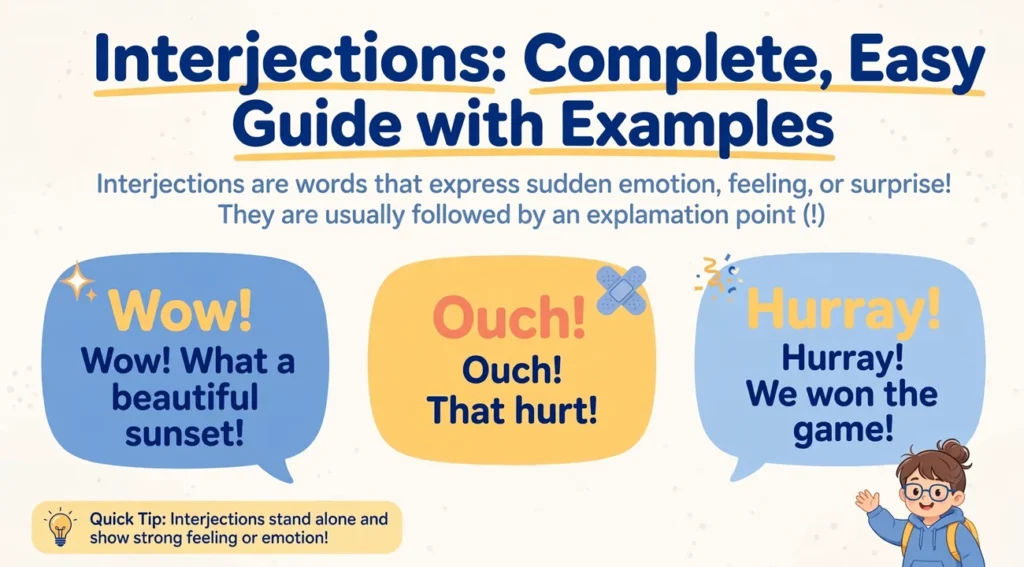
Interjections are small words or short phrases that show a strong feeling. Words like wow, ouch, hurray, oops, and alas are interjections. They show joy, pain, surprise, or anger in just one word. In this guide, you will learn the meaning, 5 simple rules, a 2-second trick, 40 examples, common mistakes, and a quick quiz.
Many learners know wow and ouch, but they are not sure where to put them in a sentence. “Wow! That is a big cake” and “Wow, that is a big cake” are both right, but the mark after the word changes the feel. The good news is that interjections follow a few clear patterns. Once you learn the main groups, you will pick the right word most of the time.
In this complete guide, you will learn what interjections are, the 5 simple rules, a 2-second trick, 40 examples, the most common mistakes, and a quick quiz to test yourself. By the end, you will use these interjections — wow, ouch, hurray, oops, and alas — with confidence.
Interjections: The Quick Answer
The fastest way to learn interjections is to see the main groups side by side. The feeling tells you which word to pick.
| Feeling | Word | Use it for | Example |
|---|---|---|---|
| Joy | hurray | Show joy | Hurray! We won the match. |
| Surprise | wow | Show wonder | Wow! That is a big cake. |
| Pain | ouch | Show a hurt | Ouch! That pin hurt me. |
| Sorrow | alas | Show a loss | Alas! He lost his keys. |
| Attention | hey | Call someone | Hey! Look at this. |
| Agreement | yes | Show a yes | Yes! I did it. |
| Mistake | oops | Show a slip | Oops! I dropped my pen. |
The golden rule: match the word to the feeling. If you are happy, pick hurray or wow. If you are hurt, pick ouch. Learn the feeling first, and the word follows.
What Are Interjections?
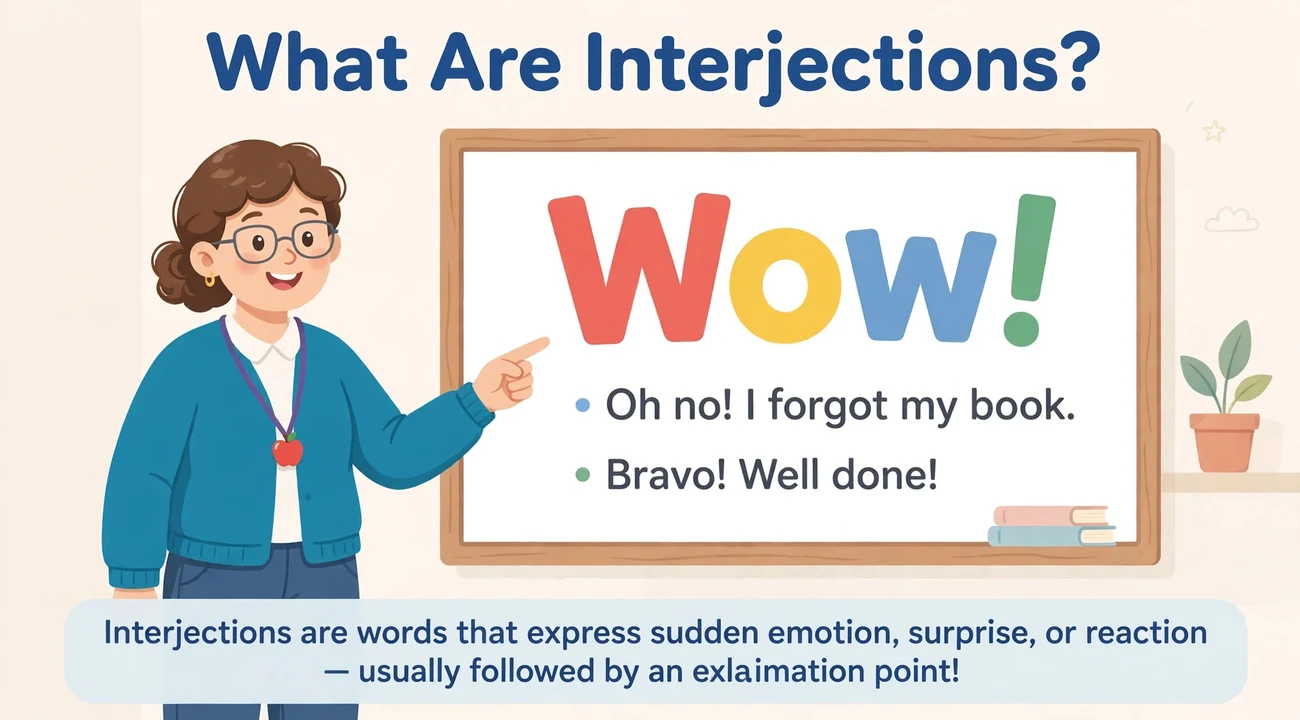
An interjection is a small word or short phrase that shows a sudden feeling. In “Wow! What a nice day,” the word wow shows surprise and joy. It is not linked to the rest of the sentence — it stands on its own and shows how the speaker feels.
Interjections do three main jobs. They show a feeling (hurray, alas), they call for attention (hey, hello), and they answer in a short way (yes, no). A few also show a wish, such as “bravo” for praise, and a few show a small mistake, such as oops.
See how small words link ideas in our guide to conjunctions. For a refresher on the basic tenses, start with our guide to the present simple tense.
| Type | Words | Example |
|---|---|---|
| Joy | hurray, wow, bravo, yippee | Hurray! We won the match. |
| Surprise | wow, oh, ah, indeed | Oh! You are here. |
| Pain | ouch, ow, ah | Ouch! That pin hurt me. |
| Sorrow | alas, oh no, ugh | Alas! He lost his keys. |
| Greeting | hello, hi, hey | Hey! Look at this. |
| Agreement | yes, indeed, sure | Yes! I did it. |
| Mistake | oops, uh-oh | Oops! I dropped my pen. |
You do not need to learn every one of these words at once. Start with wow, ouch, hurray, oops, hey, and alas. These six words cover most of the feelings you will show each day.
5 Simple Interjections Rules
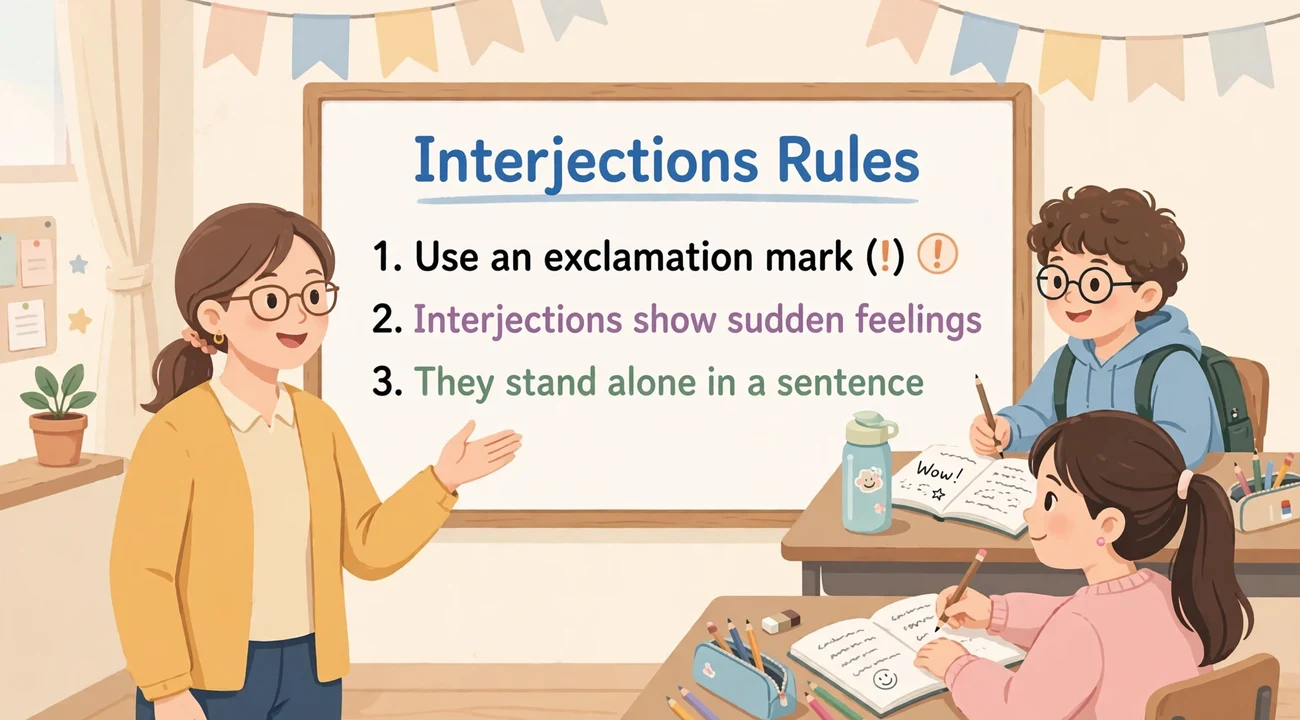
These five rules cover most of the mistakes learners make with interjections. Learn them one by one. Each rule below works in all types of sentences.
Rule 1: Put the Interjection at the Start of the Sentence
Most of these words come first, before the rest of the sentence. The feeling word opens the line, and the main idea follows it.
- Wow! That is a big cake.
- Ouch! That pin hurt me.
- Hurray! We won the match.
Rule 2: Use an Exclamation Mark for a Strong Feeling
When the feeling is strong, put an exclamation mark (!) right after the word. Wow! and ouch! feel loud and sudden, so the reader hears the sound in the words.
- Alas! He lost his keys.
- Bravo! You did a great job.
Rule 3: Use a Comma for a Mild Feeling
When the feeling is soft or mild, put a comma (,) after the word instead of an exclamation mark. “Well, I am not sure” feels calm, while “Well! I am not sure” feels loud.
- Well, I am not sure about that.
- Oh, I see what you mean.
Rule 4: Do Not Use Them in Every Sentence
These words are strong, so a little goes a long way. One or two in a short talk is fine, but one in every line feels noisy. Save them for the moments that truly show a feeling.
- Wow! That is a big cake. I want to eat it now.
- Oops! I dropped my pen. Let me pick it up.
Rule 5: Match the Word to the Feeling
Each of these words shows one feeling, so pick the word that fits the moment. Do not say hurray when you are sad, and do not say ouch when you are happy. Check the feeling first.
- Hurray! We won the match. (joy)
- Alas! He lost his keys. (sorrow)
The 2-Second Interjections Trick
Still not sure which of these words to use? Ask yourself one question: “What do I feel?”
Step 1: Name the feeling first — joy, pain, surprise, or sorrow.
Step 2: Joy takes hurray or wow. Pain takes ouch. Surprise takes wow or oh.
Step 3: A small slip takes oops. A call for attention takes hey or hello.
Try the trick on these sentences:
- “___! We won the match.” — the feeling is joy, so pick hurray and get “Hurray! We won the match.”
- “___! That pin hurt me.” — the feeling is pain, so pick ouch and get “Ouch! That pin hurt me.”
Keep this trick in mind, and the choice will soon feel natural. Most interjections become easy once you name the feeling first.
40 Interjections Examples
Here are 40 simple examples — the first 20 show joy, surprise, pain, and sorrow, and the next 20 show greetings, agreement, attention, and small mistakes.
Joy, surprise, pain, and sorrow:
- Hurray! We won the match.
- Wow! That is a big cake.
- Wow! What a nice day.
- Ouch! That pin hurt me.
- Alas! He lost his keys.
- Bravo! You did a great job.
- Yippee! School is closed today.
- Oh! You are here.
- Ah! I see what you mean.
- Oh no! I forgot my book.
- Ugh! This bag is so heavy.
- Wow! You look so happy today.
- Hurray! Our team scored a goal.
- Ouch! The hot cup burned my hand.
- Alas! The rain spoiled our picnic.
- Bravo! She sang a lovely song.
- Wow! The sky is full of stars.
- Oh! I did not know that.
- Yippee! We are going on a trip.
- Alas! My old bike is broken now.
Greetings, agreement, attention, and small mistakes:
- Hey! Look at this.
- Hello! How are you today?
- Hi! Nice to meet you.
- Yes! I did it.
- Indeed! That is true.
- Sure! I will help you.
- Oops! I dropped my pen.
- Uh-oh! The milk fell on the floor.
- Well, I am not sure about that.
- Hey! Wait for me.
- Hello! Welcome to our home.
- Yes! That is the right answer.
- Oops! I wrote the wrong word.
- Shh! The baby is sleeping.
- Hmm! Let me think about it.
- Hey! Do you want to play?
- Well, let us start the lesson now.
- Oh, I see what you mean.
- Uh-oh! My phone is out of charge.
- Yes! We can do it together.
Use these sentences in your own writing. For more short sentences, see our guide to pronouns and our guide to active vs passive voice. For the full grammar background, read Interjections on Wikipedia.
Common Interjections Mistakes
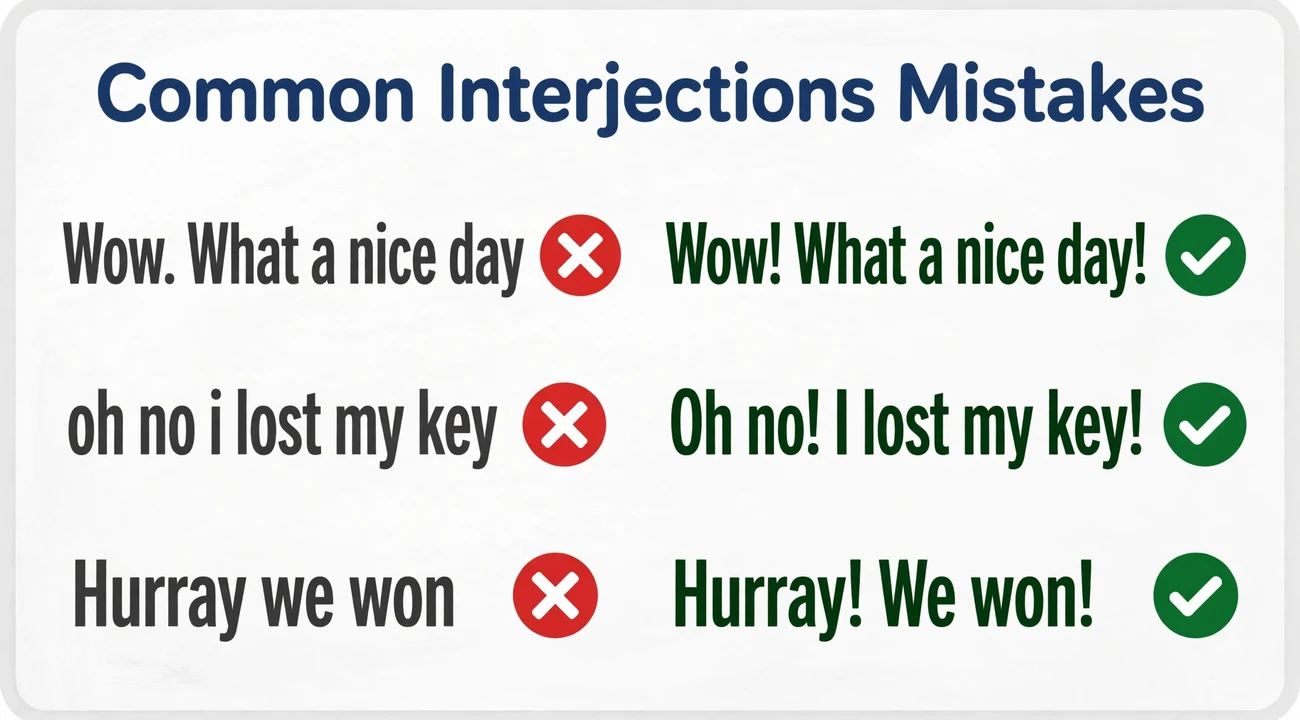
Even good learners make these mistakes. Learn them once and avoid them for life.
Mistake 1: Using the wrong word for the feeling.
Wrong: “Hurray! I lost my keys.” Right: “Alas! I lost my keys.” A loss is sad, so it takes alas, not hurray.
Mistake 2: Using an exclamation mark for a mild feeling.
Wrong: “Well! I am not sure about that.” Right: “Well, I am not sure about that.” A soft feeling takes a comma, not an exclamation mark.
Mistake 3: Using them in every sentence.
Wrong: “Wow! I woke up. Wow! I ate food. Wow! I went to school.” Right: “I woke up, ate food, and went to school.” Save the strong words for strong moments.
Mistake 4: Forgetting the mark after the word.
Wrong: “Wow that is a big cake.” Right: “Wow! That is a big cake.” The mark tells the reader how the word sounds.
Mistake 5: Putting the word in the wrong place.
Wrong: “That is a big cake wow!” Right: “Wow! That is a big cake.” The feeling word comes first, before the main idea.
Practise these fixes until the right form feels natural.
Quick Quiz: Interjections
Fill in the blank with the right word — answers are below!
- ___! We won the match. (Hurray / Alas)
- ___! That pin hurt me. (Wow / Ouch)
- ___! I dropped my pen. (Oops / Bravo)
- ___! You did a great job. (Alas / Bravo)
- ___! He lost his keys. (Hurray / Alas)
- ___! That is a big cake. (Wow / Ouch)
- ___! Look at this. (Hey / Ouch)
- ___! I did it. (Yes / Alas)
Answers:
1. Hurray
2. Ouch
3. Oops
4. Bravo
5. Alas
6. Wow
7. Hey
8. Yes
How did you do? 8/8 — excellent! 6–7 — very good. Fewer than 6 — read the trick once more.
Interjections: Quick Summary
| Feeling | Words | Example |
|---|---|---|
| Joy | hurray, wow, bravo, yippee | Hurray! We won the match. |
| Surprise | wow, oh, ah | Wow! That is a big cake. |
| Pain | ouch, ow, ah | Ouch! That pin hurt me. |
| Sorrow | alas, oh no, ugh | Alas! He lost his keys. |
| Place | start of the sentence | Wow! That is a big cake. |
| Strong feeling | exclamation mark (!) | Hurray! We won the match. |
| Mild feeling | comma (,) | Well, I am not sure. |
Interjections feel hard for a week — then easy for life.
FAQs About Interjections
What are interjections in simple words?
They are small words like wow, ouch, hurray, and oops. They show a strong feeling in just one word, such as joy, pain, surprise, or sorrow.
What is the difference between wow and ouch?
Wow shows surprise or joy, as in “Wow! That is a big cake.” Ouch shows pain, as in “Ouch! That pin hurt me.” The feeling tells you which word to pick.
Where do interjections go in a sentence?
They come at the start of the sentence in most cases. “Wow! That is a big cake” is right, while “That is a big cake wow!” is wrong.
When do we use an exclamation mark after an interjection?
Use an exclamation mark when the feeling is strong, as in “Hurray! We won the match.” Use a comma when the feeling is mild, as in “Well, I am not sure.”
Can I use interjections in formal writing?
It is best not to use them in formal writing, such as a job letter or a school essay. They fit best in stories, talks, and chats.
What are the most common interjections?
The most common ones are wow, ouch, hurray, oops, hey, hello, alas, bravo, yes, and oh. Learn wow, ouch, hurray, and oops first, then add the rest.
Conclusion
Interjections are smaller than they look. One question — “What do I feel?” — and five simple rules cover most sentences you will ever write. Remember to put the feeling word first, use an exclamation mark for a strong feeling and a comma for a mild one, and save these words for the moments that truly show a feeling.
Practise with the examples and quiz in this guide, and soon you will choose the right word without thinking. Keep building your grammar with our guide to subject-verb-agreement, and keep learning with GrammarLuck — grammar made simple.
