

Conjunctions are small words that join words, phrases, and parts of a sentence. Words like and, but, or, because, and so are conjunctions. They link ideas and show how the parts fit together. In this guide, you will learn the meaning, 5 simple rules, a 2-second trick, 40 examples, common mistakes, and a quick quiz.
Many learners know and and but, but they are not sure when to use each one. “I like tea and coffee” and “I like tea but not coffee” do not mean the same thing. The good news is that conjunctions follow a few clear patterns. Once you learn the three main groups, you will pick the right word most of the time.
In this complete guide, you will learn what conjunctions are, the 5 simple rules, a 2-second trick, 40 examples, the most common mistakes, and a quick quiz to test yourself. By the end, you will use these conjunctions — and, but, or, because, and so — with confidence.
Conjunctions: The Quick Answer
The fastest way to learn them is to see the three main groups side by side. The group tells you which word to pick.
| Group | Word | Use it for | Example |
|---|---|---|---|
| Joining | and | Add one idea to another | tea and coffee |
| Choice | or | Show a choice | tea or coffee |
| Contrast | but | Show a difference | small but strong |
| Contrast | yet | Show a surprise | tired yet happy |
| Reason | because | Give a reason | stayed home because it rained |
| Reason | since | Give a reason or time | left early since the rain began |
| Result | so | Show a result | it rained, so we stayed home |
The golden rule: ask “join, contrast, or reason?” first. Then pick and, but, or because from the right row of the table. Learn the group first, and the word follows.
What Are Conjunctions?
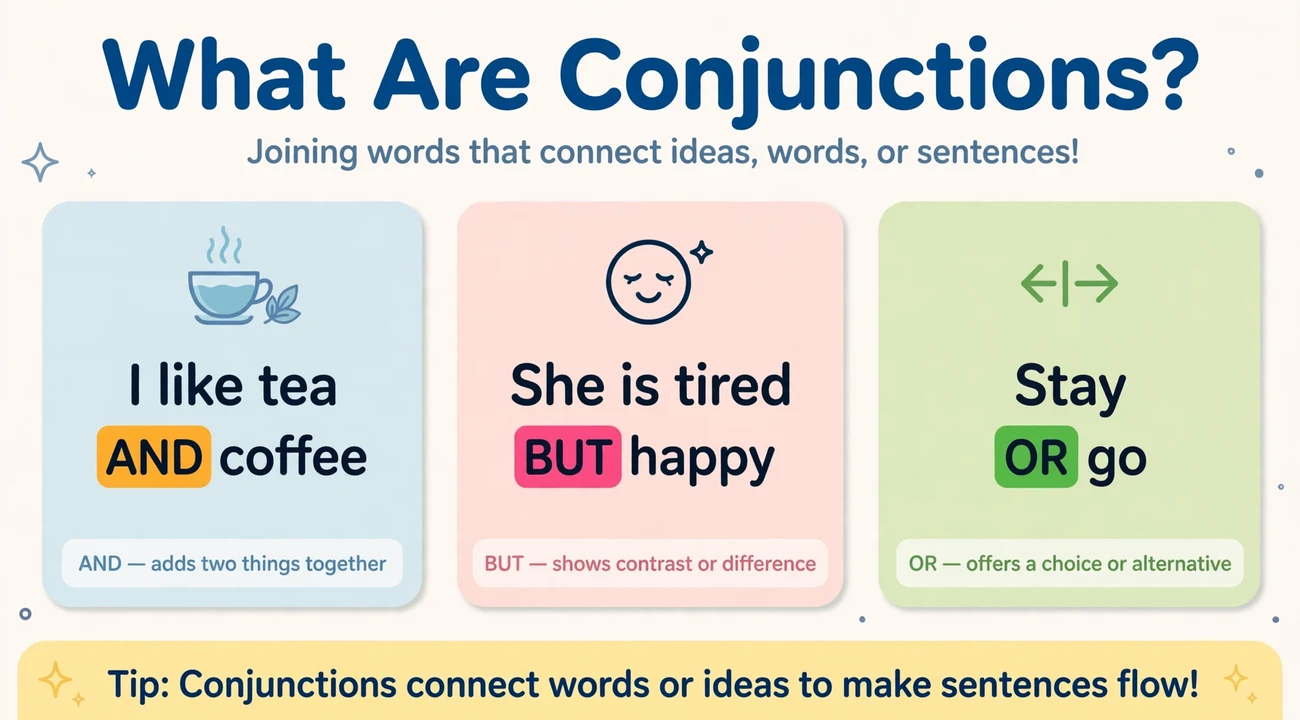
A conjunction is a small word that joins two words, two groups of words, or two full sentences. In “Ali and Sara are friends,” the word and joins Ali and Sara. Without them, a sentence feels short and broken.
Conjunctions do three main jobs. They join ideas (tea and coffee), show contrast (small but strong), and show reason or result (stayed home because it rained). A few also show choice, such as “tea or coffee.”
Read our guide to prepositions to see how small words link nouns in a sentence. For a refresher on the basic tenses, start with our guide to the present simple tense.
| Type | Words | Example |
|---|---|---|
| Coordinating | and | Ali and Sara |
| Coordinating | but | small but strong |
| Coordinating | or | tea or coffee |
| Coordinating | so | tired, so I slept early |
| Coordinating | yet | late yet happy |
| Subordinating | because | stayed home because it rained |
| Subordinating | when | call me when you arrive |
| Subordinating | if | I will come if it stops raining |
| Subordinating | although | went out although it rained |
| Correlative | both…and, either…or | both Ali and Sara |
You do not need to learn every conjunction at once. Start with and, but, or, so, because, when, and if. These seven words cover most of the sentences you will write and speak each day. When you meet a new one, ask which group it belongs to.
5 Simple Conjunctions Rules
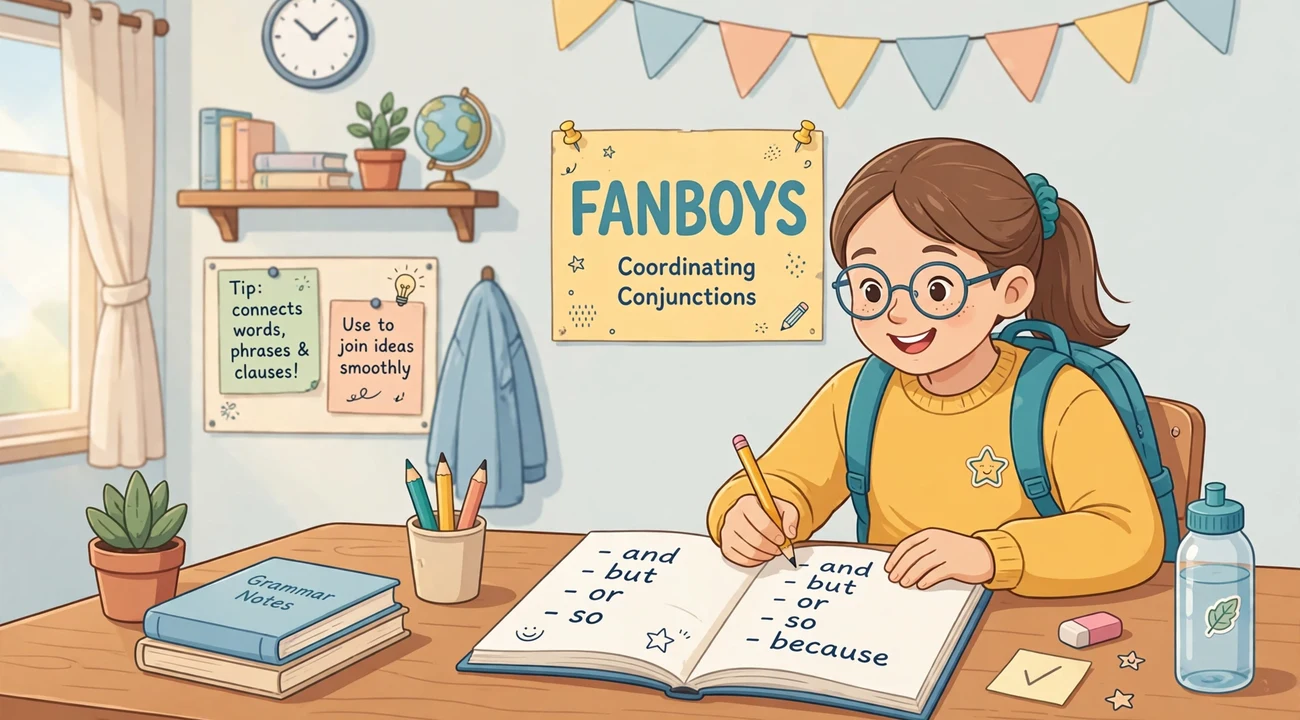
These five rules cover most of the mistakes learners make with conjunctions. Learn them one by one. Each rule below works in all types of sentences.
Rule 1: Use FANBOYS to Join Two Full Sentences
FANBOYS is a short way to recall the seven joining words. Use them to join two full sentences into one longer sentence. Each part must make sense on its own.
- I like tea, and I like coffee.
- She was tired, but she kept working.
Rule 2: Use Because, When, If, and Although for Reason and Time
These words join a main idea to a second idea that gives a reason, a time, or a fact. The second part cannot stand on its own. Put the reason part after the main part.
- We stayed home because it rained.
- I will come if it stops raining.
Rule 3: Use Correlative Pairs Together
Some of them work in pairs, and you must use both parts. Both goes with and, either goes with or, neither goes with nor, and not only goes with but also. Never use one part without the other.
- She is both smart and kind.
- You can have either tea or coffee.
Rule 4: Use a Comma Before And, But, and So in Long Sentences
When you join two full sentences with and, but, or so, put a comma before the joining word. When you join two short words, like tea and coffee, use no comma. The comma tells the reader where the first idea ends.
- I wanted to sleep, but the noise was too loud.
- Ali and Sara are friends.
Rule 5: You Can Start a Sentence with And or But
Many teachers say you must never start a sentence with and or but. In simple, modern English, you can — but only now and then, and only for a clear point. Use it once in a while, not in every line.
- And then the rain stopped.
- But she did not give up.
The 2-Second Conjunctions Trick
Still not sure which of these conjunctions to use? Ask yourself one question: “Join, contrast, or reason?”
Step 1: Do the two parts agree, differ, or explain each other?
Step 2: A same idea takes and. A different idea takes but. A reason takes because.
Step 3: A choice takes or. A result takes so.
Try the trick on these sentences:
- “I like tea ___ coffee.” — two likes, so join with and gives “tea and coffee.”
- “It rained, ___ we stayed home.” — rain caused the stay, so result takes so and gives “so we stayed home.”
Keep this trick in mind, and the choice will soon feel natural. Most of them become easy once you ask the right question first.
40 Conjunctions Examples
Here are 40 simple examples — the first 20 use coordinating words like and, but, or, and so, and the next 20 use subordinating and correlative words like because, when, and if.
Coordinating words:
- Ali and Sara are friends.
- I like tea and coffee.
- She was tired but happy.
- He is small but strong.
- Tea or coffee? You can pick one.
- Come now or later, it is your choice.
- It rained, so we stayed home.
- I was late, so I ran to school.
- She studied hard, yet she failed the test.
- He is rich yet sad.
- I like apples and oranges.
- Sara sings and dances well.
- He did not come, nor did he call.
- We can walk or take the bus.
- She is kind but firm.
- The room was dark, so I turned on the light.
- He worked all day, yet he was not tired.
- I want a pen and a book.
- The food was hot but tasty.
- Run fast, or you will miss the bus.
Subordinating and correlative words:
- We stayed home because it rained.
- I will come if it stops raining.
- Call me when you arrive.
- She went out although it rained.
- He left early since the rain began.
- I stayed in bed because I was ill.
- She smiled when she saw her friend.
- We will wait until the rain stops.
- He will pass if he works hard.
- Although she was tired, she kept working.
- She is both smart and kind.
- You can have either tea or coffee.
- Neither Ali nor Sara came to class.
- Not only Ali but also Sara won a prize.
- He ran fast so that he could catch the bus.
- I will stay here while you go to the shop.
- She took an umbrella because the sky was dark.
- We went home after the match ended.
- He asked whether she was ready.
- I will help you as long as you ask nicely.
Use these sentences in your own writing. For more short sentences, see our English sentences collection. For the full grammar background, read Conjunctions on Wikipedia.
Common Conjunctions Mistakes
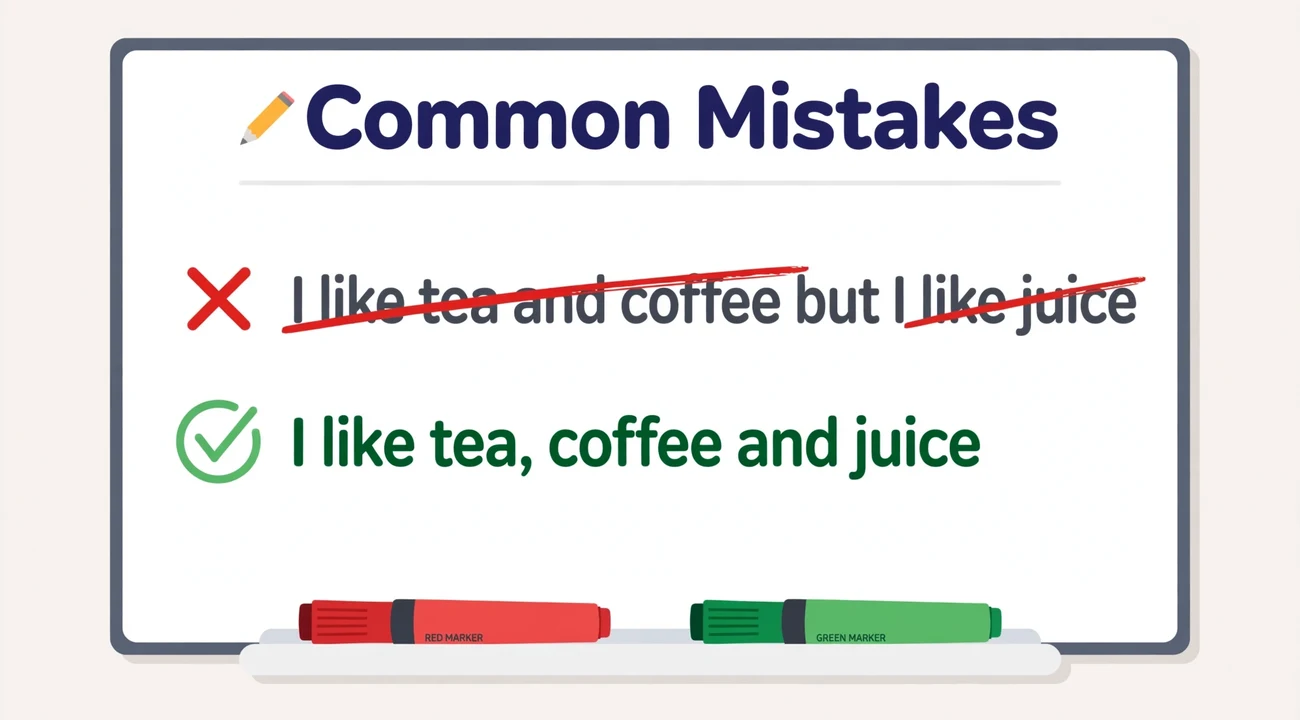
Even good learners make these mistakes. Learn them once and avoid them for life.
Mistake 1: Using “but” after “although.”
Wrong: “Although it rained, but we went out.” Right: “Although it rained, we went out.” Although already shows the contrast, so but is not needed.
Mistake 2: Using “because of” with a full sentence.
Wrong: “We stayed home because of it rained.” Right: “We stayed home because it rained.” Because takes a full sentence; because of takes a noun.
Mistake 3: Using only one part of a pair.
Wrong: “She is both smart.” Right: “She is both smart and kind.” Both must go with and.
Mistake 4: Using two joining words at once.
Wrong: “He is tall and but strong.” Right: “He is tall but strong.” Use one joining word, not two.
Mistake 5: Joining two full sentences with only a comma.
Wrong: “I like tea, I like coffee.” Right: “I like tea, and I like coffee.” A comma alone cannot join two full sentences; add and, but, or so.
Practise these fixes with short drills in our grammar exercises until the right form feels natural.
Quick Quiz: Conjunctions
Fill in the blank with the right conjunctions — answers are below!
- I like tea ___ coffee.
- She was tired ___ she kept working.
- We stayed home ___ it rained.
- Tea ___ coffee? Pick one.
- It rained, ___ we stayed home.
- I will come ___ it stops raining.
- She is ___ smart ___ kind.
- Call me ___ you arrive.
Answers:
1. and
2. but
3. because
4. or
5. so
6. if
7. both…and
8. when
How did you do? 8/8 — excellent! 6–7 — very good. Fewer than 6 — read the trick once more.
Conjunctions: Quick Summary
| Group | Words | Example |
|---|---|---|
| Coordinating (FANBOYS) | for, and, nor, but, or, yet, so | Ali and Sara, small but strong |
| Subordinating | because, when, if, although, since | stayed home because it rained |
| Correlative | both…and, either…or, neither…nor | both tea and coffee |
| Comma rule | comma before and, but, so | I wanted to sleep, but the noise was loud |
| Sentence start | and, but | And then the rain stopped. |
Conjunctions feel hard for a week — then easy for life.
FAQs About Conjunctions
What are conjunctions in simple words?
They are small words like and, but, or, because, and so. They join words, groups of words, or full sentences and show how the parts fit together.
What are the 7 FANBOYS conjunctions?
The seven are for, and, nor, but, or, yet, and so. They join two full sentences. And joins ideas, but shows a difference, or shows a choice, and so shows a result.
What is the difference between and and but?
And adds a like idea, while but shows a different idea. “Ali and Sara” adds two names, and “small but strong” shows a contrast.
Can I start a sentence with and or but?
Yes, in simple modern English. Use it now and then for a clear point, not in every line.
What are the most common conjunctions?
The most common ones are and, but, or, so, because, when, if, although, and since. Learn and, but, or, and so first, then add because and when.
Why are conjunctions hard for learners?
They are hard because the wrong word changes the meaning. “Tea and coffee” and “tea or coffee” are not the same.
Conclusion
Conjunctions are smaller than they look. Three questions and five simple rules cover most sentences you will ever write. Remember and, but, or, so, and because, learn the pairs like both…and, and put a comma before and, but, and so in long sentences.
Practise with the examples and quiz in this guide, and soon you will choose the right word without thinking. Keep building your grammar with our guide to subject-verb agreement, and keep learning with GrammarLuck — grammar made simple.
