

Pronouns are small words that take the place of a noun. Words like I, you, he, she, it, we, and they are pronouns. They help us avoid saying the same noun again and again. In this guide, you will learn the meaning, 5 simple rules, a 2-second trick, 40 examples, common mistakes, and a quick quiz.
Many learners find them hard because one small change can make a sentence wrong. “Him is my friend” sounds wrong, but “He is my friend” sounds right. The good news is that they follow a few clear patterns.
In this complete guide, you will learn what they are, the 5 simple rules, a 2-second trick, 40 examples, the most common mistakes, and a quick quiz. By the end, you will use these pronouns with confidence.
Pronouns: The Quick Answer
See the main groups side by side. Each group has its own job, and the job tells you which word to pick.
| Group | Words | Use it for | Example |
|---|---|---|---|
| Subject | I, you, he, she, it, we, they | The doer of the action | She reads a book. |
| Object | me, you, him, her, it, us, them | The receiver of the action | Ali helps her. |
| Possessive | mine, yours, his, hers, ours, theirs | To show ownership | The pen is mine. |
| Reflexive | myself, yourself, himself, herself, itself, ourselves, themselves | When the doer and receiver are the same person | He hurt himself. |
The golden rule: first ask who does the action and who receives it. The doer takes a subject word, and the receiver takes an object word.
What Are Pronouns?
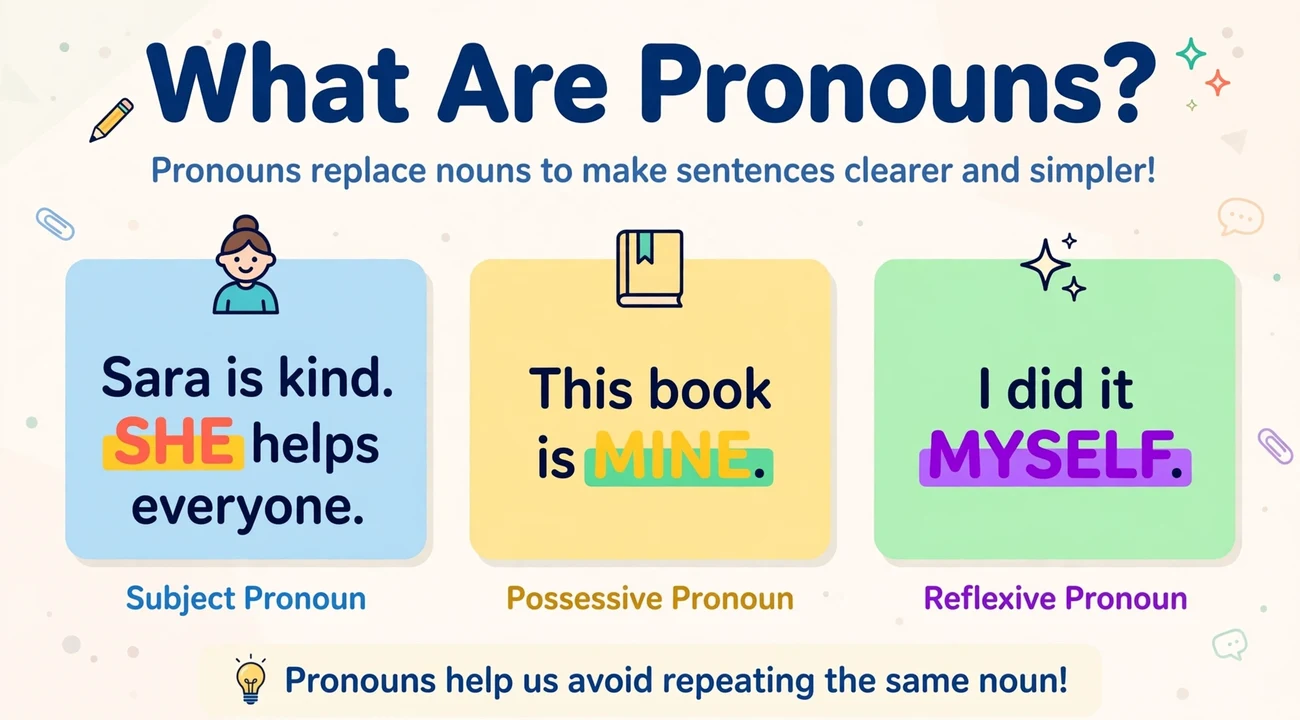
A pronoun is a small word that stands in place of a noun. In “Sara is my friend. She is kind,” the word she stands for Sara. Without these words, we would have to repeat the same name again and again.
Pronouns do four main jobs. Subject words do the action, object words receive the action, possessive words show that something belongs to someone, and reflexive words point the action back to the same person. A few also ask a question, such as who and what, and a few point to a thing, such as this and that.
See how these small words work with nouns in our guide to articles a, an, the, and start with our guide to the present simple tense for a refresher on tenses.
| Type | Words | Example |
|---|---|---|
| Personal — subject | I, you, he, she, it, we, they | They play football. |
| Personal — object | me, you, him, her, it, us, them | Call me, please. |
| Possessive | mine, yours, his, hers, ours, theirs | This bag is hers. |
| Reflexive | myself, yourself, himself, herself, itself, ourselves, themselves | She taught herself to cook. |
| Question | who, whom, whose, what, which | Who is at the door? |
| Pointing | this, that, these, those | This is my book. |
Start with the subject, object, possessive, and reflexive groups above. They cover most of the sentences you will write each day.
5 Simple Pronouns Rules
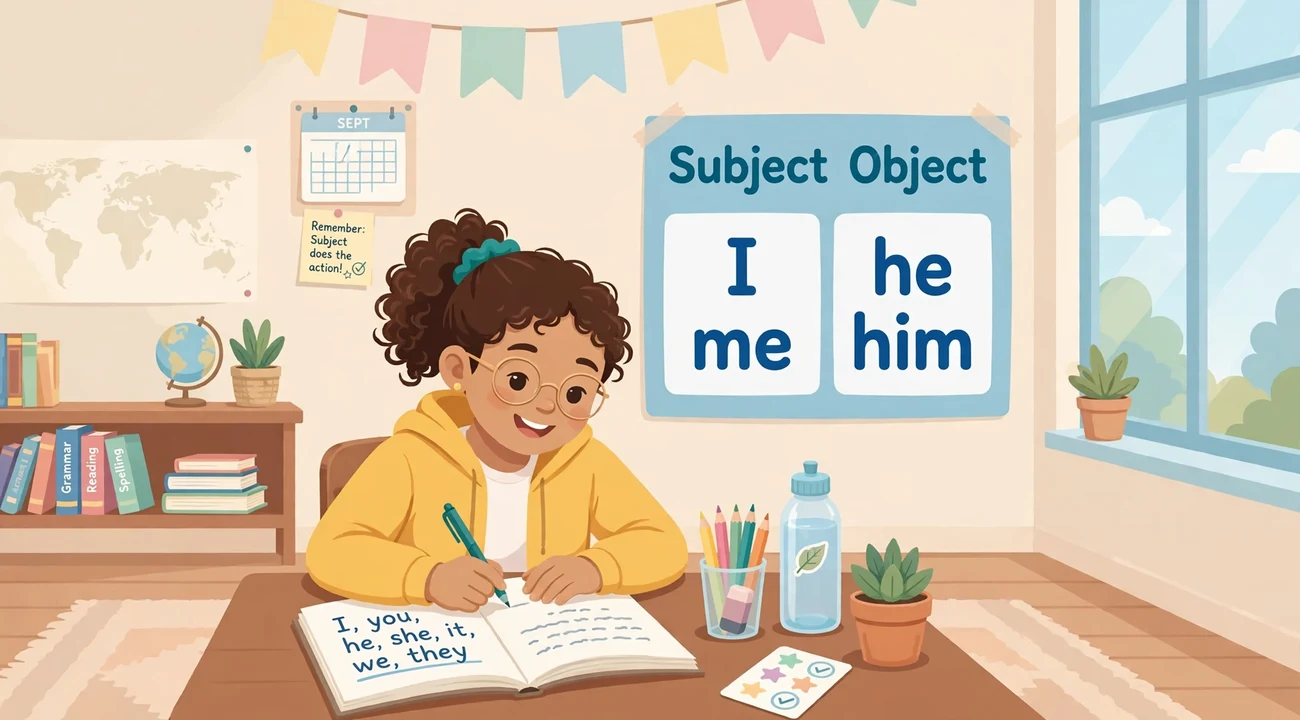
These five rules cover most mistakes. Learn them one by one, and say each example aloud. Each rule works with subject-verb agreement.
Rule 1: Use Subject Pronouns — I, You, He, She, It, We, They
Use a subject word when the word does the action. It comes before the verb in most simple sentences. I, you, he, she, it, we, and they are the seven subject words to learn first.
- She reads a book every night.
- They play football in the park.
- We are happy today.
Rule 2: Use Object Pronouns — Me, Him, Her, Us, Them
Use an object word when the word receives the action, or comes after to, for, with, or about. Me, him, her, us, and them are the object words to learn first. Note that you and it stay the same in both groups.
- The teacher called me to the front.
- Sara gave him a pen.
- Please sit with us and talk to them.
Rule 3: Use Possessive Pronouns — Mine, Yours, His, Hers, Ours, Theirs
Use a possessive word to show that something belongs to someone, and use it on its own, with no noun after it. “The pen is mine” means the pen belongs to me.
- This book is mine, and that one is yours.
- The house is ours, and the car is theirs.
- The red bag is hers, and the blue one is his.
Do not mix them up with my, your, his, her, our, and their. Those words need a noun after them, as in “my book,” while mine and yours stand alone, as in “The book is mine.”
Rule 4: Use Reflexive Pronouns — Myself, Yourself, Himself, Herself, Itself, Ourselves, Themselves
Use a reflexive word when the doer and the receiver are the same person. In “He hurt himself,” he does the action and he receives it too.
- I taught myself to swim last year.
- She made herself a cup of tea.
- They built the house themselves.
Use a reflexive word only when the action comes back to the same person. “Myself went to school” is wrong — the right form is “I went to school.”
Rule 5: Match the Pronoun to the Noun in Number and Gender
The word you choose must match the noun it stands for. A singular noun takes a singular word, and a plural noun takes a plural word. A man takes he or him, a woman takes she or her, and a thing takes it.
- Ali lost his keys, so he went back to look for them.
- The girls finished their work, and they went home.
- The dog wagged its tail, and it looked happy.
When the noun is a group of people, use they or them. “The team won their match” is correct, because the team is a group. Keep the same word all through the sentence.
The 2-Second Pronouns Trick
Still not sure which word to use? Ask yourself one question: “Doer or receiver?”
Step 1: Find the verb, and ask who does the action.
Step 2: If the missing word does the action, pick a subject word: I, you, he, she, it, we, or they.
Step 3: If it receives the action, pick an object word: me, you, him, her, it, us, or them.
Try the trick on these sentences:
- “___ is my best friend.” — the missing word does the action, so pick a subject word: “He is my best friend.”
- “The teacher praised ___.” — the missing word receives the action, so pick an object word: “The teacher praised him.”
Keep this trick in mind, and the choice will soon feel natural. Most pronouns become easy once you ask the right question first.
40 Pronouns Examples
Here are 40 simple examples — the first 20 use subject and object words, and the next 20 use possessive and reflexive words.
Subject and object:
- I am a student.
- She reads a book every night.
- He plays cricket on Sunday.
- We go to school by bus.
- They live in London.
- It is raining today.
- You are my best friend.
- The teacher called me.
- Ali helped him with his work.
- Sara gave her a flower.
- Please help us, teacher.
- I saw them at the park.
- He thanked her for the gift.
- She invited us to her home.
- We met him at the market.
- They asked me a question.
- It looks nice on you.
- You can sit with us.
- He told them a story.
- She loves him very much.
Possessive and reflexive:
- This pen is mine.
- That house is ours.
- The red bag is hers.
- The blue car is theirs.
- Is this book yours?
- The choice is his, not mine.
- She taught herself to cook.
- He hurt himself while playing.
- I made myself a sandwich.
- They did the work themselves.
- We enjoyed ourselves at the party.
- The cat cleaned itself.
- You should believe in yourself.
- The team blamed itself for the loss.
- This seat is mine, and that one is yours.
- The prize is theirs because they won.
- She looked at herself in the mirror.
- He bought himself a new watch.
- We built the shelf ourselves.
- The dog hid itself under the bed.
Use these sentences in your own writing. For more, see our English sentences collection, and read Pronoun on Wikipedia for the full background.
Common Pronouns Mistakes
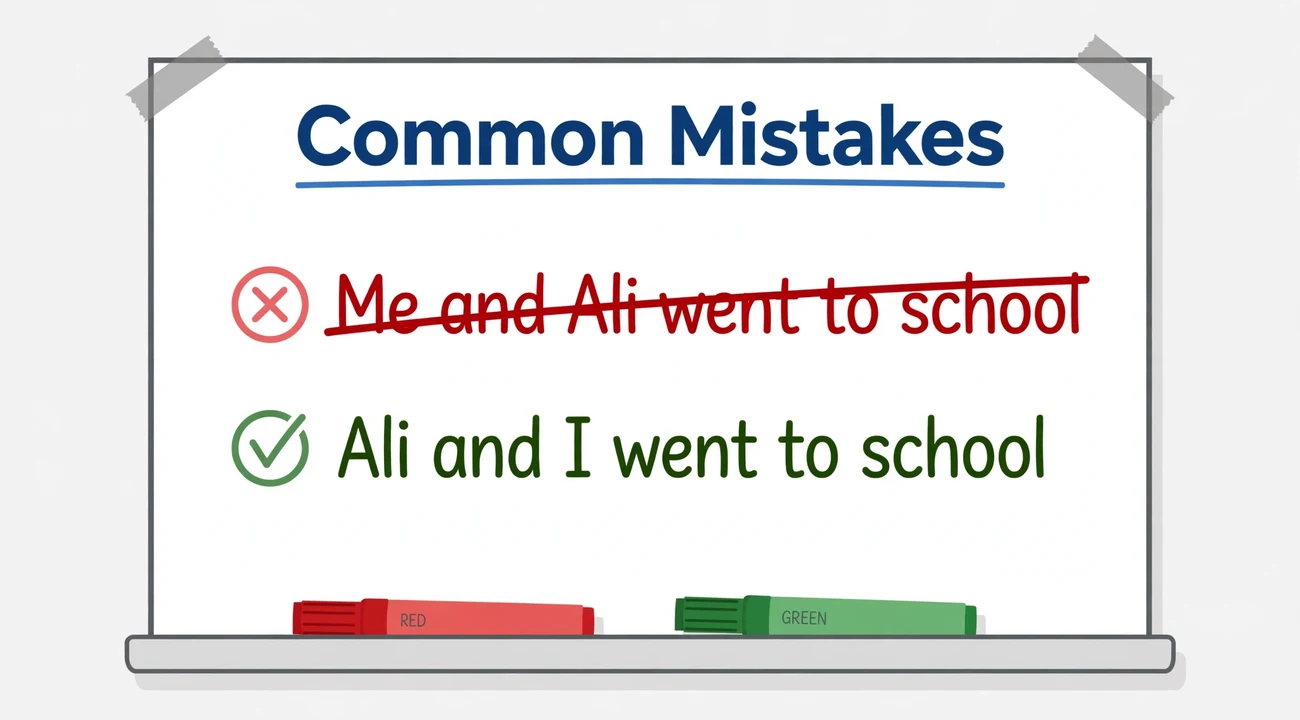
Even good learners make these mistakes. Learn them once and avoid them.
Mistake 1: Using “me” as the subject.
Wrong: “Me and Ali went to school.” Right: “Ali and I went to school.” The doer takes I, not me.
Mistake 2: Using “I” as the object.
Wrong: “The teacher called Ali and I.” Right: “The teacher called Ali and me.” The receiver takes me, not I.
Mistake 3: Using “their” for one person.
Wrong: “Each student must bring their book” in formal writing. Right: “Each student must bring his or her book.” Each student is one person.
Mistake 4: Mixing up “its” and “it’s.”
Wrong: “The dog wagged it’s tail.” Right: “The dog wagged its tail.” Its shows ownership, and it’s means “it is.”
Mistake 5: Using “myself” instead of “I” or “me.”
Wrong: “Myself went to the shop.” Right: “I went to the shop.” Myself is only correct when both are the same person.
Practise these fixes in our grammar exercises, and read our guide to prepositions for the wider rules.
Quick Quiz: Pronouns
Fill in the blank — answers are below!
- ___ am a student. (I / Me)
- The teacher praised ___. (he / him)
- This book is ___. (my / mine)
- She taught ___ to swim. (her / herself)
- ___ are my best friends. (They / Them)
- Please give the pen to ___. (I / me)
- The dog wagged ___ tail. (its / it’s)
- We did the work ___. (ourself / ourselves)
Answers:
1. I
2. him
3. mine
4. herself
5. They
6. me
7. its
8. ourselves
How did you do? 8/8 — excellent! 6–7 — very good. Fewer than 6 — read the trick once more.
Pronouns: Quick Summary
| Group | Words | Example |
|---|---|---|
| Subject | I, you, he, she, it, we, they | She reads a book. |
| Object | me, you, him, her, it, us, them | Ali helps her. |
| Possessive | mine, yours, his, hers, ours, theirs | The pen is mine. |
| Reflexive | myself, yourself, himself, herself, itself, ourselves, themselves | He hurt himself. |
| Match the noun | singular with singular, plural with plural | The girls finished their work. |
Pronouns feel hard for a week — then easy for life.
FAQs About Pronouns
What are pronouns in simple words?
Pronouns are small words like I, you, he, she, it, we, and they. They stand in place of a noun, so we do not repeat the same name.
What is the difference between subject and object pronouns?
A subject word does the action, as in “She reads.” An object word receives the action, as in “Ali helps her.”
What are possessive pronouns?
Mine, yours, his, hers, ours, and theirs stand alone, as in “The pen is mine.”
When do we use reflexive pronouns?
Use one when the doer and the receiver are the same person, as in “She taught herself to cook.” Do not use myself or himself in place of I, me, he, or him.
What is the difference between its and it’s?
Its shows ownership, as in “The dog wagged its tail.” It’s means “it is” or “it has,” as in “It’s raining.”
How can I learn pronouns fast?
Learn the four main groups from the tables in this guide, say the examples aloud, and do the quiz each day.
Conclusion
Pronouns are smaller than they look. Five simple rules cover most sentences you will ever write. Remember the doer takes a subject word, the receiver takes an object word, and a word that shows ownership stands on its own.
Practise with the examples and quiz in this guide, and soon you will choose the right word without thinking. Keep building your grammar with our guide to subject-verb agreement, and keep learning with GrammarLuck.
