

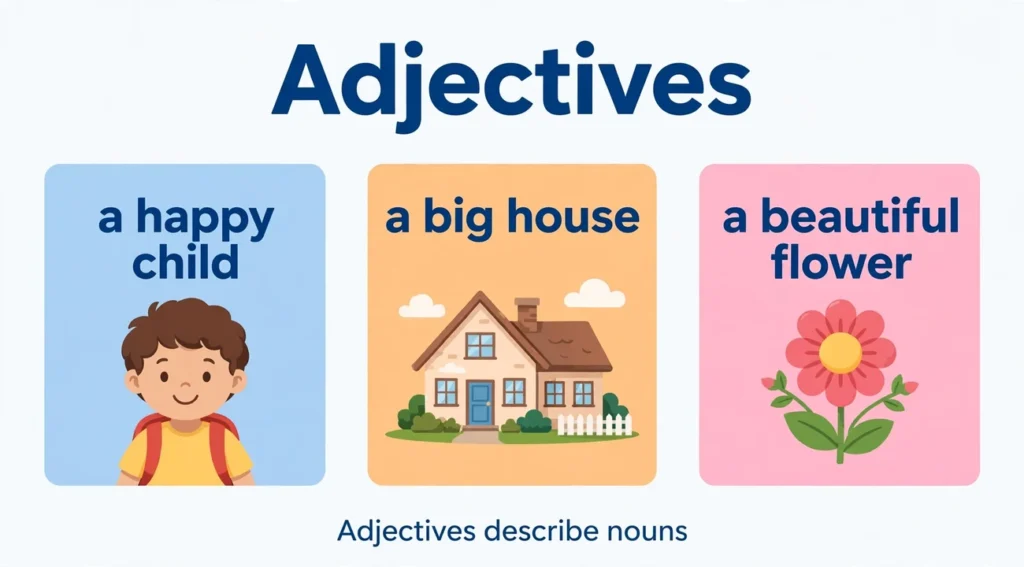
The red car stopped at the corner. She wore a beautiful dress. It was a cold morning. In each sentence, one small word paints a picture — red, beautiful, cold. These picture words are called Adjectives. Once you learn how Adjectives work, your sentences will feel richer and more exact.
Here is the short answer. An adjective is a word that describes a noun. In “The red car stopped,” red tells us what kind of car it is.
In this complete guide, you will learn what Adjectives are, the main types, where they sit in a sentence, 7 simple rules, a 2-second trick, 40 clear examples, common mistakes, and a quick quiz. By the end, using adjectives will feel easy and natural.
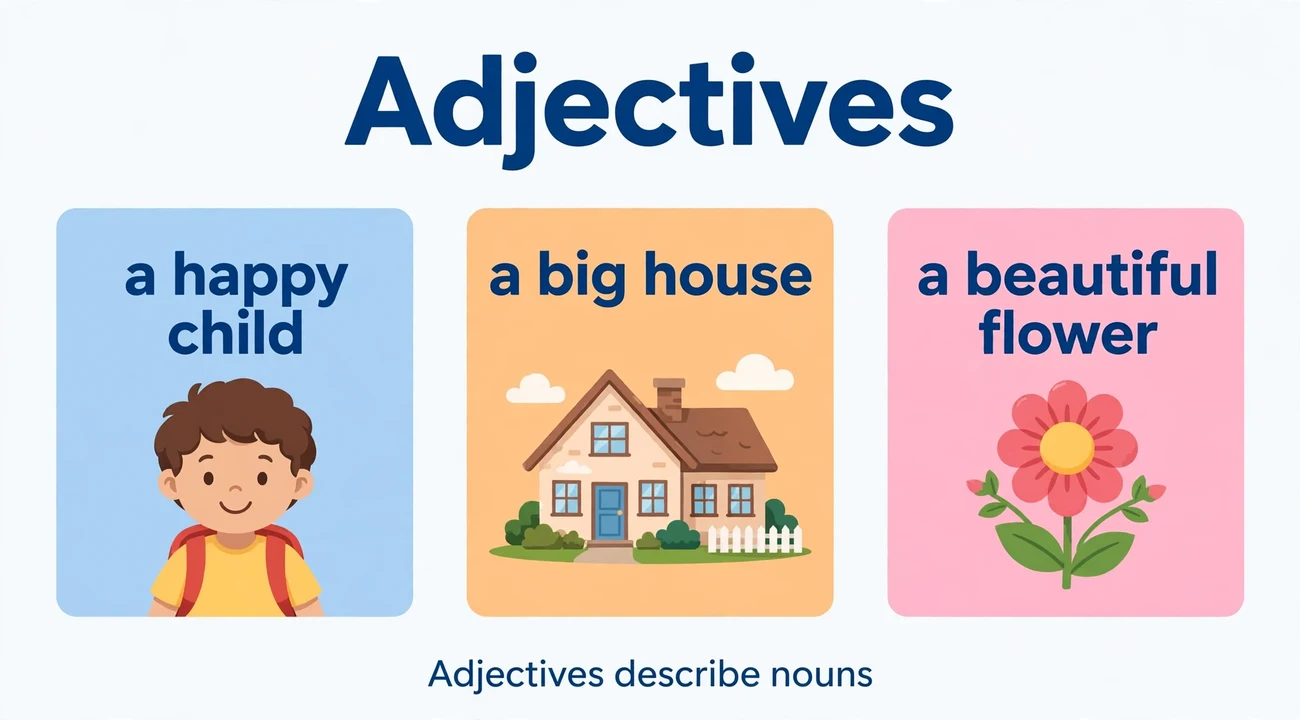
Adjectives: The Quick Answer
The fastest way to understand an adjective is to compare it with other parts of speech.
| Word | What it does | Example |
|---|---|---|
| Adjective | Describes a noun | a red car |
| Noun | Names a person, place, or thing | a car, a teacher |
| Verb | Shows an action | She runs fast. |
The key point about Adjectives is simple: an adjective always points to a noun. It tells us the size, the colour, the number, or the quality of that noun. Without adjectives, our sentences would feel flat and plain.
What Are Adjectives?
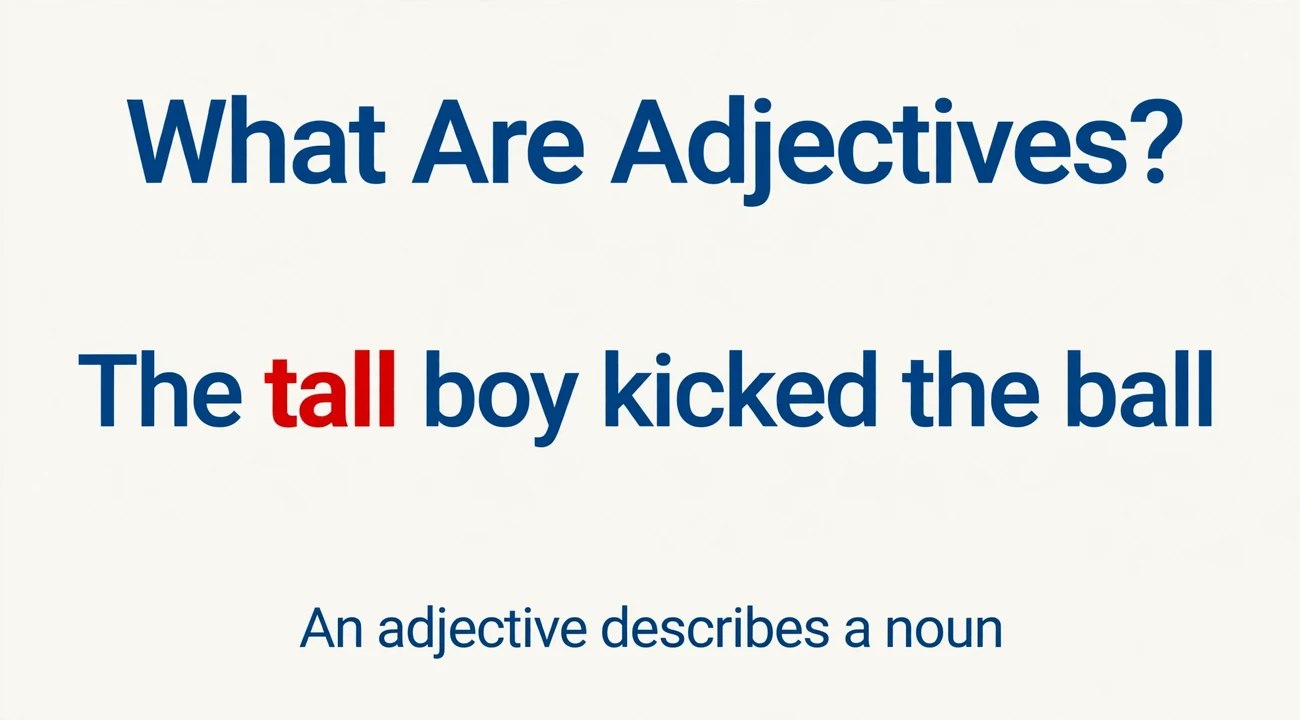
An adjective is a word that describes a noun or a pronoun. It answers simple questions: What kind? Which one? How many? Whose? In “She has three blue pens,” three tells us how many, and blue tells us the colour. Both words are adjectives.
- The tall boy won the race. (tall tells what kind)
- I bought five apples. (five tells how many)
- This is my book. (my tells whose)
- The happy child laughed. (happy tells what kind)
- That house is old. (old tells what kind)
Adjectives describe nouns, and nouns name the things we talk about. If you know your nouns well, adjectives will feel easy.
Adjectives describe nouns, and verbs show action. In “She runs fast,” runs is the verb, and fast tells us how she runs. If you know your verbs, you will spot the difference fast.
One word can change its job. In “I love this song,” love is a verb. In “Love is sweet,” love is a noun.
Before a Noun
Most adjectives sit right before the noun: a red car, a kind teacher, a cold drink. This is the most common place for an adjective in English.
After a Linking Verb
After verbs like is, was, seem, and feel, the adjective sits after the verb: “The soup is hot.” “She seems happy.” The adjective still describes the noun, even from this spot.
Types of Adjectives
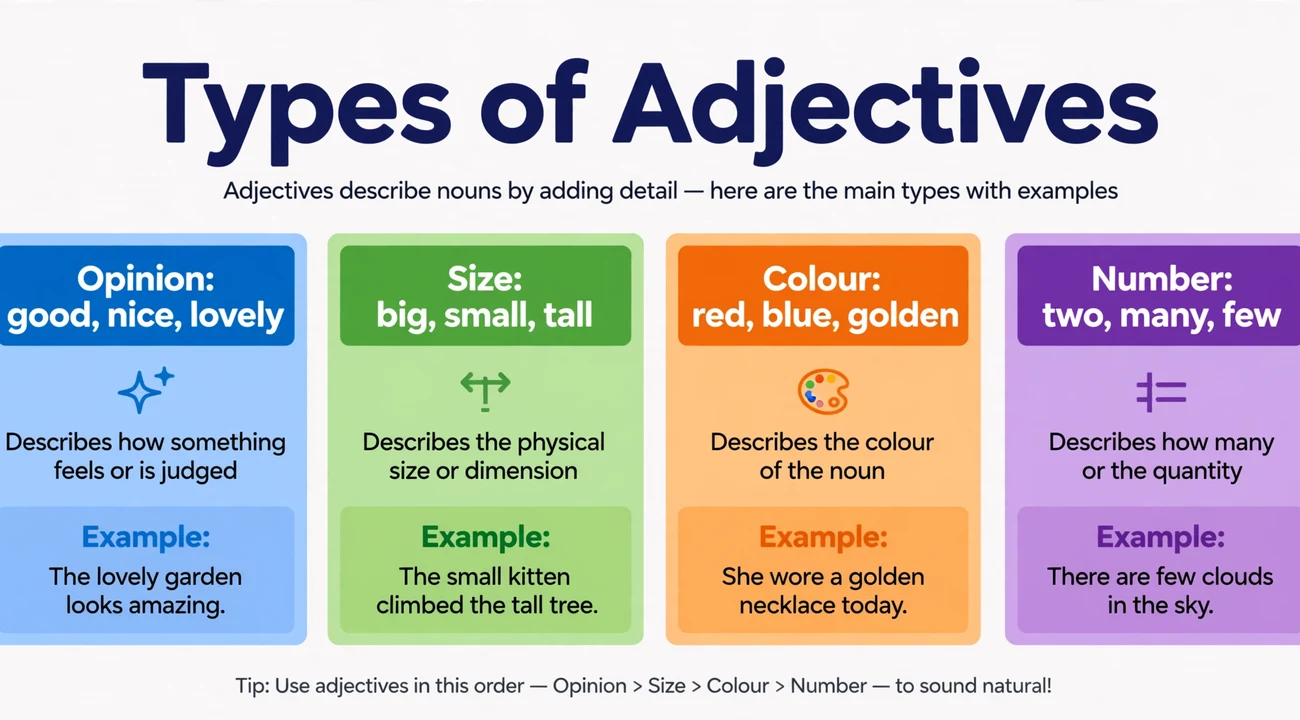
Adjectives come in a few main types. Each type answers a different question about the noun. Learn the types once, and spotting them gets easy.
| Type | Question it answers | Example |
|---|---|---|
| Descriptive | What kind? | a red car, a kind man |
| Number | How many? | three books, first prize |
| Demonstrative | Which one? | this pen, those shoes |
| Possessive | Whose? | my bag, her coat |
| Interrogative | Which? (in a question) | Which book is yours? |
Descriptive adjectives are the most common type. Words like big, small, hot, cold, happy, and sad paint a picture of the noun.
Number adjectives tell us how many or in what order: two dogs, the first day. Demonstrative adjectives point to a noun: this, that, these, those. Possessive adjectives show ownership: my, your, his, her, our, their.
Interrogative adjectives ask a question about a noun: “Which dress do you like?” “What colour is your car?” Learn more about describing words in our guide to adverbs — they describe verbs, not nouns.
7 Simple Adjectives Rules
These 7 rules cover everything you need to use them with confidence. Learn them one by one, and practise each with your own sentences.
Rule 1: Put the Adjective Before the Noun
In most cases, the adjective comes first: a blue pen, a tall tree, a sweet mango. The noun comes last.
Rule 2: Use a or an Before a Singular Adjective and Noun
Say “a big house” and “an old man.” Use an before a vowel sound: an honest boy, an apple pie. Never say “big a house” — the small word a or an always leads the group.
Rule 3: Do Not Add -s to an Adjective
They never change for plural nouns. We say “red cars,” not “reds cars.” The noun changes, but the adjective stays the same.
Rule 4: Use the Right Order for Two or More Words
When two adjectives describe one noun, use this order: opinion, size, age, colour. Say “a beautiful big old red house.” It sounds strange to say “a red old big beautiful house.”
Rule 5: Use -er and -est for Short Words
For short words, add -er to compare two things and -est to compare three or more: big, bigger, biggest; tall, taller, tallest. For longer words, use more and most: more beautiful, most beautiful.
Rule 6: Match the Verb to the Noun, Not the Adjective
The adjective never changes the verb. In “The red cars are fast,” the verb are matches cars, not red. Learn this idea in full in our guide to subject-verb agreement.
Rule 7: Use More and Most for Long Words
Words with three or more sounds take more and most: “more expensive,” “the most interesting book.” Do not add -er to these words: “expensiver” is wrong. When in doubt, use more.
Some adjectives take a fixed preposition after them — afraid of, proud of, full of, good at. See our guide to prepositions to learn the small words that follow them.
The 2-Second Adjectives Trick
Still not sure if a word is an adjective? Use this quick trick. It takes only two seconds.
Step 1: Ask “What kind?” or “Which one?” about the noun.
Step 2: If the word answers the question, it is an adjective.
Step 3: Try the word before a noun. If it fits, you have found one.
Try the trick on these examples:
- “The red car.” → What kind of car? Red. It fits — red is an adjective.
- “She is happy.” → What kind is she? Happy. It fits — happy is an adjective.
- “He runs fast.” → What kind of run? The word fast tells us about the verb, not a noun — so it is not an adjective here.
This trick works because Adjectives always describe a noun. If a word tells you something about a noun, it is doing an adjective’s job.
40 Adjectives Examples
Here are 40 simple examples. The first 20 show Adjectives before nouns, and the next 20 show them after linking verbs and in everyday phrases. See our guide to types of sentences for more short, clear lines.
Before nouns:
- The red car stopped at the corner.
- She wore a beautiful dress.
- It was a cold morning.
- The tall boy won the race.
- I read an interesting book.
- We saw a big elephant at the zoo.
- The hot soup burned my tongue.
- He lives in a small village.
- The old man walks slowly.
- She has a kind heart.
- The green field looked fresh.
- I bought three blue pens.
- The brave soldier saved the child.
- We drank cold water after the game.
- The happy child laughed all day.
- A strong wind blew the roof off.
- The sweet mango tasted lovely.
- He wore a black coat.
- The new teacher is very polite.
- My little brother loves toys.
After linking verbs and in everyday phrases:
- The soup is hot.
- She seems happy today.
- The movie was very long.
- I feel tired after work.
- The night was dark and quiet.
- This cake tastes sweet.
- The room smells fresh.
- He looks worried about the test.
- The dress is too expensive.
- Her voice sounds soft.
- The water is clean and cold.
- I am proud of my son.
- The test was easy.
- The road became slippery in the rain.
- She is afraid of the dark.
- The baby is hungry.
- His answer was correct.
- The garden is full of flowers.
- The story sounds funny.
- We are ready for the trip.
For trusted reference reading on this topic, the Wikipedia page on adjectives explains the same ideas with extra detail.
Common Adjectives Mistakes
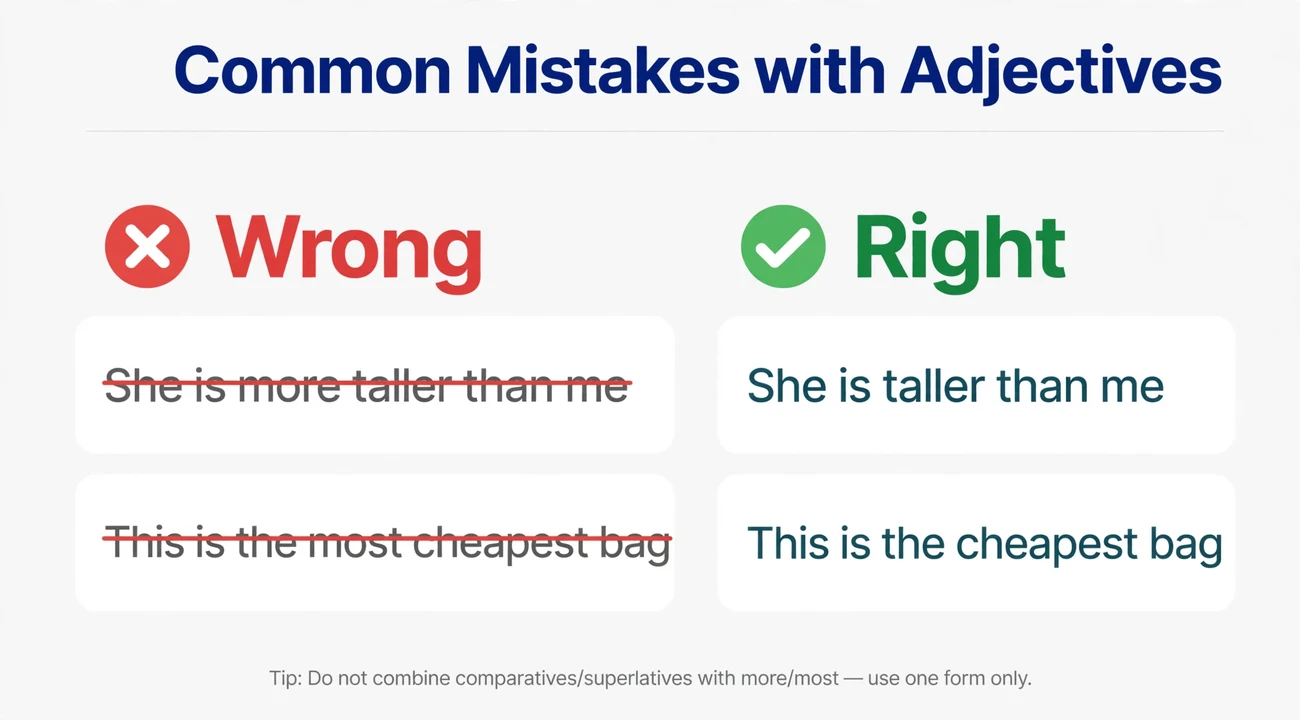
Even good learners make mistakes with Adjectives. Learn them once.
Mistake 1: Adding -s to an adjective.
Wrong: “I saw reds cars.” Right: “I saw red cars.” They never take -s, even when the noun is plural.
Mistake 2: Putting the adjective after the noun.
Wrong: “I have a car red.” Right: “I have a red car.”
Mistake 3: Using the wrong order.
Wrong: “She bought a red beautiful big dress.” Right: “She bought a beautiful big red dress.” Opinion comes first, then size, then age, then colour.
Mistake 4: Using -er with a long adjective.
Wrong: “This book is interestinger.” Right: “This book is more interesting.” Long adjectives take more and most, not -er and -est.
Mistake 5: Mixing up adjectives and adverbs.
Wrong: “She sings beautiful.” Right: “She sings beautifully.” Beautiful describes a noun, but beautifully describes the verb sings.
Quick Quiz: Adjectives
Choose the right adjective for each sentence. Answers are at the end — no peeking!
- The ___ car stopped at the corner. (red / run)
- She wore a ___ dress. (beautiful / beautifully)
- The soup is ___. (hot / heat)
- I bought ___ blue pens. (three / quickly)
- This book is ___ interesting than that one. (more / most)
Answers:
1. red — it describes the car.
2. beautiful — an adjective describes the noun dress.
3. hot — the adjective comes after is.
4. three — a number adjective tells how many.
5. more — interesting is a long adjective, so we use more.
How did you do? 5/5 — excellent, you have mastered Adjectives! 4 — very good. Fewer than 4 — read the 7 rules once more and try again.
Adjectives Quick Summary
| Point | Rule | Example |
|---|---|---|
| What is it | A word that describes a noun | red car, happy child |
| Position | Usually before the noun | a blue pen |
| After linking verbs | After is, was, seem, feel | The soup is hot. |
| Plural | Never add -s to an adjective | red cars, not reds cars |
| Comparing | Short words take -er and -est; long words take more and most | bigger, more beautiful |
The answer is simple: a word that describes a noun is an adjective. Keep this table near your desk until Adjectives feel automatic.
FAQs About Adjectives
What are Adjectives in simple words?
Adjectives are words that describe a noun. In “The red car,” red is an adjective because it tells us what kind of car it is.
Where does an adjective go in a sentence?
Most adjectives sit right before the noun: a red car, a kind man. After linking verbs like is and was, the adjective sits after the verb: “The soup is hot.”
What is the difference between an adjective and an adverb?
An adjective describes a noun: “a beautiful dress.” An adverb describes a verb: “She sings beautifully.”
Do adjectives change for plural nouns?
No. They never take -s. We say “red cars,” not “reds cars.” The noun changes, but the adjective stays the same.
What are the main types of adjectives?
The main types are descriptive, number, demonstrative, possessive, and interrogative adjectives. Each type answers a different question about the noun.
Can one word be both an adjective and a noun?
Yes. Some words change their job. In “a gold ring,” gold is an adjective. In “Gold is costly,” gold is a noun. The job of the word in the sentence decides its type.
Conclusion
Adjectives are small words with a big job. They paint a picture of the noun and tell us its size, colour, number, and quality. Learn the 7 rules, use the 2-second trick, and practise with the 40 examples above.
Keep using Adjectives in your own sentences every day. For more simple lessons like this, keep learning with GrammarLuck — grammar made simple.
