

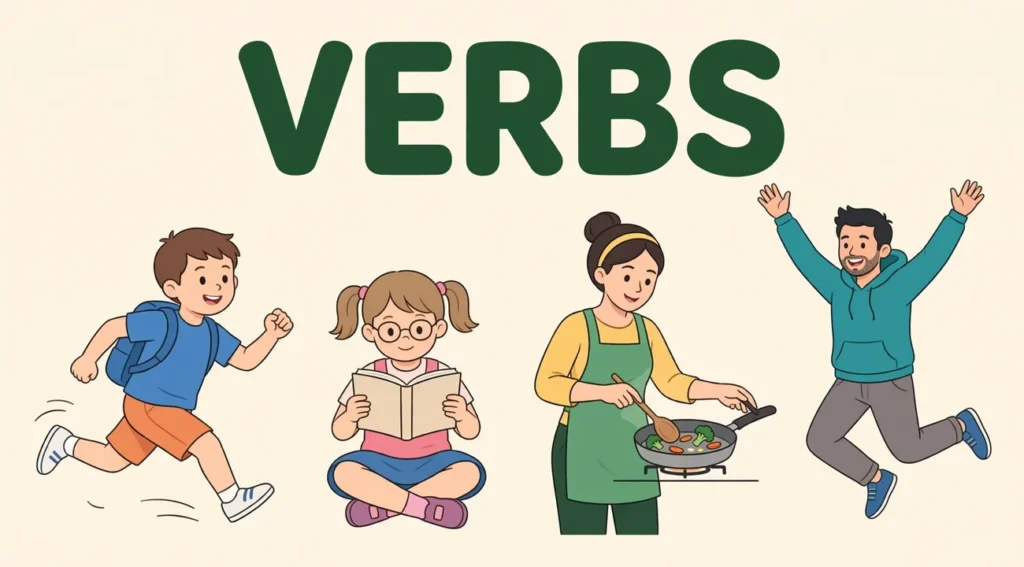
Verbs are the engine of every English sentence. Without a verb, a sentence cannot say anything at all. A verb is a word that shows an action, a state, or a change — and this guide will teach you them in the simplest way possible.
Here is the short answer: a verb tells us what the subject does or what the subject is. In “Sara runs,” the verb is “runs.” In “Sara is happy,” the verb is “is.” That is the whole idea of verbs in one line.
In this guide, you will learn what a verb is, the main types of verbs, 7 simple rules, 40 clear examples, common mistakes, and a quick quiz. By the end, verbs will feel easy.
The Quick Answer
The fastest way to understand verbs is to see the job they do.
| Verb type | What it does | Example |
|---|---|---|
| Action verb | Shows what someone does | She runs every morning. |
| Linking verb | Joins the subject to a describing word | He is tired. |
| Helping verb | Works with a main verb | She has finished her work. |
The golden rule of verbs: Every sentence needs at least one verb. If your sentence has no verb, it is not complete yet.
What Is a Verb?

A verb is a word that shows an action, a state of being, or a change. Run, jump, eat, and sleep use action verbs. “I am happy” uses a verb that shows a state. In short, verbs are the doing and being words of English.
- She sings a sweet song.
- They play football.
- The baby sleeps.
- I am hungry.
- The flowers smell sweet.
Notice how each sentence has a verb in it. Take the verb out and the sentence falls apart: “She a sweet song” makes no sense. That is why they are called the heart of a sentence.
A verb works closely with its subject. Our guide to subject-verb agreement shows how the two must match in every sentence.
Six Main Types
There are six main types of verbs to know. Learn them one by one.
| Type | What it does | Example |
|---|---|---|
| Action verb | Shows an action | Birds fly. |
| Linking verb | Joins the subject to a word | The soup tastes good. |
| Helping verb | Helps the main verb | We are going home. |
| Regular verb | Forms the past with -ed | walk → walked |
| Irregular verb | Changes form in the past | go → went |
| Transitive verb | Needs an object | She kicked the ball. |
| Intransitive verb | Needs no object | He sleeps early. |
Action verbs are the easiest type. They show what someone does: run, jump, read, write, cook, and drive. If you can do it, the word for it is probably one.
Linking verbs do not show action. They join the subject to a word that tells us more, like am, is, are, seem, and taste. In “The cake tastes sweet,” “tastes” joins “cake” to “sweet.”
Helping verbs work with the main verb to show time or meaning: is, are, was, have, has, had, can, could, will, and would. In “She is reading,” “is” works with “reading” to show that the action is happening now. Learn more in our guide to the present simple tense.
The regular verb forms the past tense by adding -ed: walk → walked, play → played, watch → watched. The irregular verb changes in a different way: go → went, eat → ate, see → saw. Learn irregular forms a few at a time, by heart.
A transitive verb needs an object to complete the meaning: “She kicked the ball.” An intransitive verb needs no object: “He sleeps early.” Some can be both: “She sang a song” and “She sang well.”
The 2-second trick to find a verb: Ask “What is the subject doing?” The word that answers is the verb. In “The dog barks loudly,” the answer is “barks.” Use this trick for one week, and spotting verbs will become a habit.
7 Simple Rules
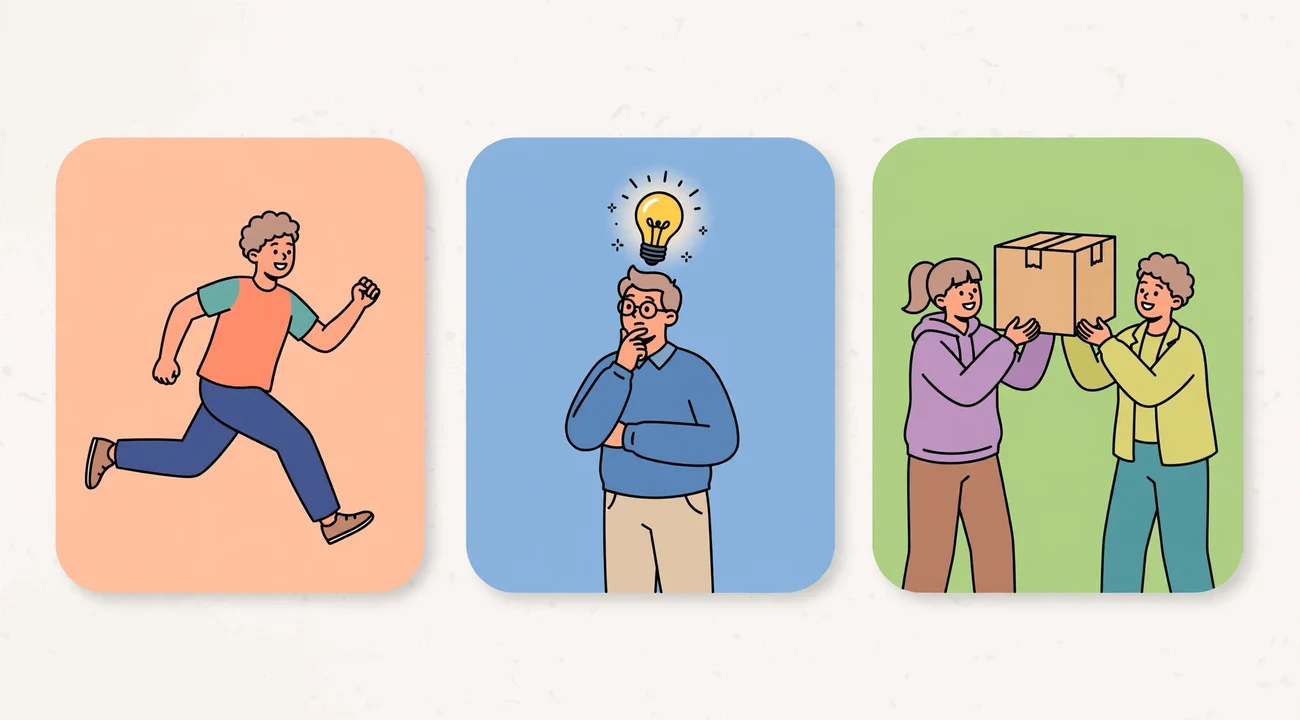
These seven rules cover the verbs you use every day.
Rule 1: Every Sentence Needs a Verb
A sentence with no verb is not complete. It may have a subject, but it says nothing until a verb arrives.
- Wrong: “The little boy in the park.” Right: “The little boy plays in the park.”
- Wrong: “My best friend Sara.” Right: “My best friend Sara is kind.”
Rule 2: The Verb Must Agree with the Subject
A singular subject takes a singular verb, and a plural subject takes a plural verb. “He plays” but “They play.” “The book is new” but “The books are new.”
Our guide to types of sentences shows how verbs work in simple, compound, and complex sentences.
Rule 3: Use the Right Tense
Tense shows the time of the action: present for now, past for before, and future for later.
- Present: “I eat breakfast every day.”
- Past: “I ate breakfast an hour ago.”
- Future: “I will eat breakfast tomorrow.”
Rule 4: Add -s or -es for He, She, and It
In the present simple, add -s or -es when the subject is he, she, or it. This small ending is easy to forget.
- He runs fast. She watches TV. It rains a lot here.
- I run fast. They watch TV. We play every day. (No -s with I, we, you, and they.)
Rule 5: Use the Correct Form After a Helping Verb
After a helping verb, the main verb takes a fixed form: -ing after be (“She is eating,” not “She is eat”) and the past participle after have (“They have finished,” not “They have finish”).
Rule 6: Add -ed for the Past
Most are regular. To make the past tense, just add -ed: walk → walked, talk → talked, clean → cleaned. Watch the spelling: if it ends in -e, add only -d (like → liked); if it ends in a consonant + y, change y to i and add -ed (study → studied).
Rule 7: In the Passive Voice, Use Be + Past Participle
In passive sentences, the verb has two parts: a form of be plus the past participle. “The letter was written by Sara.” “The house is cleaned every day.”
Our guide to active vs passive voice explains this rule with more examples.
40 Examples
Here are 40 simple examples: the first 20 show action, and the next 20 show linking and helping.
Action verbs:
- The boy runs to school.
- She reads a new book.
- They play cricket in the evening.
- My mother cooks delicious food.
- We walk to the park.
- The baby cries when hungry.
- He writes a letter.
- The teacher explains the lesson.
- Birds sing in the morning.
- She drives her car to work.
- The farmer grows wheat.
- Ali buys fresh bread.
- The dog chases the cat.
- We watch the news.
- He opens the window.
- The children jump over the wall.
- She paints a picture.
- They build a new school.
- The wind blows the leaves.
- I drink milk every night.
Linking and helping:
- She is a kind teacher.
- They are happy today.
- The milk smells fresh.
- He was late for class.
- We have finished our homework.
- The flowers look beautiful.
- She will come to the party.
- They were tired.
- The soup tastes very good.
- He can swim very well.
- It is raining outside.
- We are learning English at school.
- She has gone to the market.
- The baby seems sleepy.
- You should practise every day.
- The road became wet.
- They had left before we arrived.
- He is the best player.
- The room feels warm and bright.
- We would love to visit you.
For trusted reference reading on this topic, Wikipedia’s guide to verbs explains the history and grammar in more detail.
Common Mistakes

Even good students make these five common mistakes with verbs. Learn them once.
Mistake 1: Forgetting the verb.
Wrong: “She very happy.” Right: “She is very happy.” A sentence with no verb is incomplete.
Mistake 2: Wrong subject-verb agreement.
Wrong: “He play football.” Right: “He plays football.” A singular subject needs a verb with -s.
Mistake 3: Using the wrong past form.
Wrong: “I goed to school.” Right: “I went to school.” “Go” is irregular, so its past form is “went,” not “goed.”
Mistake 4: Forgetting -s with he, she, and it.
Wrong: “She watch TV every night.” Right: “She watches TV every night.” The -s ending is small, but it matters.
Mistake 5: Wrong form after a helping verb.
Wrong: “She has went home.” Right: “She has gone home.” After “has,” use “gone,” not “went.”
Verbs also team up with small words like in, on, and at. Our guide to prepositions shows how they work with them in everyday sentences.
Quick Quiz: Test Yourself
Choose the correct verb for each sentence. Answers are at the end!
- She ___ to school every day. (go / goes)
- They ___ playing football now. (is / are)
- He ___ his homework yesterday. (finish / finished)
- We ___ finished our work. (has / have)
- The baby ___ very sweet. (look / looks)
- She ___ a letter last week. (writes / wrote)
- They ___ to the market tomorrow. (will go / will went)
- He ___ TV every night. (watch / watches)
Answers:
1. goes (he, she, and it take -s)
2. are (they takes are, not is)
3. finished (yesterday needs the past)
4. have (we takes have, not has)
5. looks (the baby is singular)
6. wrote (last week needs the past)
7. will go (after will, use the base form)
8. watches (add -es after ch)
8/8 — excellent, you have mastered verbs! 6–7 — very good. Fewer than 6 — read the 7 rules once more.
Want more practice? Try our grammar exercises every day.
Quick Summary
| Point | What to remember |
|---|---|
| What is a verb? | A word that shows action, state, or change |
| Every sentence | Needs at least one verb |
| Action verb | Shows what someone does |
| Linking verb | Joins the subject to a word about it |
| Helping verb | Works with the main verb |
| Past tense | Regular verbs add -ed; irregular ones change form |
| Agreement | The verb must match its subject |
Keep this summary near your desk.
FAQs
What is a verb in simple words?
A verb is a word that shows an action, a state, or a change. “Run,” “eat,” and “sleep” are action verbs, while “am,” “is,” and “are” show a state. Every sentence needs at least one verb.
What are the main types of verbs?
The main types are the action verb, the linking verb, and the helping verb. The first shows what someone does, the second joins the subject to a describing word, and the third works with the main verb.
How do I find the verb in a sentence?
Ask “What is the subject doing?” The word that answers is the verb. In “The dog barks loudly,” the dog is barking, so “barks” is the verb. This trick works in almost every sentence.
What is the difference between a regular and an irregular verb?
A regular verb adds -ed for the past, like walk → walked. An irregular verb changes in a different way, like go → went and eat → ate. Learn irregular verbs by heart, a few at a time.
Can a sentence have more than one verb?
Yes. In “She is reading a book,” there are two: “is” and “reading.” In “They will come and help us,” there are three: “will,” “come,” and “help.”
How can I use verbs better in English?
Read simple English every day and notice them in each sentence. Write five sentences daily using new ones you learn. Practise the 7 rules and check your writing for the five common mistakes above.
Conclusion: Verbs are the engine of every sentence. They show action, state, and change. Learn the six types and remember the 7 simple rules.
Practise with the examples and quiz here, and soon you will use them the right way without even thinking. For more simple lessons, keep learning with GrammarLuck — grammar made simple.
