

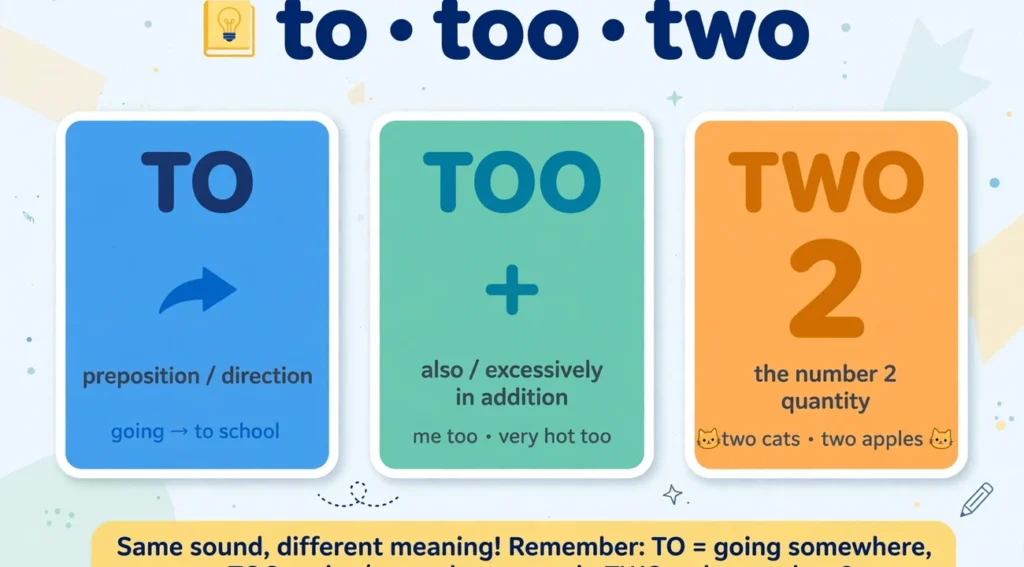
Say the three words out loud: to, too, two. They sound identical, yet each does a completely different job — and choosing the wrong one is the kind of mistake a spellchecker will never catch. The good news: one 2-second test settles it every time. Look at the spelling clue: to has one o, too has two o’s for its two meanings, and two starts with “tw”, like the number it names.
Here is the short answer. To shows direction or the start of an action: “I am going to school.” Too means “also” or “more than enough”: “I am too tired.” Two is the number 2: “I have two books.” That is the whole to vs too vs two difference in one line.
In this guide, you will learn what each word means, the 5 simple rules, a 2-second trick, 40 clear examples, the most common mistakes, and a quick quiz.
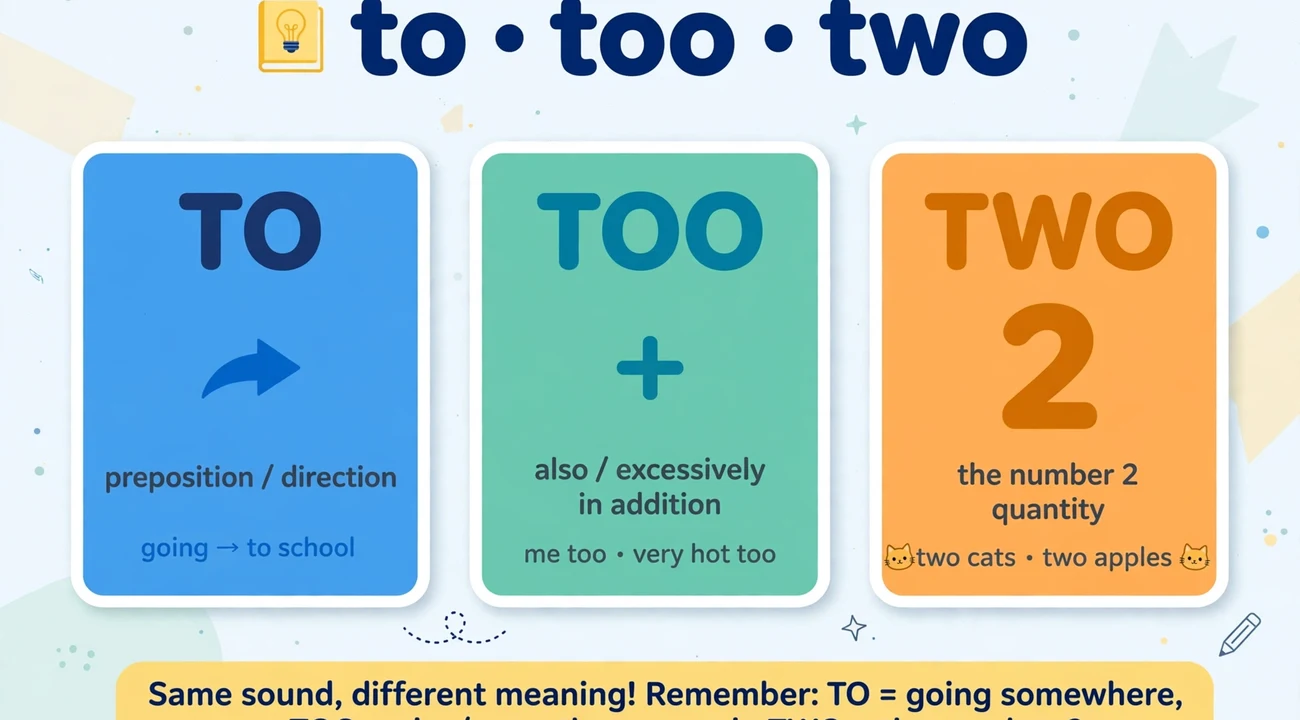
To vs Too vs Two: The Quick Answer
See the three words side by side:
| Word | Meaning | Example |
|---|---|---|
| To | Direction, place, or the start of an action | I am going to school. |
| Too | Also, or more than enough | I want cake too. / It is too hot. |
| Two | The number 2 | I have two dogs. |
The golden to vs too vs two rule: number 2 means two, “also” or “very” means too, and everything else means to.
What Do To, Too and Two Mean?
What Does To Mean?
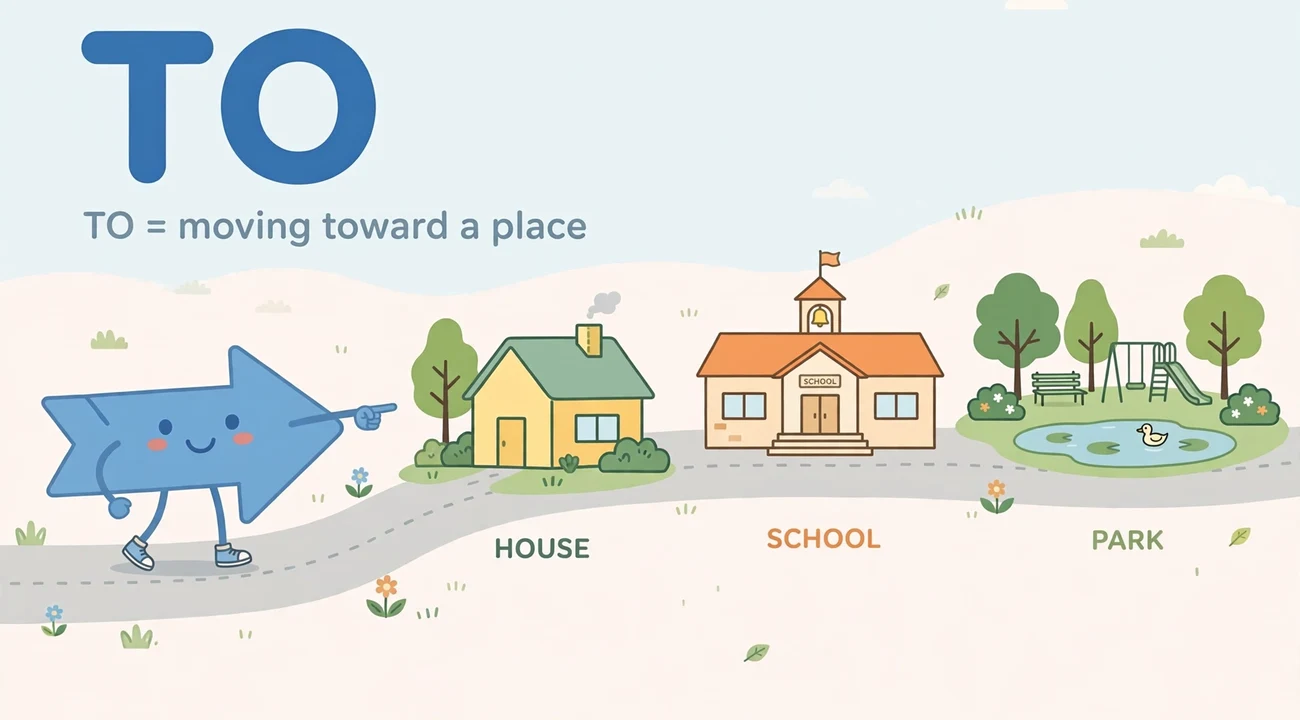
To shows direction, place, time, or the start of an action. In the to vs too vs two set, to is the word you will use most often.
- I am walking to the park.
- She gave it to her friend.
- It is ten to six.
- He wants to learn English.
- Please listen to me.
To often comes before a verb (to go, to learn) or before a place or a person. It is a small word with a big job — use it when something moves, points, or begins.
For another three-word mix-up, see our guide to There vs Their vs They’re.
What Does Too Mean?
Too has two main jobs. First, it means “also”: “I like pasta too.” Second, it means “more than enough”: “This bag is too heavy.”
- I am tired too.
- She is coming too.
- The bag is too heavy.
- It is too cold outside.
- He speaks too fast.
Too has two o’s and two meanings — “also” and “very”. If “also” or “very” fits the sentence, the answer is too.
Practise more pairs like this in our Your vs You’re guide.
What Does Two Mean?
Two is the easiest word of the three. It is only a number — the number 2. It never means “also” and it never shows direction.
- I have two sisters.
- She bought two tickets.
- There are two apples on the table.
- We need two more chairs.
- The film starts in two hours.
If you can replace the word with “2” and the sentence still works, the answer is two. If it does not work, use to or too.
The 2-Second To vs Too vs Two Trick
Still not sure? Use this to vs too vs two trick. It takes only two seconds.
Step 1: Does it mean the number 2? Write two.
Step 2: Does it mean “also” or “very”? Write too.
Step 3: Neither one? Write to.
Try the trick on these examples:
- “I have ___ dogs” → two (number 2)
- “I like cake ___” → too (also)
- “I am going ___ school” → to (direction)
- “This soup is ___ hot” → too (very)
This trick never fails. When you feel stuck in an essay, an email, or an exam, stop for two seconds, ask the two questions, and write the right word.
5 Simple To vs Too vs Two Rules

Rule 1: Use To for Direction and Actions
For movement, place, or the start of an action, use to.
- She drove to work.
- I want to sleep.
- Give it to me.
Rule 2: Use Too for “Also”
When you mean “also”, use too.
- He is hungry too.
- My sister loves rain too.
Rule 3: Use Too for “Very” or “More Than Enough”
When something is more than you need, use too.
- The music is too loud.
- This dress is too big.
Practise with daily grammar exercises.
Rule 4: Use Two Only for the Number 2
If it means the number 2, write two — only two.
- Two plus two is four.
- I need two pens.
See the same fix in our Its vs It’s guide.
Rule 5: When in Doubt, Ask the Two Questions
Still stuck? Run the 2-second trick: number 2? “Also” or “very”? If no to both, write to.
Why the To vs Too vs Two Mix-Up Happens
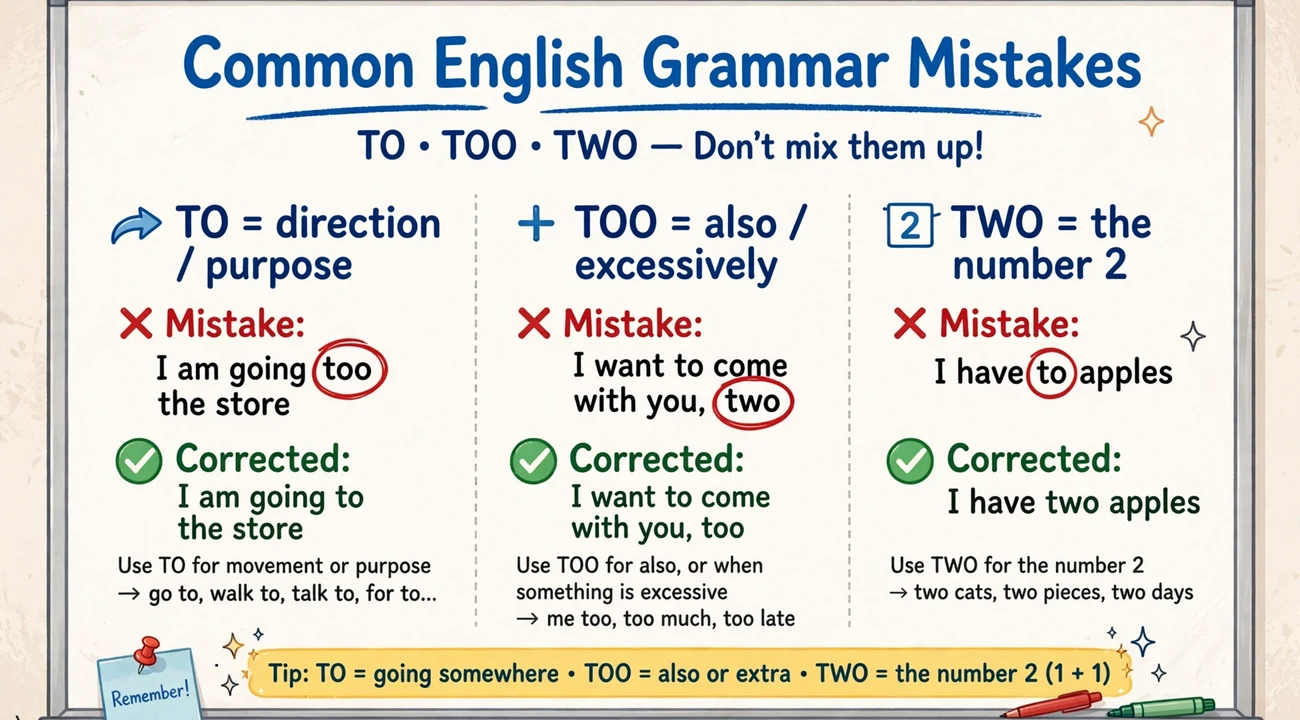
Why is to vs too vs two so confusing? The three words are homophones — words that sound the same but have different spellings and meanings.
Each spelling gives you a clue:
| Word | Spelling Clue | Meaning | Example |
|---|---|---|---|
| To | One o — the simplest | Direction or action | I am going to school. |
| Too | Two o’s — two meanings | Also / more than enough | I am too tired. |
| Two | Starts with “tw” | The number 2 | I have two dogs. |
Too has two o’s and two starts with “tw”. That pattern makes the three spellings easier to remember.
See the same pattern in our Affect vs Effect guide.
40 To vs Too vs Two Examples
Here are 40 simple examples: 14 to, 13 too, and 13 two. Read them in groups of three to see how the meanings change.
To, too and two side by side:
- I am going to school. / I am tired too. / I have two dogs.
- She gave it to him. / She wants one too. / She bought two tickets.
- It is time to go. / It is too late. / Two hours left.
In each group, the first sentence shows direction, the second shows “also” or “very”, and the third counts something.
To (direction or action):
- I am going to school.
- She gave the book to Ali.
- We walked to the park.
- He wants to sleep early.
- Please listen to me.
- I need to buy milk.
- They moved to a new house.
- She is talking to her friend.
- It is ten to six.
- I am going to play football.
- He gave it to his sister.
- We need to study for the test.
- She drove to work.
- I want to learn English.
Too (also / very):
- I am tired too.
- She is coming too.
- The bag is too heavy.
- It is too cold outside.
- He speaks too fast.
- I like tea too.
- This soup is too hot.
- She is too shy to talk.
- The music is too loud.
- He is too young to drive.
- We are too busy today.
- This dress is too big.
- My sister loves rain too.
Two (the number 2):
- I have two dogs.
- She bought two tickets.
- There are two apples on the table.
- We need two more chairs.
- The film starts in two hours.
- I have two sisters.
- Two plus two is four.
- I need two pens.
- He has two brothers.
- She ate two apples.
- We walked for two hours.
- There are two books on the desk.
- I will call you in two minutes.
Common To vs Too vs Two Mistakes
Even native speakers make these to vs too vs two mistakes.
Mistake 1: Using “to” for the number.
Wrong: “I have to dogs.” Right: “I have two dogs.” The word means “2”, so the answer is two.
Mistake 2: Using “to” for “also”.
Wrong: “I like it to.” Right: “I like it too.” “Also” fits here, so too is correct.
Mistake 3: Using “too” for direction.
Wrong: “I am going too school.” Right: “I am going to school.” Direction always takes to.
Mistake 4: Writing “to much” instead of “too much”.
Wrong: “I have to much work.” Right: “I have too much work.” “Too much” means “more than enough”.
Run the 2-second trick before you send a sentence, and these mistakes will stop.
Quick Quiz: To, Too or Two?
Choose the correct word. Answers are at the end — no peeking!
- I am going ___ school.
- I have ___ dogs.
- I like cake ___.
- This soup is ___ hot.
- She gave it ___ him.
- There are ___ apples on the table.
- We are ___ busy today.
- I want ___ learn, ___.
Answers:
1. to (direction)
2. two (the number 2)
3. too (also)
4. too (very)
5. to (direction)
6. two (the number 2)
7. too (more than enough)
8. to / too
How did you do? 8/8 — excellent! 6–7 — very good. Fewer than 6 — read the 2-second trick once more.
To vs Too vs Two: Quick Summary
| Point | To | Too | Two |
|---|---|---|---|
| Meaning | Direction or action | Also / more than enough | The number 2 |
| Use it when | Something moves, points, or begins | You mean “also” or “very” | You count to 2 |
| Spelling clue | One o — the simplest | Two o’s — two meanings | Starts with “tw” |
| Example | I am going to school. | I am too tired. | I have two dogs. |
The answer is simple: direction takes to, “also” or “very” takes too, and the number 2 takes two.
For more grammar basics, read the Blue Book of Grammar and Punctuation guide.
FAQs About To vs Too vs Two
What is the difference in simple words?
To = direction or action. Too = “also” or “very”. Two = the number 2.
How can I remember the to vs too vs two rule?
Number 2? Write two. “Also” or “very”? Write too. Neither? Write to.
When should I use “too” instead of “to”?
Use too for “also” or “more than enough”. In every other case, use to.
Can “two” mean anything except the number 2?
No. Two is only a number — never to or too.
Is it “too much” or “to much”?
Always “too much” — it means “more than enough”.
Is “to” the most common of the three?
Yes. When in doubt, guess to — then run the 2-second trick.
Conclusion
Three words, one sound, three clear jobs: to points the way, too adds “also” or “very”, and two counts to 2.
Practise with the examples and quiz, and soon you will choose the right word without thinking. Keep this guide open while you write, and the rule will soon become a habit.
Try the trick in your own writing today. Write five sentences with to, five with too, and five with two — then check each one with the 2-second trick.
Bookmark this to vs too vs two guide and use the to vs too vs two trick every time you write. With a little practice, the to vs too vs two rule will soon feel natural.
