

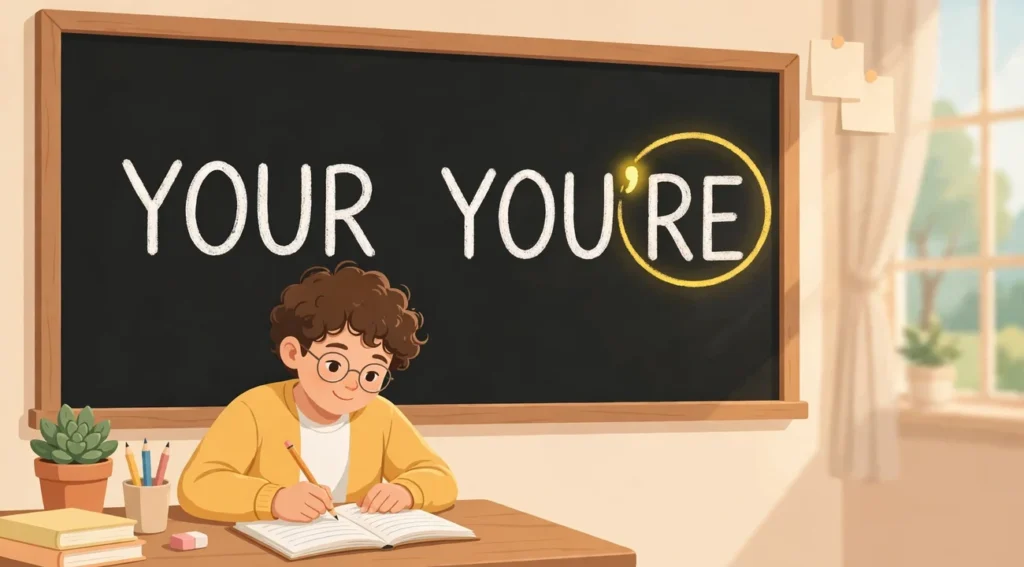
Your vs you’re is a trap built on one tiny mark: the apostrophe. Your points at what belongs to you — your book, your name, your house. You’re is really two words squashed together: you + are. So the whole your vs you’re question comes down to one quick test: can you say “you are” in this sentence? If yes, write you’re; if no, write your.
Here is the short answer. Your shows possession — it means “belonging to you.” You’re is a short form of “you are.” That is the whole your vs you’re difference in one line. This is your book, and you’re a great reader.
In this complete guide, you will learn what each word means, the 5 simple your vs you’re rules, a 2-second test, 40 clear examples, the most common mistakes, and a quick quiz. By the end, the your vs you’re question will never confuse you again.
Your vs You’re: The Quick Answer
The fastest way to understand the difference is to see them side by side.
| Word | Meaning | Example |
|---|---|---|
| Your | Belonging to you (possessive) | This is your book. |
| You’re | You are (contraction) | You’re my best friend. |
The golden your vs you’re rule: If you can replace the word with “you are” and the sentence still makes sense, use you’re. If the replacement sounds wrong, use your. This one test works in almost every sentence, and you will practise it many times in this guide.
What Does Your Mean?

Your is a possessive adjective. It shows that something belongs to you, or is connected to you. In the your vs you’re pair, your is the owner word — just like my, his, and their.
It always comes before a noun (a person, place, or thing). You can never use your on its own at the end of a sentence. It always needs a noun after it.
- This is your pen.
- I love your new shoes.
- What is your name?
- Your house is very beautiful.
- Please bring your homework tomorrow.
- Your English is improving every day.
Remember: your always points to something that belongs to you — your book, your name, your house, your smile.
If you enjoy word pairs like this one, you will also like our guide to Its vs It’s, another pair that confuses almost every English learner.
What Does You’re Mean?
You’re is a contraction — a short form made by joining two words and removing some letters. The apostrophe shows where the missing letters were. In the your vs you’re pair, you’re always means “you are.”
You’re = You + are
It is used when you are describing someone, or saying what someone is doing.
- You’re very kind. (= You are very kind.)
- You’re doing a great job. (= You are doing a great job.)
- I think you’re right. (= I think you are right.)
- You’re welcome!
- You’re going to love this movie.
- If you’re tired, take a rest.
- You’re the best teacher I have ever had.
- You’re late again!
The 2-Second Your vs You’re Test
Still not sure which word to use? Use this your vs you’re test. It takes only two seconds.
Step 1: Replace the word with “you are”. Step 2: Read the sentence again. Step 3: If it makes sense, write you’re. If it sounds silly, write your.
Try the test on these examples:
- “Is this you are book?” ❌ Silly — so use your: “Is this your book?” ✅
- “You are welcome!” ✅ Makes sense — so use you’re: “You’re welcome!” ✅
- “I like you are smile.” ❌ Silly — so use your: “I like your smile.” ✅
- “You are amazing!” ✅ Makes sense — so use you’re: “You’re amazing!” ✅
This trick never fails. When you feel stuck, stop for two seconds and run this test.
5 Simple Your vs You’re Rules

Rule 1: Use Your for Possession
When something belongs to you, use your with no apostrophe.
- Your ideas are always welcome here.
- I read your letter twice.
- Your seat is near the window.
Rule 2: Use You’re for “You Are”
When you can expand the word into “you are,” use you’re with an apostrophe.
- You’re my favourite student. (= You are)
- You’re going to win this game. (= You are)
Rule 3: Your Always Comes Before a Noun
Your is a possessive adjective, so a noun must follow it: your book, your name, your car, your smile. If no noun follows, the word cannot be your.
Rule 4: You’re Never Comes Before a Noun
You’re is a short form of “you are,” so it is always followed by an adjective, a verb, or a phrase that describes you — you’re happy, you’re running, you’re a star.
Rule 5: When in Doubt, Expand the Sentence
If a sentence still feels hard, write it in full. Instead of guessing, write “you are” in the sentence and read it aloud. Your ear will tell you the answer almost every time. Small rules like this become automatic when you practise them in daily grammar exercises.
Why the Your vs You’re Mix-Up Happens
Why is your vs you’re so confusing? Because the two words are homophones — they sound exactly the same when you say them. Your ear cannot tell them apart, so only spelling can.
There is a second reason too. In normal English, an apostrophe often shows possession: Sara’s book, the teacher’s desk. So learners naturally want to write you’re book for possession. But pronouns follow a different rule. Look at this table:
| Possessive word | Example | Contraction | Example |
|---|---|---|---|
| your | This is your book. | you’re = you are | You’re happy. |
| his | The coat is his. | he’s = he is | He’s happy. |
| her | The coat is hers. | she’s = she is | She’s happy. |
| its | The dog wagged its tail. | it’s = it is | It’s happy. |
| their | The house is theirs. | they’re = they are | They’re happy. |
In every row, the possessive word has no apostrophe, and the contraction has one. The your vs you’re pair follows exactly the same pattern. Once you see this pattern, the your vs you’re rule becomes easy to remember.
This is the same kind of pattern you learn in our Affect vs Effect guide — two similar words, one clear rule, and the confusion disappears.
Your vs You’re Examples Side by Side
Reading pairs together is the fastest way to train your eye.
- Your dog is cute. / You’re a good dog owner.
- Is that your phone? / You’re holding my phone!
- Your idea is great. / You’re very creative.
- I like your dress. / You’re looking beautiful today.
- Your room is clean. / You’re so organised!
40 Your vs You’re Examples
Here are 40 simple examples. The first 20 use your, and the next 20 use you’re.
Your (possession):
- Your bag is on the chair.
- I like your new haircut.
- What is your favourite food?
- Your mother is calling you.
- Please wash your hands before dinner.
- Your voice sounds sweet.
- I borrowed your umbrella yesterday.
- Your exam starts at nine o’clock.
- Don’t forget your ticket.
- Your garden looks lovely in spring.
- I love your kind words.
- Your team played really well.
- Is this your first time in London?
- Your smile makes my day better.
- Please check your answers before you submit.
- Your hard work will pay off one day.
- I saved your seat next to mine.
- Your plan sounds perfect to me.
- The teacher praised your essay.
- Your health is more important than money.
You’re (you are):
- You’re the best friend I have.
- You’re going to love this place.
- I know you’re busy today.
- You’re doing really well in class.
- You’re welcome to stay for dinner.
- You’re not alone — I am with you.
- You’re so funny, I laughed all day.
- You’re going to be late for school.
- I think you’re right about this.
- You’re the reason I smile every day.
- You’re looking great in that dress.
- You’re invited to my birthday party.
- You’re a fast learner.
- You’re going to enjoy this book.
- You’re always so kind to everyone.
- You’re the first person I call when I need help.
- You’re stronger than you think.
- You’re never too old to learn something new.
- You’re my favourite person in the whole world.
- You’re amazing — the your vs you’re rule is simple now!
Common Your vs You’re Mistakes
Even native speakers make these mistakes. Learn them once and avoid them forever.
Mistake 1: Using your for “you are.” Wrong: “Your welcome.” Right: “You’re welcome.” Run the test: “you are welcome” makes sense, so the apostrophe belongs there.
Mistake 2: Using you’re for possession. Wrong: “I found you’re book.” Right: “I found your book.” The test: “you are book” sounds silly, so no apostrophe.
Mistake 3: Writing “your right” in a message. Wrong: “Your right about that.” Right: “You’re right about that.” The test: “you are right” works, so use the contraction.
Mistake 4: Writing “your going to” in a text. Wrong: “Your going to love it.” Right: “You’re going to love it.” The test: “you are going to love it” works perfectly, so use you’re.
If you want a full check of mistakes like these in your own writing, read our guide on how to check and fix your English grammar.
Quick Quiz: Your or You’re?
Choose the correct word for each sentence. Answers are at the end — no peeking!
- ___ going to be late for school.
- Is this ___ bag?
- ___ my favourite student.
- Please wash ___ hands before eating.
- I think ___ going to win the game.
- ___ homework is very neat.
- ___ welcome to visit us anytime.
- ___ smile makes my day better.
Answers:
- You’re (You are going to be late)
- Your (the bag belongs to you)
- You’re (You are my favourite student)
- Your (the hands belong to you)
- You’re (You are going to win)
- Your (the homework belongs to you)
- You’re (You are welcome)
- Your (the smile belongs to you)
How did you do? 8/8 — excellent! 6–7 — very good. Fewer than 6 — read the 2-second test once more and try again.
Your vs You’re: Quick Summary
| Point | Your | You’re |
|---|---|---|
| Meaning | Belonging to you | You are |
| Type | Possessive adjective | Contraction |
| Apostrophe | Never | Always |
| Followed by | A noun | An adjective or verb |
| Test | “You are” sounds wrong | “You are” sounds right |
| Example | This is your book. | You’re a star. |
If you are building your punctuation and grammar basics step by step, the Blue Book of Grammar and Punctuation is a trusted next read after this guide.
FAQs About Your vs You’re
What is the difference between your and you’re in simple words?
Your shows that something belongs to you, like “your book.” You’re means “you are,” like “you’re welcome.” That is the only rule you need.
How can I remember the your vs you’re rule?
Use the 2-second test: replace the word with “you are.” If the sentence makes sense, write you’re. If it sounds silly, write your.
Is “your welcome” correct?
No. The correct form is “You’re welcome,” because it means “you are welcome.” Writing “your welcome” is one of the most common your vs you’re mistakes.
Can your ever mean “you are”?
No. Your only shows possession. It never means “you are.” If you mean “you are,” you must write you’re with an apostrophe.
Is you’re formal or informal?
You’re is a contraction, so it is slightly informal. In very formal writing, you can write “you are” in full. In essays, emails, blogs, and exams, you’re is perfectly fine.
Which one is used more often, your or you’re?
Both are very common in everyday English. Your appears a little more often because we talk about things that belong to people all the time — your name, your house, your phone.
Conclusion
This rule is smaller than it looks. One apostrophe, two meanings: your owns something, and you’re joins “you are” together. Remember the 2-second test, keep possessive words apostrophe-free, and expand the sentence whenever you feel unsure.
Practise with the examples and quiz in this guide, and soon you will choose the right word without even thinking. For more simple lessons, keep learning with GrammarLuck — grammar made simple.
