


The past perfect tense shows that one past action happened before another past action. For example, “I had finished my homework before my friend arrived” — the homework was done first, and the friend came later. Both actions are in the past, but one happened earlier — and that earlier action takes this form.
Many learners mix up the past perfect tense with the past simple. They say, “I finished my homework before my friend arrived,” and it sounds fine — so why do we need a second tense? The answer is simple: the past simple tells you that something happened, but this tense tells you the order of events.
In this guide, you will learn the meaning, the form, 5 rules, a 2-second trick, 40 examples, the most common mistakes, and a quick quiz. By the end, you will use the past perfect tense with confidence in exams, essays, and everyday English.
Past Perfect Tense: The Quick Answer
The fastest way to understand it is to compare it with the past simple.
| Tense | When to use it | Example | Time words |
|---|---|---|---|
| Past perfect | The earlier of two past actions | I had finished before he arrived. | before, after, already |
| Past simple | A finished action at a finished time | I finished my homework yesterday. | yesterday, last week, ago |
The golden rule: use the past perfect tense when your sentence has two past actions and you want to show which one came first. “I had eaten breakfast before I left the house” — breakfast first, then leaving. Use the past simple when there is only one past action. For a full refresher, read our guide to the past simple tense.
What Is the Past Perfect Tense?
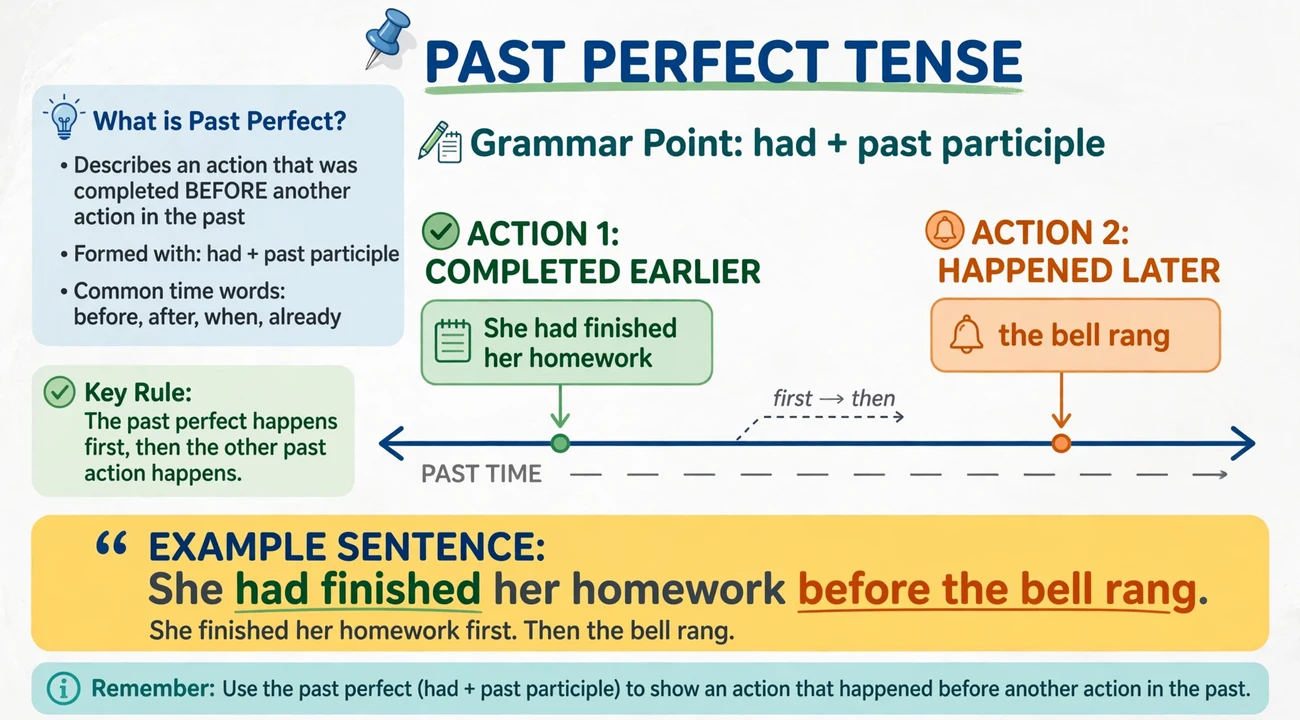
The past perfect tense talks about the earlier of two past actions. “The train had left before we reached the station.” The train left first. We reached the station second.
The form of the past perfect tense is simple: had + past participle (the third form of the verb). The good news is that had never changes — it is the same for every subject.
| Subject | Form | Example |
|---|---|---|
| All subjects | had + past participle | I had finished my work. |
Regular verbs end in -ed: finished, lived, watched. Irregular verbs have their own forms: gone, seen, eaten, written, done. Unlike the present perfect tense, which uses have or has, the past perfect tense uses had for every subject. To compare the two tenses, read our guide to the present perfect tense. If you are not sure how verbs agree with their subjects, read our guide to subject-verb agreement.
5 Simple Past Perfect Tense Rules
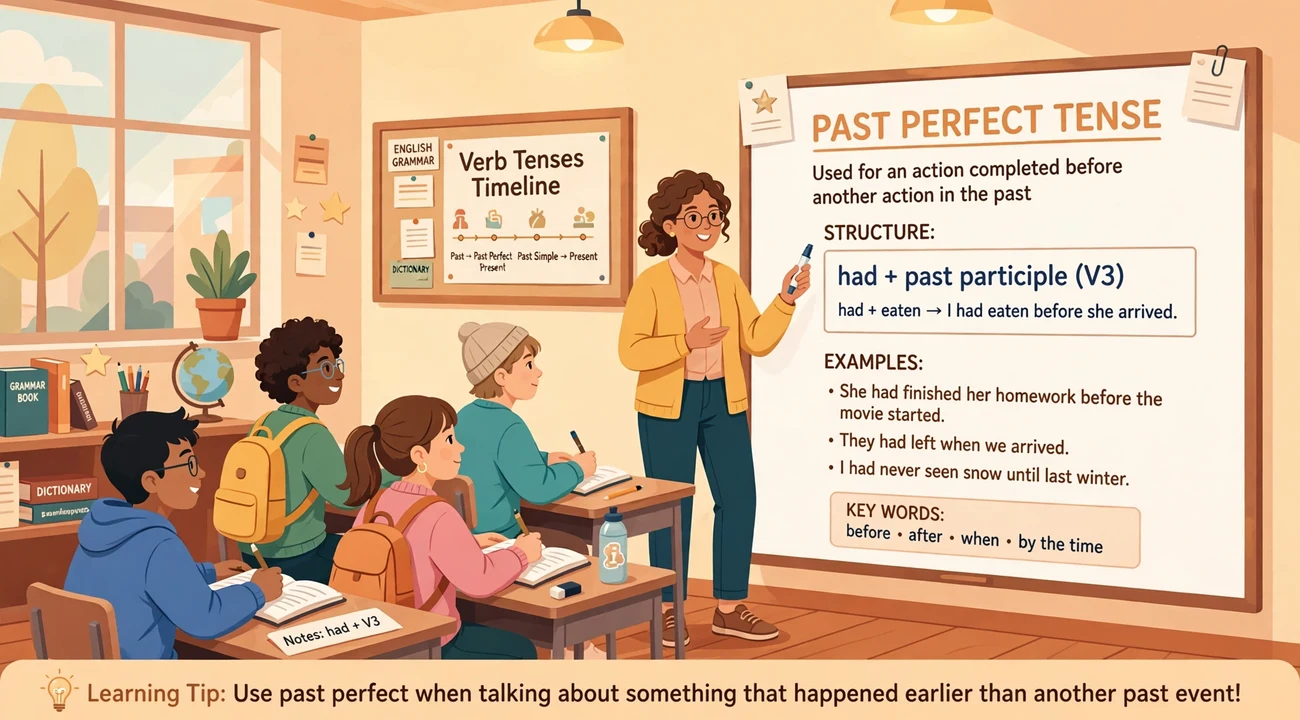
Rule 1: Use It for the Earlier of Two Past Actions
When your sentence has two past actions, use this tense for the first one, and the past simple for the second. This is the main use.
- I had locked the door before I went to bed.
- She had read the book before she watched the film.
Rule 2: Use It with Before and After
The words before and after are the clearest signs of this tense. Before points to the later action, and after points to the earlier one — but the earlier action always takes had + the past participle.
- He had left the office before the meeting started.
- After I had finished my lunch, I went for a walk.
Rule 3: Use It to Show a Cause in the Past
When a past result has a past cause, the cause takes this tense.
- She was tired because she had slept badly the night before.
- The road was wet because it had rained all morning.
Rule 4: Use It in Reported Speech
When you report what someone said, the past simple moves one step back into this tense. This shift is called backshift.
- Direct: “I finished my work.” Reported: “He said he had finished his work.”
- Direct: “I saw the film.” Reported: “She said she had seen the film.”
Rule 5: Use It with By the Time and By + a Past Time
By the time and by + a past time show that something was already complete.
- By the time we arrived, the show had started.
- By 2010, they had lived in London for ten years.
The 2-Second Past Perfect Tense Trick
Still not sure? Ask one question: “Which action happened first?” This trick takes only two seconds.
Step 1: Find the two past actions. Step 2: If there is only one, use the past simple. Step 3: If there are two, the first one takes had + the past participle.
Try the trick on these sentences:
- “The bus had left when I arrived — the bus left first, so had left is right.”
- “I arrived when the bus left — both actions happened at the same time, so the past simple is right.”
Keep this trick in mind, and the choice will soon feel natural.
40 Past Perfect Tense Examples
Here are 40 simple examples of the past perfect tense, grouped by use.
The earlier action:
- I had finished my homework before dinner.
- She had cooked lunch before the guests came.
- They had cleaned the house before the party.
- He had read the book before the film.
- We had bought the tickets before the show.
- The train had left before we reached the station.
- I had met him before that day.
- She had saved money before she bought the car.
- They had painted the room before the guests came.
- He had locked the door before he went to bed.
- We had watched the news before going out.
- She had written the letter before posting it.
- I had eaten breakfast before I left the house.
- They had built the house before winter.
- He had fixed the bike before his son woke up.
- She had learned the song before the show.
- We had packed before the taxi arrived.
- I had exercised before breakfast.
- They had booked a hotel before flying to Paris.
- He had closed the shop before the rain.
Negative and question forms:
- I had not seen that film before last night.
- She had never visited London before 2020.
- They had not finished the work by Friday.
- He had not met her before the party.
- We had eaten nothing since morning.
- Had you finished your homework before dinner?
- Had she tried sushi before that day?
- Had they left before the rain started?
- Had he read the email before the meeting?
- Had we met before? No, we had never met.
With before and after:
- After I had finished my lunch, I went for a walk.
- She called after she had arrived home.
- He had brushed his teeth before school.
- The baby had fallen asleep before we got home.
- After they had cleaned the kitchen, they watched a film.
- He had already left when I called him.
- By the time we got there, the shop had closed.
- I had just finished my tea when the phone rang.
- She had worked there five years before she moved.
- They had lived there ten years before they sold it.
You can also use the past perfect tense in the passive voice — “The room had been cleaned before the guests arrived.” Learn how that works in our guide to active vs passive voice. For more trusted reading, Pluperfect on Wikipedia explains the same tense with more examples.
Common Past Perfect Tense Mistakes
Even good learners make these mistakes — learn them once and avoid them.
Mistake 1: Using it for a single past action. Wrong: “I had finished my homework yesterday.” Right: “I finished my homework yesterday.” When there is only one past action, use the past simple.
Mistake 2: Using the past simple for the earlier of two actions. Wrong: “The train left before we reached the station.” Right: “The train had left before we reached the station.” Use the past perfect tense for the first action and the past simple for the second.
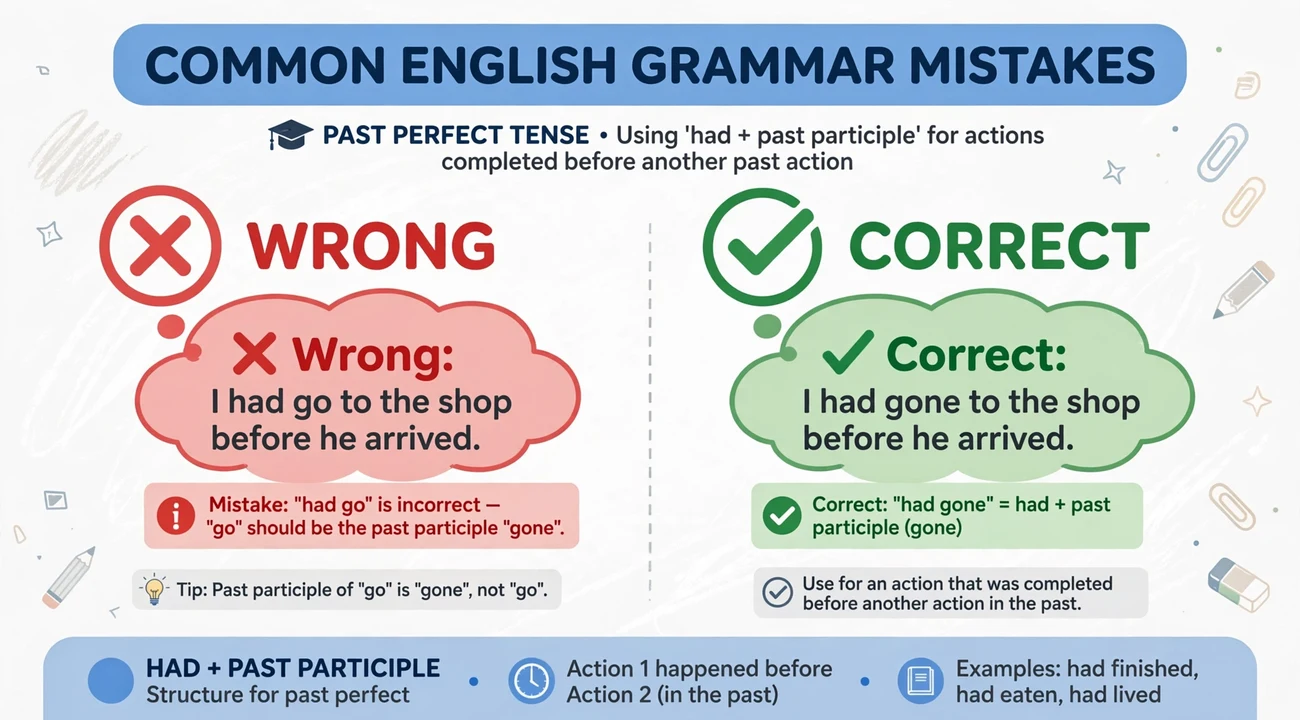
Mistake 3: Using had with the past simple form. Wrong: “She had went to school.” Right: “She had gone to school.” Went is the past simple; gone is the past participle.
Mistake 4: Using had + -ing. Wrong: “I had finishing my work before dinner.” Right: “I had finished my work before dinner.” After had, always use the past participle.
Mistake 5: Mixing it up with the past continuous tense. Wrong: “I was finishing my homework before he arrived.” Right: “I had finished my homework before he arrived.” The past continuous talks about an action in progress, not a finished one. If this pair confuses you, read our guide to the past continuous tense.
The best way to stop making these mistakes is daily practice. Write five sentences of your own every day.
Quick Quiz: Past Perfect Tense
Fill in the correct form — answers are below!
- I ___ (finish) my homework before dinner.
- She ___ never ___ (visit) London before 2020.
- They ___ (leave) before the rain started.
- By the time we arrived, the show ___ (start).
- He said he ___ (see) the film.
- After I ___ (eat) lunch, I went for a walk.
- I ___ (meet) him before that day. (Use the negative form.)
- She ___ (work) there for five years before she moved.
Answers: 1. had finished 2. had, visited 3. had left 4. had started 5. had seen 6. had eaten 7. had not met / had never met 8. had worked
How did you do? 8/8 — excellent! 6–7 — very good. Fewer than 6 — read the trick once more.
Past Perfect Tense: Quick Summary
| Use | Example | Time words |
|---|---|---|
| Earlier past action | I had finished before he arrived. | before, after |
| Complete before a past time | She had finished by 8 o’clock. | by the time, by 2010 |
| Past cause | He was tired because he had not slept. | because |
| Reported speech | She said she had seen the film. | said, told |
| Negative and questions | Had you finished before dinner? | had not, never, ever |
The past perfect tense feels hard for a week — then easy for life.
FAQs About the Past Perfect Tense
What is the past perfect tense in simple words?
The past perfect tense talks about the earlier of two past actions. It is formed with had + the past participle, as in “I had finished my work before he arrived.”
When do I use the past perfect tense and not the past simple?
Use this tense when your sentence has two past actions, as in “The train had left before we reached the station.” Use the past simple when there is only one past action, as in “I finished my work yesterday.”
What words often come with this tense?
The most common time words are before, after, by the time, already, just, never, and ever.
Can I use the past perfect tense with yesterday?
No. Yesterday is a single finished time, so use the past simple: “I finished my work yesterday,” not “I had finished my work yesterday.”
Is “I had went” correct?
No. Went is the past simple form of go, and gone is the past participle, so the correct sentence is “I had gone to school.” Always use the past participle after had.
Do I always need two past actions to use it?
Not always. You can also use it with by the time or by + a past time, as in “By 8 o’clock, she had finished her work.”
Conclusion
The past perfect tense is smaller than it looks. One form — had + past participle — covers the earlier of two past actions, a past cause, and reported speech. Remember: the first past action takes had, and the second takes the past simple.
Practise with the examples and quiz here, and soon you will choose the right tense without thinking. You can also practise with our guide to the types of sentences. For more simple lessons, keep learning with GrammarLuck.
