

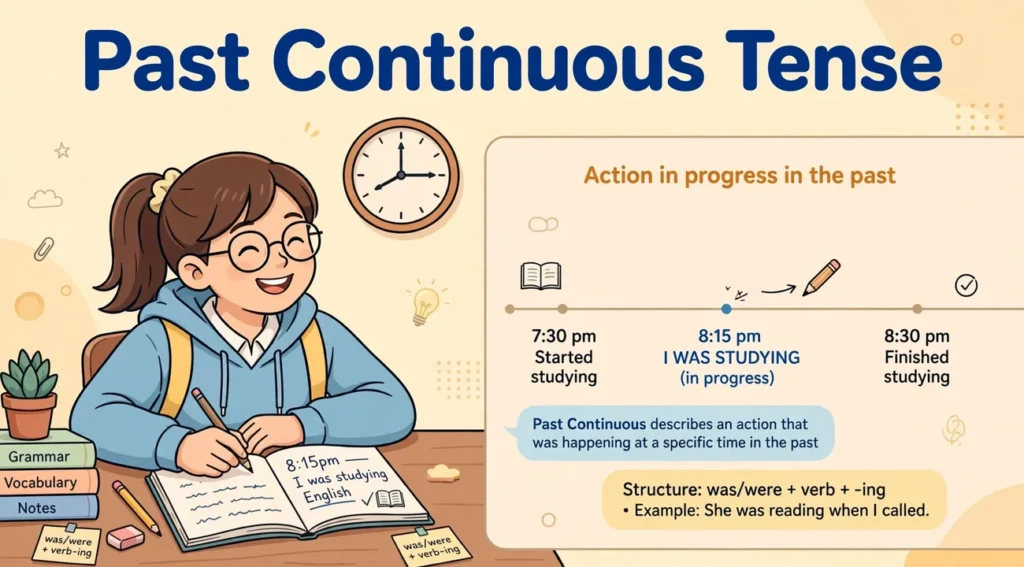
The past continuous tense is one of the most useful tenses in English. It talks about an action that was in progress at a moment in the past. If you can say “I was reading” or “They were playing,” you already know this tense. You just need the rules to use it with confidence.
In this complete guide, you will learn what the past continuous tense means, how to form it with was and were, 5 simple rules, a 2-second memory trick, 40 clear examples, the most common mistakes, and a quick quiz.
By the end, you will know exactly when to use this tense and when to use the past simple instead.
Past Continuous Tense: The Quick Answer
Here is the short answer. Use the past continuous tense for an action that was in progress at a past moment. Use the past simple for an action that started and finished in the past.
| Tense | Form | Example | Use |
|---|---|---|---|
| Past continuous | was / were + verb-ing | I was reading at 9 pm. | An action in progress |
| Past simple | verb + -ed (or past form) | I read a book yesterday. | A finished action |
The key idea is simple. This tense shows an action in progress, and the past simple shows a finished action. When one action interrupts another, the long action is past continuous and the short one is past simple: “I was reading when she called.”
If you want to compare the two tenses in more detail, read our guide to the past simple tense after this one.
What Is the Past Continuous Tense?
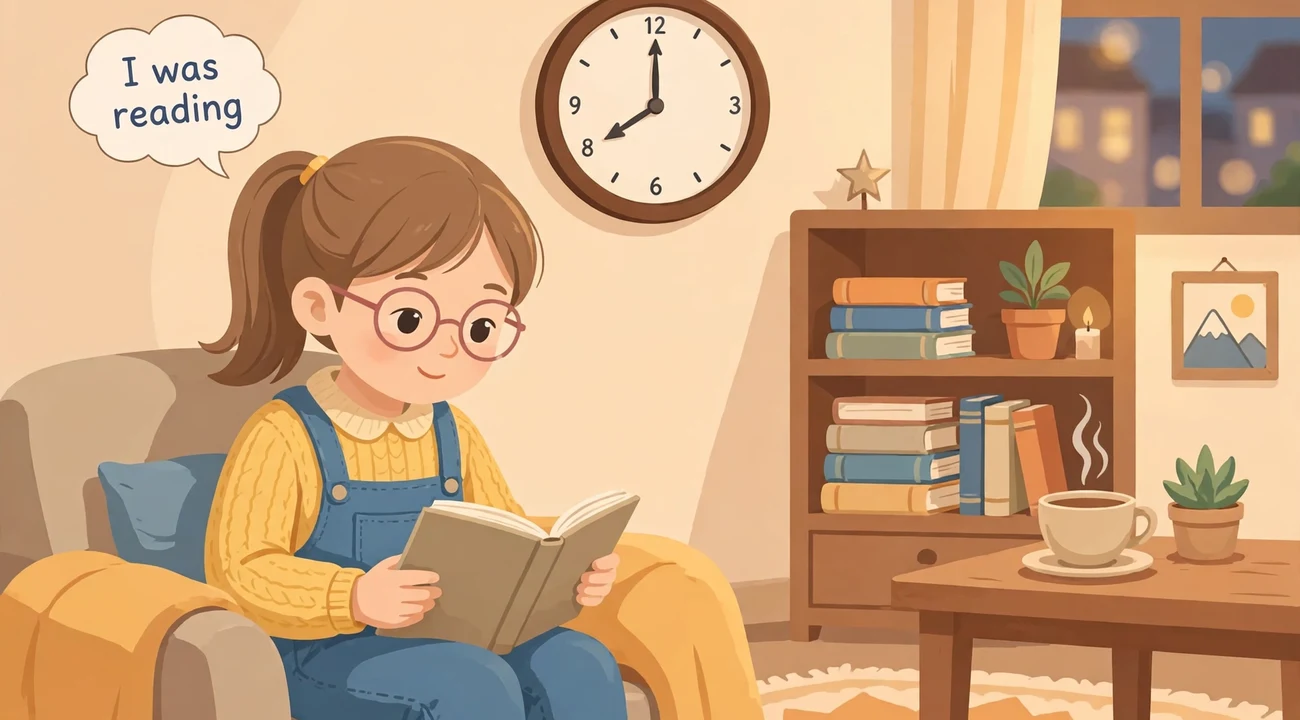
This tense describes an action that was happening over a period of time in the past. It does not say when the action finished — only that it was in progress at that moment.
- She was cooking dinner at 7 pm.
- They were watching TV all evening.
- It was raining this morning.
You use the past continuous tense to set the scene in a story, to talk about two actions happening at the same time, and to show that one action was interrupted by another.
How to Form the Past Continuous Tense
The form is simple: was / were + verb-ing. Use was with I, he, she, and it. Use were with you, we, and they. The verb-ing part never changes, no matter who the subject is.
| Subject | Was / Were | Example |
|---|---|---|
| I | was | I was studying. |
| He / She / It | was | She was singing. |
| You / We / They | were | They were working. |
For a negative, add not after was or were: “I was not reading.” For a question, put was or were first: “Were you sleeping?”
Spelling Rules for Verb-ing
Most verbs just add -ing: play → playing, read → reading. If a verb ends in -e, drop the e first: make → making, write → writing. If a short verb ends in one vowel and one consonant, double the last letter: run → running.
Once you know these small spelling rules, the past continuous tense is easy to build. The same verb-ing form also appears in the present tense, so you can refresh it in our guide to the present simple tense.
5 Simple Past Continuous Tense Rules

The 2-second memory trick: Ask yourself, “Was it in progress?” If the action was in progress at that past moment — like a film still running — use the past continuous tense. If the action was already finished, use the past simple.
Rule 1: Always Use Was or Were + Verb-ing
The past continuous tense always has two parts: was or were, and a verb with -ing. Never use one part without the other. “I was read” is wrong. “I was reading” is right.
- I was cooking lunch.
- They were playing football.
Choosing was or were is a matter of subject-verb agreement, which you can practise in our guide to subject-verb agreement.
Rule 2: Use It for an Action in Progress at a Past Moment
Use the past continuous tense when you want to say what was happening at a clear past time.
- At 8 pm last night, I was doing my homework.
- This time yesterday, we were flying to London.
Rule 3: Use It with When for an Interrupted Action
When a short action interrupts a longer action, the longer action is in this tense and the short action is in the past simple. The word when joins the two parts.
- I was reading when she called.
- He was driving when the phone rang.
Rule 4: Use It with While for Two Actions at the Same Time
When two actions were happening at the same time in the past, use the past continuous tense for both of them. The word while joins the two parts.
- While I was cooking, he was washing the dishes.
- While she was reading, her brother was playing games.
Rule 5: Use It to Set the Scene in a Story
Stories often start with this tense to paint the scene before the main action begins. It tells the reader what was already happening when the story started.
- The sun was shining, and the birds were singing.
- Everyone was sleeping when the alarm went off.
You can see scene-setting in longer texts in our guide to the types of sentences.
40 Past Continuous Tense Examples
Here are 40 simple examples. The first 20 are plain sentences. The next 20 use when and while.
- I was reading a book last night.
- She was cooking dinner at 7 pm.
- They were playing football in the park.
- He was watching a film with friends.
- We were studying for our exams.
- It was snowing all day yesterday.
- The baby was sleeping in her cot.
- You were talking too loudly.
- My mother was cleaning the house.
- The students were listening to the teacher.
- I was waiting for the bus at 8 am.
- She was wearing a red dress.
- They were building a new house.
- He was fixing his old bicycle.
- We were planning our summer holiday.
- The dog was barking at the postman.
- She was practising the piano.
- I was thinking about my future.
- They were laughing at a funny joke.
- He was running in the morning.
- I was having breakfast when the phone rang.
- She was walking to school when she saw her friend.
- They were swimming when it started to rain.
- He was driving home when his car broke down.
- We were eating dinner when the guests arrived.
- While I was reading, my sister was drawing.
- While they were playing, their parents were cooking.
- She was singing while he played the guitar.
- While we were walking, it was getting dark.
- I was working when my boss called me.
- He was sleeping when the alarm went off.
- They were travelling when the news came.
- She was writing a letter when the power went out.
- While I was studying, my brother was watching TV.
- We were sitting in the garden when it began to rain.
- He was talking on the phone when I arrived.
- They were waiting for us at the station.
- While she was cooking, the children were playing outside.
- I was looking for my keys when I found my old photo.
- At midnight, everyone was sleeping.
For more trusted reading, the Grammarly guide to the past continuous tense explains the same rules with extra examples.
Common Past Continuous Tense Mistakes
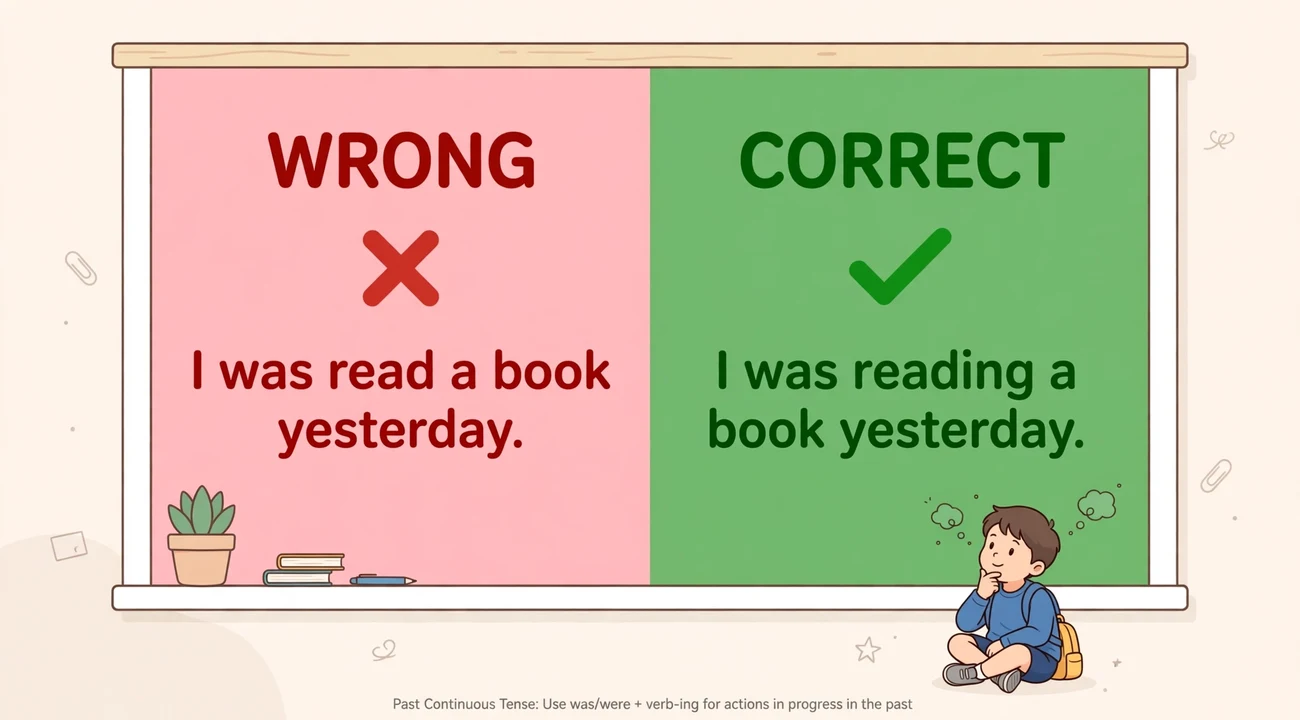
Even good students make these past continuous tense mistakes. Learn them once and avoid them forever.
Mistake 1: Using the past simple for an action in progress.
Wrong: “I read when she called.” Right: “I was reading when she called.”
Mistake 2: Forgetting the -ing ending.
Wrong: “I was read a book.” Right: “I was reading a book.” The verb after was or were must always end in -ing.
Mistake 3: Using was with they, we, or you.
Wrong: “They was playing football.” Right: “They were playing football.” Use was with I, he, she, and it only.
Mistake 4: Using the past continuous for a short, finished action.
Wrong: “I was finished my homework at 6 pm.” Right: “I finished my homework at 6 pm.” A quick finished action takes the past simple, not this tense.
Mistake 5: Wrong spelling of the verb-ing form.
Wrong: “She was makeing a cake.” Right: “She was making a cake.” Drop the final e before you add -ing.
This tense also changes form in the passive voice, so if you want to go further, read our guide to active vs passive voice next.
Quick Quiz: Past Continuous Tense?
Choose the correct form for each sentence. Answers are at the end — no peeking!
- I ___ (read) a book when she called.
- They ___ (play) football at 5 pm yesterday.
- While I was cooking, he ___ (wash) the dishes.
- She ___ (not listen) to the teacher.
- What ___ you ___ (do) at 9 pm last night?
- It ___ (rain) when we left the house.
- He ___ (drive) when the phone rang.
- We ___ (study) all evening yesterday.
Answers:
1. was reading
2. were playing (they takes were)
3. was washing
4. was not listening
5. were / doing
6. was raining (it takes was)
7. was driving
8. were studying (we takes were)
How did you do? 8/8 — excellent! 6–7 — very good. Fewer than 6 — read the 5 rules once more. You can find more practice in our grammar exercises collection.
Quick summary
| Use | Example |
|---|---|
| Action in progress at a past moment | I was reading at 9 pm. |
| Interrupted action (with when) | I was reading when she called. |
| Two actions at the same time (with while) | While I was cooking, he was washing up. |
| Setting the scene in a story | The sun was shining, and the birds were singing. |
FAQs About the Past Continuous Tense
What is the past continuous tense in simple words?
This tense talks about an action that was in progress at a moment in the past. It uses was or were plus a verb ending in -ing, like “I was reading.”
How do I form the past continuous tense?
Use was or were plus verb-ing. Say “I was reading” and “They were playing.” For a negative, add not: “I was not reading.” For a question, put was or were first: “Were you sleeping?”
What is the difference between the past continuous tense and the past simple tense?
The past continuous tense shows an action in progress: “I was reading at 9 pm.” The past simple shows a finished action: “I read the book yesterday.” Use this tense for the long action and the past simple for the short one that interrupts it.
Can I use the past continuous tense with when and while?
Yes. Use when for a short action that interrupts a longer one: “I was reading when she called.” Use while for two actions happening at the same time: “While I was cooking, he was washing the dishes.”
Which verbs can I not use in the past continuous tense?
Some verbs describe a state, not an action, and they are not normally used in this tense. These include know, like, love, want, believe, and understand. Say “I knew the answer,” not “I was knowing the answer.”
Is “was” or “were” correct with “you”?
Always use were with you, even for one person: “You were sleeping.” Was is only for I, he, she, and it.
Conclusion
The past continuous tense is a small rule with a big job. It paints the background of the past: what was happening and what was interrupted. Remember the form — was or were plus verb-ing — and ask the 2-second question: “Was it in progress?”
Practise with the 40 examples and the quiz in this guide, and soon you will choose the right tense without even thinking. For more simple lessons like this, keep learning with GrammarLuck — grammar made simple.
