

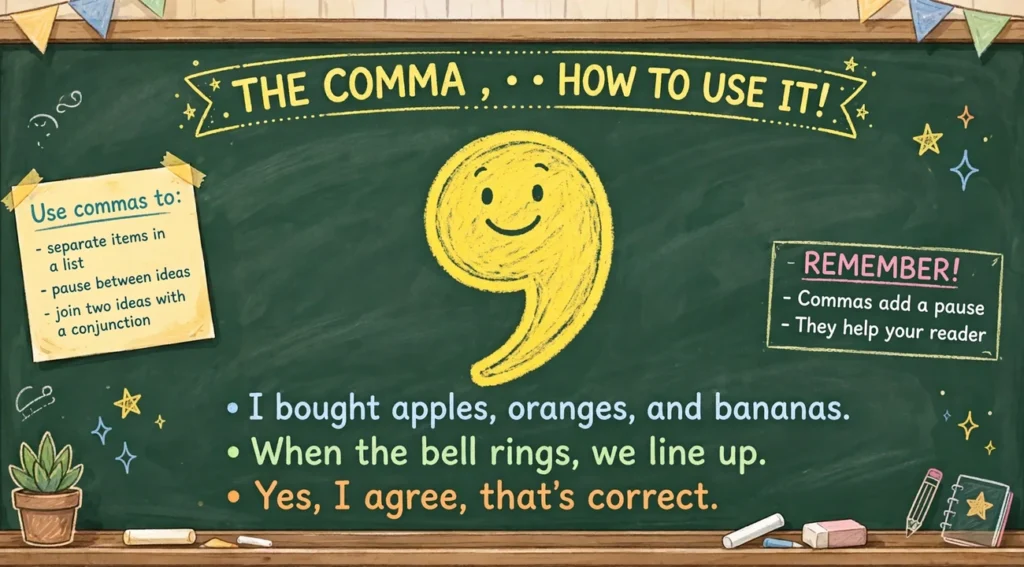
The comma is one of the smallest marks in English, but it does a very big job. It can change a sentence’s meaning, tell the reader where to pause, and make a confusing line clear. In this comma rules guide, you will learn 8 simple rules that fix common comma mistakes.
Here is the short answer. A comma is a small mark (,) that shows a short pause, separates items in a list, and joins ideas. That is the whole comma rules lesson in one line.
In this guide: what a comma is, the 8 comma rules, a 2-second trick, 40 examples, common mistakes, and a quick quiz.
Comma Rules: The Quick Answer
The fastest way to learn comma rules is to see all 8 rules side by side.
| Rule | Use a comma… | Example |
|---|---|---|
| 1. Lists | In a list | Apples, oranges, and bananas. |
| 2. Joining sentences | Before and, but, so | I was tired, so I slept. |
| 3. Intro words | After an intro | After lunch, we walked. |
| 4. Extra information | Around extra words | Sara, my friend, loves books. |
| 5. Names | Around a name | Ali, open the door. |
| 6. Dates and addresses | In dates | June 1, 2026 |
| 7. Quotes | Before a quote | She said, “Hello.” |
| 8. Comma splice | Never join two sentences | Wrong: I was tired, I slept. |
The golden comma rules test is simple: read the sentence aloud. If you pause for a short breath, a comma probably belongs there.
What Is a Comma?
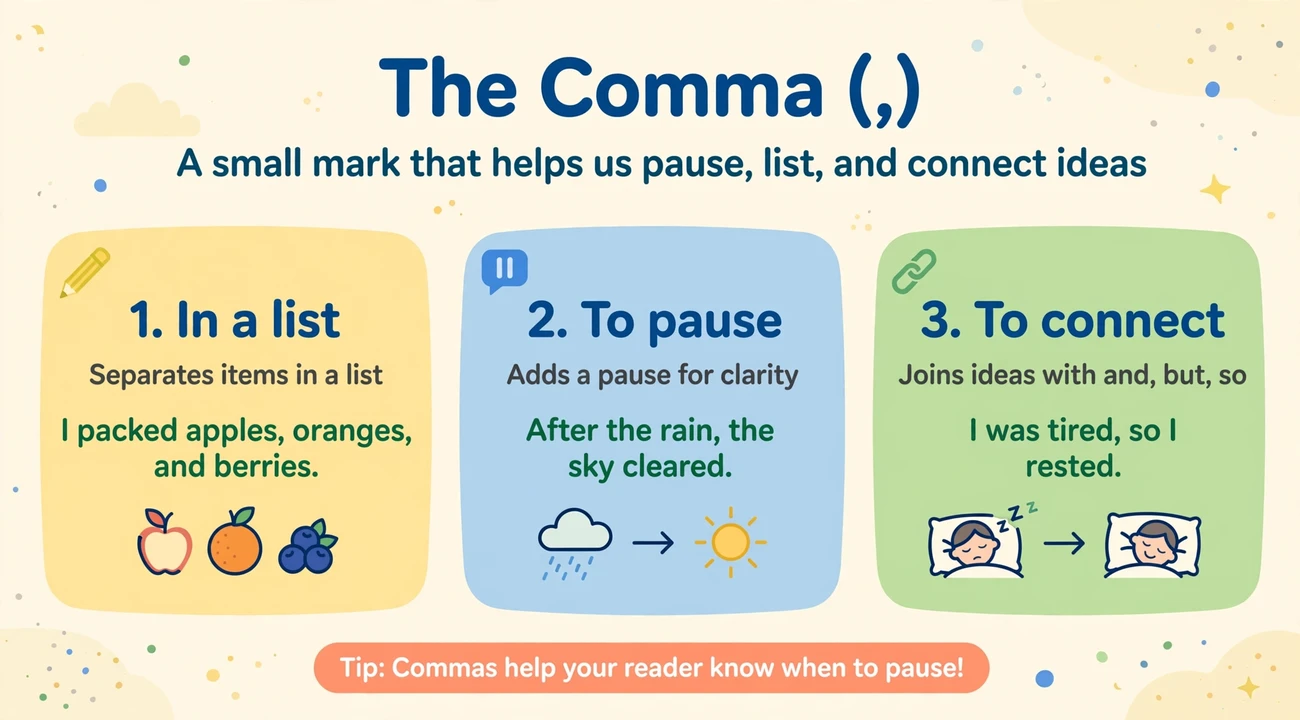
A comma is a small mark like a tiny tail: (,). It tells the reader to pause and shows how a sentence fits. Learning comma rules starts with one clear idea: a comma is a helper, not a decoration.
A comma has three jobs. It separates things, like items in a list. It adds a pause, like after an intro word. And it connects ideas with and or but.
- Separate: pens, books, and bags.
- Pause: Well, let us start.
- Connect: I studied, and I passed.
For the full history, see Comma on Wikipedia. For one special comma, read our Oxford Comma guide.
8 Simple Comma Rules

These 8 comma rules cover almost every comma you will ever need.
Rule 1: Use Commas in Lists
Put a comma between items in a list of three or more.
- I bought apples, oranges, and bananas.
- She speaks English, Urdu, and French.
- We need pens, books, and bags.
Rule 2: Use a Comma Before FANBOYS
FANBOYS means for, and, nor, but, or, yet, so. Put a comma before one of these words between two full sentences.
- I was tired, so I went to bed.
- She studied hard, and she passed.
- He wanted to play, but it rained.
Both sides must be full sentences. This is one of the most tested comma rules in exams.
Rule 3: Use a Comma After an Intro Word
Put a comma after a short intro word or phrase.
- After lunch, we went for a walk.
- Yes, I agree with you.
- However, we still need time.
Rule 4: Use Commas Around Extra Information
Some words are extra — the sentence works without them. Put commas around them.
- Sara, my best friend, loves books.
- My brother, who lives in Lahore, is a doctor.
- Ali, the tallest boy, won.
No commas if the detail is needed. See also our Who vs Whom guide.
Rule 5: Use Commas with Names
Put a comma around the name when you speak to someone.
- Ali, please open the door.
- Thank you, Sara, for your help.
- Mom, can I go out to play?
Hence “Let’s eat, Grandma!”
Rule 6: Use Commas in Dates and Addresses
Put a comma after the day and the year, and between the city and the country.
- We met on June 1, 2026.
- She was born on March 5, 2010.
- He lives in Lahore, Pakistan.
With only a month and a year, no comma: “June 2026.”
Rule 7: Use a Comma Before Quotes
Put a comma before the quote when the sentence leads in with said or asked.
- She said, “I am ready.”
- He asked, “Where are we going?”
- The teacher said, “Well done.”
If the quote comes first, the comma goes inside.
Rule 8: Never Join Two Sentences with Only a Comma
Two full sentences joined by only a comma is a comma splice. It is always wrong.
- Wrong: I was tired, I went to bed.
- Right: I was tired, so I went to bed.
- Right: She loves tea. She drinks it daily.
Fix it with so, a full stop, or a semicolon.
The 2-Second Comma Trick
Still not sure where a comma goes? Use this comma rules trick. It takes only two seconds.
Step 1: Read the sentence aloud, slowly.
Step 2: Mark each place where you pause for a short breath.
Step 3: Is the pause a list, an intro, or a name? Then a comma belongs there. If it joins two full sentences, add a joining word or a full stop.
Try it: “I bought apples oranges and bananas” needs commas. “After lunch we went for a walk” needs one after “lunch.”
This trick works in essays, emails, and exams.
40 Comma Rules Examples
Here are 40 simple examples.
Lists (1–10):
- I need pens, books, and bags.
- She bought milk, bread, and eggs.
- We visited Paris, Rome, and Madrid.
- The box has red, blue, and green balls.
- He likes tea, coffee, and juice.
- My friends are Ali, Sara, and Bilal.
- The shop sells shirts, pants, and shoes.
- We saw lions, tigers, and bears.
- She plays piano, guitar, and violin.
- I want rice, chicken, and salad.
Joining sentences (11–20):
- I was hungry, so I ate.
- She ran fast, but she missed the bus.
- He is rich, yet he lives simply.
- You can call me, or send a text.
- It was cold, so we stayed inside.
- I like tea, and he likes coffee.
- She tried hard, but she lost.
- He is tired, for he worked late.
- Study hard, and you will pass.
- I wanted to go out, but it rained.
Intro words and names (21–30):
- Well, let us start now.
- Yes, I will come to your party.
- However, the plan did not work.
- In the evening, we play cricket.
- After school, I do my homework.
- Sara, please bring your book.
- Thank you, teacher, for your help.
- Boys, listen to me carefully.
- Oh, I forgot my keys.
- First, wash your hands.
Dates, quotes and extra information (31–40):
- We met on July 4, 2025.
- She lives in Karachi, Pakistan.
- He said, “I will help you.”
- “Good morning,” the teacher said.
- My sister, who is a nurse, is here.
- The car, which is old, still runs.
- On May 10, 2024, we moved house.
- “Please sit down,” she said.
- Ahmed, my neighbour, is a good man.
- It is clear now — the comma rules are simple!
For more short sentences to practise with, read our collection of simple English sentences for learners.
Common Comma Mistakes
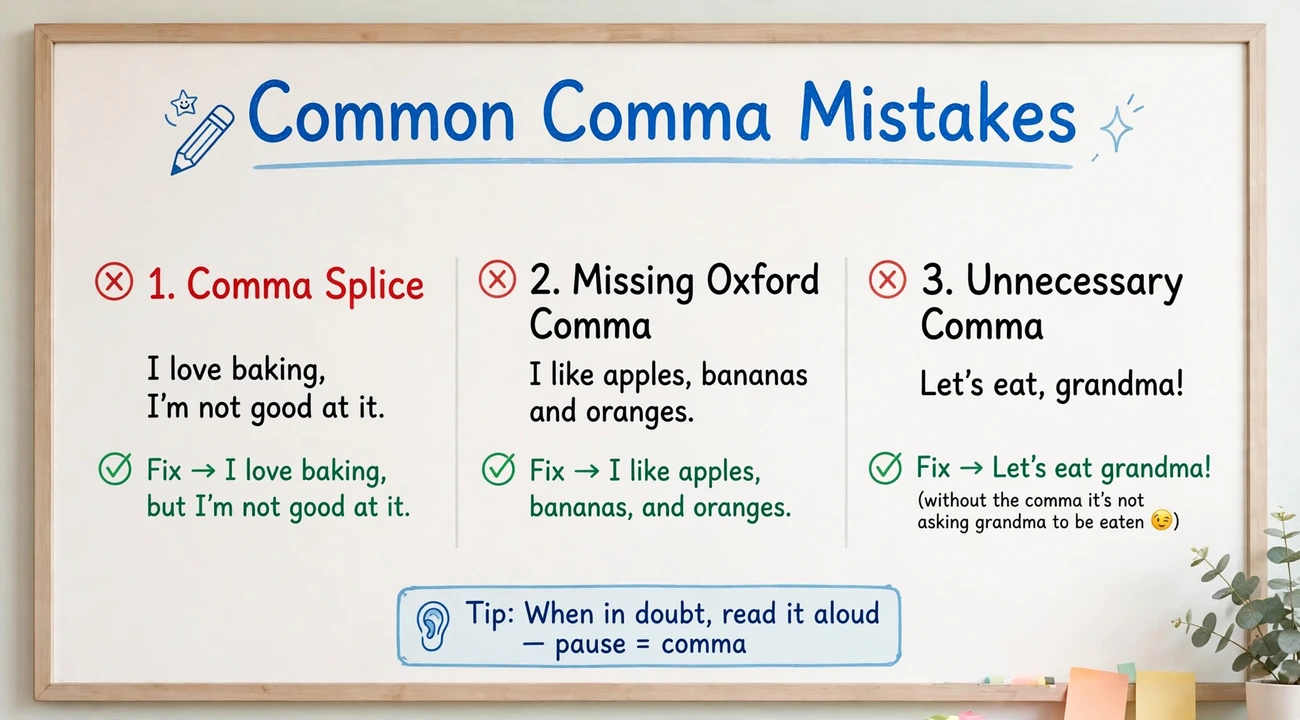
Even good writers break comma rules. Learn these four mistakes once.
Mistake 1: The comma splice.
Wrong: “I was tired, I went to bed.” Right: “I was tired, so I went to bed.”
Mistake 2: Missing comma in a list.
Wrong: “I bought apples oranges and bananas.” Right: “I bought apples, oranges, and bananas.”
Mistake 3: Comma between subject and verb.
Wrong: “The boy, went to school.” Right: “The boy went to school.”
Mistake 4: Comma after “because.”
Wrong: “I stayed home, because it was raining.” Right: “I stayed home because it was raining.”
For a full check of your writing, read our guide on how to check and fix your English grammar.
Quick Quiz: Test Your Comma Rules
Pick the correct sentence in each pair. This short comma rules quiz uses what you learned. Answers are below!
- a) I bought apples oranges and bananas. b) I bought apples, oranges, and bananas.
- a) After lunch we went for a walk. b) After lunch, we went for a walk.
- a) I was tired, I went to bed. b) I was tired, so I went to bed.
- a) Ali please open the door. b) Ali, please open the door.
- a) She said “I am ready.” b) She said, “I am ready.”
- a) We met on June 1 2026 at the park. b) We met on June 1, 2026, at the park.
- a) Sara my best friend loves books. b) Sara, my best friend, loves books.
Answers:
1. b (lists)
2. b (intro)
3. b (two sentences need more than a comma)
4. b (name)
5. b (quote)
6. b (year)
7. b (extra words)
7/7 — excellent! 5–6 — very good. Fewer than 5 — read the rules again.
Comma Rules: Quick Summary
| Rule | Remember | Example |
|---|---|---|
| Lists | Between items | Apples, oranges, bananas |
| Joining | Comma + and, but, so | I was tired, so I slept. |
| Intro words | After the intro | After lunch, we walked. |
| Extra words | On both sides | Sara, my friend, sings. |
| Names | Around the name | Ali, come here. |
| Dates | After day and year | June 1, 2026 |
| Quotes | Before the quote | She said, “Hello.” |
| Comma splice | Never alone | Use so, and, or a full stop |
Keep this comma rules summary near your desk. Next read: the Blue Book of Grammar and Punctuation. If you like word pairs, read our Its vs It’s guide next.
FAQs About Comma Rules
When do I use a comma?
Use a comma in lists, after intro words, around extra information, before and or but between two full sentences, and in dates. The simplest comma rules answer: if the reader needs a short pause, add a comma.
Do I need a comma before “and” in a list?
Yes. This final comma is the Oxford comma. It keeps lists clear, as in “I love my parents, Lady Gaga, and Humpty Dumpty.”
What is a comma splice?
It joins two full sentences with only a comma: “I was tired, I went to bed.” Fix it with so, a full stop, or a semicolon.
Do I need a comma after “because”?
No, not when because comes after the main sentence. Use one only when because starts the sentence. This is a good comma rules habit to learn early.
How many commas are too many?
There is no fixed number. Ask whether each comma does a job. If it does not separate, pause, or connect anything, leave it out.
Can I skip commas in short sentences?
Yes. “I went home.” and “She is happy.” are clear without one. A comma is a tool for clarity.
Conclusion
These 8 comma rules are smaller than they look. Lists, joining words, intro words, extra information, names, dates, quotes — and never a comma splice.
Practise these comma rules every day, and soon you will place commas without thinking. Use this guide again and again until the comma rules feel easy, and share it with a friend who also wants to write better English. Keep learning with GrammarLuck.
