

The future simple tense is one of the first verb forms you learn in English, and one of the most useful. We use it every day to talk about things that will happen later. In this guide, you will learn the rules, the uses, and the most common mistakes, all in simple English.
Here is the short answer. The future simple tense talks about an action that will happen later. You form it with will + the base verb — I will go, she will call, and they will win.
In this complete guide, you will learn what the future simple tense is, when to use it, the 5 simple rules, 50 clear examples, the most common mistakes, and a quick quiz. By the end, you will use it with full confidence.
Future Simple Tense: The Quick Answer
See will, shall, and won’t side by side.
| Form | Example |
|---|---|
| will + base verb | I will help you. |
| shall + base verb | We shall meet at noon. |
| will not / won’t | She won’t be late. |
The golden rule: if you decide now, promise something, or guess what will happen, use will + the base verb.
What Is the Future Simple Tense?
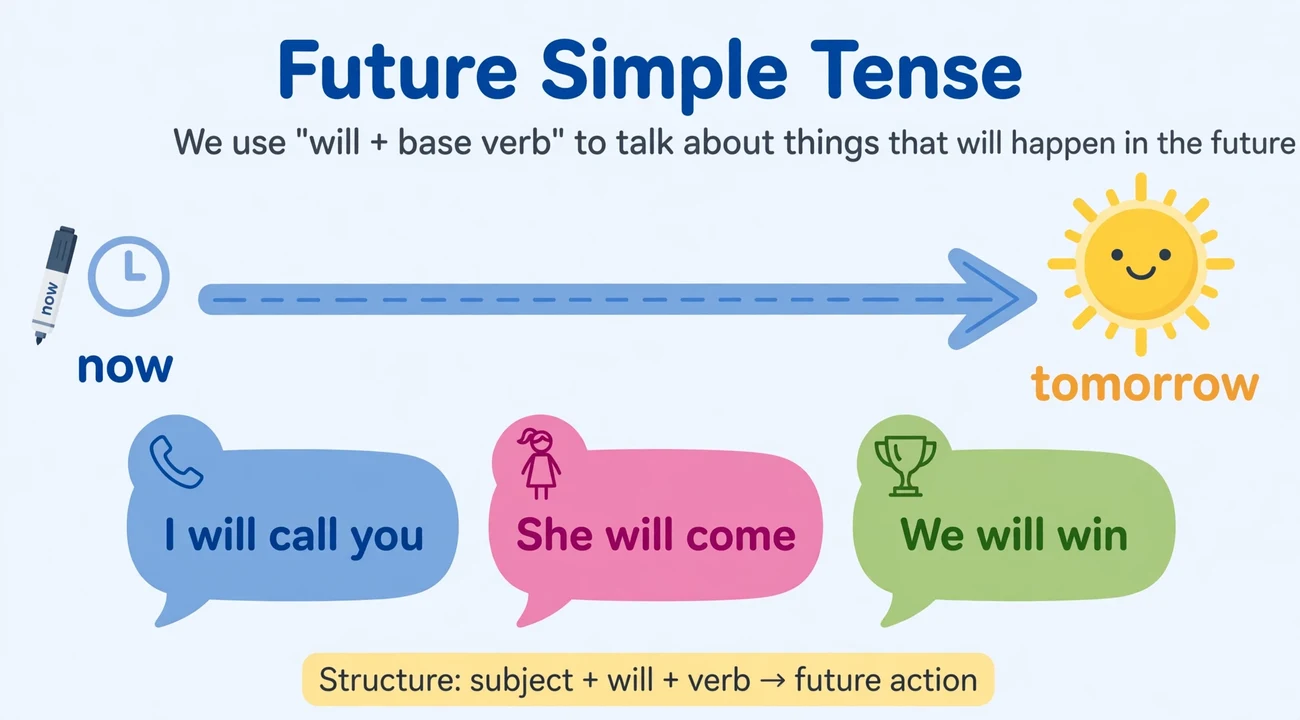
The future simple tense is the verb form for actions that will happen after now. The action has not happened yet — it sits in the future.
- I will call you tomorrow.
- She will visit us next week.
- They will win the match.
In every sentence, the time is in the future and the action is still to come — that is the heart of the future simple tense.
First, see how the present works in our present simple tense guide.
When Do We Use the Future Simple Tense?
We use it in five common situations.
1. Quick Decisions
We use will when we decide at the moment of speaking, with no plan made before.
- I will take the last seat.
- We will order pizza.
2. Promises
We use will to make a promise.
- I will help you.
- She will call you back.
3. Predictions
We use will to say what we think will happen, often with I think or probably.
- It will rain tomorrow.
- Our team will win the cup.
4. Facts About the Future
We use will for facts about the future, like age, dates, and times.
- I will be 20 next month.
- The train will leave at 9.
5. Offers and Help
We use will to offer help, often as a question.
- I will carry your bag.
- Shall I open the window?
It also works in the passive voice — see our active vs passive voice guide.
How to Form the Future Simple Tense: A Quick Memory Trick
Here is a two-second trick. Ask yourself: “Did I plan this before, or am I deciding now?” If you are deciding now, use will. If the plan was made before, use going to.
To form it, take will + the base verb: I will go, you will go, he will go, and they will go. The verb never changes after will — no -s, no -ed, and no -ing.
The future simple tense stays the same for every person: I will, you will, he will, she will, we will, and they will. There is no -s for he or she.
5 Simple Future Simple Tense Rules

These five rules cover almost every sentence you will write.
Rule 1: Use Will + the Base Verb
Put will before the base verb, and never change the verb after will.
- go → will go
- play → will play
- watch → will watch
Rule 2: Use Shall with I and We
Shall is the old, polite form of will, used with I and we, mostly in questions and offers.
- I shall wait for you.
- Shall we start now?
- We shall see you tomorrow.
Rule 3: Make Negatives with Won’t
For a negative, use will not, or the short form won’t, before the base verb.
- I will not stay late.
- She won’t come to the party.
- They won’t win this time.
Rule 4: Make Questions with Will First
For a question, put Will at the start, then the subject, then the base verb.
- Will you help me?
- Will she call tonight?
- Will they arrive on time?
Rule 5: Never Change the Spelling
There are no spelling changes here. The base verb stays the same after will, shall, and won’t.
| Base Verb | After Will | Example |
|---|---|---|
| study | will study | I will study tonight. |
| try | will try | She will try again. |
| stop | will stop | He will stop at noon. |
The form does not change with he, she, or it — see our subject-verb agreement guide.
Future Simple Tense vs Going To vs Present Continuous
The difference is simple: will is for a quick decision or a guess, going to is for a plan made before, and the present continuous is for a fixed plan with a time and place.
| Future Simple (quick decision) | Going To (plan made before) | Present Continuous (fixed plan) |
|---|---|---|
| I will help you. | I am going to help you. | I am helping you tomorrow. |
| She will call tonight. | She is going to call tonight. | She is calling at 8 p.m. |
| We will visit them. | We are going to visit them. | We are visiting them on Sunday. |
Quick decisions point to will, plans made before point to going to, and fixed plans with a set time point to the present continuous.
Compare it with the past in our past simple tense guide.
50 Future Simple Tense Examples
Here are 50 examples with the future simple tense in action. The first 30 are affirmative, the next 10 are negative, and the last 10 are questions.
- I will call you tomorrow.
- She will visit friends next week.
- They will play cricket Sunday.
- He will open the shop.
- We will eat lunch at home.
- Ali will study for his test.
- Sara will cook dinner.
- The train will leave on time.
- My father will work late.
- I will buy a new phone.
- She will read a new book.
- He will take the bus to work.
- We will watch a film tonight.
- They will come to my party.
- I will write a letter to my friend.
- She will wear a red dress.
- The teacher will teach a song.
- He will give a talk.
- We will drink tea.
- I will meet Ali.
- She will try a new recipe.
- The children will carry bags.
- We will plan a trip.
- He will drop the parcel.
- I will stop at the shop.
- She will smile at the gift.
- They will dance at the wedding.
- I will live in a big city.
- We will travel to London next year.
- He will finish his work soon.
- I will not watch TV tonight.
- She will not work tomorrow.
- They will not play today.
- He will not eat fast food.
- We will not travel.
- I won’t be late for class.
- She won’t like the cold weather.
- He won’t forget your birthday.
- They won’t win today.
- We won’t wait for long.
- Will you see the film tonight?
- Will she call you tomorrow?
- Will they finish on time?
- Will he buy the tickets?
- Will we meet Ali next week?
- Will you enjoy the party?
- Will she come today?
- Will it rain tomorrow?
- Will they help us with the move?
- Will you write to me soon?
For more everyday sentences, see our 100 English sentences collection.
For more on the history and forms of this tense, see the Future tense on Wikipedia page.
Common Future Simple Tense Mistakes
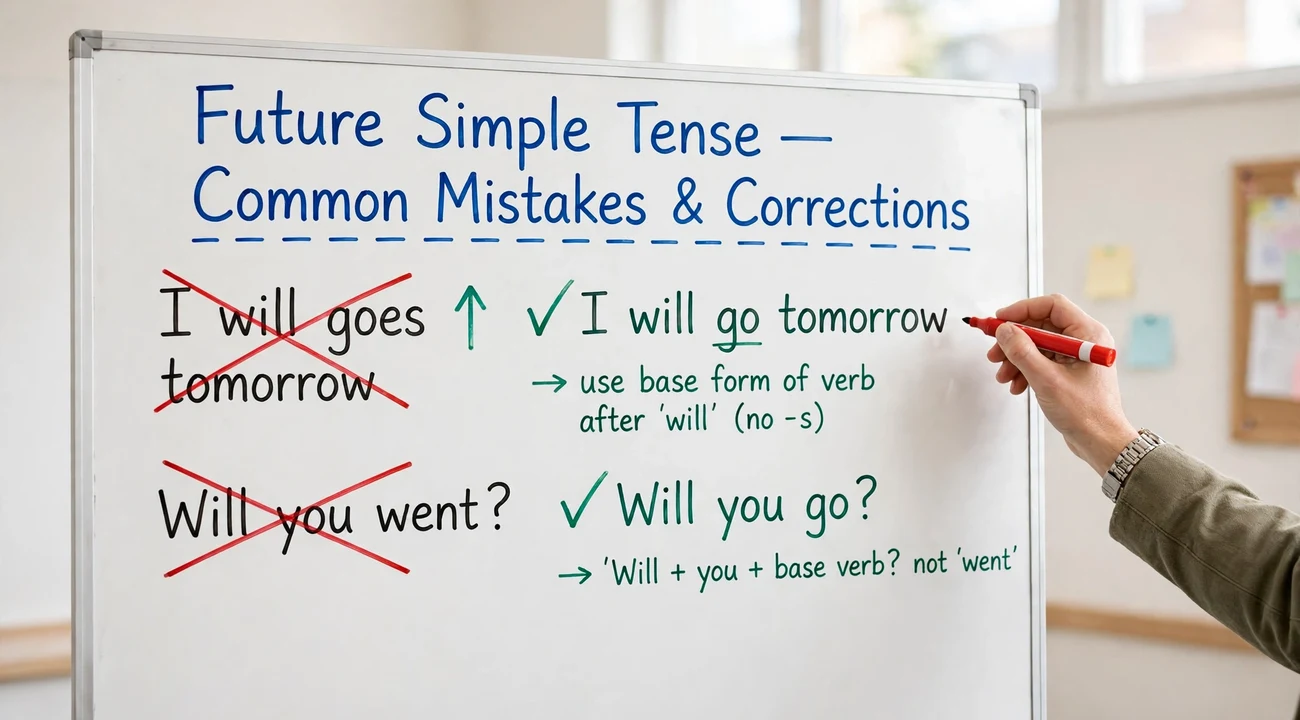
Even good learners make these mistakes.
Mistake 1: Adding -s or -ed after will.
Wrong: “She will goes to school.” Right: “She will go to school.” After will, the verb stays in its base form.
Mistake 2: Using will with going to in one sentence.
Wrong: “I will going to help you.” Right: “I will help you.” Use will or going to, never both at once.
Mistake 3: Using will for a fixed plan.
Wrong: “I will meet Ali at 5 p.m. — we fixed it last week.” Right: “I am meeting Ali at 5 p.m.” A fixed plan with a set time takes the present continuous, not will.
Mistake 4: Putting will after the subject in a question.
Wrong: “You will help me?” Right: “Will you help me?” In a question, Will comes first, before the subject.
Mistake 5: Using shall with he, she, or they.
Wrong: “He shall come tomorrow.” Right: “He will come tomorrow.” Shall is for I and we only, not for he, she, or they.
Write short, clear sentences — see our types of sentences guide.
Quick Quiz: Test Your Future Simple Tense
Choose the correct future simple tense form. Answers are at the end — no peeking!
- Tomorrow, I ___ (go) to the market.
- She ___ (call) you tonight.
- They ___ (not / come) to the party.
- ___ you ___ (help) me with this bag?
- He ___ (be) 20 next month.
- We ___ (watch) a film tonight.
- It ___ (rain) tomorrow, I think.
- Ali ___ (buy) a new bike soon.
Answers:
1. will go
2. will call
3. will not come
4. Will / help
5. will be
6. will watch
7. will rain
8. will buy
How did you do? 8/8 — excellent! 6–7 — very good. Fewer than 6 — read the 5 rules once more.
Future Simple Tense: Quick Summary
| Point | How It Works |
|---|---|
| Use | Actions that will happen later |
| Form | will + base verb |
| Shall | Only with I and we |
| Negative | will not / won’t + base verb |
| Question | Will + subject + base verb |
| Time words | tomorrow, next week, soon, next year |
A quick decision, a promise, or a prediction means the future simple tense. Keep this summary near your desk.
FAQs About the Future Simple Tense
What is the future simple tense in simple words?
It is the verb form for actions that will happen later, like “I will go” and “She will call.”
How do I form the future simple tense?
Use will + the base verb: go becomes will go. For negatives, use will not or won’t + the base verb; for questions, Will + subject + base verb.
What is the difference between the future simple tense and going to?
The future simple tense is for quick decisions and guesses, like “I will help you.” Going to is for plans made before, like “I am going to help you.”
When do we use shall?
We use shall with I and we, mostly in polite questions and offers, like “Shall we start?”
What is the short form of will not?
The short form is won’t: “She will not come” becomes “She won’t come.”
Is the future simple the same as the simple future?
Yes. They are two names for the same tense.
Conclusion
The future simple tense is simple once you know the pattern: will + the base verb. Quick decisions, promises, and guesses all take will.
Practise a little every day, and the future simple tense will soon feel natural. Keep learning with GrammarLuck — grammar made simple.
