


The present perfect tense is one of the most useful tenses in English. It talks about the past, but it keeps one foot in the present. When you say “I have finished my homework,” the action happened in the past, but the result matters now — the homework is done. In this guide, you will learn the form, the rules, and the small words that make it easy.
Many learners mix up this tense with the past simple. They say “I have seen him yesterday” — and it sounds wrong to a careful reader. The good news is that the difference is simple once you see it. The past simple talks about a finished time. This tense talks about a past action that still touches the present.
In this complete guide, you will learn the meaning, the form, 5 simple rules, a 2-second trick, 40 clear examples, the most common mistakes, and a quick quiz. By the end, you will use this tense with confidence in exams, emails, and everyday English.
Present Perfect Tense: The Quick Answer
The fastest way to understand it is to see it next to the past simple.
| Tense | When to use it | Example | Time words |
|---|---|---|---|
| Present perfect tense | Past action with a present result | I have finished my homework. | just, already, yet, ever, never |
| Past simple | Finished action at a finished time | I finished my homework yesterday. | yesterday, last week, ago |
The golden rule: use this tense when the time is not finished or the exact time does not matter. Use the past simple when the time is finished and you know when it happened. “I have lived here for five years” — I still live here. “I lived here in 2015” — that time is over. For a full refresher on the other side of this pair, read our guide to the past simple tense.
What Is the Present Perfect Tense?
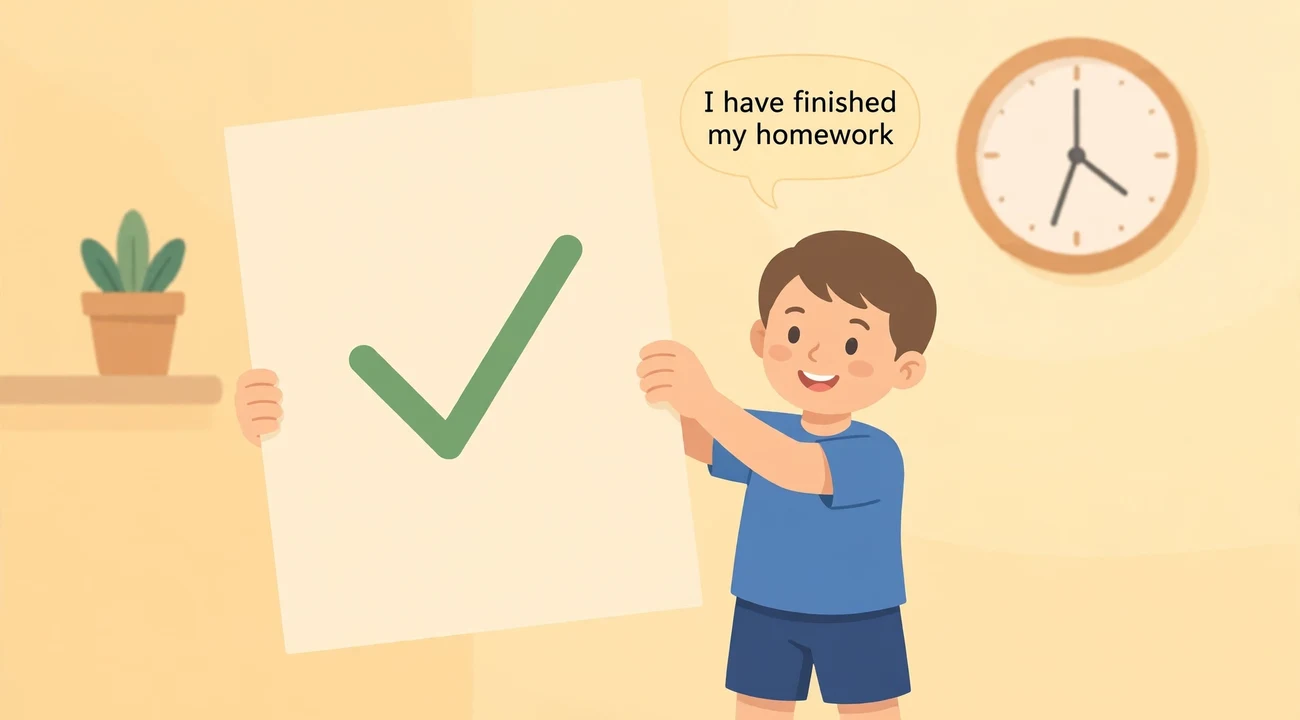
This tense connects the past with the present. It is used for actions that started in the past and still matter now.
Look at two sentences: “I have lost my keys.” The keys are still lost now. “She has broken her arm.” Her arm is still broken now.
This tense is also used for life experience — things you have done at some time in your life, without saying when. “I have visited London.” “He has never tried sushi.”
The form is simple: have or has + past participle (the third form of the verb). Use have with I, you, we, and they. Use has with he, she, and it.
| Subject | Form | Example |
|---|---|---|
| I / you / we / they | have + past participle | I have finished my work. |
| He / she / it | has + past participle | She has finished her work. |
The past participle of regular verbs ends in -ed: finished, lived, watched. Irregular verbs have their own forms: gone, seen, eaten, written, done. Have and has must agree with the subject, so if you are not sure about this part, read our guide to subject-verb agreement. If you are still learning the basic tenses, start with our guide to the present simple tense first.
5 Simple Present Perfect Tense Rules
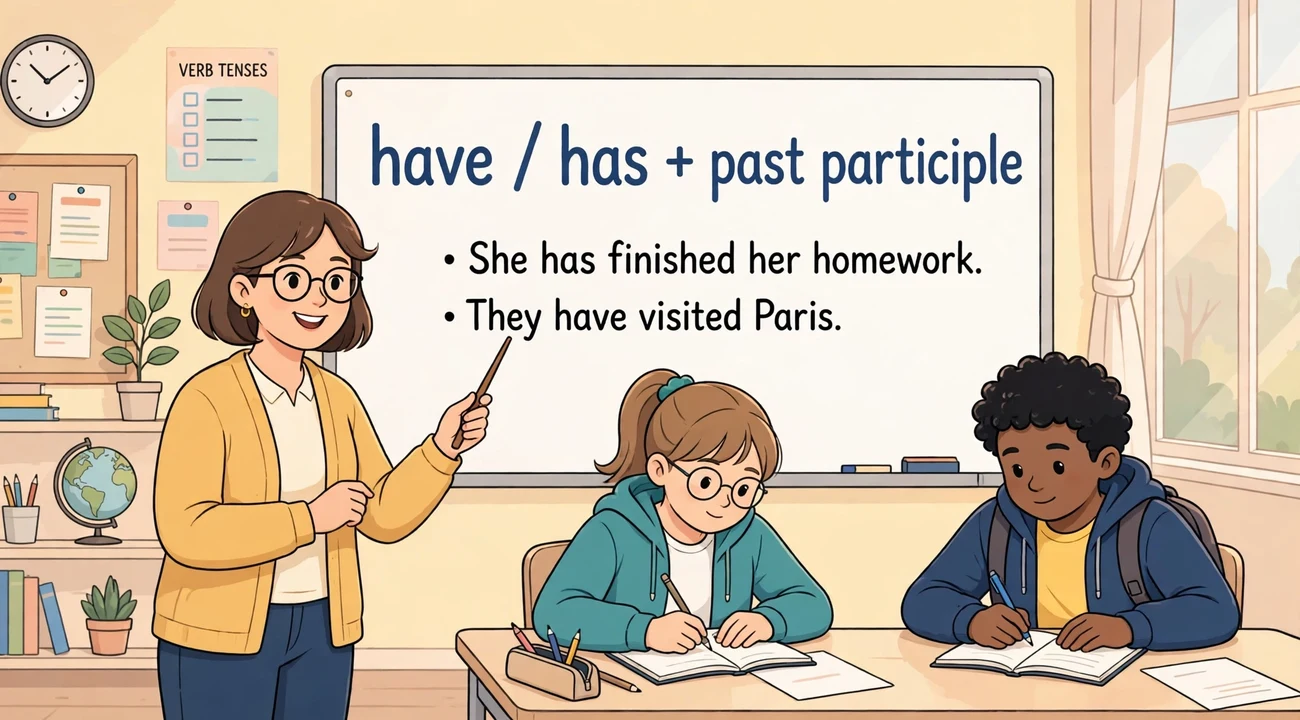
Rule 1: Use It for a Past Action with a Present Result
When a past action has a result that is still true now, use this tense.
- I have broken my phone, so I cannot call you.
- She has lost her wallet, so she is upset.
Rule 2: Use It for Life Experience with Ever and Never
Use this tense to talk about things you have done in your life, without saying when. The words ever and never often appear in these sentences.
- Have you ever ridden a horse?
- I have never seen snow.
Rule 3: Use It for Unfinished Time (Today, This Week, This Year)
When the time is still going on, use this tense. Today is not over yet, and neither is this week.
- I have read two books today.
- We have had three meetings this week.
Rule 4: Use It for Recent Actions with Just, Already, and Yet
The words just, already, and yet are close friends of this tense. Just means a very short time ago, already means sooner than expected, and yet is used in questions.
- They have just left the office.
- I have already finished my lunch.
- Have you done your homework yet?
Rule 5: Use Since for a Point in Time and For for a Period of Time
Since is used with a point in time, when something started. For is used with a period of time, how long it lasted.
- I have known him since 2018. (2018 is a point in time.)
- I have known him for eight years. (Eight years is a period of time.)
The 2-Second Present Perfect Tense Trick
Still not sure which tense to use? Ask yourself one question: “Is the time finished?” This trick takes only two seconds.
Step 1: Look for a finished time word, like yesterday or last week.
Step 2: If you find one, use the past simple.
Step 3: If not, use this tense.
Try the trick on these sentences:
- “I have seen that film.” — No time word, so this tense is right. ✅
- “I saw that film yesterday.” — Yesterday is a finished time, so the past simple is right. ✅
Keep this trick in mind during exams and emails, and the choice will soon feel natural.
40 Present Perfect Tense Examples
Here are 40 simple examples, grouped by use.
A present result:
- I have finished my homework.
- She has lost her keys.
- They have just arrived at the airport.
- He has broken his leg.
- We have cleaned the house.
- The baby has fallen asleep.
- I have bought a new phone.
- She has cooked dinner for us.
- It has stopped raining at last.
- They have painted the room white.
Life experience:
- Have you ever flown in a plane?
- I have never eaten sushi.
- She has visited London twice.
- He has worked in three countries.
- We have watched that film before.
- Have you ever met a famous person?
- I have read all of her books.
- They have lived in five cities.
- She has tried scuba diving once.
- He has never driven a car.
Unfinished time:
- I have read two books today.
- We have had three tests this week.
- She has already finished her work.
- They have just left the house.
- Have you seen my bag yet?
- I have not slept well this week.
- He has scored two goals today.
- We have met four new students this month.
- She has called me twice today.
- It has been a busy morning.
Since and for:
- I have lived here since 2019.
- She has worked here for six years.
- They have known each other since school.
- We have waited for two hours.
- He has played football since childhood.
- It has rained for three days.
- I have had this bike since my birthday.
- She has studied English for four years.
- They have owned this shop since 2015.
- We have been friends for a long time.
You can also use this tense in the passive voice. Learn how that works in our guide to active vs passive voice. For more trusted reading, the Grammarly guide to the present perfect tense explains the same rules with more examples.
Common Present Perfect Tense Mistakes
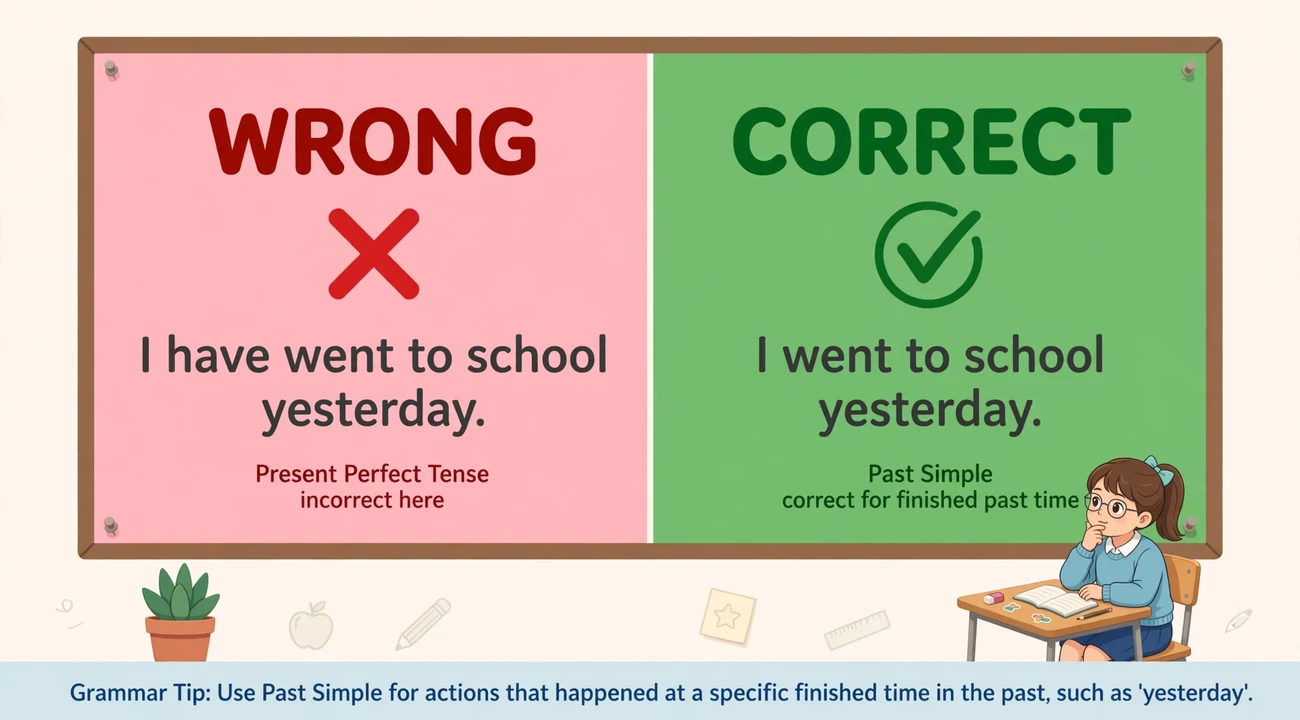
Even good learners make these mistakes — learn them once and avoid them forever.
Mistake 1: Using it with a finished time word.
Wrong: “I have met him last week.” Right: “I met him last week.” Last week is finished time.
Mistake 2: Using the past simple with yet.
Wrong: “Did you finish your homework yet?” Right: “Have you finished your homework yet?” The word yet needs the present perfect tense in questions.
Mistake 3: Mixing up have and has.
Wrong: “She have finished her work.” Right: “She has finished her work.” He, she, and it take has.
Mistake 4: Using the wrong past participle.
Wrong: “I have went to London.” Right: “I have gone to London.” Gone and eaten are the past participles of go and eat.
The best way to stop making these mistakes is daily practice. Try our free grammar exercises and test yourself every day.
Quick Quiz: Present Perfect Tense
Fill in the correct form — answers are below!
- I ___ (finish) my homework.
- She ___ never ___ (be) to Paris.
- They ___ just ___ (arrive).
- We ___ (live) here since 2018.
- He ___ (lose) his keys.
- ___ you ever ___ (try) sushi?
- I ___ (see) that film yesterday.
- She ___ (work) here for three years.
Answers:
1. have finished
2. has, been
3. have, arrived
4. have lived
5. has lost
6. Have, tried
7. saw (past simple — yesterday!)
8. has worked
How did you do? 8/8 — excellent! 6–7 — very good. Fewer than 6 — read the trick once more and try again.
Present Perfect Tense: Quick Summary
| Use | Example | Time words |
|---|---|---|
| Present result | I have lost my keys. | just, already |
| Life experience | I have visited London. | ever, never, before |
| Unfinished time | I have read two books today. | today, this week, this year |
| Recent action | They have just arrived. | just, already, yet |
| Since and for | She has lived here for five years. | since 2020, for five years |
The present perfect tense feels hard for a week — then easy for life.
FAQs About the Present Perfect Tense
What is the present perfect tense in simple words?
The present perfect tense talks about a past action that still matters now. It is formed with have or has + the past participle, as in “I have finished my work.”
When do I use the present perfect tense and not the past simple?
Use the present perfect tense when the time is unfinished or the exact time does not matter, as in “I have lived here for five years.” Use the past simple when the time is finished, as in “I lived here in 2015.”
What is the difference between since and for in the present perfect tense?
Since is used with a point in time, as in “since 2018” or “since Monday.” For is used with a period of time, as in “for eight years” or “for five days.”
Can I use the present perfect tense with yesterday?
No. Yesterday is a finished time, so use the past simple: “I saw him yesterday,” not “I have seen him yesterday.” This is the most common mistake with the present perfect tense — use the 2-second trick to avoid it.
What are the time words for the present perfect tense?
The most common time words are just, already, yet, ever, never, since, for, today, this week, and this year. If you see one of them, the present perfect tense is often the right choice.
Is “I have went” correct?
No. Went is the past simple form of go. The past participle is gone, so the correct sentence is “I have gone to London.” Always use the past participle after have or has.
Conclusion
This tense is smaller than it looks. One form — have or has + past participle — covers a present result, life experience, and unfinished time. Remember the golden rule: finished time takes the past simple, and unfinished time takes the present perfect tense.
Practise with the examples and quiz in this guide, and soon you will choose the right tense without even thinking. You can also practise building these sentences in new forms with our guide to the types of sentences. For more simple lessons, keep learning with GrammarLuck.
