

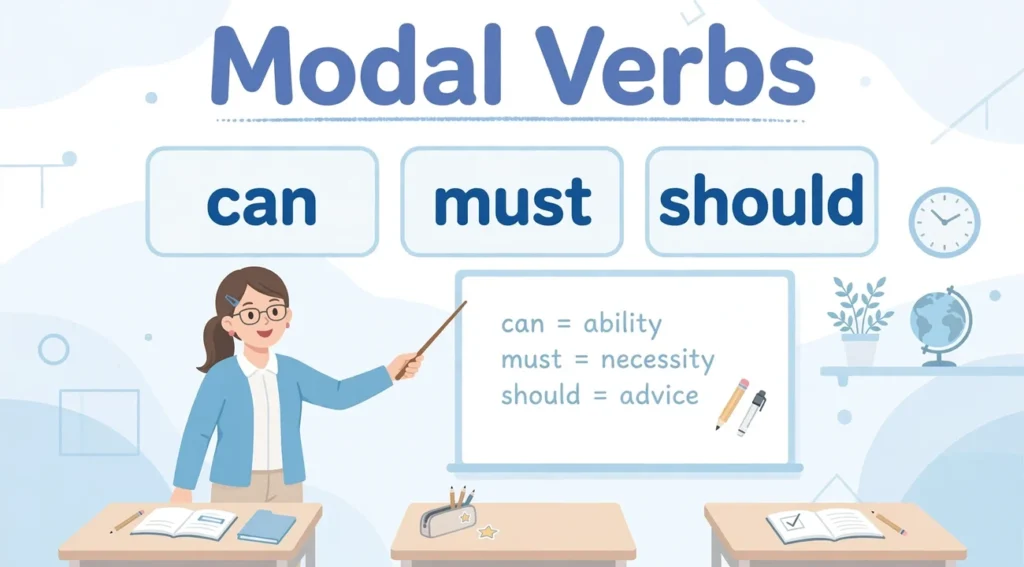
Modal verbs are small words with a big job. Words like can, could, must, should, may, might, will, would, and shall are modal verbs. They do not show an action by themselves. Instead, they change the meaning of the main verb. They help us talk about ability, permission, advice, duty, and possibility. In this guide, you will learn what they are, how to use them, and the mistakes to avoid.
Here is the short answer. Modal verbs always come before the main verb, and they never change their form. We say “She can swim,” not “She cans swim.” We say “They must go,” not “They musts go.” That one fact makes them easy to learn once you know the rules.
In this complete guide, you will learn their meaning, the 7 simple rules, a 2-second test, 40 clear examples, the most common mistakes, and a quick quiz. By the end, you will use them with full confidence.
Modal Verbs: The Quick Answer
The fastest way to understand them is to see them side by side. This table shows the nine main ones and one short example for each.
| Modal Verb | Main Use | Example |
|---|---|---|
| can | Ability | I can swim very well. |
| could | Past ability, request | Could you help me, please? |
| may | Permission, possibility | You may sit here. |
| might | Possibility | It might rain today. |
| must | Duty, strong rule | You must stop at a red light. |
| should | Advice | You should drink more water. |
| will | Future, promise | I will help you. |
| would | Polite request, wish | Would you like some tea? |
| shall | Formal future, offer | Shall we start now? |
The most useful ones in daily English are can, could, must, should, and will. Learn these five well, and you can build most of the sentences you need.
What Are Modal Verbs?
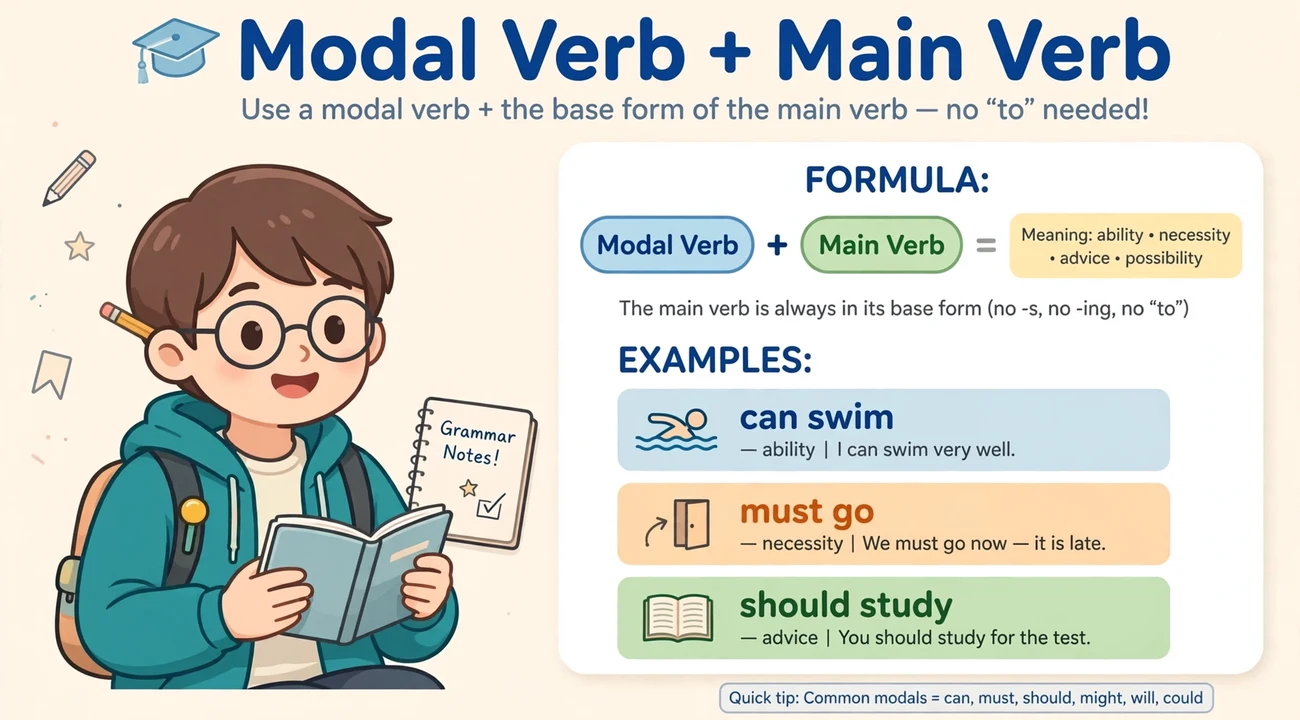
Modal verbs are a special group of helping verbs. A helping verb works with a main verb to build a full sentence. In “She can swim,” can is the modal verb and swim is the main verb.
They never take -s, -ed, or -ing at the end. We never say “cans,” “musted,” or “shoulding.” The form stays the same for every person: “I can,” “He can,” “She can,” “They can.” That makes modal verbs much easier than normal verbs, which change with the subject.
The nine core ones are can, could, may, might, must, shall, should, will, and would. They always work with a main verb, and they always come before it. To revise the basics first, read our guide to verbs.
Each one has its own job. Can shows ability, may asks for permission, must shows a duty, should gives advice, and might shows a small chance. For a deeper look, see Wikipedia’s guide to English modal verbs.
The 2-Second Modal Verbs Test
Not sure if a word is a modal verb? Use this quick test. It takes only two seconds.
Step 1: Find the helping word that comes just before the main verb.
Step 2: Ask: does this word stay the same for he, she, it, and they?
Step 3: If the word never changes, it is a modal verb. If it changes, it is a normal verb.
Try the test on these sentences:
- “He can run.” / “They can run.” Can never changes.
- “She must go.” / “We must go.” Must never changes.
- “He goes to school.” / “They go to school.” The word changes, so it is a normal verb.
Memory trick: Think of the word MOOD. They show the mood of a sentence — what the speaker feels about the action. Can shows ability, may shows permission, might shows possibility, must shows duty, and should shows advice.
7 Simple Modal Verbs Rules

These seven rules cover almost everything you need to use them correctly. Learn them one by one.
Rule 1: Always Use the Base Form After a Modal Verb
After these verbs, always use the base form of the main verb — the plain form with no -s, -ed, or -ing. We say “She can swim,” not “She can swims.”
- He can play the guitar.
Rule 2: Never Add “To” After a Modal Verb
Never put to after them. We say “You must go,” not “You must to go.” The only exceptions are ought to and have to, which always keep their to.
Rule 3: The Form Never Changes
Their form never changes. They look the same with I, you, he, she, it, we, and they. This is very different from the present simple tense, where we add -s for he, she, and it.
- I can, you can, he can, she can, they can.
Rule 4: Put the Modal Verb First to Ask a Question
To make a question, put the modal verb before the subject: modal verb + subject + main verb. “You can swim” becomes “Can you swim?” See the types of sentences for more question forms.
- Can you help me, please?
- Should we leave now?
Rule 5: Add “Not” After the Modal Verb for Negatives
To make a negative sentence, add not right after the modal verb: subject + modal verb + not + main verb. “You must go” becomes “You must not go.”
- You must not smoke in this room.
Rule 6: Choose the Right Modal Verb for the Meaning
Each one has its own job, so pick the one that matches your meaning. Use can for ability, may for permission, must for a duty, should for advice, might for a small chance, and will for the future. For more on future plans, read our guide to the future simple tense.
- Ability: I can speak English.
Rule 7: Never Use Two Modal Verbs Together
English never uses two of them in one verb group. “You must can go” is wrong. “She should will come” is wrong.
- Wrong: You must can swim. Right: You must learn to swim.
40 Modal Verbs Examples
Here are 40 simple examples. The first 20 show ability, permission, and advice. The next 20 show possibility, duty, and the future.
Ability, permission, and advice:
- I can swim very well.
- She can speak three languages.
- They can play football.
- He could read at the age of four.
- We could see the sea from our room.
- You may sit here if you like.
- May I come in, please?
- Students may use the library.
- It might rain this evening.
- He might come to the party.
- You must finish your homework today.
- We must follow the school rules.
- You should drink more water.
- She should study every day.
- I will help you with your work.
- They will visit us next week.
- Would you like a cup of tea?
- I would love to learn French.
- Shall we start the lesson now?
- We shall meet again tomorrow.
Possibility, duty, and the future:
- You can call me any time.
- Birds can fly, but penguins cannot.
- Could you open the window, please?
- I could run very fast as a child.
- May I borrow your pen?
- It may snow in the hills tonight.
- She might be at home now.
- You might like this new book.
- Drivers must stop at a red light.
- You must not smoke in this room.
- We should be kind to animals.
- You should not waste your time.
- He will be here in ten minutes.
- I will not forget your kind help.
- Would you mind closing the door?
- She would visit her grandmother in summer.
- Shall I carry your bag for you?
- We shall win the match.
- You must wear a helmet on a bike.
- Children should respect their teachers.
Common Modal Verbs Mistakes
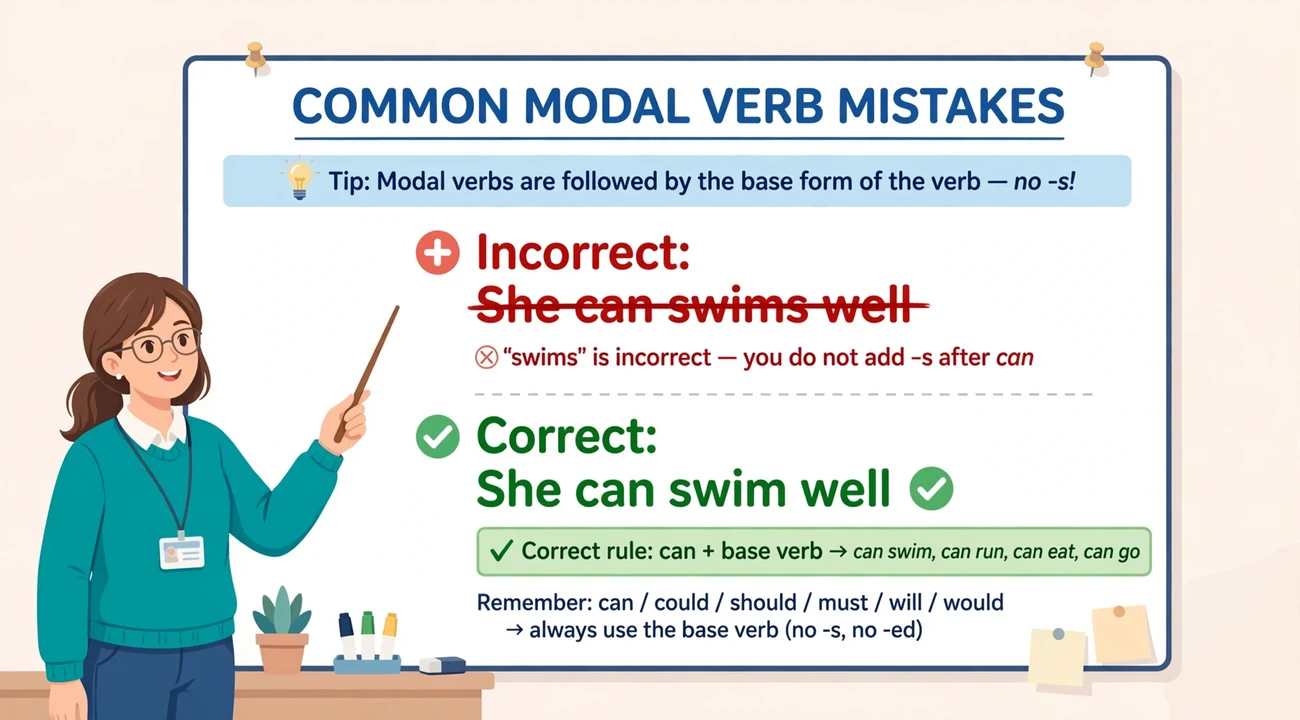
Even good learners make these mistakes. Learn them once and avoid them forever.
Mistake 1: Adding -s to a modal verb.
Wrong: “She cans swim.” Right: “She can swim.” They never take -s, not even with he, she, or it.
Mistake 2: Adding “to” after a modal verb.
Wrong: “You must to go now.” Right: “You must go now.” The only exceptions are ought to and have to.
Mistake 3: Using two modal verbs together.
Wrong: “You must can do it.” Right: “You must be able to do it.”
Mistake 4: Using “can” for a past ability.
Wrong: “When I was five, I can swim.” Right: “When I was five, I could swim.” Use could for past ability, not can.
Mistake 5: Mixing up must and should.
Wrong: “You must drink more water” (for simple advice). Right: “You should drink more water.” Must is a strong duty or rule; should is friendly advice. The same care with tone helps in active vs passive voice too.
Mistake 6: Forgetting “not” in negatives.
Wrong: “You must smoke here” (when smoking is not allowed). Right: “You must not smoke here.” One small word changes the whole meaning.
Quick Quiz: Modal Verbs
Choose the correct word for each sentence. Answers are at the end — no peeking! For more practice, try our free grammar exercises.
- I ___ swim very well. (a) can (b) cans (c) can to
- You ___ finish your work today. (a) should (b) shoulds (c) to should
- ___ you help me, please? (a) Must (b) Can (c) Cans
- She ___ speak English when she was five. (a) can (b) could (c) cans
- You ___ not smoke here. (a) must (b) musts (c) must to
- It ___ rain tomorrow. (a) mights (b) might (c) might to
Answers:
1. can (modal verbs never take -s)
2. should (it gives advice)
3. Can (it comes first)
4. could (past ability)
5. must (a strong rule)
6. might (a small chance)
How did you do? 6/6 — excellent! 4–5 — very good. Fewer than 4 — read the 7 rules once more and try again.
Modal Verbs: Quick Summary
| Point | Rule | Example |
|---|---|---|
| Form after the modal verb | Always the base form | She can swim. |
| “To” after the modal verb | Never (except ought to / have to) | You must go. |
| Change with he, she, it | Never changes | He can, they can. |
| Questions | Modal verb first | Can you help me? |
| Negatives | Modal verb + not | You must not smoke. |
| Two of them | Never together | You must be able to go. |
For students, writers, and bloggers, the answer is simple: learn the nine main modal verbs, use the base form after them, and never add -s or “to.”
FAQs About Modal Verbs
What are modal verbs in simple words?
Modal verbs are small helping verbs like can, could, must, should, may, might, will, would, and shall. They come before the main verb and show ability, permission, advice, duty, or possibility.
How many are there in English?
There are nine main ones: can, could, may, might, must, shall, should, will, and would.
Do modal verbs change with he, she, or they?
No. Modal verbs never change their form. We say “He can,” “She can,” and “They can.”
What comes after a modal verb?
Always the base form, with no “to” and no -s, -ed, or -ing. We say “She can swim,” not “She can swims” or “She can to swim.”
What is the difference between must and should?
Must shows a strong duty or rule: “You must stop at a red light.” Should shows friendly advice: “You should drink more water.”
Can we use two together?
No. English never uses two modal verbs in one verb group. “You must can go” is wrong. Say “You must be able to go” instead.
Conclusion
Modal verbs are small words, but they change a sentence in a big way. Can shows ability, may shows permission, must shows duty, should shows advice, and might shows possibility. The rules are simple: use the base form after them, never add -s or “to,” and never use two together.
Practise modal verbs every day with the examples and quiz in this guide, and soon you will choose the right word without even thinking. For more simple lessons, keep learning with GrammarLuck — grammar made simple.
