

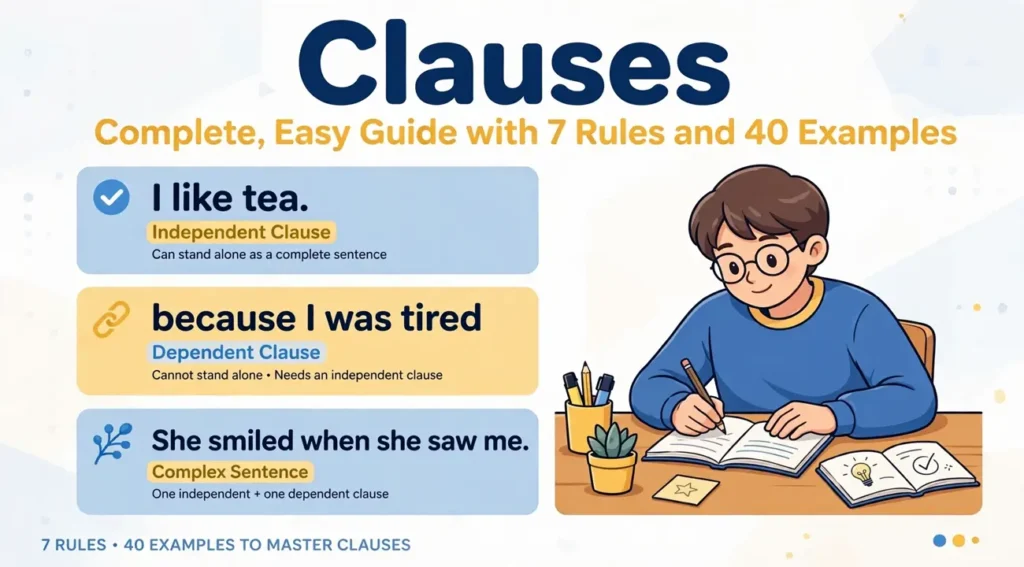
Every English sentence is built from clauses. A clause is a small group of words with a subject and a verb. Once you can spot them, English grammar becomes much easier to read, write, and fix.
Here is the short answer. An independent clause can stand alone as a full sentence. A dependent clause cannot stand alone — it needs an independent clause to finish the idea. That is the whole difference in one line.
In this complete guide, you will learn what clauses are, the two main types, three special kinds, 7 simple rules, a 2-second trick, 40 examples, the most common mistakes, and a quick quiz.

Clauses: The Quick Answer
The fastest way to understand the difference is to see the two types side by side.
| Type | Can it stand alone? | Example |
|---|---|---|
| Independent clauses | Yes — it is a full sentence | She finished her homework. |
| Dependent clauses | No — it needs a main clause | because she finished her homework |
The golden rule for clauses: If a group of words has a subject and a verb but cannot stand alone, it is a dependent clause. If it can stand alone, it is independent.
What Are Clauses?
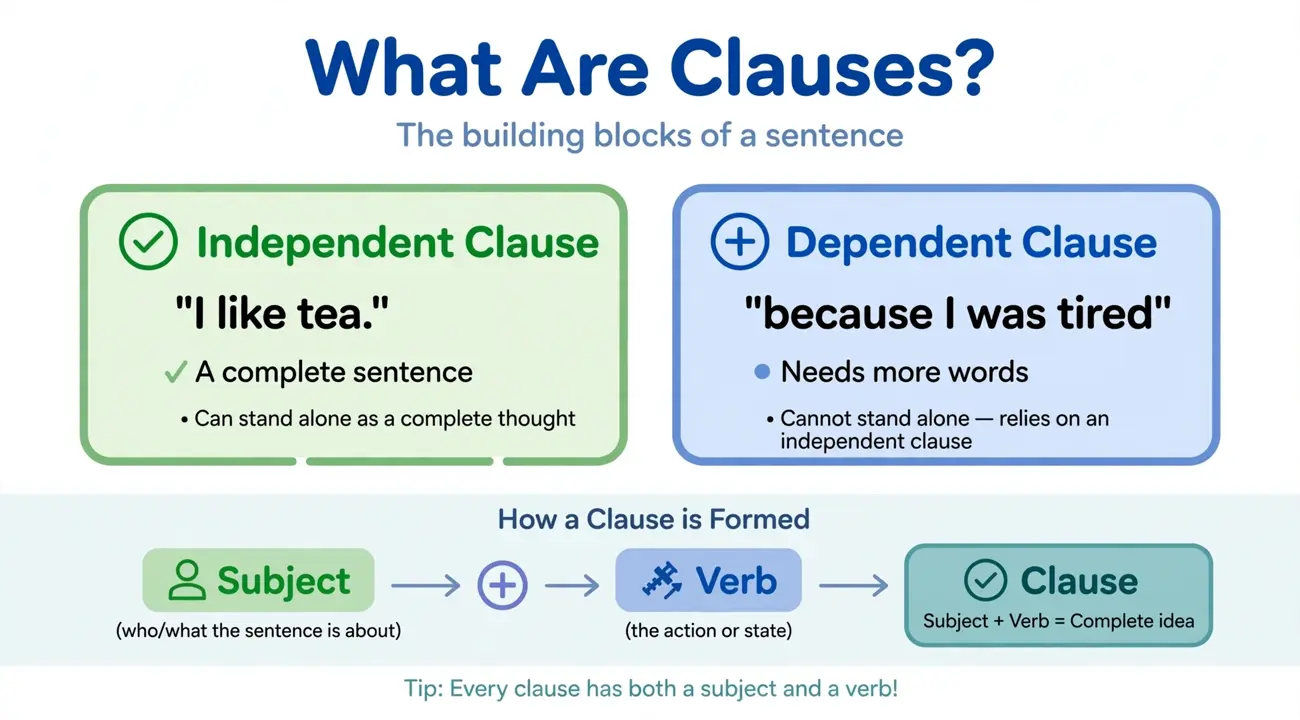
A clause is a group of words with two parts: a subject (who or what it is about) and a verb (what the subject does or is). A phrase is different — it has no subject and verb together. “In the morning” is a phrase, but “when the sun rose” is a clause.
There are two main kinds of clauses, and three special kinds that do the jobs of nouns, adjectives, and adverbs.
Independent Clauses
An independent clause has a subject and a verb, and it makes full sense on its own. It is also called a main clause.
- She reads a book every night.
- The train arrived on time.
- We watched a film and ate popcorn.
Each example above could be a full sentence by itself. That is the test: if you can put a full stop after it and it still makes sense, it is independent. Read more in our guide to types of sentences.
Dependent Clauses
A dependent clause also has a subject and a verb, but it does not make full sense on its own. It starts with a word like because, if, when, although, or that.
- because it was raining
- if you finish your work
- when the bell rings
None of these can be a sentence alone. Each one must join an independent clause: “We stayed inside because it was raining.” The joining words are called conjunctions.
Noun Clauses
A noun clause is a dependent clause that does the job of a noun. It can be the subject or the object of a sentence.
- What you said surprised me. (subject)
- I know that she is honest. (object)
- She asked whether the shop was open. (object)
Test it like this: if you can replace the whole clause with “it” and the sentence still works, it is a noun clause.
Adjective Clauses
An adjective clause is a dependent clause that describes a noun, just like an adjective does. It usually starts with who, whom, which, or that.
- The man who lives next door is a doctor.
- This is the book that I told you about.
- She wore the dress which her mother made.
The clause “who lives next door” tells us which man we mean — without it, we would not know.
Adverb Clauses
An adverb clause is a dependent clause that tells us when, where, why, or how something happens. It often starts with because, when, if, although, or while.
- We left early because the roads were busy. (why)
- Call me when you reach home. (when)
- If it rains, we will stay inside. (condition)
Groups that start with “if” show a condition — learn more in our guide to conditionals. An adverb clause can sit at the start or the end of a sentence.
7 Simple Clauses Rules
Rule 1: Every Clause Needs a Subject and a Verb
A group of words is only a clause if it has both a subject and a verb. “Running fast” is not a clause — it has no subject. “She runs fast” is a clause.
Rule 2: An Independent Clause Can Stand Alone
If a clause makes full sense on its own, it is independent. “The sun set” is a complete idea, and you can write it as a sentence.
Rule 3: A Dependent Clause Needs a Main Clause
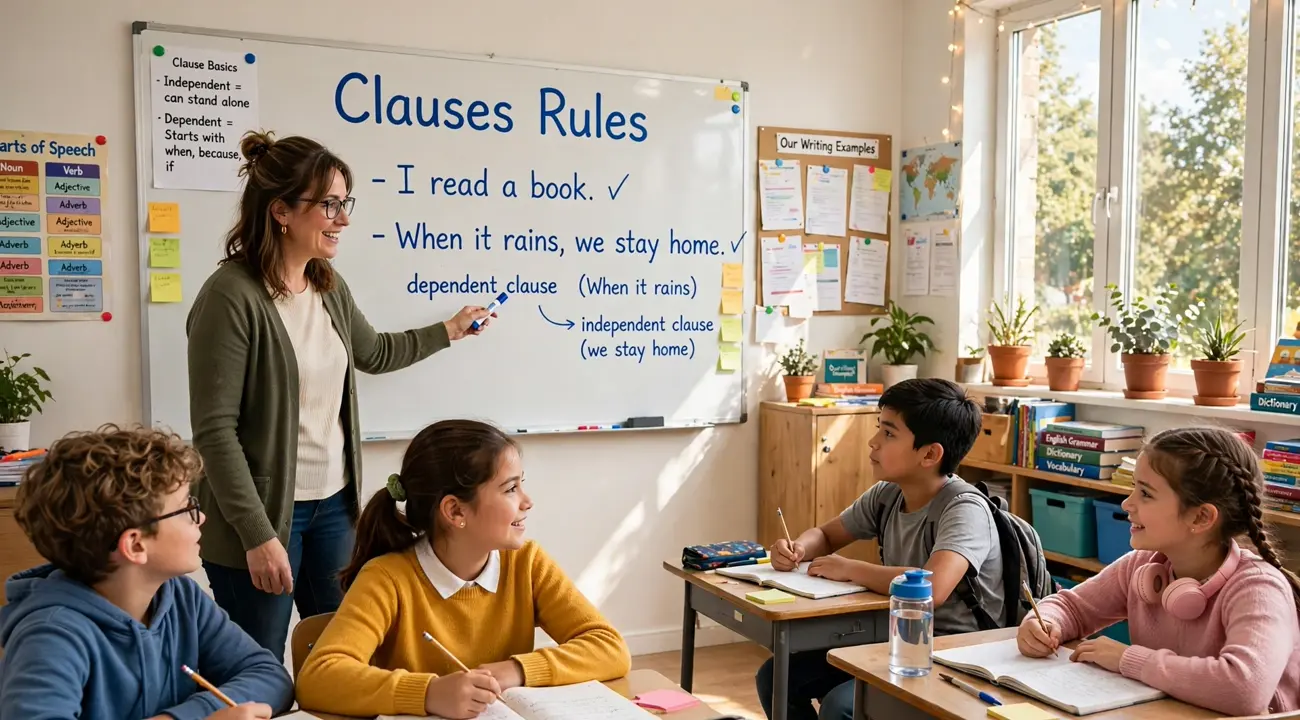
A dependent clause cannot be a sentence alone. Never write “Because I was late.” Join it to a main clause: “Because I was late, I missed the bus.”
Rule 4: Use a Comma After a Dependent Clause at the Start
When a dependent clause comes first, put a comma before the main clause: “When the rain stopped, we went outside.” When it comes last, you do not need a comma.
Rule 5: Match the Verb to the Subject in Every Clause
Each clause has its own subject, and the verb must match that subject. In “The boys who play football are my friends,” “are” matches “boys,” not “football.” This is the heart of subject-verb agreement.
Rule 6: Do Not Join Two Full Sentences with Only a Comma
Two full sentences joined by only a comma make a comma splice. Wrong: “It was late, we went home.” Right: “It was late, so we went home.”
Rule 7: A Clause Is Not the Same as a Phrase
A phrase has no subject and verb together, but a clause always has both. “In the garden” is a phrase, while “While she worked in the garden” is a clause. Our guide to prepositional phrases shows phrases that learners mix up with clauses.
The 2-Second Clauses Trick
Still not sure if a group of words is a clause? Use this 2-second trick. Step 1: Find the verb. Step 2: Ask “who or what does this verb?” — that is the subject. If you find both, you have a clause.
40 Clauses Examples
Here are 40 simple examples. The first 20 are independent clauses, and the next 20 are dependent clauses.
Independent (1–20):
- She finished her homework before dinner.
- The children played in the park all afternoon.
- My father drives to work every morning.
- The cat slept on the warm sofa.
- We bought fresh bread from the bakery.
- The teacher explained the lesson with a smile.
- Birds build their nests in tall trees.
- He fixed the broken chair in an hour.
- The river flows quietly through the valley.
- She wrote a long letter to her friend.
- The shop opens at nine every morning.
- They watched the stars from the roof.
- The old man walks slowly to the market.
- Our team won the match by two goals.
- The baby cried through the whole night.
- She sings sweet songs in the choir.
- The rain washed the dusty streets clean.
- He reads the news while drinking his tea.
- The students answered every question with care.
- Winter brings cold winds and short days.
Dependent (21–40):
- because she was tired
- if you come on time
- when the sun rises
- although it rained all day
- that he told me yesterday
- what she wants for lunch
- who lives in the old house
- which you bought last week
- while the children were sleeping
- before the train left the station
- after we finished the meal
- since he moved to the city
- unless you study every day
- as soon as the bell rings
- wherever you go in life
- though the road was long
- whenever she calls her mother
- until the work is done
- so that we can reach on time
- whether the shop is open today
For more reading, the Clause page on Wikipedia explains the same ideas with clear examples.
Common Clauses Mistakes
Even good writers make these mistakes.
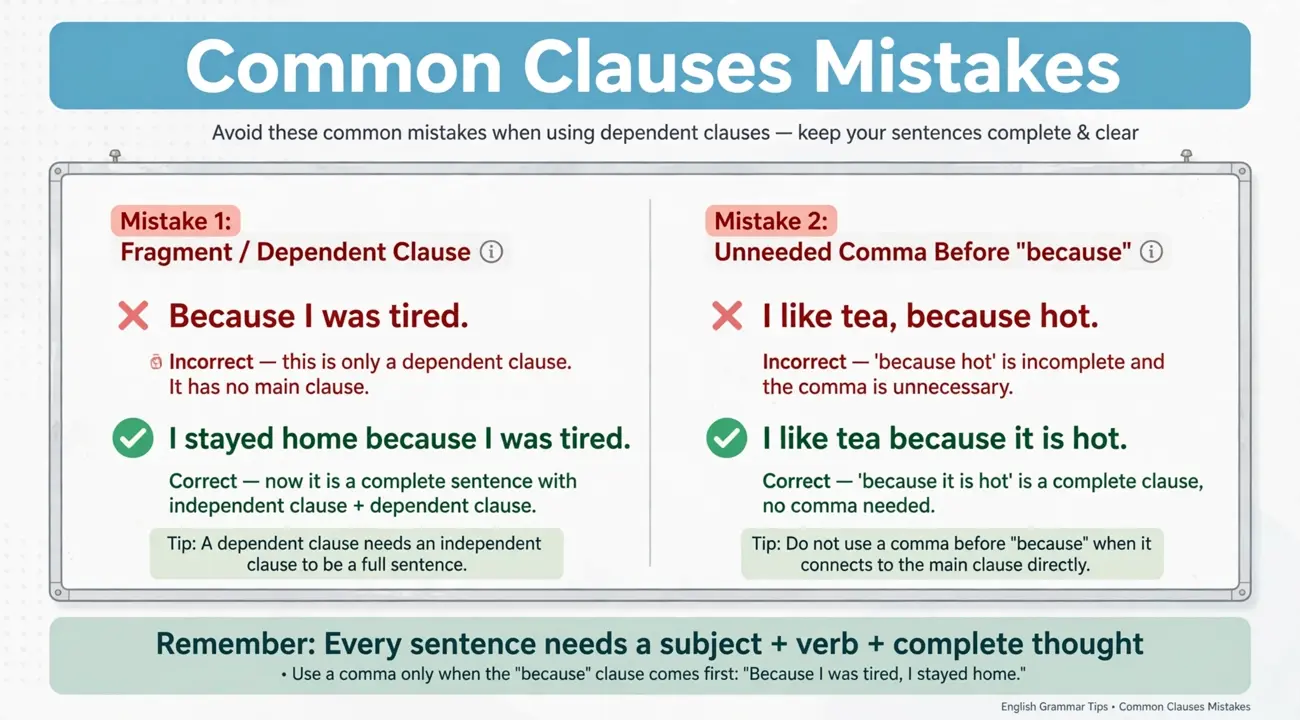
Mistake 1: Writing a dependent clause as a full sentence.
Wrong: “Because I was tired.” Right: “I went to bed early because I was tired.”
Mistake 2: Joining two full sentences with only a comma.
Wrong: “The sun set, the sky turned red.” Right: “The sun set, and the sky turned red.”
Mistake 3: Forgetting the comma after a front clause.
Wrong: “When the rain stopped we went out.” Right: “When the rain stopped, we went out.”
Mistake 4: Mixing up a phrase and a clause.
Wrong: “In the morning, is the best time to study.” Right: “The morning is the best time to study.”
For more practice with mistakes like these, try our daily grammar exercises.
Quick Quiz: Test Your Clauses
Choose the right answer. Answers are at the end — no peeking!
- Which group of words is an independent clause? a) because it rained b) The dog barked loudly. c) when the bell rings
- Which group of words is a dependent clause? a) She sings well. b) The sun rose. c) if you call me
- What does “who lives next door” do in a sentence? a) It describes a noun. b) It is the main verb. c) It is a phrase.
- Which sentence has a comma splice? a) It was cold, so we stayed inside. b) It was cold, we stayed inside. c) We stayed inside because it was cold.
- Which group of words is a noun clause? a) I know that he is kind. b) The red car. c) In the garden.
Answers:
1. b — it can stand alone.
2. c — it cannot stand alone.
3. a — it describes a noun.
4. b — a comma alone cannot join two sentences.
5. a — it is the object of “know.”
How did you do? 5/5 — excellent! 3–4 — very good. Fewer than 3 — read the 2-second trick once more.
Clauses: Quick Summary
| Type of Clause | Job | Example |
|---|---|---|
| Independent | Stands alone as a sentence | She reads every night. |
| Dependent | Needs a main clause | because she reads every night |
| Noun | Works as a subject or object | I know that she reads. |
| Adjective | Describes a noun | the book that she reads |
| Adverb | Tells when, why, or how | She reads when she is free. |
A clause has a subject and a verb, an independent clause stands alone, and a dependent clause needs a friend. A clause can also be active or passive — our guide to active vs passive voice shows both forms.
FAQs About Clauses
What is a clause in simple words?
A clause is a group of words with a subject and a verb. “She reads” is a clause, and so is “She reads every night.”
Can a sentence have more than one clause?
Yes. A simple sentence has one clause, and a long sentence can have three or four clauses.
What is the difference between a clause and a phrase?
A clause has both a subject and a verb. A phrase does not. “In the morning” is a phrase, but “when the morning came” is a clause.
Can a dependent clause be a sentence on its own?
No. A dependent clause cannot stand alone as a sentence. It always needs an independent clause with it.
What starts a dependent clause?
It often starts with because, if, when, although, while, that, who, or which. These linking words are called subordinating conjunctions.
Do I need a comma before a dependent clause?
It depends on the order. If the dependent clause comes first, put a comma after it. If it comes last, you do not need a comma.
Conclusion
That is the whole story. A clause is a group of words with a subject and a verb. An independent clause can stand alone, a dependent clause needs a main clause, and the noun, adjective, and adverb kinds do special jobs inside a sentence.
Once you can see the clauses in a sentence, you can fix almost any grammar mistake. Keep reading, keep writing, and keep learning with GrammarLuck — grammar made simple.
