

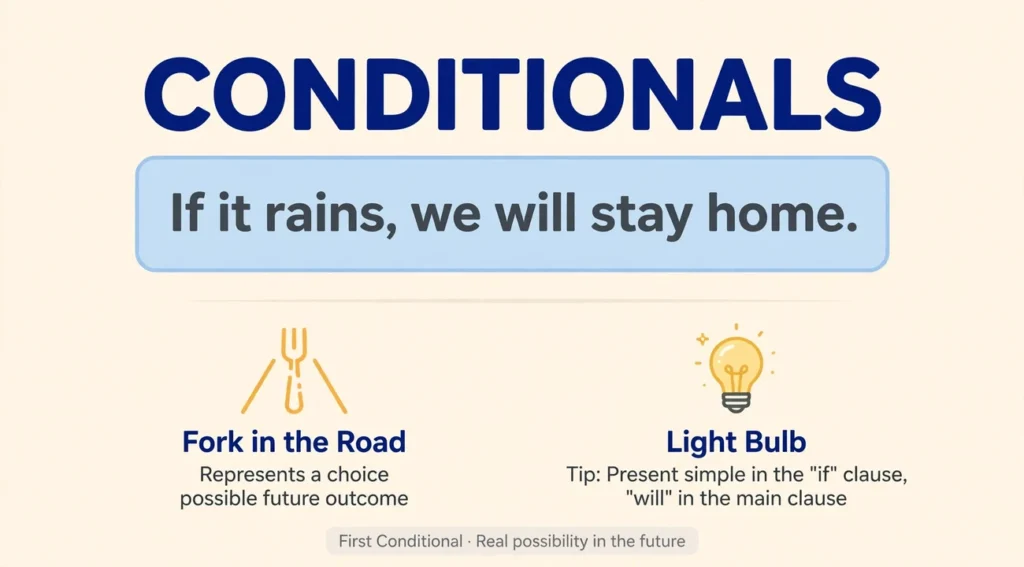
If it rains, we stay at home. If I had money, I would travel the world. If you had studied, you would have passed the test. These three sentences all use conditionals. Each one joins a condition to a result.
In short, a conditional sentence has two parts: an if-clause and a result clause. The if-clause gives the condition, and the result clause tells us what happens.
In this guide, you will learn the 4 main types, 7 simple rules, a 2-second trick, 40 examples, common mistakes, and a quick quiz.
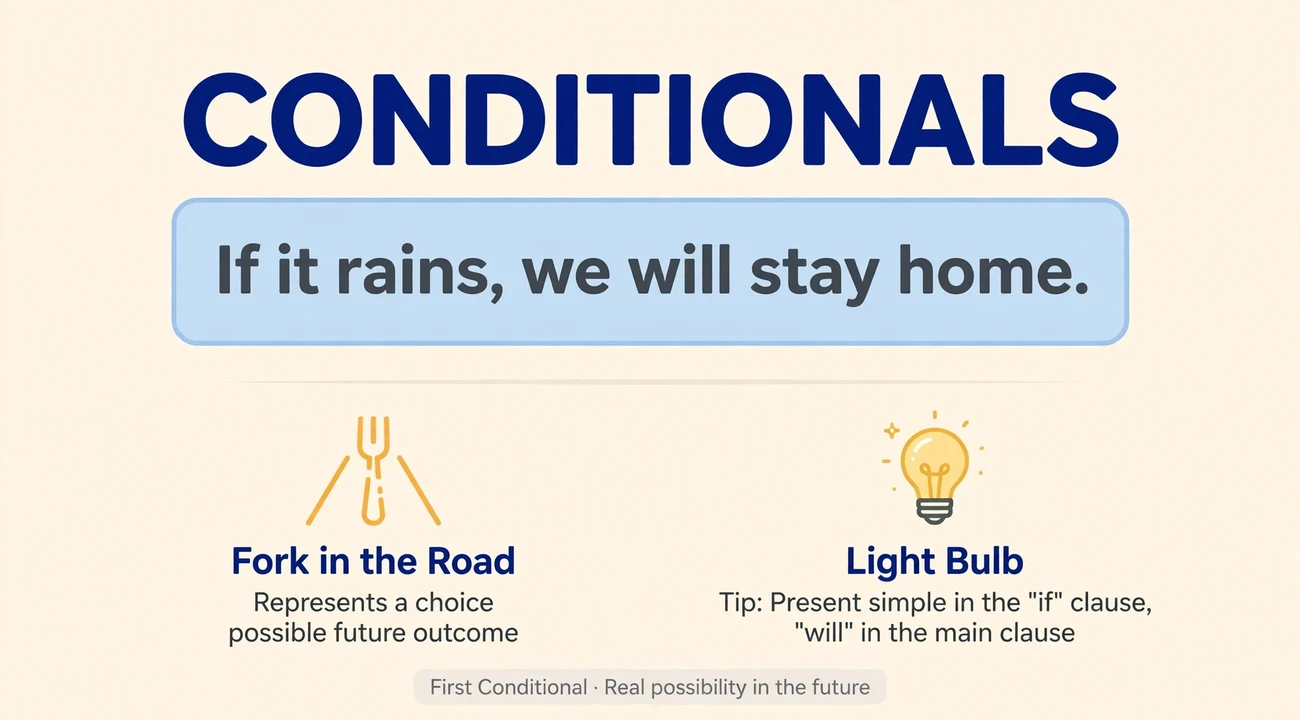
Conditionals: The Quick Answer
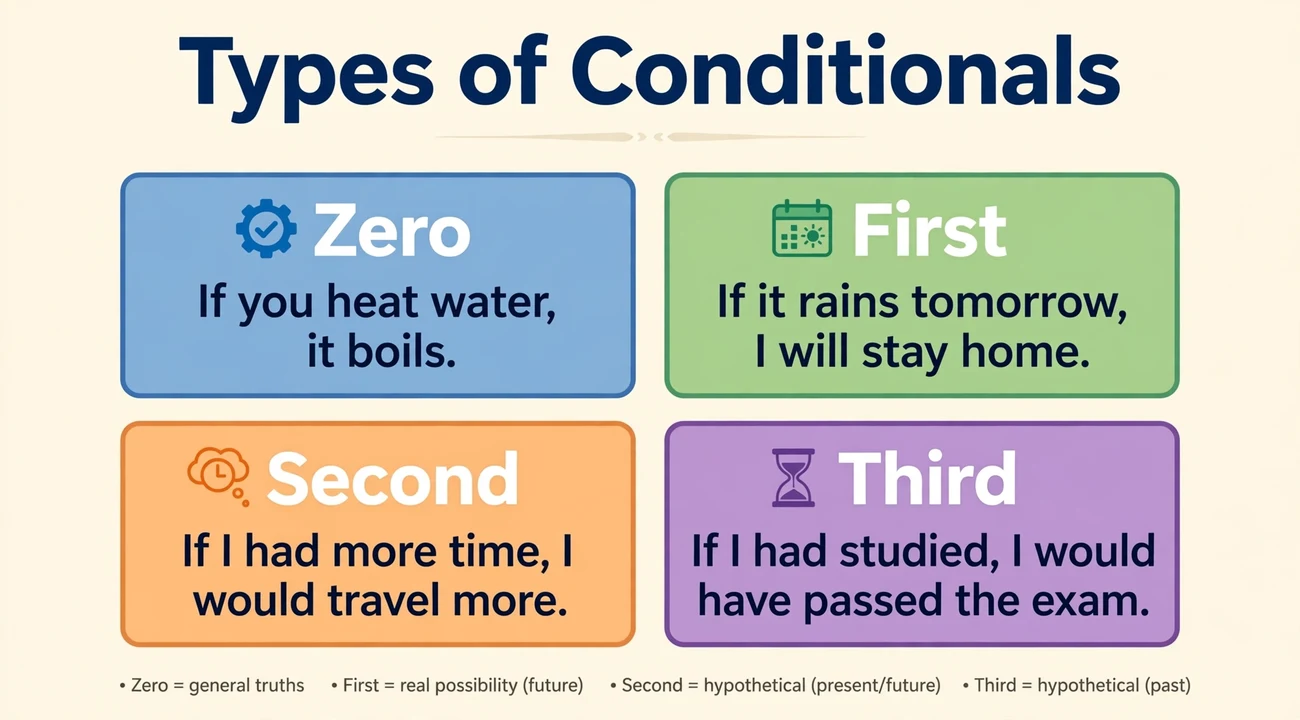
Compare the 4 main types side by side.
| Type | When to use it | Example |
|---|---|---|
| Zero conditional | Facts, always true | If you heat water, it boils. |
| First conditional | A real future plan | If it rains tomorrow, we will stay at home. |
| Second conditional | An imaginary present idea | If I had money, I would travel. |
| Third conditional | A past event that never happened | If you had studied, you would have passed. |
The key point about conditionals is simple: the verb tense tells you the type.
What Are Conditionals?
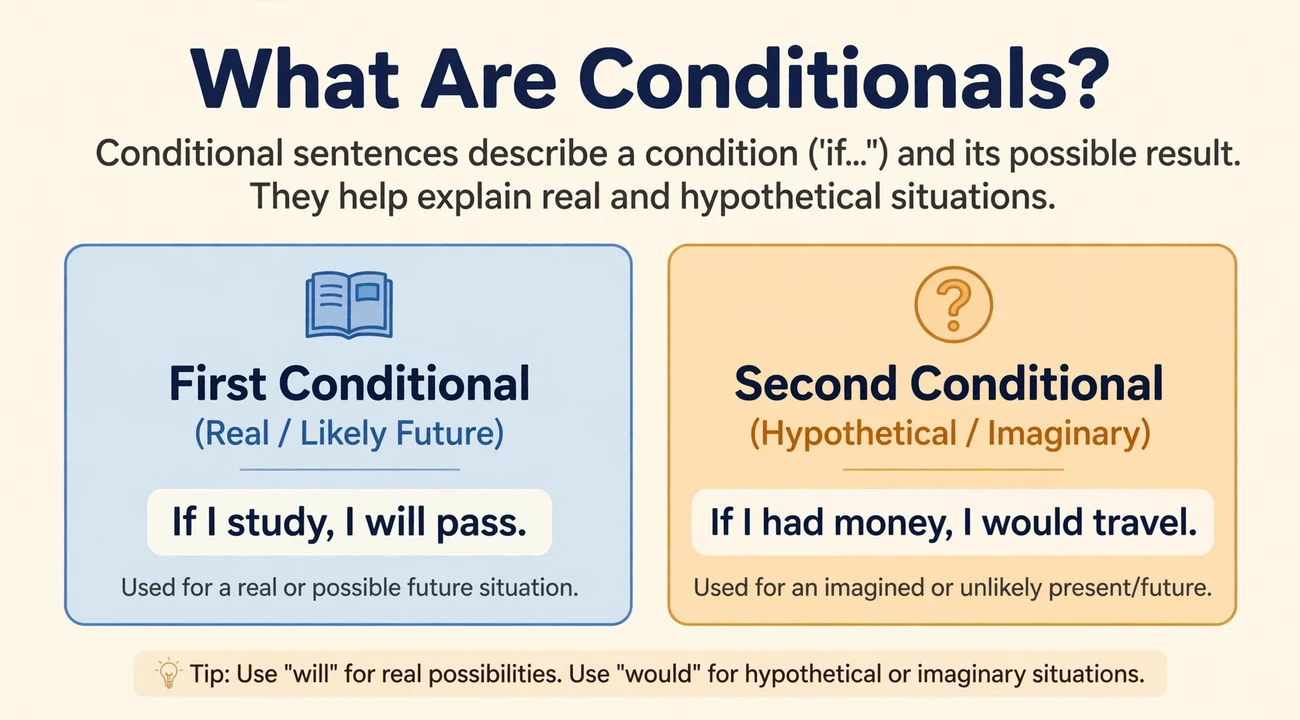
Conditionals show a cause and a result. In “If she calls me, I will answer the phone,” the call is the condition, and my answer is the result.
- If you press this button, the door opens.
- If I were rich, I would buy a big house.
- If he had listened, he would not have made that mistake.
Each part needs the right verb form. Know your verbs well, and conditionals will feel much easier.
Learn more about sentence types in our guide to types of sentences.
Zero Conditional
Use it for facts that are always true. Both parts use the present simple: if + present simple, present simple. If you heat water, it boils.
First Conditional
Use it for a real plan in the future. The if-clause uses the present simple tense, and the result clause uses will + verb. See our guide to the present simple tense.
Second Conditional
Use it for an imaginary idea in the present — a dream that is not real right now. The if-clause uses the past simple tense, and the result clause uses would + verb. Learn it in our guide to the past simple tense.
Third Conditional
Use it for a past event that did not happen — often a regret. The if-clause uses the past perfect tense, and the result clause uses would have + past participle. Revise them in our guide to the present perfect tense.
A mixed conditional joins a past cause with a present result: “If I had studied medicine, I would be a doctor now.”
7 Simple Conditionals Rules
These 7 rules cover everything you need to use conditionals with confidence. Practise each rule with your own sentences.
Rule 1: Put If in the If-Clause
The word if always sits in the condition part. Say “If it rains, we will stay at home.” The result clause takes will, would, or would have.
Rule 2: Do Not Use Will After If
This is the most common error with conditionals. Never put will right after if — say “If it rains tomorrow, we will stay at home,” not “If it will rain tomorrow.” See our guide to subject-verb agreement.
Rule 3: Match the Verb Tense to the Type
Zero uses present + present. First uses present + will. Second uses past simple + would. Third uses past perfect + would have.
Rule 4: You Can Start with the Result Clause
You do not have to put the if-clause first. “We will stay at home if it rains” means the same. Watch the comma: use one when the if-clause comes first, and none when it comes second.
Rule 5: You Can Mix the Types
Real English often mixes the types: “If I had studied medicine, I would be a doctor now.” Match each half to its own time.
Rule 6: Use Were, Not Was, After If I
In a second conditional sentence, use were after I, he, she, and it: “If I were you, I would study more.” You will hear “If I was you” in speech, but in exams, always use were.
Rule 7: Use a Comma When If Comes First
When the if-clause opens the sentence, put a comma after it: “If you study hard, you will pass the test.” When the result clause opens the sentence, skip the comma.
The 2-Second Conditionals Trick
Not sure which type to use? This trick takes two seconds.
Step 1: Ask “Is it real or imaginary?”
Step 2: Ask “Now, the future, or the past?”
Step 3: fact is zero, real future is first, imaginary now is second, past regret is third.
Try it: “If you heat water, it boils” is a fact, so it is zero. “If it rains tomorrow, we will stay at home” is a real future plan, so it is first. “If I had money, I would travel” is imaginary, so it is second. “If you had studied, you would have passed” is a past regret, so it is third.
Conditionals rest on two questions: real or imaginary, and which time.
40 Conditionals Examples
Here are 40 examples: 20 zero and first, then 20 second, third, and mixed.
Zero and first conditional:
- If you heat water, it boils.
- If it rains, the ground gets wet.
- If you mix red and white, you get pink.
- If the sun shines, the snow melts.
- If you press this button, the door opens.
- If you do not water plants, they die.
- If I eat peanuts, I feel sick.
- If you drop ice, it melts.
- If she works late, she feels tired.
- If you freeze water, it turns to ice.
- If it rains tomorrow, we will stay at home.
- If you study hard, you will pass the test.
- If she calls me, I will answer the phone.
- If we leave now, we will catch the bus.
- If he saves money, he will buy a bike.
- If you help me, I will finish early.
- If they invite us, we will go to the party.
- If I see him, I will tell him.
- If you do not hurry, you will miss the train.
- If the shop is open, I will buy bread.
Second, third, and mixed:
- If I had money, I would travel the world.
- If she knew the answer, she would tell us.
- If we lived in London, we would speak English daily.
- If I were you, I would study more.
- If he worked harder, he would get a better job.
- If it rained today, we would stay inside.
- If I had a car, I would drive to work.
- If they asked me, I would help them.
- If you spoke slowly, I would understand you.
- If she had time, she would learn French.
- If you had studied, you would have passed the test.
- If it had rained, we would have stayed at home.
- If she had left earlier, she would have caught the train.
- If I had known, I would have helped you.
- If they had saved money, they would have bought a house.
- If he had listened, he would not have made that mistake.
- If we had booked early, we would have got cheap tickets.
- If I had studied medicine, I would be a doctor now.
- If she were rich, she would have bought that house.
- If you had practised more, you would speak better English.
For trusted reference reading on this topic, the Wikipedia page on conditional sentences explains the same ideas with extra detail.
Common Conditionals Mistakes
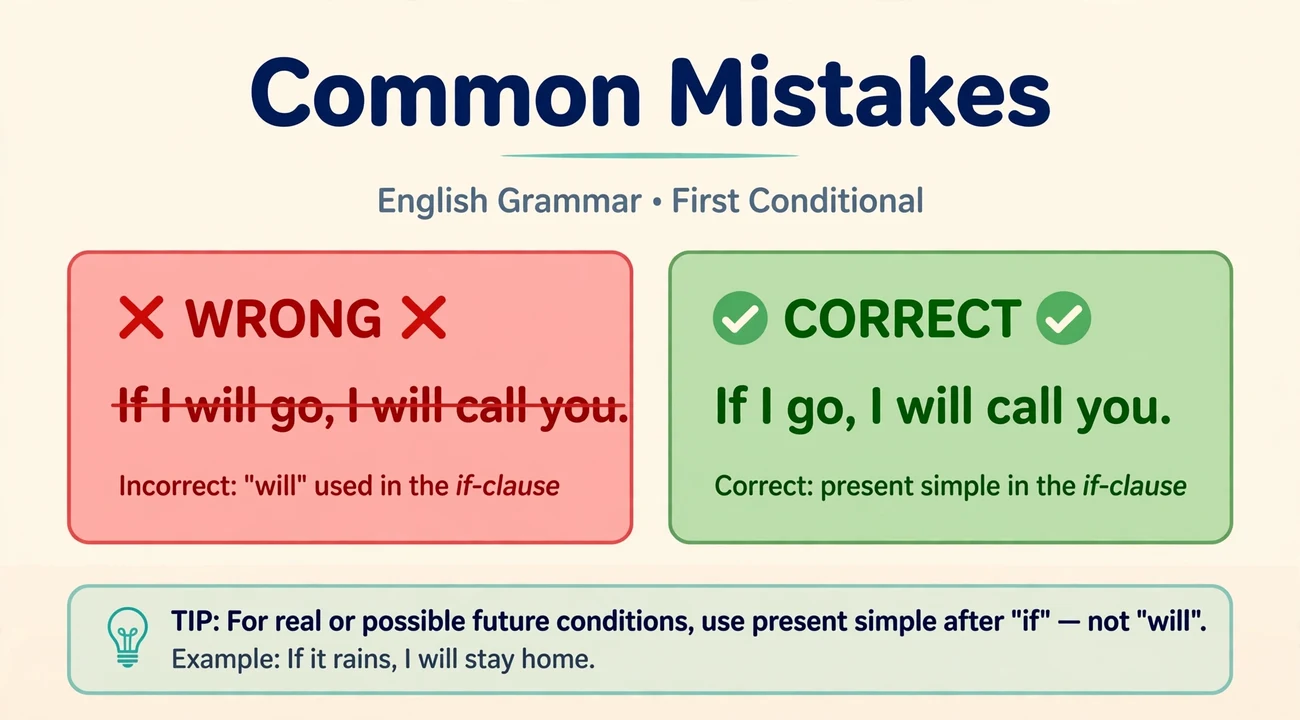
Even good learners make mistakes with conditionals. Learn them once.
Mistake 1: Using will after if.
Wrong: “If it will rain, we will stay at home.” Right: “If it rains, we will stay at home.” Will belongs in the result clause, never right after if.
Mistake 2: Using would in both clauses.
Wrong: “If I would have money, I would travel.” Right: “If I had money, I would travel.” The if-clause takes the past simple, not would.
Mistake 3: Mixing up the third conditional tenses.
Wrong: “If you had studied, you would pass the test.” Right: “If you had studied, you would have passed the test.” A past regret needs would have + past participle.
Mistake 4: Using was instead of were.
Wrong: “If I was you, I would help.” Right: “If I were you, I would help.” Use were after I, he, she, and it.
Mistake 5: Forgetting the comma when if comes first.
Wrong: “If it rains we will stay at home.” Right: “If it rains, we will stay at home.” Put a comma after an opening if-clause.
Quick Quiz: Conditionals
Choose the right verb for each sentence and test yourself on conditionals. Answers are at the end — no peeking!
- If you heat ice, it ___. (melts / melted)
- If it rains tomorrow, we ___ stay at home. (will / would)
- If I had money, I ___ travel the world. (will / would)
- If you had studied, you ___ passed the test. (will have / would have)
- If I ___ you, I would study more. (am / were)
Answers:
1. melts — a fact, so it is zero.
2. will — a real future plan, so it is first.
3. would — an imaginary idea, so it is second.
4. would have — a past regret, so it is third.
5. were — second conditional sentences use were after I.
How did you do? 5/5 — excellent! 4 — very good. Fewer than 4 — read the 7 rules once more.
Conditionals Quick Summary
| Type | When to use it | Structure | Example |
|---|---|---|---|
| Zero | Facts, always true | If + present simple, present simple | If you heat water, it boils. |
| First | Real future plan | If + present simple, will + verb | If it rains, we stay at home. |
| Second | Imaginary present idea | If + past simple, would + verb | If I had money, I would travel. |
| Third | Past event that never happened | If + past perfect, would have + past participle | If you had studied, you would have passed. |
| Mixed | Past cause, present result | If + past perfect, would + verb | If I had studied medicine, I would be a doctor now. |
Ask if the idea is real or imaginary, and which time it talks about. Keep this table near your desk until conditionals feel automatic.
FAQs About Conditionals
What are conditionals in simple words?
Conditionals have an if-clause and a result clause. The if-clause gives the condition, and the result tells us what happens.
How many types of conditionals are there?
Four main types: zero, first, second, and third — plus a mixed type, which joins a past cause with a present result.
What is the difference between the first and second conditional?
The first is a real future plan: “If it rains, we will stay at home.” The second is an imaginary idea: “If I had money, I would travel.”
When do I use the third conditional?
Use it for a past event that did not happen — often a regret.
Can I start a sentence with the result clause?
Yes. “We will stay at home if it rains” means the same. Just use a comma when the if-clause comes first, and no comma when it comes second.
What is a mixed conditional?
It joins two times in one sentence: a past cause with a present result, like “If I had studied medicine, I would be a doctor now.”
Conclusion
Conditionals are small sentences with a big job. They let you talk about facts, plans, dreams, and regrets with just the word if and the right verb tense. Learn the 4 types and practise with the 40 examples above.
Keep using conditionals in your own sentences every day. Keep learning with GrammarLuck — grammar made simple.
