

A sentence fragment is a group of words that looks like a sentence but is not complete. It is missing a subject, a verb, or a complete thought. In this guide to sentence fragments, you will learn how to spot them in seconds and fix them with one simple test.
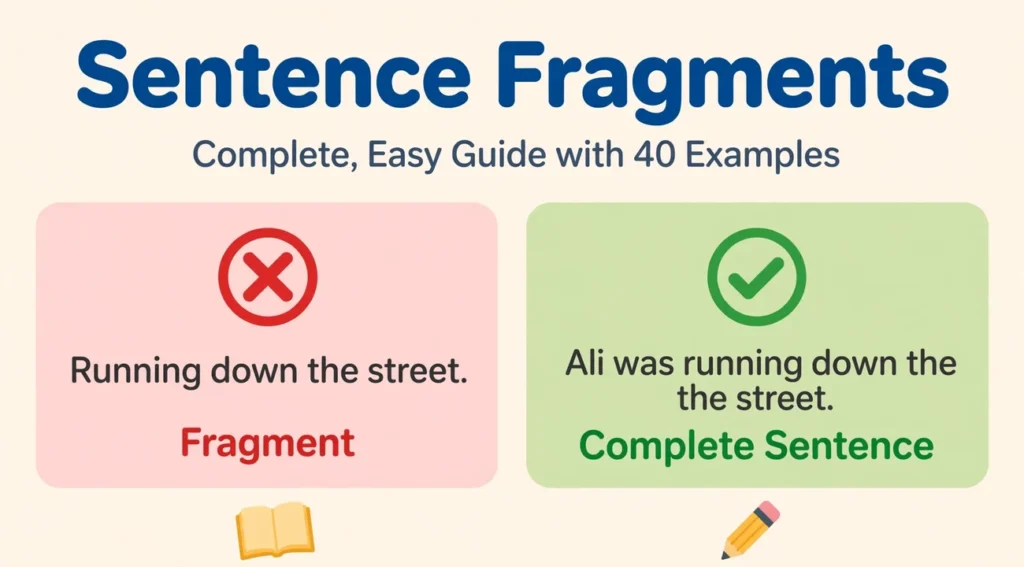
Here is the short answer. A sentence fragment is an incomplete sentence. It may start with a capital letter and end with a full stop, but it does not give a full idea. “Running to school.” is a fragment. “Ali is running to school.” is a complete sentence.
In this complete guide, you will learn what sentence fragments are, what a complete sentence needs, a 2-second test, 7 simple rules, 40 examples, the most common mistakes, and a quick quiz. By the end, sentence fragments will never confuse you again.
Sentence Fragments: The Quick Answer
The fastest way to understand sentence fragments is to see them side by side with the fixed sentence.
| Fragment | Problem | Fixed Sentence |
|---|---|---|
| After the rain stopped. | No subject and no verb | After the rain stopped, we went outside. |
| Running down the road. | No subject, no full idea | The boy is running down the road. |
| Because she was tired. | The idea is not finished | She went to bed early because she was tired. |
| The book on the table. | No verb | The book on the table is mine. |
The golden sentence fragments rule is simple. Read the words aloud and ask, “Who did what?” If you cannot answer, you have a sentence fragment.
What Is a Sentence Fragment?
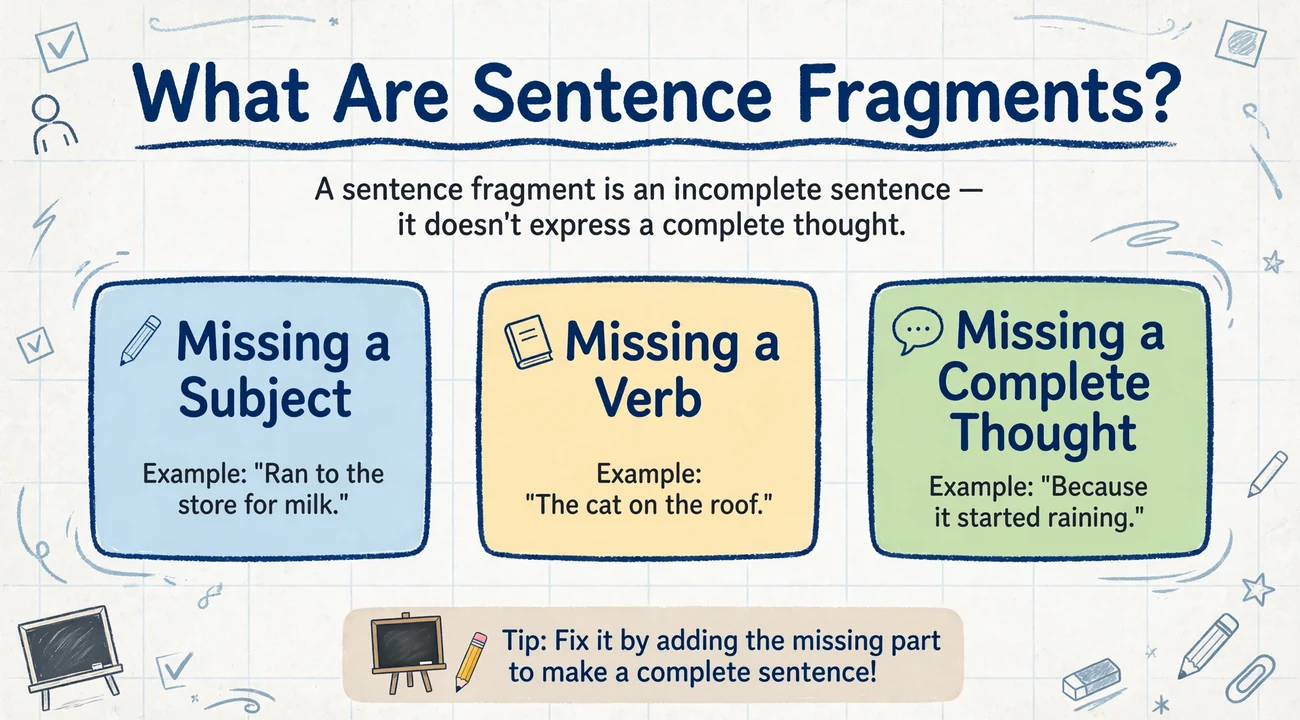
A sentence fragment is a group of words that is punctuated like a sentence but cannot stand alone. It may have a subject but no verb, or a verb but no subject, so it does not express a complete thought.
Take “After lunch.” It has a capital letter and a full stop, so it looks like a sentence. But it tells us nothing on its own — after lunch, what happened? The idea is unfinished, which is why it is one of the most common sentence fragments in student writing.
See our guide to types of sentences.
What Does a Complete Sentence Need?
A complete sentence needs three things. If one is missing, the words become a fragment. Learn this list and you will spot sentence fragments fast.
| Part | What It Does | Example |
|---|---|---|
| Subject | Tells who or what the sentence is about | The cat |
| Verb | Tells the action or the state | slept |
| Complete thought | Makes full sense all by itself | The cat slept. |
Each part has a job: the subject names the person or thing, the verb shows the action, and the complete thought makes sense alone. Fail one test, and the words are a fragment.
One idea, missing a different part each time:
- Missing subject: “Slept all day.” → “The cat slept all day.”
- Missing verb: “The cat on the mat.” → “The cat is sleeping on the mat.”
- Missing complete thought: “When the bell rang.” → “When the bell rang, we went home.”
The 2-Second Sentence Fragment Test
Still not sure? Use this sentence fragments test. It takes only two seconds, and it finds sentence fragments in any text.
Step 1: Ask, “Who did what?” Step 2: If you can answer, the sentence is complete. If not, you have found a fragment.
Try the test on these examples:
- “After the rain stopped.” ❌ Who stopped? No one. What happened? We do not know.
- “The rain stopped.” ✅ Who? The rain. What happened? It stopped.
- “Running to the bus.” ❌ Who is running? We do not know.
- “Sara is running to the bus.” ✅ Who? Sara. What happened? She is running.
This trick never fails. When you feel stuck, stop and ask the two questions.
7 Simple Sentence Fragment Rules
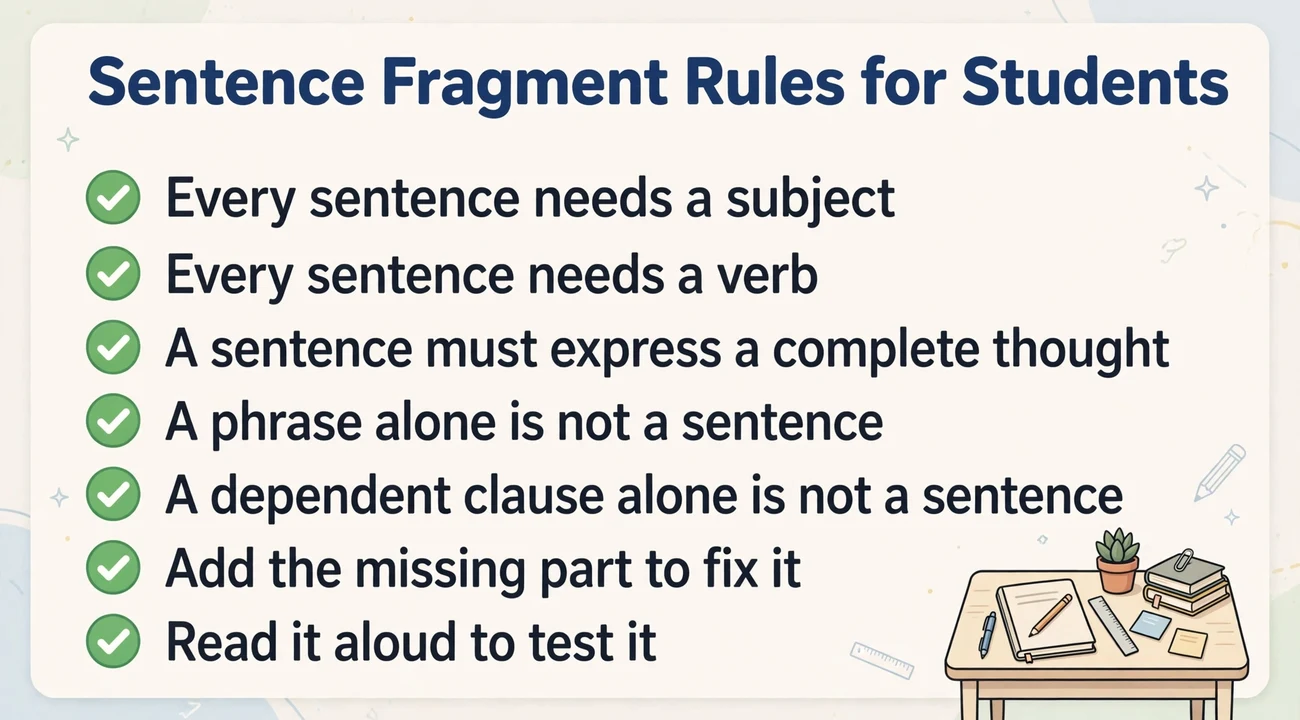
These seven rules cover almost every sentence fragment you will meet. Learn them once, and fixing fragments becomes easy.
Rule 1: Every Sentence Needs a Subject and a Verb
A sentence must have someone or something doing an action. “Ran fast.” has a verb but no subject, so it is a fragment. “Ali ran fast.” is complete. A missing subject is the most common cause of sentence fragments — see our guide to subject-verb agreement.
Rule 2: Because, When, If, and Although Do Not Make a Sentence Alone
Words like because, when, if, and although start a dependent clause — a group of words that cannot stand alone. “Because she was tired.” leaves the reader waiting. Finish it: “She went to bed early because she was tired.” This pattern causes more sentence fragments than any other mistake. See our guides to clauses and comma rules.
Rule 3: An -ing Verb Cannot Stand Alone
Many sentence fragments start with an -ing word. “Swimming in the pool.” has no subject and no full verb. Add both: “The children are swimming in the pool.” See how full verbs work in our guide to the present simple tense.
Rule 4: A Sentence That Starts with To + Verb Is Not Complete Alone
“To pass the exam.” is a plan, not a sentence. It gives the goal, but not who will do it. Finish it: “To pass the exam, you must study every day.”
Rule 5: A Group of Words with No Verb Is Not a Sentence
“The tall building near the park.” has no verb, so nothing happens in it. Add one: “The tall building near the park is new.”
Rule 6: A Group of Words That Only Describes Something Is Not a Sentence
“A very cold morning in January.” describes a time, but nothing happens. Fix it: “It was a very cold morning in January.”
Rule 7: When in Doubt, Read the Sentence Aloud
Your ear often catches what your eye misses. Read the words aloud and ask, “Who did what?” If the answer is missing, add it. This habit will remove most sentence fragments from your writing.
40 Sentence Fragment Examples
Here are 40 examples of sentence fragments. The first 20 are fragments, wrong on their own. The next 20 show the same ideas fixed as complete sentences.
Sentence fragments (wrong on their own):
- After the rain stopped. ❌
- Running down the street. ❌
- Because she was tired. ❌
- The book on the table. ❌
- When the bell rang. ❌
- To learn English well. ❌
- The tall man in the blue coat. ❌
- Swimming in the pool. ❌
- Under the old bridge. ❌
- While we were waiting. ❌
- A very cold morning in January. ❌
- The dog with the red collar. ❌
- If you study hard. ❌
- Walking to school every day. ❌
- The house at the end of the road. ❌
- Although it was late. ❌
- Singing in the shower. ❌
- After finishing his homework. ❌
- The girl with the long hair. ❌
- Before the sun rose. ❌
Fixed as complete sentences:
- After the rain stopped, we went outside. ✅
- The boy is running down the street. ✅
- She went to bed early because she was tired. ✅
- The book on the table is mine. ✅
- When the bell rang, we went home. ✅
- To learn English well, you must practise every day. ✅
- The tall man in the blue coat is my uncle. ✅
- The children are swimming in the pool. ✅
- We sat under the old bridge. ✅
- While we were waiting, we played a game. ✅
- It was a very cold morning in January. ✅
- The dog with the red collar is mine. ✅
- If you study hard, you will pass. ✅
- Ali is walking to school every day. ✅
- The house at the end of the road is empty. ✅
- Although it was late, we kept working. ✅
- She is singing in the shower. ✅
- After finishing his homework, he went to play. ✅
- The girl with the long hair is my friend. ✅
- Before the sun rose, the birds started to sing. ✅
For a deeper look, the Wikipedia article on sentence fragments explains the same idea in more detail.
Common Sentence Fragment Mistakes
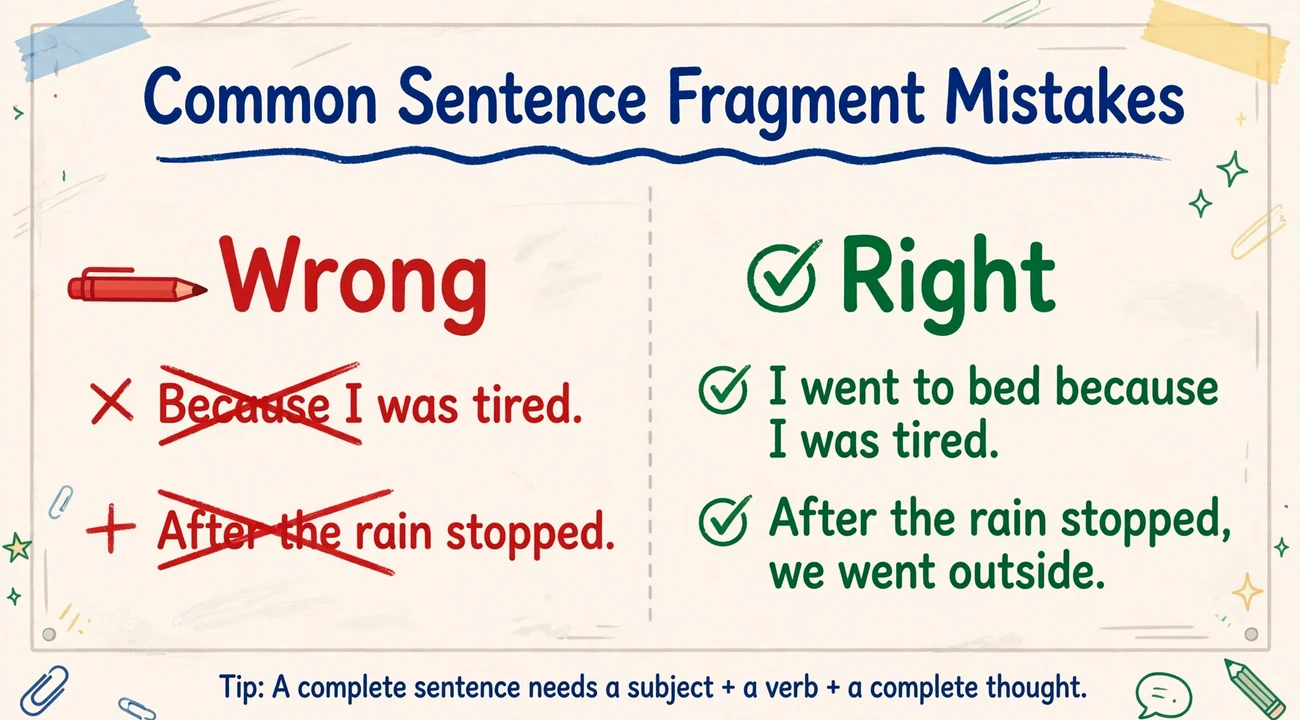
Even good writers make these mistakes with sentence fragments. Learn them once.
Mistake 1: Starting with because and stopping there. Wrong: “I stayed at home. Because it was raining.” Right: “I stayed at home because it was raining.” Join the because part to the main sentence.
Mistake 2: Writing an -ing phrase as a full sentence. Wrong: “We went to the park. Playing football all day.” Right: “We went to the park and played football all day.”
Mistake 3: Forgetting the verb. Wrong: “My best friend Sara. She is very kind.” Right: “My best friend Sara is very kind.” The first group has no verb, so it is not a sentence.
Mistake 4: Treating a description as a sentence. Wrong: “The test was hard. A very long test with many questions.” Right: “The test was hard. It was a very long test with many questions.”
Quick Quiz: Fragment or Complete Sentence?
Read each group of words. Is it a fragment or a complete sentence? Answers are at the end — no peeking!
- After the movie ended.
- The dog barked all night.
- Running through the park.
- She opened the window.
- Because it was raining.
- The tall man in the blue coat.
- He finished his homework.
- To learn English well.
Answers: 1. Fragment — “After the movie ended, we went home.” 2. Complete sentence. 3. Fragment — “The children are running through the park.” 4. Complete sentence. 5. Fragment — “We stayed inside because it was raining.” 6. Fragment — “The tall man in the blue coat is my uncle.” 7. Complete sentence. 8. Fragment — “To learn English well, you must practise every day.”
How did you do? 8/8 — excellent! 6–7 — very good. Fewer than 6 — read the 2-second test once more.
FAQs About Sentence Fragments
| Question | Short Answer |
|---|---|
| What is a sentence fragment? | An incomplete group of words |
| What is missing? | A subject, a verb, or a complete thought |
| How do I find one? | Ask, “Who did what?” |
| How do I fix one? | Add the missing part or join it to a sentence |
What is a sentence fragment in simple words?
A sentence fragment is a group of words that looks like a sentence but is not complete — it is missing a subject, a verb, or a complete thought. “After lunch.” is a fragment; “We went home after lunch.” is complete.
How can I find sentence fragments in my writing?
Read each sentence aloud and ask, “Who did what?” If you cannot answer, you have found a fragment. Short groups of words after a full stop are the most common place to look for sentence fragments.
Is “Because I was tired” a sentence fragment?
Yes. It starts with because, so the idea is not finished. Join it to a full sentence: “I went to bed early because I was tired.”
Are sentence fragments always wrong?
In essays, exams, and formal emails, yes — fix them. In stories and ads, writers sometimes use short fragments on purpose, like “Not a chance.”
What is the difference between a sentence fragment and a run-on sentence?
Sentence fragments are too short — they are missing a part. A run-on sentence is too long — it joins two full sentences without the right punctuation.
Can a sentence fragment have a verb?
Yes. “Running down the street.” has a verb form, but no subject and no complete thought. A real sentence needs all three parts.
Conclusion
A sentence fragment is a small mistake with a simple fix. Check for a subject, a verb, and a complete thought — if one part is missing, add it or join the words to a nearby sentence.
Practise with the examples and quiz here, and soon you will spot sentence fragments without even thinking. For more simple lessons, keep learning with GrammarLuck — grammar made simple.
