


A run-on sentence is one of the most common mistakes in English writing. It joins two complete thoughts without the right punctuation. The reader gets lost. The good news is that run-on sentences are easy to spot and fix once you know the rules.
Here is the short answer. A run-on sentence joins two complete sentences into one long sentence with no period, no semicolon, and no joining word. For example: “I love rain it makes me happy.” The fix is simple: “I love rain. It makes me happy.”
In this guide, you will learn the two kinds of run-on sentences, a 2-second test, 7 simple rules, 40 examples, common mistakes, and a quick quiz. By the end, you will spot run-on sentences in your own writing.
Run-On Sentences: The Quick Answer
The fastest way to understand run-on sentences is to see them next to the correct version.
| Run-On Sentence | Correct Sentence |
|---|---|
| I was tired I went to bed early. | I was tired, so I went to bed early. |
| She loves tea she drinks it every morning. | She loves tea. She drinks it every morning. |
The golden rule: one sentence holds only one complete thought, unless the two thoughts are joined with a period, a semicolon, or a comma plus a joining word.
What Is a Run-On Sentence?
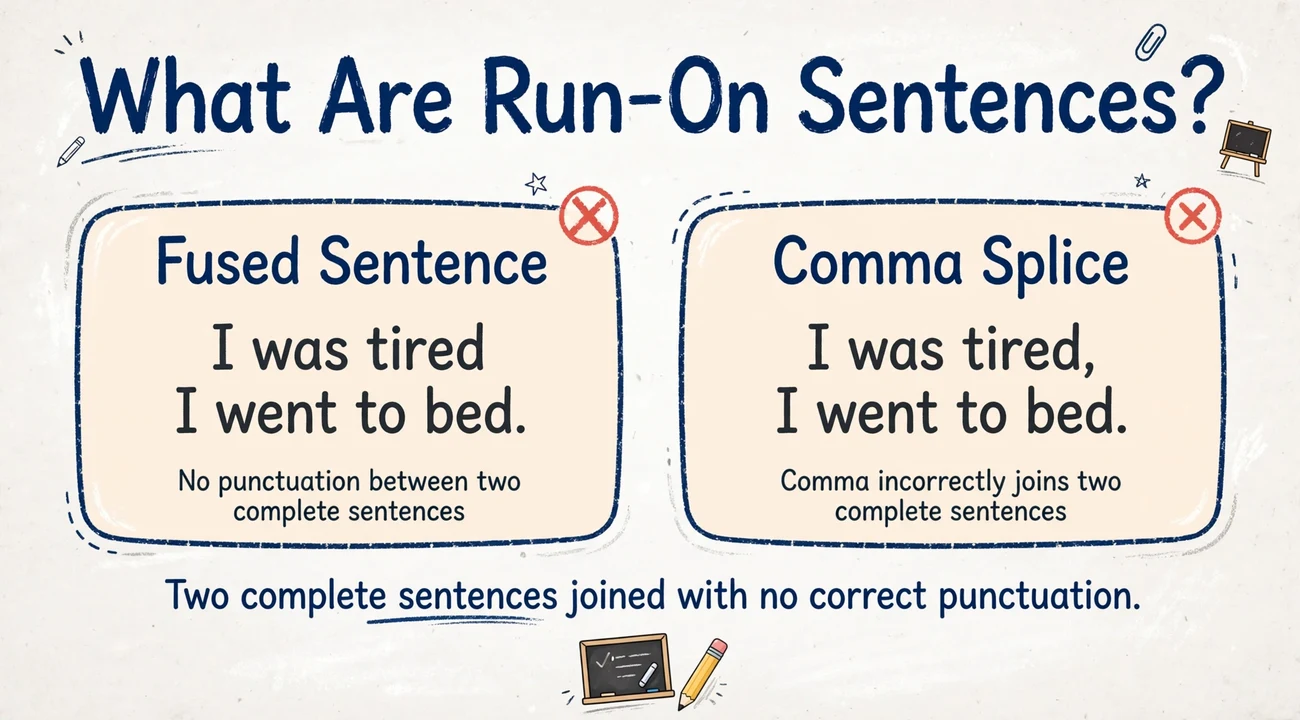
A run-on sentence joins two or more complete thoughts without correct punctuation or a joining word. A complete thought can stand alone — it has a subject and a verb.
Look at this example: “The sun came out the birds started to sing.” The first thought is “The sun came out.” The second is “The birds started to sing.” Both are full sentences, joined with nothing at all.
Run-on sentences happen because speech and writing work in different ways. When we speak, our voice shows the pauses. When we write, punctuation must show them. Writers who forget the punctuation end up with run-on sentences.
To spot run-on sentences, read our guide to the types of sentences. It explains simple, compound, and complex sentences in plain words.
Comma Splice vs Fused Sentence
There are two kinds of run-on sentences: the comma splice and the fused sentence. Both are wrong in the same way, but they look different.
| Type | Looks Like | Example |
|---|---|---|
| Comma splice | Two full sentences, only a comma | I was hungry, I ate a sandwich. |
| Fused sentence | Two full sentences, nothing between them | I was hungry I ate a sandwich. |
A comma splice joins two complete sentences with only a comma. “I was hungry, I ate a sandwich” is a comma splice. The fix: “I was hungry, so I ate a sandwich.”
A fused sentence joins two complete sentences with nothing at all — no comma, no joining word, no period. “I was hungry I ate a sandwich” is a fused sentence. The fix: “I was hungry. I ate a sandwich.” Once you see the two kinds, you will find run-on sentences everywhere.
Our guide to comma rules shows you where a comma can and cannot go.
The 2-Second Run-On Sentences Test
Not sure if your sentence is a run-on? Use this test.
Step 1: Read the sentence aloud.
Step 2: Find the two complete thoughts inside it.
Step 3: Check how they are joined — period, semicolon, or comma plus a joining word?
Try the test on these examples:
- “She finished her homework she went out to play.” Two thoughts, joined with nothing — it is a run-on sentence. ❌
- “She finished her homework, and she went out to play.” Joined with a comma and the word and — it is correct. ✅
This trick works every time. When you feel unsure while writing, stop for two seconds and run this test.
7 Simple Rules to Fix Run-On Sentences
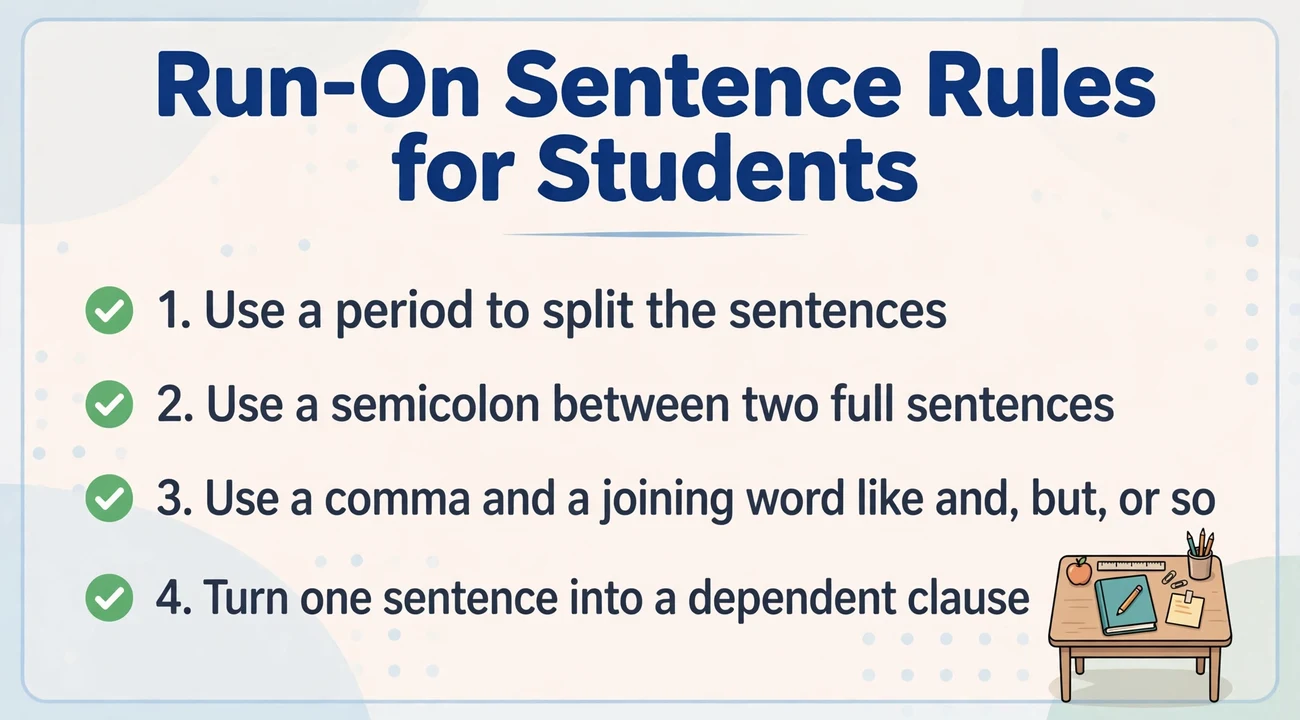
You can fix every run-on sentence with one of these 7 rules.
Rule 1: Split with a Period
Put a full stop between the two complete thoughts. Wrong: “It was late we went home.” Right: “It was late. We went home.”
Rule 2: Join with a Semicolon
A semicolon joins two closely linked thoughts. Wrong: “I love the rain it helps me relax.” Right: “I love the rain; it helps me relax.”
Rule 3: Add a Comma and a Joining Word
A comma plus a joining word — and, but, or so — can join two complete thoughts. Wrong: “She was tired she kept working.” Right: “She was tired, but she kept working.” See our guide to conjunctions.
Rule 4: Add a Word Like Because, When, or Although
Words like because, when, and although can turn one complete thought into part of a longer sentence. Wrong: “We stayed inside it was raining.” Right: “We stayed inside because it was raining.” See our guide to clauses.
Rule 5: Turn One Part into a Short Phrase
Sometimes you can shorten one thought so it is no longer a full sentence. Wrong: “The train left the station it was full of people.” Right: “The train left the station, full of people.”
Rule 6: Use a Colon or a Dash for a Strong Break
A colon or a dash can join two thoughts when the second one explains the first: “I have one goal this year: I want to read fifty books.”
Rule 7: Read Your Sentence Aloud and Check the Joins
The last rule is a habit. Read your work aloud before you finish. If you hear two full ideas with no pause between them, you have found a run-on sentence. Then pick one of the six fixes above. See our guide to subject-verb agreement.
40 Run-On Sentences Examples
Here are 40 examples. The first 20 are run-on sentences — each one is wrong. The next 20 are the same ideas, fixed.
Run-on sentences (wrong):
- I woke up late I missed the bus. ❌
- She loves music she plays the piano. ❌
- It was raining we stayed at home. ❌
- He was hungry he ate two sandwiches. ❌
- The movie was long I enjoyed it. ❌
- We went to the park the children played. ❌
- My phone died I could not call. ❌
- She studied hard she passed the test. ❌
- The shop was closed we went home. ❌
- I like tea my brother likes coffee. ❌
- The train was late we waited an hour. ❌
- He ran fast he missed the bus. ❌
- It was cold we wore coats. ❌
- She opened the book she started reading. ❌
- We visited London we saw Big Ben. ❌
- The baby was tired she fell asleep. ❌
- I need new shoes my old ones are torn. ❌
- He smiled she smiled back. ❌
- The garden was dry we watered it. ❌
- She cooked dinner we ate together. ❌
Fixed:
- I woke up late. I missed the bus. ✅
- She loves music, and she plays the piano. ✅
- It was raining, so we stayed at home. ✅
- He was hungry, so he ate two sandwiches. ✅
- The movie was long, but I enjoyed it. ✅
- We went to the park. The children played. ✅
- My phone died, so I could not call. ✅
- She studied hard, and she passed the test. ✅
- The shop was closed, so we went home. ✅
- I like tea, but my brother likes coffee. ✅
- The train was late; we waited an hour. ✅
- He ran fast, but he missed the bus. ✅
- It was cold, so we wore coats. ✅
- She opened the book and started reading. ✅
- We visited London, and we saw Big Ben. ✅
- The baby was tired, so she fell asleep. ✅
- I need new shoes because my old ones are torn. ✅
- He smiled, and she smiled back. ✅
- The garden was dry, so we watered it. ✅
- She cooked dinner, and we ate together. ✅
The Wikipedia article on run-on sentences explains the same ideas with the terms grammar books use.
Common Run-On Sentences Mistakes
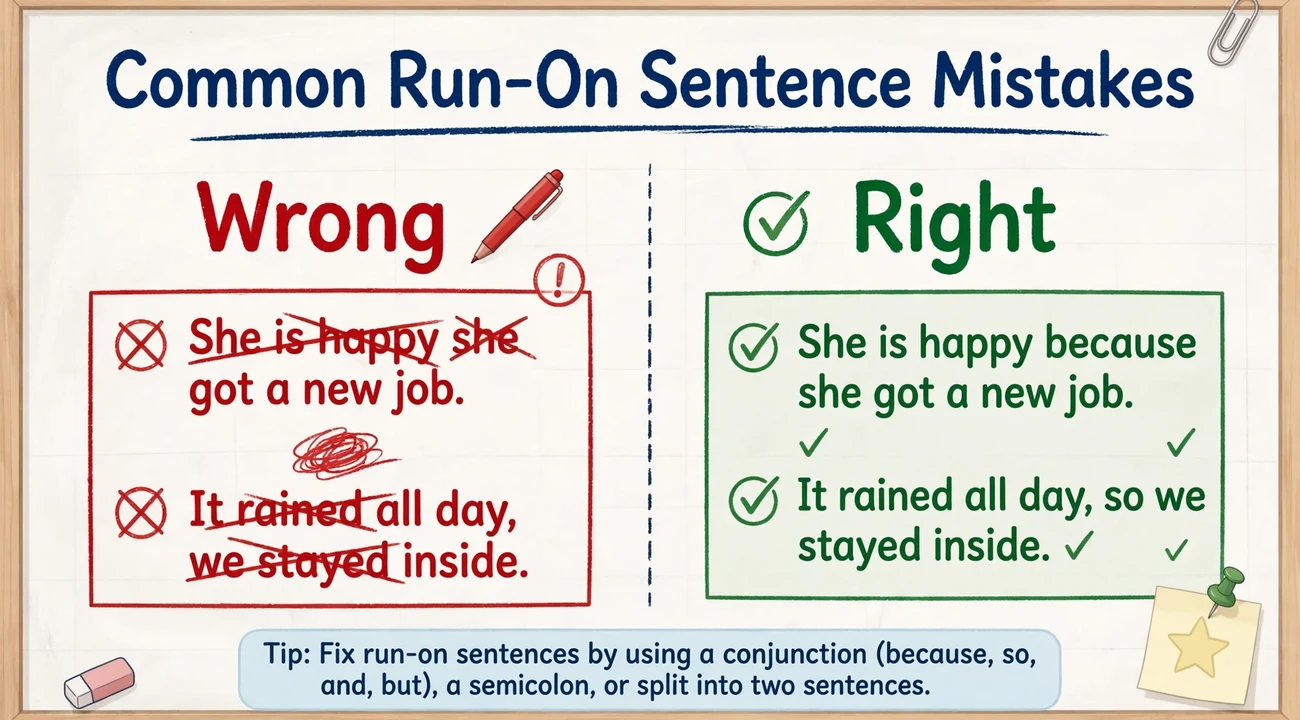
Even good writers make these run-on sentences mistakes.
Mistake 1: Thinking a long sentence is always a run-on.
Wrong: “This sentence is long, so it must be a run-on.” Right: a long sentence with correct joins is fine.
Mistake 2: Joining two sentences with only a comma.
Wrong: “I was tired, I went to bed.” Right: “I was tired, so I went to bed.” A comma alone cannot join two full sentences — it needs a joining word.
Mistake 3: Joining two sentences with only the word “and.”
Wrong: “I was tired and I went to bed.” Right: “I was tired, and I went to bed.” When and joins two full sentences, it needs a comma before it.
Mistake 4: Adding more words instead of fixing the join.
Wrong: “I was tired I went to bed early so I slept well.” Right: “I was tired. I went to bed early, so I slept well.”
Quick Quiz: Spot the Run-On Sentence
Read each sentence and find the run-on sentences. Answers are at the end — no peeking!
- I went home I was tired.
- I went home because I was tired.
- She likes apples, she eats one every day.
- She likes apples. She eats one every day.
- We waited for the bus it never came.
- We waited for the bus, but it never came.
- He read the book he loved it.
- He read the book, and he loved it.
Answers:
1. Run-on — joined with nothing.
2. Correct — “because” joins the two parts.
3. Run-on — a comma splice.
4. Correct — two short sentences.
5. Run-on — joined with nothing.
6. Correct — “but” joins the parts.
7. Run-on — joined with nothing.
8. Correct — “and” joins the parts.
How did you do? 8/8 — excellent! 6–7 — very good. Fewer than 6 — read the test once more.
Run-On Sentences: Quick Summary
| Point | Remember |
|---|---|
| What it is | Two complete thoughts joined the wrong way |
| Two kinds | Comma splice and fused sentence |
| How to fix it | Period, semicolon, or comma + joining word |
| Quick test | Read aloud, find the two thoughts, check the join |
| Remember | One sentence, one thought — unless the join is right |
Keep this summary near your desk until the rule becomes automatic.
FAQs About Run-On Sentences
What is a run-on sentence in simple words?
A run-on sentence joins two complete sentences into one sentence without the right punctuation. For example: “I was tired I went to bed.”
Is a long sentence a run-on sentence?
No. A run-on sentence is about the join, not the length.
What is the difference between a run-on sentence and a comma splice?
A comma splice is one kind of run-on sentence. It joins two complete sentences with only a comma. The other kind is a fused sentence, which joins them with nothing at all.
How do I fix a run-on sentence fast?
The fastest fix is a period. Put a full stop between the two complete thoughts. Or use a semicolon, or a comma plus and, but, or so.
Can a run-on sentence have a comma in it?
Yes. A comma splice is a run-on sentence with a comma in it — but the comma is alone, with no joining word. A comma can only join two full sentences with and, but, or so.
Are run-on sentences always wrong?
In school work, exams, emails, and essays, yes. In stories and poems, writers sometimes break the rule on purpose for effect. But until you know the rule well, always fix run-on sentences in your writing.
Conclusion
A run-on sentence is simply two complete thoughts joined the wrong way. Now you know the two kinds of run-on sentences and the 7 simple rules to fix them: split with a period, join with a semicolon, add a comma and a joining word, or use a word like because.
Practise with the examples and quiz in this guide, and soon you will spot run-on sentences without thinking. Keep learning with GrammarLuck — grammar made simple.
