

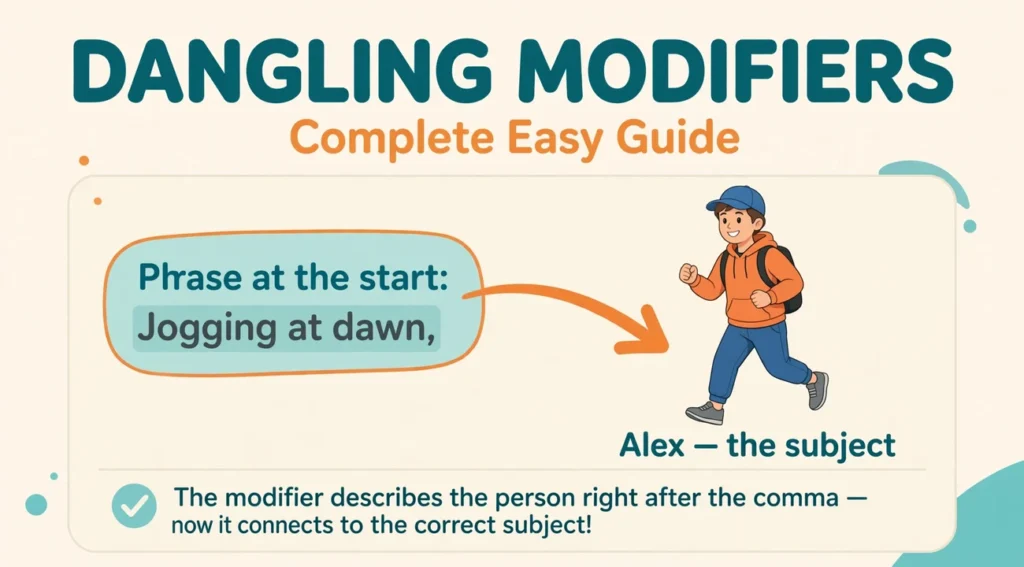
A dangling modifier is a word or phrase that describes the wrong person or thing in a sentence. In this guide to dangling modifiers, you will learn how to spot them in seconds and fix them with one simple test.
Here is the short answer. Dangling modifiers are easy to miss because the sentence still sounds fine. Running late, the bus left without me. sounds fine, but the bus was not running late – I was. The words point to the wrong subject.
In this complete guide, you will learn what dangling modifiers are, how to find them, a 2-second test, 7 simple rules, 40 examples, common mistakes, and a quick quiz. By the end, they will never confuse you again.
Dangling Modifiers: The Quick Answer
The fastest way to understand dangling modifiers is to see them side by side with the fixed sentence.
| Dangling Modifier | Problem | Fixed Sentence |
|---|---|---|
| Running late, the bus left without me. | The bus was not late | Running late, I missed the bus. |
| Walking to school, the rain started. | The rain was not walking | Walking to school, I got wet in the rain. |
| Tired after work, the bed felt great. | The bed was not tired | Tired after work, I fell into bed. |
| To pass the exam, the book was read twice. | The book was not passing | To pass the exam, Sara read the book twice. |
The golden dangling modifiers rule is simple. Find the word the opening phrase describes. If it is not the subject, it is dangling.
What Are Dangling Modifiers?
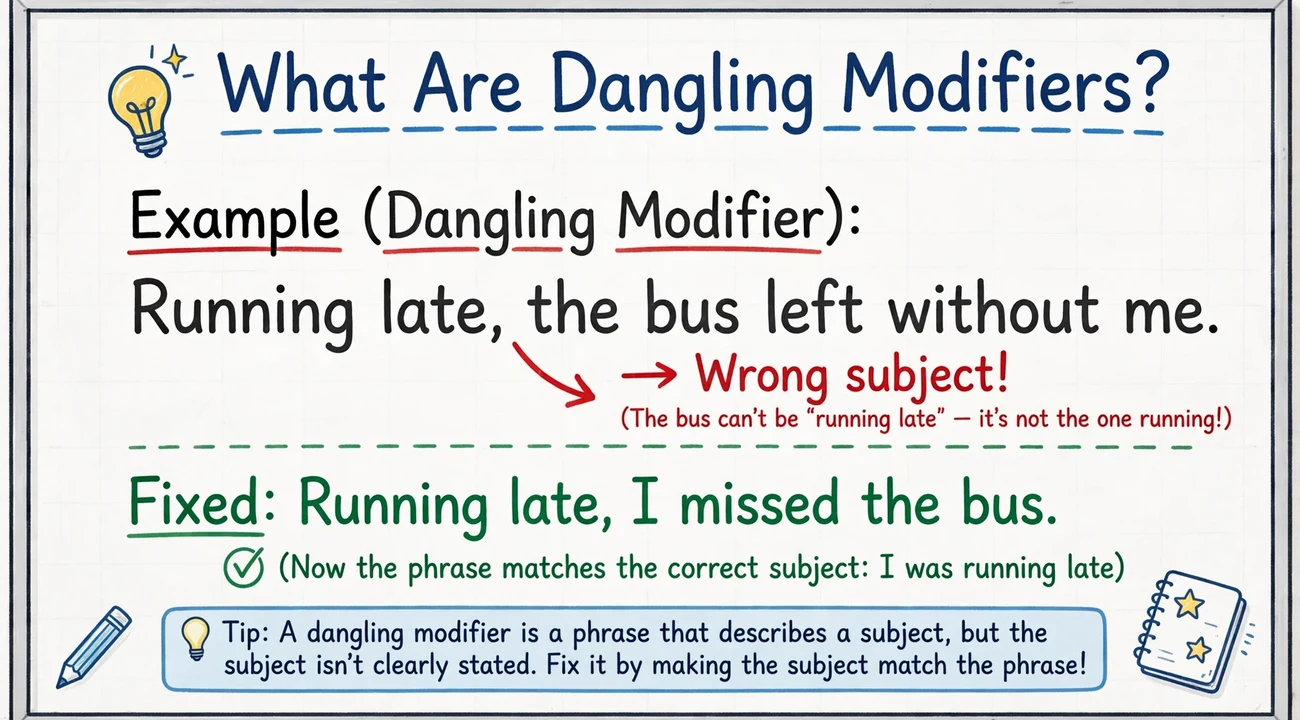
Dangling modifiers are phrases at the start of a sentence with no clear person or thing to describe. They usually begin with an -ing word, a -ed word, or to plus a verb, and the reader links them to the nearest subject – often the wrong one.
Take Running late, the bus left without me. The phrase running late needs a person, but the subject is the bus, so the words say the bus was running late. That is wrong – and this is one of the most common dangling modifiers in student writing.
See our guide to types of sentences.
What Does a Modifier Need to Describe?
A modifier needs a clear target. If the target is missing or wrong, the sentence fails. Learn this list and you will spot dangling modifiers fast.
| Part | What It Does | Example |
|---|---|---|
| Modifier | Describes a person or thing | Running late |
| Subject | The person or thing described | I |
| Clear match | They agree | Running late, I missed the bus. |
Each part has a job: the modifier describes, the subject is the person or thing, and the clear match joins them. If they do not match, you get dangling modifiers.
The 2-Second Dangling Modifier Test
Still not sure? Use this dangling modifiers test. It takes only two seconds.
Step 1: Ask, Who is doing the action in the opening phrase? Step 2: If that person is not the subject, you have found a dangling modifier.
Try the test on these examples:
- Running late, the bus left without me. – The bus was not running late.
- Running late, I missed the bus. – I was running late.
- Walking to school, the rain started. – The rain was not walking.
- Walking to school, I got wet in the rain. – I was walking.
When you feel stuck, ask the two questions.
7 Simple Dangling Modifiers Rules
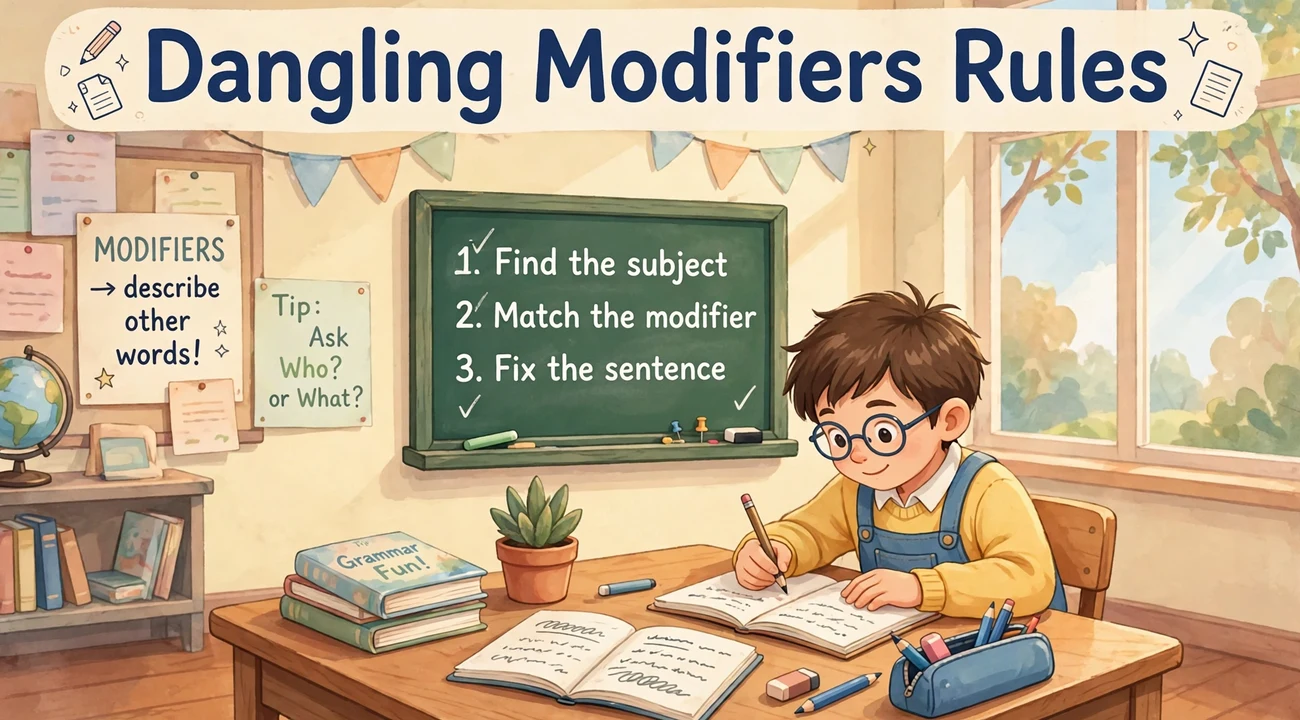
These seven rules cover almost every dangling modifier you will meet. Learn them once.
Rule 1: Find the Subject First
A dangling modifier usually sits at the start of a sentence, so find the subject first. Ask, Who is doing the action in the opening phrase? If not, you have a dangling modifier to fix. See our guide to subject-verb agreement.
Rule 2: Keep the Modifier Close to the Word It Describes
A modifier should sit next to the word it describes. After reading the book, the movie was a letdown. The book was read by me, not by the movie. Fix it: After reading the book, I found the movie a letdown. See our guide to clauses.
Rule 3: An -ing Phrase Needs a Clear Subject
Many dangling modifiers start with an -ing word. Swimming in the pool, the towel got wet. The towel was not swimming. Add the real person: Swimming in the pool, Ali got his towel wet. See our guide to gerunds.
Rule 4: A To + Verb Phrase Needs a Clear Doer
A to plus verb phrase also needs a clear doer. To learn English well, the book must be read daily. The book is not learning. Fix it: To learn English well, you must read every day. See our guide to infinitives.
Rule 5: Do Not Trust a Sentence Just Because It Sounds Fine
Dangling modifiers are easy to miss because the sentence still sounds fine. Having finished the report, the email was sent. It sounds smooth, but the email did not finish the report. Always check the subject.
Rule 6: Move the Modifier or Rewrite the Sentence
You can fix dangling modifiers in two ways: move the modifier next to the right word, or rewrite the sentence so the subject is clear. Covered in mud, the house smelled of wet dog. – Covered in mud, the dog came into the house. Either fix works – see our guide to active vs passive voice.
Rule 7: Read the Sentence Aloud
Your ear catches what your eye misses. Read the words aloud and ask, Who is doing this action? If the answer does not match the subject, fix it. This habit will remove most dangling modifiers from your writing.
40 Dangling Modifier Examples
Here are 40 examples of dangling modifiers: the first 20 are wrong, and the next 20 show the same ideas fixed.
Dangling (wrong on their own):
- Running late, the bus left without me.
- Walking to school, the rain started.
- Tired after work, the bed felt great.
- To pass the exam, the book was read twice.
- Having finished the report, the email was sent.
- Swimming in the pool, the towel got wet.
- Covered in mud, the house smelled of wet dog.
- While cooking dinner, the phone rang.
- After reading the book, the movie was a letdown.
- Driving home, the road was dark.
- Bored in class, the clock seemed to stop.
- Excited about the trip, the bags were packed early.
- To bake a cake, the oven must be hot.
- Worried about the test, the night felt very long.
- Sitting on the bench, the birds sang sweetly.
- Hungry after the game, the pizza was gone in minutes.
- Without looking up, the homework was finished.
- Having lost the keys, the house stayed locked.
- Laughing at the joke, the tea spilled on the table.
- At the age of five, my father bought me a bike.
Fixed as complete sentences:
- Running late, I missed the bus.
- Walking to school, I got wet in the rain.
- Tired after work, I fell into bed.
- To pass the exam, Sara read the book twice.
- Having finished the report, I sent the email.
- Swimming in the pool, Ali got his towel wet.
- Covered in mud, the dog came into the house.
- While cooking dinner, I heard the phone ring.
- After reading the book, I found the movie a letdown.
- Driving home, I could barely see the road.
- Bored in class, I watched the clock.
- Excited about the trip, we packed our bags early.
- To bake a cake, you must heat the oven first.
- Worried about the test, I could not sleep all night.
- Sitting on the bench, I listened to the birds sing.
- Hungry after the game, we ate the pizza in minutes.
- Without looking up, he finished his homework.
- Having lost the keys, we could not open the house.
- Laughing at the joke, she spilled her tea on the table.
- At the age of five, I got my first bike from my father.
For a deeper look, the Wikipedia article on dangling modifiers explains the same idea in more detail.
Common Dangling Modifier Mistakes

Even good writers make these mistakes with dangling modifiers.
Mistake 1: Starting with an -ing phrase and forgetting the person. Wrong: Running late, the bus left without me. Right: Running late, I missed the bus. Name the person.
Mistake 2: Letting the passive voice hide the doer. Wrong: To pass the exam, the book was read twice. Right: To pass the exam, Sara read the book twice. Passive sentences often create dangling modifiers – check the subject twice.
Mistake 3: Trusting a sentence because it sounds smooth. Wrong: Having finished the report, the email was sent. Right: Having finished the report, I sent the email. Sound is not proof.
Mistake 4: Fixing the wrong word. Wrong: Walking to school, the rain started, so I ran. Right: Walking to school, I got wet in the rain. Fix the subject, not the ending.
Quick Quiz: Dangling Modifier or Correct Sentence?
Read each sentence. Is it a dangling modifier or a correct sentence? Answers follow – no peeking!
- Running late, the bus left without me.
- Running late, I missed the bus.
- Having finished the report, the email was sent.
- She opened the window.
- To pass the exam, Sara read the book twice.
Answers: 1. Dangling modifier – fix: Running late, I missed the bus. 2. Correct sentence. 3. Dangling modifier – fix: Having finished the report, I sent the email. 4. Correct sentence. 5. Correct sentence.
How did you do? 5/5 – excellent! 4 – very good. Fewer than 4 – read the 2-second dangling modifiers test once more.
FAQs About Dangling Modifiers
| Question | Short Answer |
|---|---|
| What is a dangling modifier? | A phrase that describes the wrong word |
| How do I find one? | Ask who is doing the action |
| How do I fix one? | Name the right person |
| Are they always wrong? | Yes, in clear writing – fix them |
What is a dangling modifier in simple words?
A dangling modifier is a phrase at the start of a sentence that describes the wrong person or thing. In Running late, the bus left without me., the bus was not running late – I was.
How can I find them in my writing?
Read each sentence and ask, Who is doing the action in the opening phrase? If that person is not the subject, you have found one. Look for phrases that start with -ing, -ed, or to plus a verb.
Is Walking to school, the rain started a dangling modifier?
Yes. The rain was not walking to school. Fix it by naming the real person: Walking to school, I got wet in the rain.
Are dangling modifiers always wrong?
In essays, exams, and formal emails, yes – fix them. In casual speech, people use them all the time.
What is the difference between a dangling modifier and a misplaced modifier?
A dangling modifier has no clear word to describe at all. A misplaced modifier has a clear word, but it sits in the wrong place. The fix is different: a dangling modifier needs a new subject, a misplaced modifier just needs to move.
Can a dangling modifier have a verb?
Yes. Running late, the bus left without me. has a verb form, but no clear person doing the running. A real sentence needs the phrase and subject to match.
Conclusion
A dangling modifier is a small mistake with a simple fix. Find the person doing the action and make them the subject. If the two do not match, rewrite the sentence.
Practise with the examples and quiz here, and soon you will spot dangling modifiers without even thinking. For more simple lessons, keep learning with GrammarLuck – grammar made simple.
